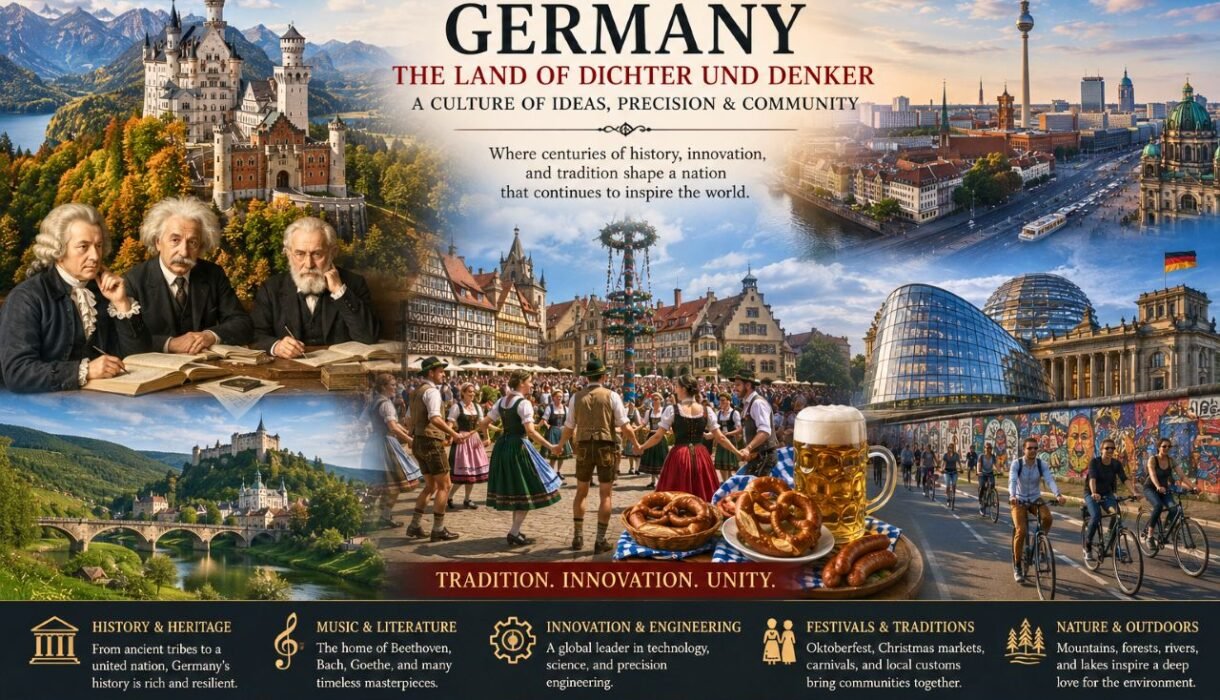

Situated at the geographical and economic heart of Europe, Germany (Deutschland) represents a masterfully ordered cultural landscape where historical precision, intellectual depth, and a vibrant community spirit converge. Famously dubbed the Land der Dichter und Denker (Land of Poets and Thinkers), Germany has fundamentally shaped global philosophy, classical music, engineering, and scientific discovery. – Culture
The German people (die Deutschen) are often stereotyped as strictly formal and intensely focused on efficiency. While a deep respect for order (Ordnung) is a core cultural pillar, it exists alongside a profound love for nature, deep regional pride, and a joyful appreciation for community festivities. From the fairytale alpine castles of Bavaria to the cutting-edge, avant-garde urban subcultures of Berlin, German culture offers a rich, multi-layered journey through heritage, precision, and renewal.
History & Origins
The historical evolution of Germany is a compelling narrative of regional fragmentation, exceptional cultural output, devastating wartime collapse, and ultimate democratic unification.
[Germanic Tribes & Roman Conflicts] ➔ [The Holy Roman Empire] ➔ [The Reformation & 30 Years’ War] ➔ [Rise of Prussia & 1871 Unification] ➔ [WWI, WWII, & Partition] ➔ [1990 Fall of Berlin Wall & Rebirth]
- The Fragmented Foundations: In antiquity, the territory was inhabited by distinct Germanic tribes that fiercely resisted Roman conquest. Following the collapse of Charlemagne’s Carolingian Empire, the region consolidated into the Holy Roman Empire of the German Nation, a highly decentralized patchwork of hundreds of independent duchies, principalities, and free cities that lasted for nearly a millennium.
- The Reformation and the Prussian Rise: In 1517, Martin Luther initiated the Protestant Reformation in Wittenberg, fundamentally altering European religion, politics, and the German language itself. Following the Napoleonic Wars, the Kingdom of Prussia rose to dominance, and under the brilliant diplomacy of Otto von Bismarck, successfully unified these independent states into the modern German Empire in 1871.
- Destruction and Division: The 20th century brought immense tragedy. The collapse of the German Empire after World War I gave way to the fragile Weimar Republic, which was subsequently subverted by the rise of the Nazi regime, culminating in the horrors of World War II and the Holocaust. Following its total defeat in 1945, Germany was split down the middle by the Iron Curtain into West Germany (BRD) and East Germany (DDR).
- Reunification: The peaceful popular uprisings of 1989 led to the historic fall of the Berlin Wall. On October 3, 1990, the nation officially achieved Reunification (Wiedervereinigung), establishing the modern, deeply democratic federal republic we see today.
Culture, Traditions & Customs
Social Rules and Etiquette
German social life operates on clear expectations of mutual respect and personal boundaries. Punctuality (Pünktlichkeit) is considered an essential virtue; arriving even five minutes late to a meeting or dinner reservation without prior notice is viewed as a serious insult to the host’s time. Similarly, quiet hours (Ruhezeit) are legally protected in residential neighborhoods on Sundays and late evenings, ensuring quiet relaxation for all.
Life Milestones and Celebrations
- Schultüte (The School Cone): On the very first day of first grade (Einschulung), every German child receives a massive, brightly decorated cardboard cone filled with candies, toys, and school supplies. This historic 19th-century tradition is designed to sweeten the serious transition into formal academic life.
- Polterabend: Held on the evening before a traditional wedding, family and friends gather outside the couple’s home to smash plates, ceramic bowls, and tiles onto the ground. The bride and groom must work together to sweep up every single shard. This noisy ritual symbolically drives away evil spirits, while the shared cleanup proves their ability to tackle hardships as a unified team.
Seasonal Festivals
- Oktoberfest: Held annually in Munich, this massive 16-to-18-day folk festival (Volksfest) draws millions of international visitors to celebrate Bavarian culture, traditional music, and regional brewing arts.
- Weihnachtsmärkte (Christmas Markets): Beginning in late November, historic town squares across Germany transform into winter wonderlands. Illuminated wooden stalls sell hand-crafted nutcrackers, roasted almonds, and steaming mugs of Glühwein (spiced mulled wine), celebrating a festive communal spirit.
Languages & Communication
The official language is German (Deutsch), a West Germanic language that serves as the native tongue for more than 95 million people in Europe.
Linguistic Architecture
German is a highly structured language characterized by its use of three grammatical genders (masculine, feminine, and neuter), four noun cases, and its unique capacity for constructing compound words (Komposita). Rather than creating a new phrase, German simply fuses smaller words together to describe complex concepts. For example, Kummerspeck translates literally to “grief-bacon” (the weight gained from emotional overeating), while Schadenfreude describes the complex pleasure derived from another person’s misfortune.
Communication Dynamics
Germans are highly direct, analytical, and explicit communicators. They avoid excessive hyperbole and value honest, upfront feedback. In professional settings, the formal pronoun Sie is strictly maintained alongside surnames until an individual explicitly offers the casual du.
“Übung macht den Meister.”
Translation: “Practice makes the master.” This classic proverb underpins the German dedication to craftsmanship, deep technical mastery, and lifelong professional learning.
Geography
Germany features a highly varied geography that slopes gently downward from south to north. The country is bordered by nine European nations, making it a critical continental hub.
The territory transitions across three distinct zones:
- The Northern Lowlands: A flat terrain stretching to the North and Baltic Seas, characterized by marshy agricultural lands and historic maritime trading ports like Hamburg.
- The Central Uplands: A rolling interior region of dense, ancient woodlands, volcanic hills, and deep river valleys, home to the legendary Black Forest (Schwarzwald) and the Harz Mountains.
- The Southern Alps: A majestic mountain region defining the border with Austria, featuring pristine alpine lakes and Germany’s highest peak, the Zugspitze (2,962 meters).
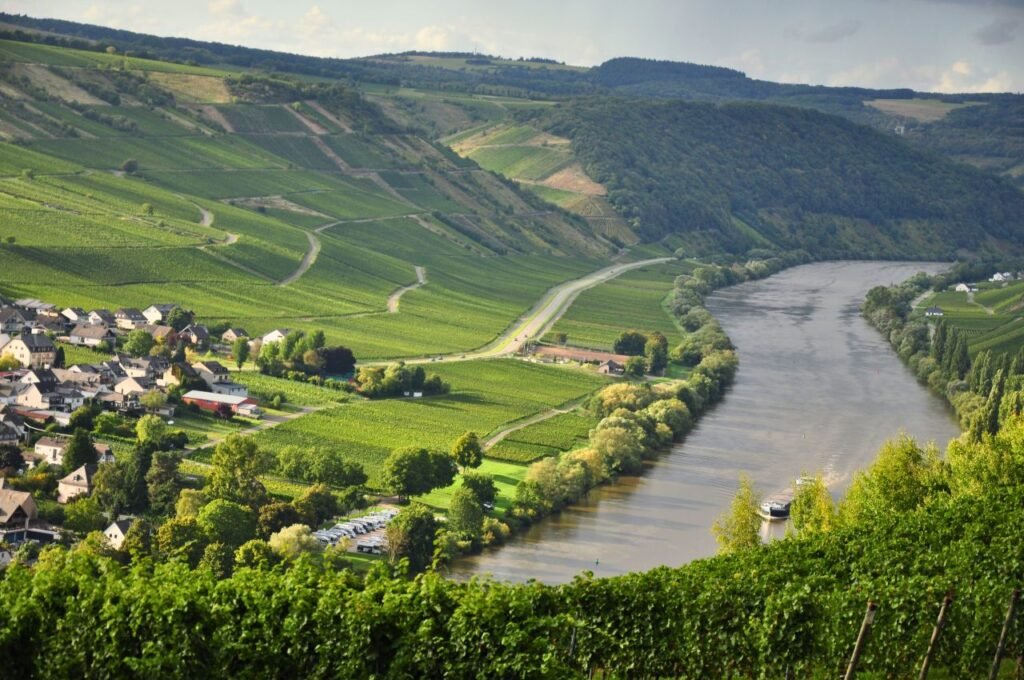
The nation is threaded together by major river superhighways, notably the Rhine, the Danube, and the Elbe, which have historically driven industrial logistics and fostered picturesque vineyard regions.
Economy
Germany operates the largest national economy in Europe and stands as an international powerhouse of export-driven manufacturing, anchored by the principles of the Social Market Economy (Soziale Marktwirtschaft). Key pillars include:
- Automotive Engineering: Home to global industrial giants including Volkswagen, BMW, Mercedes-Benz, and Porsche.
- The Mittelstand: The true backbone of the economy, consisting of hundreds of thousands of highly specialized, family-owned, small-to-medium enterprises that dominate niche international markets.
- Industrial Machinery and Chemicals: Leading global innovation via powerhouses like Siemens and BASF.
- The Green Energy Transition (Energiewende): Investing heavily in renewable energies, aiming to completely phase out fossil fuels in favor of domestic wind, solar, and hydrogen systems.
Politics
Germany is a democratic, federal parliamentary republic. The country is organized into 16 federal states (Bundesländer), each possessing its own local government, educational systems, and police forces.
The head of government is the Federal Chancellor (Bundeskanzler), who holds executive legislative authority, while the Federal President (Bundespräsident) serves as the ceremonial head of state. Legislative authority is split between the Bundestag (the federal parliament elected directly by the people) and the Bundesrat (representing the state governments). Politics relies heavily on a system of proportional representation, requiring multi-party coalitions and deep compromise to form governments. Germany is a core founding member of the European Union and an integrated pillar of NATO.
Ethnic Groups
The vast majority of the population is ethnically German.
The nation’s historical layout has transformed over the past seventy years through major waves of migration. In the 1960s, the Gastarbeiter (Guest Worker) program brought a large Turkish community, which has since established a vibrant, multi-generational presence in German urban centers.
Following the geopolitical crises of the 21st century, Germany welcomed millions of refugees and immigrants from Syria, Ukraine, Afghanistan, Iraq, and Poland. Additionally, the state officially recognizes and protects four indigenous minority groups: the Sorbs, the Frisians, the Roma and Sinti, and the Danish minority along the northern border.
Beliefs & Values
Secularization and Regional Diversity
Germany is historically divided between a Protestant north and east, and a deeply Catholic south and west—a layout reflecting the territorial choices made during the Reformation. While approximately 50% of the population maintains formal membership in either the Catholic or Evangelical (Lutheran) Church, daily society is highly secular.
Core Moral Values
German worldview and moral values are heavily anchored in specific social concepts:
| Value | Cultural Core | Social Impact |
| Feierabend | The boundary separating the workday from personal free time. | Protects work-life balance; calls and emails from employers after hours are culturally discouraged. |
| Umweltschutz | Deep commitment to environmental conservation and recycling. | Drives a highly complex national waste-sorting system and massive public support for green initiatives. |
| Solidarität | Collective social responsibility. | Cultivates a robust public healthcare, unemployment, and pension system funded through progressive taxation. |
Food & Cuisine
Traditional German cuisine (Deutsche Küche) is hearty, comforting, and deeply tied to local agriculture. While historical recipes focus heavily on meat and potatoes, modern German food culture is highly diverse, featuring a booming plant-based movement (Berlin is regularly ranked as a vegan capital of Europe) and extensive international influences.
- Brotkultur (Bread Culture): Bread is a sacred element of daily life, with over 3,000 officially recognized varieties produced across the country. Germans love heavy, nutrient-dense loaves made from rye, spelt, and whole seeds. The evening meal is traditionally called Abendbrot (Evening Bread), consisting of fresh slices of bread topped with fine cheeses, cold meats, and pickles.
- Wurst (S sausages): Germany boasts more than 1,500 distinct types of sausage, including the grilled Bratwurst, the smoked Blutwurst, and Berlin’s world-famous street food icon, the Currywurst (sliced pork sausage smothered in a spiced ketchup and curry powder sauce).
- Sauerbraten: A classic national pot roast. Tough cuts of beef are marinated for several days in a rich mixture of wine, vinegar, and aromatic spices before being slow-cooked and served with potato dumplings (Klöße) and sweet red cabbage.
- The Reinheitsgebot (Beer Purity Law): Established in 1516, this legendary regulation mandates that German beer can only be brewed using four pure ingredients: water, barley, hops, and yeast, preserving an unparalleled global standard of brewing quality.
Clothing & Symbols
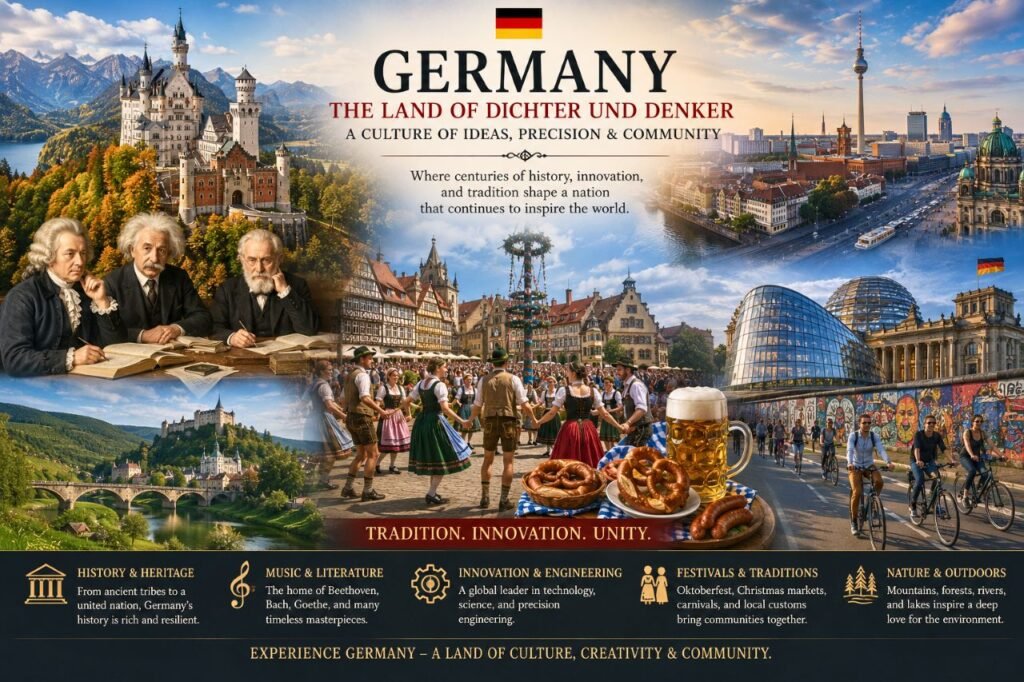
Discover the essence of Germany
Trachten vs. Functional Modern Style
In daily life, modern Germans favor a highly practical, weather-resilient fashion aesthetic. High-quality outdoor brands are incredibly popular, prioritizing comfort and utility.
However, regional identity flourishes through Trachten (traditional folk clothing). In the south, this includes the iconic Lederhosen (robust leather shorts worn with suspenders by men) and the Dirndl (a beautifully structured dress featuring a fitted bodice, white blouse, and full apron worn by women). Once reserved for historic rural harvests, Trachten have experienced a massive modern revival, proudly worn by young and old alike during major regional festivals.
National Symbols
The national flag features three clean horizontal bands of Black, Red, and Gold (Schwarz-Rot-Gold), colors that historically symbolized the 19th-century volunteer democratic movements fighting against absolute monarchy. The official coat of arms features the Bundesadler (Federal Eagle), an ancient imperial symbol of sovereignty and strength that is today rendered cleanly across government buildings and coins.
Music, Dance & Art
Classical Mastery and the Avant-Garde
Germany’s contribution to global high culture is monumental. It is the birthplace of classical music masters like Johann Sebastian Bach, who perfected counterpoint, and Ludwig van Beethoven, whose soaring symphonies shattered classical boundaries to usher in the Romantic era. This legacy lives on through more than 130 professional symphony orchestras operating across the country.
In the 20th century, Germany revolutionized visual arts and industrial production through the founding of the Bauhaus School by Walter Gropius, establishing a clean, geometric design philosophy where form strictly follows function.
Electronic Innovation and Street Subcultures
- Krautrock and Electronic Pioneers: In the 1970s, bands like Kraftwerk pioneered electronic music using synthesizers and drum machines, directly laying the foundations for modern synth-pop, hip-hop, and electronic dance music (EDM).
- Berlin Techno Culture: Following the fall of the Berlin Wall, abandoned industrial spaces in the east transformed into world-famous temples of techno music (such as the legendary club Berghain). This unique urban subculture was officially recognized as an official UNESCO Intangible Cultural Heritage.
Summary
The culture of Germany stands as an inspiring proof of what can be accomplished when a society balances structural precision with human solidarity. By anchoring their modern federal identity to rigorous engineering standards, artistic innovation, and an unwavering respect for ecological preservation, the German people have built a highly progressive, stable, and deeply reflective nation. From the communal warmth of a candlelit Christmas market to the technical genius of the Mittelstand and the historic melodies of Beethoven, Germany continues to offer the world a powerful template for resilience, balance, and cultural depth.
At Best Culture Insight, we see culture as the heartbeat of every society – the way people live, connect, and express their identity.