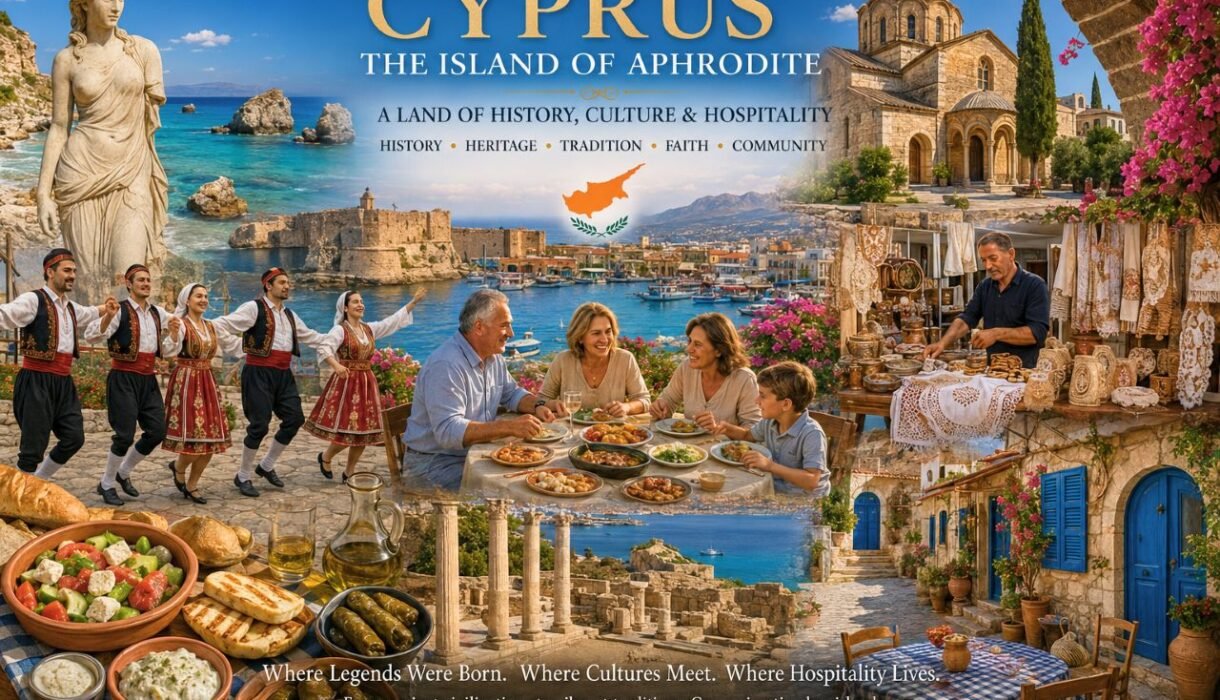

Rising gracefully from the warm, turquoise waters of the easternmost Mediterranean, Cyprus (Kypros / Kıbrıs) acts as a radiant cultural bridge connecting Europe, the Levant, and Asia Minor. Famously celebrated since antiquity as the mythical birthplace of Aphrodite, the goddess of love and beauty, this sun-drenched island nation is home to a people whose identity is shaped by millennia of epic history, deep spiritual devotion, and an unshakeable bond with the land and sea. – Culture
Cypriot culture is not defined by a single static tradition; rather, it is a brilliant regional mosaic where Hellenic foundations and Turkish traditions interweave with remnants of Byzantine, Frankish, Venetian, and British historical epochs. Renowned for their boundless, warm-hearted hospitality (philoxenia), their relaxed Mediterranean tempo, and an unhurried lifestyle, Cypriots cherish community solidarity, family milestones, and culinary arts above all else.
History & Origins
The strategic position of Cyprus made it one of the most highly coveted prizes of the ancient and medieval worlds, transforming the island into a living museum of human civilization.
[Mycenaean Greek Settlements]➔[Assyrian, Egyptian & Persian Conquests]➔[Hellenistic & Roman Eras]➔[Byzantine Golden Age]➔[Lusignan & Venetian Rule]➔[Ottoman Period]➔[British Administration]➔[Independence]
- The Hellenization and Classical Antiquity: While indigenous communities thrived during the Bronze Age, the core cultural trajectory of the island was set around 1200 BC with the arrival of Mycenaean Greeks. They introduced the Greek language, building styles, and mythologies that remain foundational to the island’s identity today.
- The Age of Medieval Fortresses: Following centuries of Roman rule, Cyprus became a jewel of the Byzantine Empire, giving rise to spectacular painted churches hidden deep within the Troodos Mountains. In 1191, during the Third Crusade, King Richard the Lionheart of England seized the island, ushering in centuries of Western European feudal rule under the French Lusignan Dynasty and, later, the maritime Republic of Venice, which erected the monumental stone defensive walls that still encircle Nicosia.
- The Ottoman and British Transformations: In 1571, the Ottoman Empire assumed control, introducing an influx of Turkish settlers who established the island’s distinct Turkish Cypriot community. In 1878, Great Britain took over administration, modernizing the legal, administrative, and educational frameworks.
- Modern Sovereignty: Cyprus achieved independence in 1960. Following a period of intercommunal tensions, a Greek-backed coup attempt in 1974 led to a military intervention by Turkey. This event physically divided the island into the Greek Cypriot south and the Turkish Cypriot north, separated by a UN Buffer Zone—a complex geopolitical reality within which daily cultural life and a shared love for the island still deeply connect both communities.
Culture, Traditions & Customs
Marriage & Family Milestones
Family stands as the absolute structural anchor of Cypriot life, commanding fierce loyalty across generations. Traditional weddings are spectacular, village-wide events that can draw thousands of guests.
A beloved traditional highlight is the Ploumisma ritual. On the morning of the wedding, musicians play the violin and lute while family members take turns pinning money to the garments of the bride and groom as a financial blessing for their new household. Following the religious ceremony, epic feasts feature hours of traditional folk dancing, including the competitive Drepani (sickle) dance.
Festivals & Folklore Celebrations
- Kataklysmos (Festival of the Flood): Celebrated 50 days after Orthodox Easter, this unique coastal festival coincides with Pentecost but traces its roots directly to ancient pagan celebrations honoring Aphrodite and Adonis. Cities hold water fights, boat races, and spirited folk poetry competitions (chattista), where performers engage in witty, improvised rhyming battles.
- The Limassol Wine Festival: Held every September, this dynamic festival celebrates Cyprus’s thousands of years of viticultural history. Visitors enjoy free flowing local wine directly from barrels, crush grapes barefoot in traditional stone troughs, and listen to traditional acoustic guitar ensembles.
Languages & Communication
The linguistic reality of Cyprus mirrors its diverse historical roots. The Republic of Cyprus features two official languages: Greek and Turkish, while English is universally spoken in business, tourism, and daily administration due to historic British governance.
Dialectical Nuances
The spoken vernacular of the daily populace is highly distinct. Greek Cypriots speak Cypriot Greek, a rich, archaic dialect that retains linguistic features of ancient Homeric Greek and classical vocabulary missing from standard modern Greek, heavily enriched with loanwords from French, Italian, and Turkish. Similarly, Turkish Cypriots speak Cypriot Turkish, a dialect characterized by a relaxed grammatical flow and unique phonetic variations from standard mainland Istanbul Turkish.
Greetings & Expressions
- Greetings: Chairete (Formal Greek hello), Kalimera (Good morning), Merhaba (Turkish hello), and Günaydın (Turkish good morning) are universally met with smiles.
- “Siga-siga” / “Yavaş-yavaş”: Both the Greek and Turkish phrases translate directly to “Slowly-slowly.” This shared verbal expression represents the fundamental guiding philosophy of the island—rejecting modern stress, taking your time, and savoring the present hour.
Geography
Cyprus boasts a stunningly varied topography packaged into a compact Mediterranean island footprint, offering dramatic microclimates.
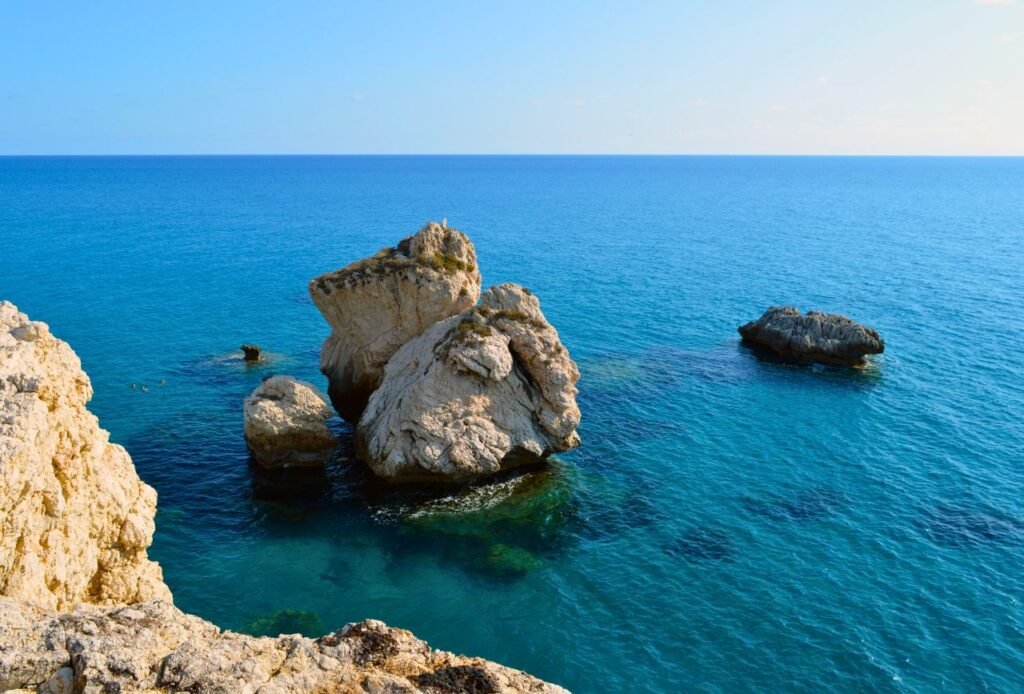
The center of the island is dominated by the sprawling Troodos Mountains, an pine-forested alpine range whose peaks are dotted with traditional stone villages, vineyards, and snow resorts during the brief winter months. Skirting the northern coast is the narrow, jagged Kyrenia mountain range, characterized by dramatic limestone peaks and medieval mountaintop castles.
Between these two mountain systems lies the wide, flat Mesaoria Plain, an agricultural heartland that glows gold with wheat harvests in the spring. This gives way to a world-class coastline featuring dramatic limestone sea caves in Cape Greco and the white-sand beaches of Ayia Napa.
Economy
Cyprus operates a highly developed, high-income market economy that has successfully pivoted toward modern service fields.
While historical pillars like citrus farming, olive oil pressing, and potato cultivation remain culturally vital, the modern GDP is driven by international maritime shipping, financial services, legal consulting, and real estate. Tourism remains a massive economic driver, welcoming millions of European travelers annually to the island’s pristine coastal resorts.
Furthermore, the island is historically famous for producing Commandaria, a rich, amber-colored dessert wine that holds the official Guinness World Record as the oldest manufactured wine script still in active production globally.
Politics
The political governance of the island is unique and defined by its modern historical divisions:
- The Republic of Cyprus: A presidential democracy that exercises governance over the southern two-thirds of the island. The President acts as both head of state and head of government, leading an elected council of ministers. The Republic became a full member of the European Union in 2004 and utilizes the Euro currency.
- The Northern Territory: The northern third of the island is administered by the Turkish Republic of Northern Cyprus (TRNC), a self-declared state recognized solely by Turkey, which uses the Turkish Lira.
- The Green Line: A physical United Nations-monitored Buffer Zone cuts directly through the historic center of the capital city, Nicosia, making it the last divided capital city in the world. Despite this split, numerous pedestrian checkpoints allow residents to cross easily for work, commerce, and shared cultural events.
Ethnic Groups
The population of Cyprus is divided into two primary native cultural communities:
- Greek Cypriots: Making up roughly 78% of the total population, they trace their linguistic lineage to the ancient Mycenaean migrations and culturally align with Hellenic European traditions.
- Turkish Cypriots: Constituting approximately 18% of the population, they trace their origins to the Ottoman integration of the 16th century, possessing a distinct secular, Mediterranean-Turkish identity.
The island also shelters smaller, historic, and constitutionally recognized Christian minority groups who have enriched Cypriot society for centuries: the Maronites (tracing back to Lebanon), the Armenians (who arrived as refugees in the early 20th century), and a small Anglo-Cypriot community.
Beliefs & Values
Religious Life
Spirituality in Cyprus is a vital cultural force. The overwhelming majority of Greek Cypriots belong to the Church of Cyprus, an autocephalous (self-governing) Eastern Orthodox Christian institution granted independence back in 431 AD. Religious holidays like Easter (Pascha) are celebrated with massive village bonfires and candlelit midnight processions.
Conversely, the majority of Turkish Cypriots practice secular Sunni Islam, marking religious milestones like Eid with familial feasts, though their overall lifestyle is highly secularized and relaxed compared to mainland counterparts.
Hospitality and the Coffeehouse
The supreme moral value across Cyprus is Philoxenia—the love of strangers. To enter a Cypriot home is to be instantly showered with food, coffee, and sweets.
The primary center of social life in any village is the Kafeneio (traditional coffeehouse). Historically reserved for older men, it remains a vital community hub where locals sit outdoors for hours under vine trellises, drinking strong coffee, playing animated games of Tavli (backgammon), and discussing local politics.
Food & Cuisine
Cypriot cuisine (Kypriaki kouzina) is an aromatic celebration of fresh ingredients, wild herbs, and slow-cooking methods that perfectly marries Greek freshness with Middle Eastern spices.
[Cold Dips: Tzatziki & Hummus]➔[Grilled Halloumi & Loukaniko]➔[Slow-Cooked Kleftiko & Stuffed Sheftalia]➔[Sweet Baklava & Glyka tou Koutaliou]
- Halloumi / Hellim: The undisputed gastronomic king of Cyprus. This iconic, squeaky white cheese is made from a traditional blend of goat and sheep milk, infused with fresh mint leaves. Because of its extraordinarily high melting point, it can be grilled or fried to a beautiful golden crust while remaining soft and warm on the inside.
- Meze: The ultimate expression of Cypriot social dining. Rather than ordering a single plate, diners enjoy a slow procession of 20 to 30 small tapas-style dishes that can last an entire evening, starting with dips like Tahini and Taramasalata, moving to grilled meats, and finishing with fresh fruits.
- Kleftiko: A legendary meat dish with a fascinating history. Leg of lamb is heavily seasoned with bay leaves, garlic, and red wine, then sealed tightly inside a domed wood-fired clay oven and slow-baked for up to 24 hours until the meat slips effortlessly off the bone.
The Bandit’s Secret: The word Kleftiko translates directly to “stolen meat,” originating from historic mountain bandits (klephts) who would bury stolen goats in hidden underground pits over hot coals to cook slowly without letting smoke reveal their hiding positions.
- Sheftalia: Succulent, skinless minced pork and beef sausages mixed with finely chopped onions and parsley, wrapped delicately in caul fat and grilled over glowing charcoal embers.
Clothing & Symbols

Cyprus island of history and culture
Lefkara Lace: Leonardo da Vinci’s Choice
The most revered artistic craft and symbol of Cyprus is Lefkaritika (Lefkara Lace), created exclusively in the hillside stone village of Pano Lefkara. For centuries, women have sat outside their doors hand-weaving intricate geometric linen lace pieces using a complex counting method.
According to historical records, the great master Leonardo da Vinci visited the village in 1481 and purchased a large Lefkaritika cloth to adorn the main altar of the Duomo di Milano, a historic event that elevated the lace to a global symbol of textile luxury.
Traditional Attire & Symbols
The historic traditional attire of Cyprus was built for durability and heat management. Men wore the voluminous Vraka, a pair of dark, pleated baggy breeches that gathered at the knee, paired with an embroidered waistcoat (gileko) and sturdy leather boots. Women wore the elegant Sayan or Sayia, a long silk outer tunic split up the sides over a white chemise, accompanied by traditional gold coin necklaces.
The national symbol of Cyprus is the Mouflon, a rare, majestic wild sheep featuring curved horns that roams the deep pine forests of the Paphos mountain range, proudly stamped onto national coins and official state seals.
Music, Dance & Art
Acoustic Traditions and Poetic Duels
The traditional acoustic landscape of Cyprus relies on two primary instruments: the Violin (bioli) and the Lute (laouto). Together, they provide the energetic, rhythmic accompaniment for traditional folk dances.
A unique vocal art form is Chattista, an ancient style of improvised rhyming song. Two folk poets face each other in front of a live audience, taking quick turns chanting witty, rhyming 15-syllable verses to outsmart each other, requiring immense mental sharpness and lyrical humor.
Dynamic Folk Dances
Cypriot traditional dancing is highly expressive and segregated into distinct physical forms:
- The Male Dances: Highly athletic and performative. In the Antikristos or the Zeibekikos, men perform intense leaps, squats, and spins close to the ground to demonstrate physical strength. In the famous Drepani dance, a dancer performs complex tricks with a sharp harvesting sickle, spinning it rapidly around his neck and limbs without breaking rhythm.
- The Female Dances: Characterized by absolute modesty, fluid grace, and subtle, controlled steps, emphasizing composure and elegance.
Summary
The culture of Cyprus stands as an inspiring, timeless monument to human cultural adaptation and survival. By absorbing the artistic, culinary, and architectural brilliance of the empires that crossed its shores while fiercely maintaining its core Hellenic and Mediterranean traditions, this island has nurtured a society that feels simultaneously ancient and modern. From the slow, crackling wood-fires of underground Kleftiko ovens to the geometric precision of UNESCO-protected Lefkara lace, Cyprus remains a radiant land where diverse historical pathways meet under a warm sun, welcoming the world with open arms.
At Best Culture Insight, we see culture as the heartbeat of every society – the way people live, connect, and express their identity.