The Identity of Western Australia: A Tapestry of Ancient Heritage and Modern Diversity
Posted in :

Western Australia (WA) is a land of immense proportions, striking contrasts, and profound cultural depth. Occupying the entire western third of the Australian continent, WA is home to a unique social fabric that gracefully balances the ancient, continuous heritage of its First Nations peoples with a vibrant, modern multiculturalism fueled by global migration. To understand Western Australian culture is to understand a community shaped by isolation, bound by a collective resilience, and deeply connected to an extraordinary natural landscape.
This comprehensive guide explores the multi-faceted layers of Western Australian culture, celebrating its history, traditions, geography, and the diverse peoples who call this vast state home.
History & Origins: The Deep Roots of the West
The cultural narrative of Western Australia is split into two distinct yet intersecting timelines: the ancient Aboriginal history dating back over 60,000 years, and the relatively recent era of European maritime exploration and colonial settlement.
First Nations Custodianship
Long before lines were drawn on a map, Western Australia was entirely cared for by diverse Aboriginal groups. In the fertile south-west, the Noongar (or Nyungar) people formed the largest cultural bloc. To the north, across the rugged expanses of the Pilbara and the Kimberley, nations such as the Yamatji, Martu, and Kimberley groupings developed intricate social systems perfectly adapted to their distinct environments. Their history is recorded not in textbooks, but in the landscape itself—through complex songlines (dreaming tracks) that map geographic terrain and ancestral creation stories.
Maritime Encounters and Colonial Shift
The first recorded European contact occurred in 1616 when Dutch explorer Dirk Hartog landed on the western coast. However, permanent colonial settlement did not begin until 1826, when the British established a military outpost at King George Sound (modern-day Albany), followed closely by the founding of the free-settler Swan River Colony in 1829, which would later become the capital city of Perth.
The mid-19th century introduction of convict labor and the booming gold rushes of the 1890s in Kalgoorlie transformed the colony overnight. It drew a massive influx of interstate and international migrants, setting the foundation for the resource-driven, egalitarian pioneer culture that still influences the state today.
Geography: The Land of Epic Proportions
Geography is the silent director of Western Australian lifestyle and culture. Covering more than 2.5 million square kilometers (roughly the size of Western Europe), WA is the second-largest country subdivision in the world.
Northern WA (The Kimberley) ➔ Tropical Monsoons, Red Gorges, Ancient Boab Trees
Central WA (Pilbara & Deserts) ➔ Breathtaking Iron Ore Earth, Vast Arid Horizons
Southern WA (Perth & South-West) ➔ Mediterranean Climate, Rolling Vineyards, Tall Karri Forests
Because of this extreme vastness, regional subcultures vary significantly. The “Top End” tropical lifestyle of Broome is defined by a slow, maritime rhythm, whereas the south-west boasts a sophisticated, nature-integrated coastal aesthetic. The sheer physical isolation of Perth—separated from the eastern states by the vast Nullarbor Plain—has fostered a highly independent, self-reliant, and community-focused mindset among its residents.
Economy: Driven by the Earth
The economic engine of Western Australia directly shapes its cultural values of hard work, entrepreneurship, and innovation. WA is a global powerhouse for mining, mineral resources, and agriculture. The state produces a significant portion of the world’s iron ore, liquefied natural gas (LNG), gold, and alumina.
This resource wealth has birthed a highly distinct socio-economic phenomenon: the FIFO (Fly-In, Fly-Out) lifestyle. Thousands of workers live in the coastal cities but fly out to remote desert mine sites for weeks at a time. This modern economic structure has profoundly impacted family dynamics, community sports clubs, and neighborhood structures throughout the state.
Additionally, WA’s economy is deeply supported by premium viticulture in the Margaret River region, broadacre grain farming in the Wheatbelt, and a rapidly expanding international tourism and clean energy sector.
Politics: Fiercely Independent
Politically, Western Australia has historically viewed itself as distinct from the rest of the nation. This sense of isolation has translated into a political culture characterized by fierce state pride and advocacy for regional autonomy.
Federally, WA operates within Australia’s framework of a constitutional monarchy and a parliamentary democracy. At the state level, the Parliament of Western Australia is based in Perth, split into a Legislative Assembly and a Legislative Council. The political climate tends to be pragmatic, heavily focused on managing resource royalties, regional development, environmental conservation, and navigating the historical and ongoing complexities of Aboriginal land rights and native title settlements.
Ethnic Groups: A Modern Global Melting Pot
While Western Australia’s foundation is anchored in British colonial ancestry and First Nations heritage, post-World War II migration permanently altered the state’s demographic landscape. Today, WA is one of the most culturally diverse jurisdictions in Australia, with over 32% of its population born overseas.
Indigenous Foundations ➔ Noongar, Yamatji, Martu, and Kimberley Peoples
European Waves ➔ British, Irish, Italian, and Dutch Settlers
Modern Asian & African Influx ➔ Malaysian, Chinese, Indian, Filipino, and South African Communities
This intersection of heritages has given rise to highly unique multi-ethnic communities. For instance, the northern town of Broome boasts a highly celebrated historic fusion of Aboriginal, Japanese, Malay, and Filipino cultures—a direct legacy of the lucrative pearling industry of the late 19th century.
Beliefs & Values: The Worldview of the West
Spirituality and moral values in Western Australia are highly diverse, reflecting a balance between ancient traditional beliefs and a modern, secular society.
Aboriginal Spirituality: Connected to Boodja
For Indigenous Western Australians, spirituality is anchored entirely in Country (Boodja). Central to Noongar cosmology is the Waugal (the Dreamtime Rainbow Serpent), a creator spirit responsible for forming the rivers, lakes, and water sources across the south-west. This worldview emphasizes custodianship, reciprocity, and a deep moral obligation to take only what is needed from the earth to ensure ecological and spiritual balance.
Modern Values
The broader Western Australian community values mateship, egalitarianism, and a fair go for all. Religious practices include Christianity, Islam, Buddhism, and Hinduism, reflecting the state’s multicultural makeup. However, like much of Australia, the overarching culture is highly secular, with many residents finding their sense of peace and reflection through a deep appreciation for nature and the outdoors.
Culture, Traditions & Customs
Western Australian traditions are an elegant blend of deep-time First Nations protocols, inherited Western milestones, and contemporary multicultural practices.
Welcoming and Rites of Passage
In public and formal settings, it is standard practice to begin events with a Welcome to Country performed by an Elder of the local Traditional Owner group, or an Acknowledgement of Country. This protocol recognizes the enduring spiritual connection of Indigenous peoples to the land.
Historically, Indigenous communities observed rigorous rites of passage, where youth were taught traditional survival skills, hunting lore, and tribal laws by Elders during extended bush journeys. Today, these traditions survive through community-led cultural workshops and intergenerational storytelling.
Marriage and Family Celebrations
In modern WA, marriage ceremonies take many beautifully diverse forms. A wedding might feature a traditional civil or religious ceremony overlooking the Swan River, an Indian Mehndi and Baraat procession in suburban Perth, or a Chinese tea ceremony. Within Aboriginal communities, marriages are celebrated as a profound binding of massive, intricate kinship networks, often accompanied by traditional Smoking Ceremonies, where native flora (like eucalyptus leaves) is smoldering to cleanse the space, ward off bad spirits, and bless the couple’s future.
Smoking Ceremony ➔ smoldering native leaves ➔ Cleansing, blessing, and welcoming good spirits
Naming Ceremonies
In addition to traditional religious baptisms, secular Naming Ceremonies have become increasingly popular in local parks and beaches. For First Nations families, naming practices are deeply tied to ancestral connections, totem assignments, and geographic birthplaces, formally welcoming a newborn into the protective custody of the wider community.
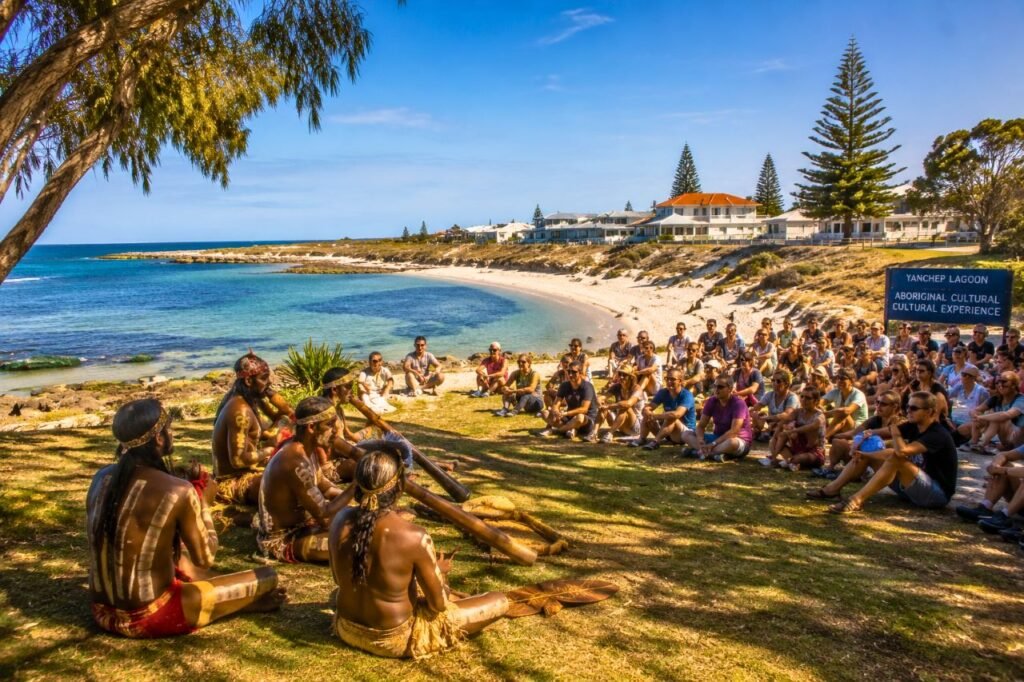
Cultural performance at Yanchep Lagoon, Western Australia – Australia
Festivals and Public Holidays
The cultural calendar is defined by large-scale public gatherings.
- The Perth Festival: Established in 1953, it is the oldest international arts festival in the Southern Hemisphere, showcasing cutting-edge theater, music, and visual arts.
- Shinju Matsuri (Festival of the Pearl): Held annually in Broome, this spectacular event celebrates the unique harmony of Aboriginal, Asian, and European cultures that shaped the region’s identity.
Languages & Communication: Voices of the West
English is the primary language of governance and daily life in Western Australia, spoken with the distinct, relaxed Australian accent. However, the linguistic landscape is highly diverse.
Indigenous Languages
Before European contact, hundreds of distinct dialects were spoken across the state. Today, immense preservation efforts focus on Noongar wongin (language) in the south-west.
| Noongar Word | English Meaning | Usage Context |
| Kaya | Hello / Yes | Standard everyday greeting across the south-west |
| Wanju | Welcome | Used to invite people into a communal space or Country |
| Boodja | Land / Country | Refers to the physical and spiritual landscape |
| Moort | Family / Kin | Refers to the intricate network of relations |
Expressions and Idioms
Western Australians utilize classic Australian colloquialisms but have birthed a few geographical terms of their own. Residents of the eastern states are affectionately referred to as coming from the “Eastern States” or being “Over East.” The phrase “The Bush” refers to any rural or forested area, while “The Outback” denotes the vast, arid interior of the state.
Food & Cuisine: A Gastronomic Paradise
Western Australian cuisine is heavily defined by its pristine oceans, fertile soils, and a burgeoning farm-to-table movement that honors the seasons.
Traditional Aboriginal Bush Tucker
For millennia, Indigenous peoples harvested a rich bounty from the land based on a six-season calendar (Birak, Bunuru, Djeran, Makuru, Djilba, and Kambarang). This diet included yongka (kangaroo), karda (goanna), bardi (witchetty grubs), and a vast array of native berries and tubers like the quandong (a native peach). Fishing was a highly sophisticated art, utilizing ancient stone fish traps along coastal waterways to catch barramundi and mullet.
Traditional Foraging ➔ Seafood (Marron, Mud Crabs) + Land Game (Kangaroo) + Bush Fruit (Quandong)
Contemporary Seafood and Fusion
Today, WA is world-famous for its pristine seafood. Delicacies include Marron (a rare, sweet freshwater crayfish native to the south-west), exquisite mud crabs from the Kimberley, and Western Rock Lobster.
The culinary culture is a dynamic fusion of fresh local ingredients and Asian-European cooking techniques. A weekend ritual for many locals involves visiting regional farmers’ markets, enjoying a beachside dish of fish and chips at sunset, or pairing premium grass-fed beef with a world-class Cabernet Sauvignon in the Margaret River wine region.
Clothing & Symbols: Expressing Identity
Modern attire in Western Australia is casual, practical, and highly influenced by the sunny climate. Sun-protective clothing, broad-brimmed hats, and casual footwear are standard daily wear.
Traditional and Ceremonial Attire
Historically, Aboriginal peoples in the cooler southern regions crafted beautiful, insulating cloaks made from kangaroo skins (boka), stitched together using sinew and adorned with natural ochre patterns.
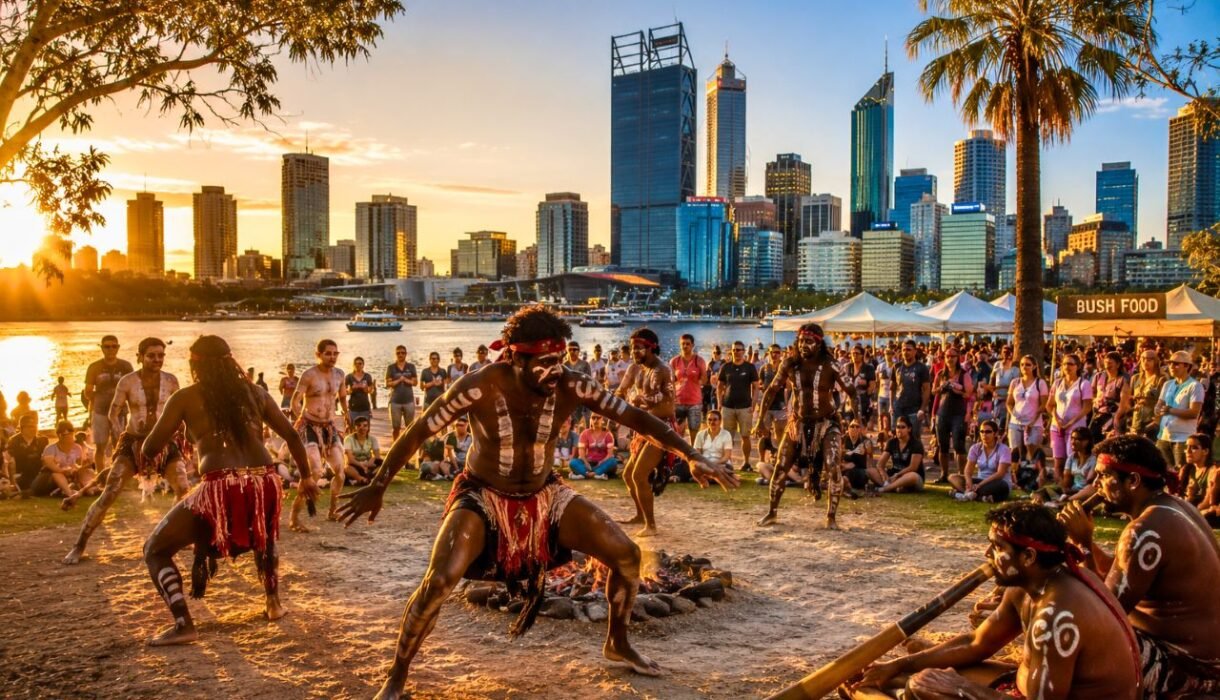
For ceremonial gatherings and dances (corroborees), body painting is highly significant. Using natural earth pigments—white clay, yellow silt, and red iron oxide ochre—intricate linear and circular patterns are painted onto the skin. These markings are not mere decorations; they represent a person’s skin group, tribal status, ancestral totems, and the specific Dreaming story being performed.
Natural Ochre Paint ➔ Applied to Skin ➔ Denotes Status, Lineage, and Totemic Connections
State Icons
The state’s official emblem is the Black Swan (Cygnus atratus), a bird native to the region that features prominently on the Western Australian flag. The state floral emblem is the striking Red and Green Kangaroo Paw, a unique wildflower that blooms spectacularly across the coastal sandplains every spring.
Music, Dance & Art: The Voice of Creativity
The artistic expression of Western Australia is bold, deeply moving, and internationally celebrated.
Indigenous Visual Arts
WA is home to some of the oldest continuous art movements in the world. The Kimberley region is world-renowned for its distinct styles of rock art, including the ancient Gwion Gwion figures and the striking Wandjina spirit motifs.
Modern Aboriginal artists from communities like Warmun and Fitzroy Crossing utilize natural ochres and acrylics to paint stunning, abstract interpretations of their ancestral lands, commanding immense respect in global fine art galleries.
Performance and Sound
Traditional music features the mesmerizing, deep resonance of the Didgeridoo (traditionally known as the Yidaki or Mago in northern regions), accompanied by rhythmic clapping sticks to guide dancers during community storytelling performances.
In contemporary music, WA has a legendary reputation as an incubation hub for world-class indie, rock, and electronic acts. The isolation of Perth has historically forced local musicians to collaborate closely, creating a distinct, highly supportive music scene that has birthed internationally acclaimed bands.
Summary
Western Australia’s culture is a dynamic, living masterpiece. It is anchored firmly in the ancient wisdom, languages, and artistic traditions of the world’s oldest continuous living culture. Over this foundational layer, waves of global migration have woven a sophisticated, inclusive, and forward-looking society. Defined by its massive geography, driven by a resilient economy, and expressed through an outdoor-loving, egalitarian lifestyle, Western Australia stands as a proud testament to how ancient heritage and modern diversity can harmoniously co-exist under a single, brilliant sun.
At Best Culture Insight, we see culture as the heartbeat of every society—the way people live, connect, and express their identity.