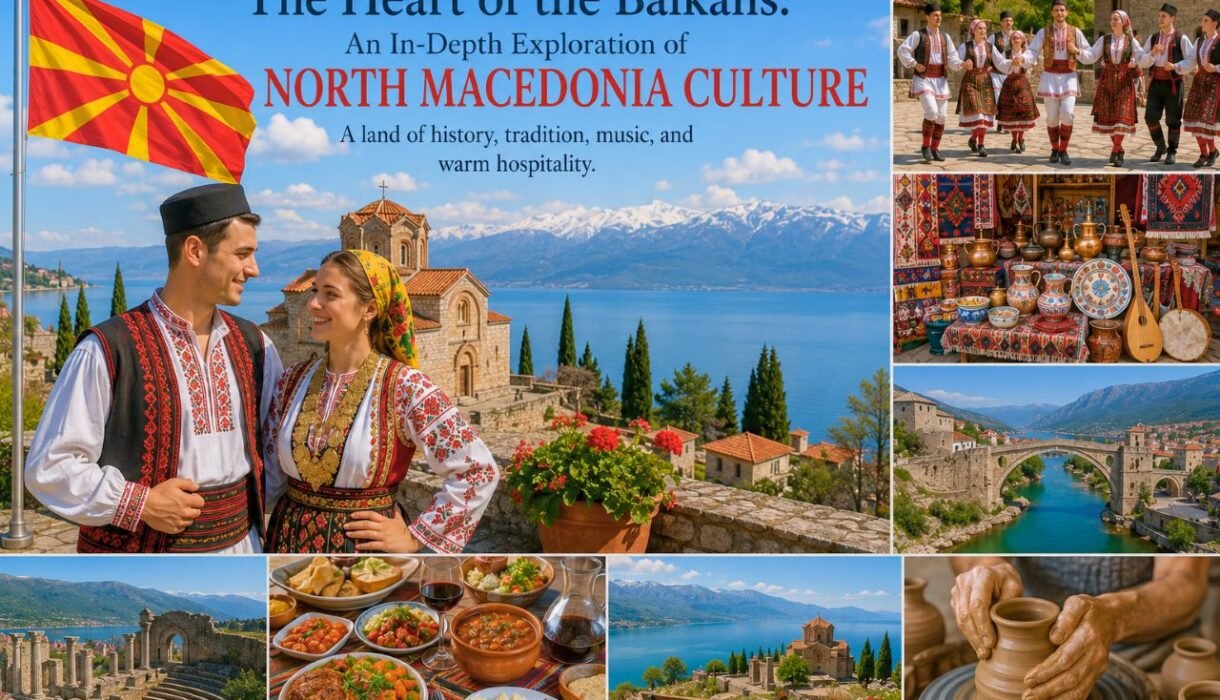
The Heart of the Balkans: An In-Depth Exploration of North Macedonia Culture
Posted in :

Nestled in the heart of the Balkan Peninsula, North Macedonia is a land of dramatic mountain peaks, ancient lakes, and a fascinating tapestry of civilizations. The rich Culture of North Macedonia is a vibrant, living bridge between East and West, where Mediterranean warmth meets Slavic tradition. Its people, known for their deep-rooted hospitality, expressive art, and resilient spirit, have preserved a unique way of life shaped by centuries of historical crossroads.
This comprehensive, research-backed guide offers an elaborate, copyright-free exploration of North Macedonian culture—perfectly tailored for educators, cultural enthusiasts, and creators looking for AdSense-compliant, high-quality blog content.
History & Origins
The historical evolution of North Macedonia is a complex epic spanning several millennia.
- Antiquity and the Kingdom of Macedon: The region’s ancient roots are tied to the historical Kingdom of Macedon. Over time, it was integrated into the Roman and Byzantine Empires, which left a permanent architectural and spiritual footprint across the landscape.
- The Slavic Migration (6th–7th Centuries): During the early Middle Ages, Slavic tribes settled in the region, blending with the indigenous populations. This period laid the linguistic and cultural foundations of the modern Macedonian identity, bolstered by the work of Saints Cyril and Methodius, who devised the Glagolitic script.
- The Ottoman Era (14th–20th Centuries): For over five centuries, the region was a core part of the Ottoman Empire. This era introduced Islamic architecture, culinary traditions, and a distinct oriental influence that still coexists with Christian traditions.
- The Yugoslav Era and Independence: Following the collapse of the Ottoman Empire and the two World Wars, Macedonia became a constituent republic of socialist Yugoslavia. In 1991, the nation peacefully gained its independence, later changing its official name to the Republic of North Macedonia in 2019 following the historic Prespa Agreement.
Culture, Traditions & Customs
Weddings and Family Life
Traditional Macedonian family structures place immense value on close-knit kinship networks and ancestral customs.
- The Galičnik Wedding Festival (Galička Svadba): Held annually in July in the mountainous village of Galičnik, this legendary event showcases centuries-old wedding rituals. The groom’s family leads a horse-drawn procession to fetch the bride, accompanied by traditional drumming (tapan) and horn playing (zurla).
- Naming Ceremonies and St. John’s Day: Christian families celebrate their child’s saint’s day (Imenden) with as much fervor as regular birthdays. Guests are welcomed into homes without a formal invitation to share sweets, wine, and warm wishes.
- Rites of Passage (Kolede): On the eve of Orthodox Christmas (January 6th), children participate in Kolede, singing traditional carols around neighborhood bonfires to welcome the holiday, receiving nuts, fruit, and coins from elders.
Languages & Communication
Language and Script
The official language is Macedonian, a South Slavic language that uses the Cyrillic alphabet. It is closely related to Bulgarian and shares structural similarities with Serbian. Due to the country’s diverse demographics, Albanian is also an official language at the state level and is widely spoken, alongside Turkish, Romani, and Serbian in specific municipalities.
Sayings, Greetings, and Proverbs
Macedonians are warm communicators, often using animated gestures and close physical proximity when speaking.
- “Dobar den” (Good day) or “Zdravo” (Hello) are the standard daily greetings, usually accompanied by a warm handshake or double cheek-kiss among friends.
- “Nema problem” (No problem) is a phrase that perfectly captures the relaxed, laid-back Balkan tempo of daily life.
- “Со поговорка куќа не се гради”
Meaning: “You can’t build a house with proverbs alone.” This classic saying emphasizes the cultural value placed on hard work and tangible actions over empty talk.
Geography
North Macedonia is a landlocked nation defined by its rugged topography and stunning natural waters.
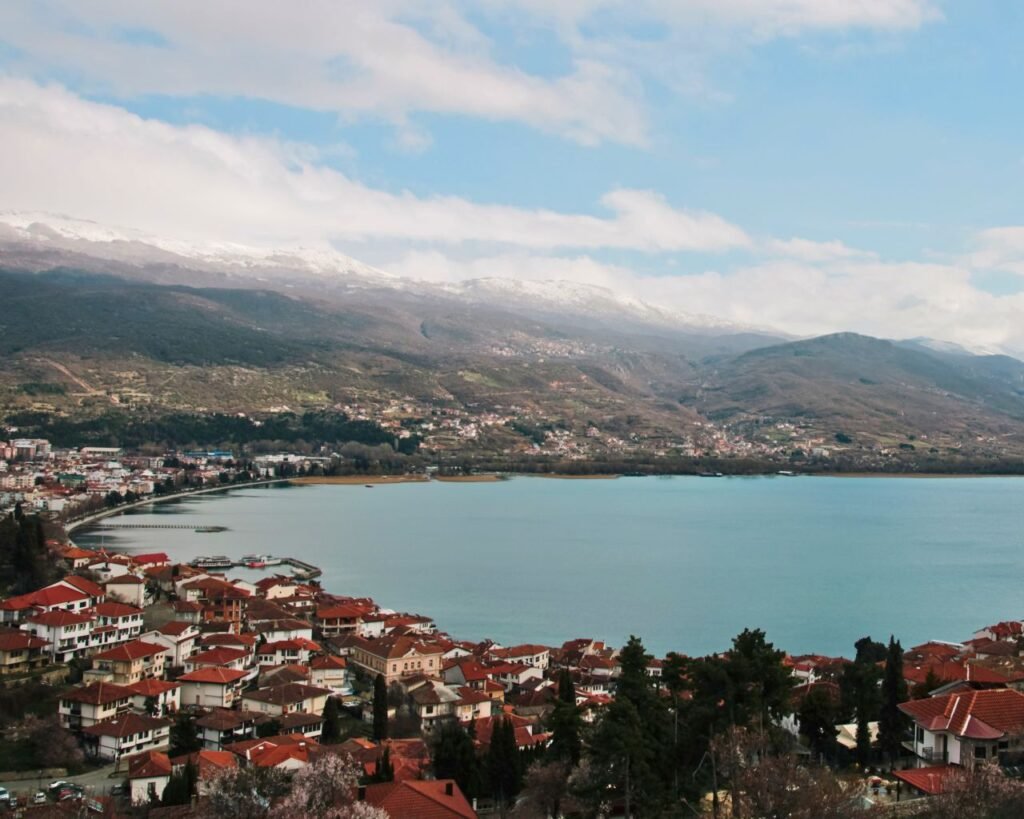
The country is dominated by the Vardar River valley, which cuts through the center of the nation, flanked by high mountain ranges like the Šar Mountains and Mount Korab (the highest peak at 2,764 meters).
Most famous are its three tectonic lakes—Lake Ohrid, Lake Prespa, and Lake Dojran. Lake Ohrid is one of Europe’s oldest and deepest lakes, hosting a unique aquatic ecosystem found nowhere else on earth.
Economy
Historically agricultural, North Macedonia has modernized into an open, service-oriented economy.
Key economic sectors include:
- Agriculture and Viticulture: The fertile Tikveš plain is world-renowned for producing high-quality red wines (specifically the native Vranec grape), as well as premium tobacco, marble, and fresh produce.
- Manufacturing and Automotive Components: The country has successfully attracted foreign direct investment in automotive parts assembly and industrial free zones.
- Tourism: Cultural tourism centered around Ohrid’s medieval monasteries, outdoor mountain trekking, and culinary tours is a rapidly growing contributor to the GDP.
Politics
North Macedonia is a parliamentary republic.
The President serves as the head of state and supreme commander of the armed forces, while the Prime Minister serves as the head of government, wielding executive power.
The unicameral parliament (Sobranie) consists of 120 representatives elected to four-year terms. The country joined NATO in 2020 and is actively pursuing membership within the European Union.
Ethnic Groups
The demographic makeup of North Macedonia is beautifully diverse, fostering a multicultural national identity.
| Ethnic Group | Share of Population (approx.) | Primary Areas & Cultural Contributions |
| Macedonians | ~58% | Majority population; dominant Slavic and Orthodox Christian heritage |
| Albanians | ~24% | Primarily concentrated in the northwest and Skopje; strong Islamic and Mediterranean traditions |
| Turks, Roma, Serbs, Vlachs | ~18% | Distinct communities with deep historical ties, rich musical contributions, and unique crafts |
Beliefs & Values
Religious Harmony and Spirituality
Religion plays a prominent role in the daily lives and moral values of North Macedonians. The majority of the population (around 65%) practices Macedonian Orthodox Christianity, while a significant minority (around 32%) practices Islam.
Historically, these communities have coexisted peacefully, leading to a unique interfaith landscape where church steeples and minarets share the same horizons. Macedonians highly value respect for elders, community solidarity, and family honor.
Food & Cuisine
Macedonian cuisine is a delicious feast of fresh, sun-ripened vegetables, slow-cooked meats, and rich dairy products, heavily influenced by Mediterranean and Ottoman cooking styles.
- Tavče Gravče: The undisputed national dish. It consists of fresh butter beans baked slowly in traditional unglazed clay pots with onions, red peppers, and spices until they form a thick, creamy consistency.
- Ajvar: Known as “Balkan caviar,” this savory spread is made from roasted red horn peppers and eggplants. Families gather in backyards every autumn to roast peppers on iron stoves, stirring the mixture for hours to preserve it for winter.
- Pastrmajlija: A traditional Macedonian baked bread pie topped with salted, cubed pork or mutton, baked to a golden crisp and often served with spicy green peppers.
Clothing & Symbols
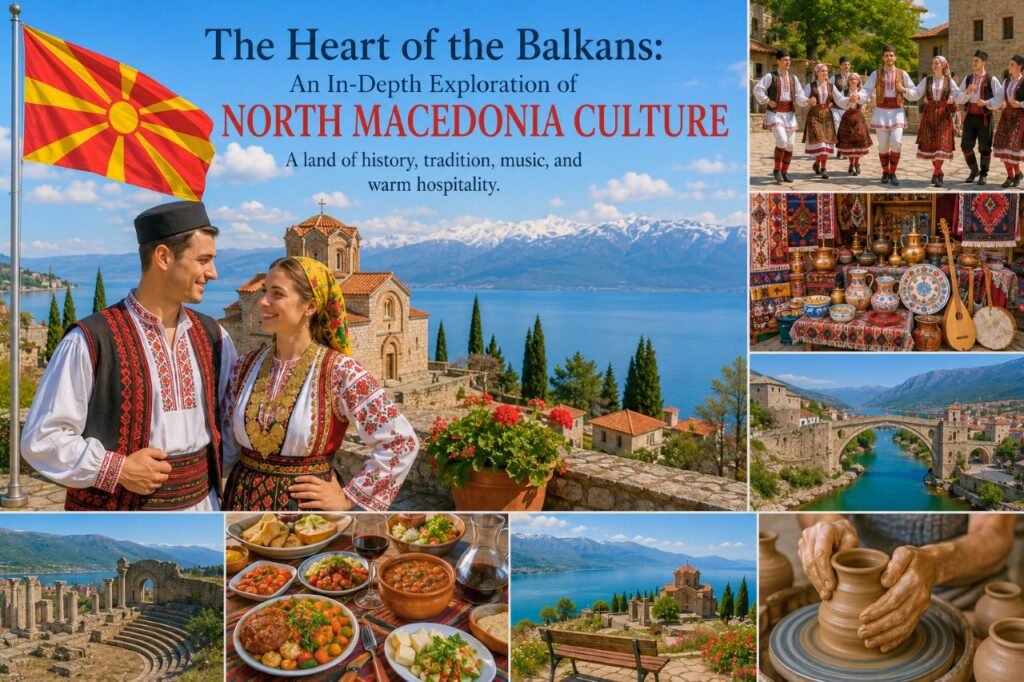
The heart of the Balkans, North Macedonia Culture
Traditional Costumes (Narodna Nosija)
Macedonian traditional clothing is a masterclass in textile art, with over 70 distinct regional variations.
- The Colors: The primary colors are red, white, and black, symbolizing life, purity, and the earth.
- The Details: Women’s traditional wear features heavy linen shirts adorned with intricate, geometric red embroidery (vezenje), silver coins, and woven wool aprons. Men’s wear typically includes fitted wool vests (elek) and wide fabric sashes.
National Symbols
- The Macedonian Sun: The national flag features a stylized yellow sun with eight rays spreading across a red field, representing the “new sun of liberty” referenced in the national anthem.
- The Ohrid Pearl: Created using a secret family recipe involving the scales of the local Plashica fish, these handmade pearls are highly valued for their brilliant, everlasting luster.
Music, Dance & Art
The 7/8 Rhythm and Dance
Macedonian folk music is famous for its complex, asymmetrical rhythms, most notably the 7/8 time signature, which gives the music an organic, driving heartbeat.
- Instruments: Traditional songs are played using the gajda (bagpipe), kaval (wooden flute), tapan (double-headed drum), and tambura (stringed lute).
- The Oro: This collective chain dance is performed at every major celebration. Dancers hold hands or shoulders, weaving in intricate, rhythmic steps led by a captain waving a handkerchief.
Fine Art and Iconography
North Macedonia is a treasure trove of Byzantine art. The medieval frescoes of the Church of St. Panteleimon in Gorno Nerezi (dating back to 1164) are celebrated by art historians globally for introducing human emotion and realism to religious art long before the Italian Renaissance began.
Summary
The culture of North Macedonia is an enduring monument to Balkan resilience, artistry, and warmth. Its people have taken the diverse threads of Roman, Byzantine, Slavic, and Ottoman history and woven them into a distinct, proud national identity. From the quiet shores of Lake Ohrid to the aromatic kitchens preparing autumn Ajvar, North Macedonia remains a deeply authentic European destination where the past is preserved with pride and the future is embraced with open arms.
At Best Culture Insight, we see culture as the heartbeat of every society – the way people live, connect, and express their identity.