The Heart of the Andes: A Deep Dive into Bolivia’s Rich Culture and Living Traditions – Bolivia, South America.
Posted in :

Nestled in the rugged core of South America, Bolivia is a country of breathtaking contradictions and unparalleled cultural preservation. Often called the most indigenous nation on the continent, its identity is not locked away in museums; it lives dynamically on the streets, in the high-altitude plazas, and across the tropical lowlands.
To meet the people of Bolivia—the Bolivianos—is to encounter a deep-seated resilience, an unshakeable connection to the Earth, and a communal warmth that counters the thin, cold air of the Andes. From the dizzying heights of La Paz to the endless white expanse of the salt flats, Bolivian culture is a vivid tapestry of ancient empires, colonial history, and a modern, prideful resurgence of native identity.
History & Origins
Bolivia’s cultural lineage stretches back thousands of years, far predating the arrival of European explorers or even the rise of the Inca Empire.
- The Ancient Empires: Long before colonial boundaries were drawn, advanced civilizations flourished in the high-altitude plains (Altiplano). The most notable was the Tiwanaku Empire near Lake Titicaca, which thrived between 300 AD and 1000 AD. They mastered advanced stone architecture, astronomy, and high-altitude agriculture.
- The Incan Expansion and Spanish Conquest: In the 15th century, the Inca Empire absorbed the regional Aymara kingdoms into their vast territory. This was short-lived, however, as Spanish conquistadors arrived in the 1530s. The discovery of a literal mountain of silver in Potosí turned Bolivia into the economic engine of the Spanish Empire, fundamentally altering the region through forced labor, spiritual conversion, and colonial architecture.
- Independence and Evolution: Led by the liberator Simón Bolívar (from whom the country takes its name), Bolivia achieved independence in 1825. Over the subsequent centuries, despite political turmoil and geographical losses, the core indigenous population preserved their ancestral customs, leading to a massive cultural and political shift in the early 21st century that formally redefined the nation around its pluralistic roots.
Culture, Traditions & Customs
Bolivian traditions seamlessly weave pre-Columbian spiritualism with Catholic rituals, creating unique societal milestones and festivals.
- The Carnaval de Oruro: This is Bolivia’s cultural masterpiece, designated by UNESCO as a Masterpiece of the Oral and Intangible Heritage of Humanity. It is a spectacular festival where thousands of dancers and musicians hit the streets in elaborate, colorful costumes. The celebration blends Catholic imagery of the Virgin of the Tunnel with ancient Andean legends, featuring dances that narrate the struggle between good and evil.
- Marriage and the Rutucha: Traditional marriages, especially in rural areas, are major community affairs lasting several days, involving elaborate gift-giving rituals and communal feasts. Another critical rite of passage is the Rutucha—a child’s first haircut ceremony. Family and community members gather, and each person cuts a lock of the child’s hair while presenting a financial donation or gift to help secure the child’s future.
- The Alasitas Festival: Every January, Bolivians flock to La Paz for Alasitas, a festival dedicated to Ekeko, the traditional Andean god of abundance and prosperity. Attendees buy miniature versions of things they desire in the coming year—such as tiny houses, cars, passports, or miniature dollar bills—and have them blessed by both indigenous shamans and Catholic priests.
Languages & Communication
Bolivia celebrates its linguistic diversity at an institutional level. Rather than enforcing a single tongue, the country recognizes Spanish and 36 distinct indigenous languages as official.
- Linguistic Pillars: While Spanish (Castellano) is widely used in governance and urban commerce, millions of citizens actively speak Quechua (the language of the Inca Empire) and Aymara (pre-Inca highlands). In the eastern lowlands, Guaraní is highly prominent.
- Greetings & Etiquette: Communication in Bolivia is polite and highly relational. A formal greeting like “Buenos días” (Good morning) or “Buenas tardes” (Good afternoon) is expected before starting any conversation, even with a taxi driver or market vendor. A soft handshake is standard, while close friends exchange cheek kisses or warm back claps.
- Cultural Expressions:
- ¡Wiri wiri! – An Aymara-infused slang expression used to describe rapid gossip or idle chatter.
- Ama sua, ama llulla, ama quella – A historic Quechua proverb embedded in the constitution, meaning “Do not steal, do not lie, do not be lazy.”
Geography
Bolivia is a landlocked nation divided into starkly contrasting ecological zones, which directly shape the lifestyles and subcultures of its inhabitants.
- The Altiplano (Highlands): A vast, cold, high-altitude plateau cradled by the Andes mountains. It houses the administrative capital, La Paz, and the historic lake Titicaca. This region is the traditional stronghold of the Aymara and Quechua cultures.
- The Valles (Valleys): A temperate, fertile zone characterized by rolling hills, deep canyons, and Mediterranean-like microclimates. Cities like Cochabamba and Sucre drive the country’s agricultural variety here.
- The Llanos (Lowlands): Comprising over half of Bolivia’s territory, this flat, tropical expanse transitions into the Amazon basin. Centered around Santa Cruz, this region features a warmer climate, distinct ranching cultures, and indigenous lowland tribes.
Economy
Bolivia’s economy is historically tied to its immense natural wealth, transitioning through different eras of resource extraction.
- Mining: The historic foundation of the country’s export market. While Potosí’s silver dominated the colonial era, modern mining shifts toward tin, zinc, and silver alloys.
- Natural Gas & Lithium: Bolivia holds massive reserves of natural gas, which it pipes to regional neighbors like Brazil and Argentina. Crucially, the Salar de Uyuni salt flats contain one of the planet’s largest known deposits of lithium, a critical component for the global transition to electric vehicle batteries.
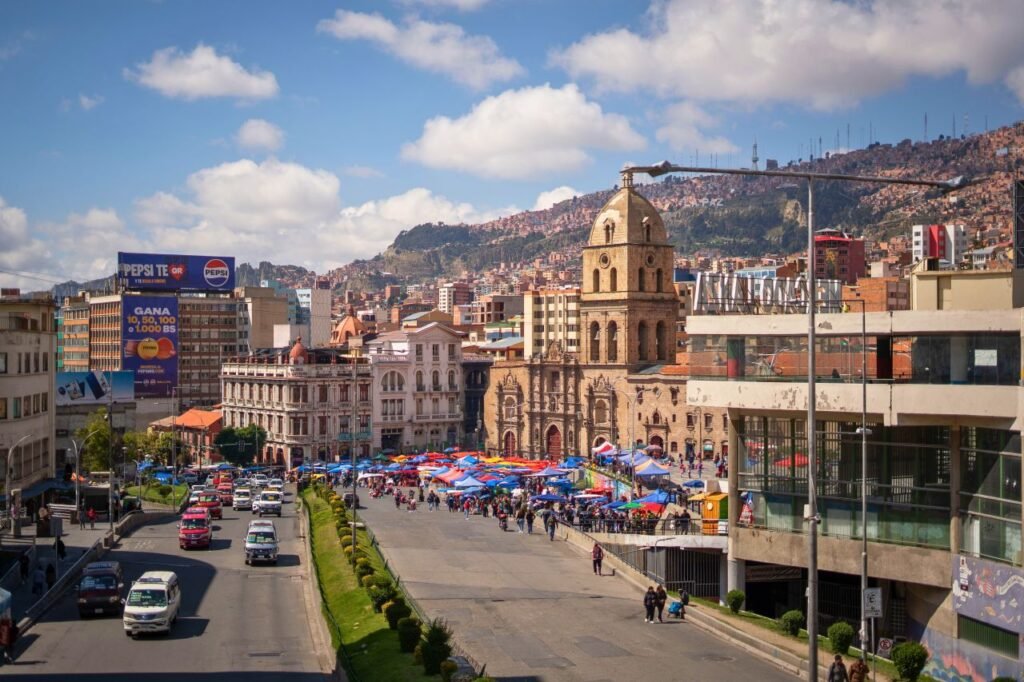
- Traditional Agriculture & Markets: Away from heavy industry, small-scale farming remains central. The country is a global provider of organic quinoa, coffee, and cacao, supported domestically by massive open-air informal markets managed by traditional merchants.
Politics
Formally known as the Plurinational State of Bolivia, the nation’s political layout underwent a massive transformation with the 2009 constitution. This historic document formally shifted political power toward the country’s long-marginalized indigenous majority. It recognized traditional indigenous justice systems on equal footing with civil law, established regional autonomy for native territories, and enshrined the concept of environmental stewardship into national governance. Political engagement in Bolivia is fiercely grassroots, with labor unions, neighborhood councils, and agrarian groups wielding massive mobilizational power.
Ethnic Groups
The demographic makeup of Bolivia is a source of immense national pride and cultural variety.
| Group Category | Approximate Population | Primary Regions | Cultural Legacy |
| Quechua | ~30% | High Valleys & Altiplano | Heirs to the Inca agricultural techniques and textile arts. |
| Aymara | ~25% | Altiplano & Lake Titicaca | Pre-Inca civilization known for linguistic preservation and urban commerce. |
| Mestizo | ~25-30% | Urban Centers | Mixed European and Indigenous ancestry dominant in modern cities. |
| Lowland Tribes | ~5% | Amazonian Plains | Includes Guaraní, Chiquitano, and Moxos groups with unique forest traditions. |
Beliefs & Values
The Bolivian worldview is a beautiful example of syncretism—the blending of seemingly contradictory religious beliefs into a harmonious daily practice.
- Pachamama (Mother Earth): While the majority of Bolivians identify as Roman Catholic, reverence for Pachamama remains absolute. She is viewed as a living, breathing deity who sustains life. Before drinking an alcoholic beverage, it is standard practice to spill a small drop onto the ground as a libation called a challa, thanking the Earth.
- The Amautas: Indigenous shamans or spiritual guides, known as amautas or yatiris, are regularly consulted by people from all walks of life. They read coca leaves to divine the future, perform cleansing rituals, and lead sacrificial offerings (mesas) to ensure success in business, health, and family life.
- Sumak Kawsay (Vivír Bien): This foundational moral philosophy translates to “Living Well.” Rather than pursuing individualistic, consumer-driven wealth, it emphasizes living in harmony with one’s community, ancestral heritage, and the natural environment.
Food & Cuisine
Bolivian food is hearty, comforting, and intensely localized, built around mountain staples like corn, legumes, and thousands of varieties of native potatoes.
- The Salteña: The undisputed king of Bolivian street food. A salteña is a savory baked pastry shell filled with a rich, sweet, and highly juicy stew of beef or chicken, potatoes, peas, and raisins. Eating one cleanly without spilling the hot broth is a true cultural art form.
- Silpancho: A popular, filling dish originating from the valleys of Cochabamba, consisting of a massive, thinly pounded breaded beef schnitzel served over a generous bed of rice and boiled potatoes, topped with a fried egg and a fresh tomato and onion relish.
- Sopa de Maní: A creamy, deeply comforting soup made from ground raw peanuts, beef or chicken bones, vegetables, and topped with crispy, thin-cut french fries. It is a traditional staple served at family weekend lunches across the nation.
Clothing & Symbols
Traditional clothing in Bolivia is an explicit declaration of ethnic pride, regional geography, and social status.
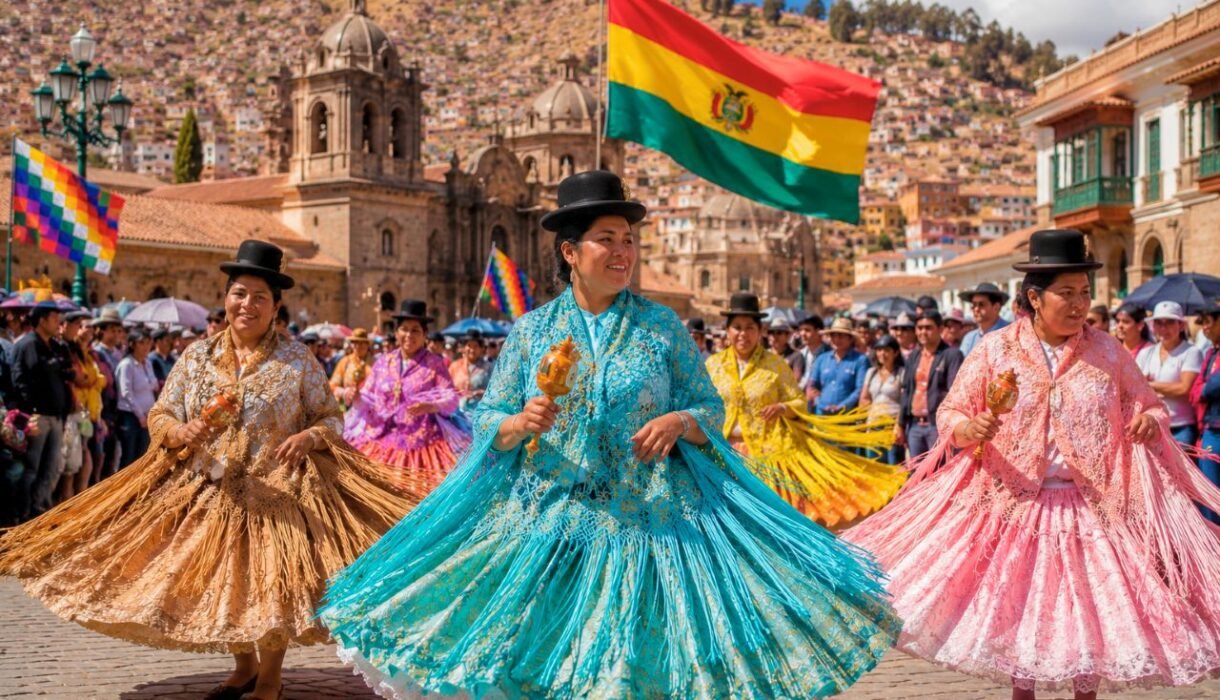
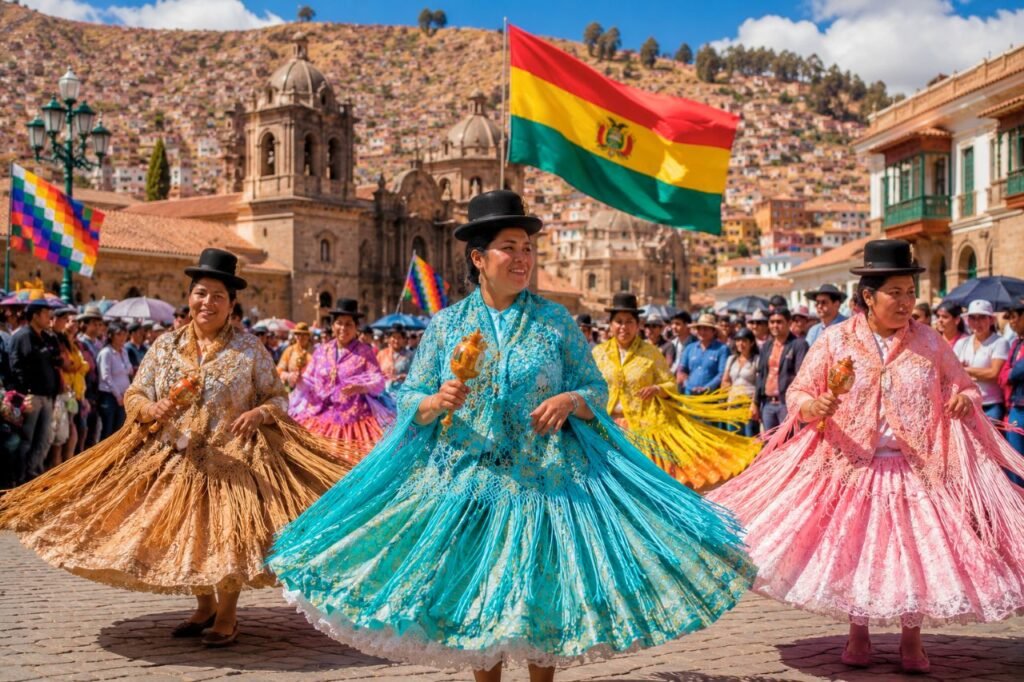
- The Iconic Cholita Fashion: The traditional attire of urban Aymara and Quechua women—known proudly as Cholitas—is one of the most distinctive cultural symbols in South America. The ensemble features a heavy, multi-layered pleated skirt called a pollera, an ornate embroidered shawl held together with a decorative gold or silver pin (topo), and a distinct felt bowler hat (bombín).
The Secret of the Hat: The tilt of the bowler hat communicates a woman’s marital status. Positioned straight on the head means she is married; tilted to the side indicates she is single, widowed, or looking for a partner.
- The Wiphala: Alongside the traditional red, yellow, and green national flag, Bolivia recognizes the Wiphala as an official state symbol. This square, 49-square mosaic rainbow flag represents the indigenous peoples of the Andes, with each color symbolizing a specific element of life, earth, and human connection.
Music, Dance & Art
Artistic expression in Bolivia is high-energy, percussive, and inherently collaborative, deeply tied to communal dance circles.

- Andean Folk Music: The soundscapes of the Altiplano are driven by traditional wind instruments like the zampoña (pan flute) and the quena (wooden flute), backed by the rhythmic strumming of the charango—a small, ten-stringed lute traditionally crafted from the dried shell of an armadillo (now made of sustainably sourced wood).
- The Caporales and Morenada: Bolivian choreography is highly athletic. The Caporales dance features heavy, rhythmic boot-stomping, flashing bells, and energetic leaps, satirizing colonial overseers. The Morenada features slow, heavy steps and massive, weighted costumes that mimic the clanking chains of enslaved populations during the silver mining era, serving as a powerful dance-narrative of historical endurance.
- Indigenous Weaving: Textines are a major visual art form. In communities like Jalq’a and Tarabuco, master weavers use backstrap looms to create intricate tapestries. These works contain complex geometric patterns and stylized animal shapes that encode history, spiritual stories, and local mythologies within the threads.
Summary
The culture of Bolivia is a living, breathing testament to the power of ancestral preservation. It is a society that has successfully defended its indigenous soul against centuries of external pressure, creating a unique contemporary landscape where ancient earth deities are honored alongside modern technologies. Through the colorful whirl of a pollera skirt, the haunting notes of a pan flute, and an unyielding respect for Pachamama, Bolivia offers an enriching, authentic glimpse into the enduring spirit of the Andes.
At Best Culture Insight, we see culture as the heartbeat of every society—the way people live, connect, and express their identity.