The First Free Black Republic: An Elaborate Journey into Haiti Culture
Posted in :

Haiti is a land of unmatched historical significance, artistic brilliance, and unbreakable human spirit. Occupying the western third of the Caribbean island of Hispaniola in North America, Haiti is much more than its geographical boundaries. It is a cultural superpower whose customs, language, and arts have left an indelible mark on the global landscape. – Haiti Culture
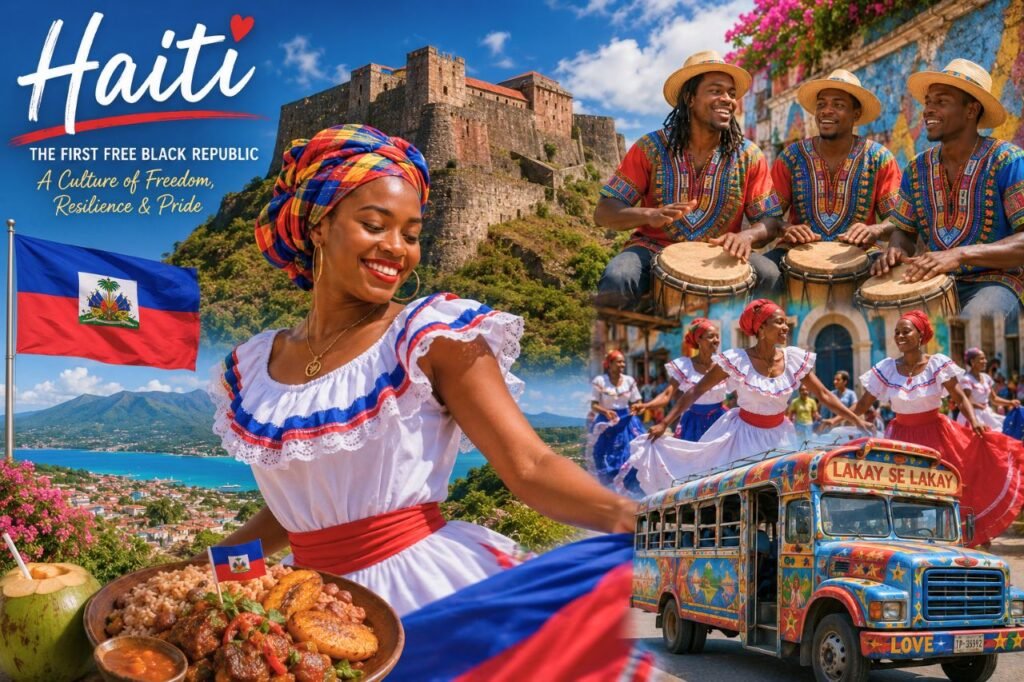
The culture of Haiti—known natively as Ayiti (“Land of High Mountains”)—is defined by its depth, creative energy, and profound communal pride. The Haitian people, or Ayisyen, possess a vibrant worldview shaped by the ultimate victory of freedom over oppression.
Haitian daily life is a sensory experience. It echoes through the polyrhythmic beat of drums in a neighborhood courtyard, the brilliant murals adorning public buses (tap-taps), and the rich, comforting aroma of slow-cooked spices. At its core, Haitian culture is a masterpiece of syncretism, where deep West African traditions have melded with European influences and indigenous remnants to forge an identity that is fiercely independent and joyfully celebrated.
History & Origins
The modern identity of Haiti was forged in the fires of the most successful slave rebellion in human history. Long before European colonization, the island was home to the indigenous Taíno people. In 1492, Christopher Columbus claimed the island for Spain, naming it La Española. By the late 17th century, France gained control of the western third, renaming it Saint-Domingue.
[Taíno Civilization] ➔ [1492: Spanish Conquest] ➔ [1697: French Saint-Domingue] ➔ [1791–1804: Haitian Revolution] ➔ [1804–Present: Independence]
Under French rule, Saint-Domingue became the most lucrative colony in the world, built entirely on the brutal exploitation of hundreds of thousands of enslaved West Africans. These Africans brought with them diverse spiritual, linguistic, and musical traditions from the Fon, Yoruba, Kongo, and Ewe kingdoms.
On August 14, 1791, a secret spiritual gathering at Bois Caïman, led by Boukman Dutty and Cécile Fatiman, ignited the Haitian Revolution. Armed with immense courage and brilliant strategy, revolutionary leaders like Toussaint Louverture and Jean-Jacques Dessalines defeated Napoleon’s armies. On January 1, 1804, Haiti declared its independence, making it the first free Black republic in the world and the second independent nation in the Americas. This monumental victory remains the foundational anchor of all Haitian culture.
Geography
Haiti’s landscape is dramatically rugged and diverse, living up to its original Taíno name. The country is crossed by two parallel mountain ranges, with peaks like Pic la Selle rising over $2,600\text{ meters}$ above sea level. These mountains cradle fertile valleys, such as the Artibonite Valley, the country’s agricultural heartland.
Haiti features spectacular coastlines along the Atlantic Ocean and the Caribbean Sea, including the pristine Gulf of Gonâve. Its geography also includes important ecological treasures like the pine forests of the Forêt des Pins and historic interior fortresses like the Citadelle Laferrière, an architectural wonder built atop the mountain Bonnet à l’Evêque to protect the newly freed nation.
Economy
Historically an agricultural giant exporting sugar, indigo, and coffee, Haiti’s modern economy is a mix of agricultural pursuits, informal commerce, and light manufacturing.
| Economic Sector | Major Components | Cultural Significance |
| Agriculture | Mangoes, vetiver oil, coffee, cocoa, rice | Smallholder farming (abitan) fosters a strong connection to the ancestral soil. |
| Manufacturing | Apparel assembly, textiles, artisanal crafts | Employs urban populations; drives global export of distinct Haitian art. |
| Remittances | Financial support from the diaspora | Provides a crucial social safety net for health, housing, and schooling. |
Haiti is also the world’s leading supplier of high-grade vetiver, an essential aromatic oil used by the world’s finest perfume houses. A massive informal network of market women, known affectionately as Madan Sara, forms the distribution backbone of the domestic economy, moving goods tirelessly from rural farms to bustling city markets.
Politics
Haiti is historically structured as a semi-presidential republic, featuring an elected President as head of state and a Prime Minister as head of government, working alongside a bicameral National Assembly.
The nation’s political path has been complex, marked by long periods of foreign intervention, dictatorial eras (such as the Duvalier regime), and systemic economic blockades imposed by colonial powers post-independence. Despite these challenges, the political consciousness of the Haitian public remains incredibly active. Popular movements consistently draw inspiration from the 1804 revolutionary constitution, championing absolute national sovereignty, local community empowerment, and social justice.
Ethnic Groups
The population of Haiti is highly unified in its ancestral roots, with approximately 95% of citizens identifying as being of direct African descent. The remaining 5% comprises individuals of mixed heritage (Mulatto), alongside small historical immigrant lineages of Levantine (Lebanese and Syrian) and European descent who have integrated over generations into the country’s commercial sectors. This shared demographic history creates a deep, widespread connection to African traditions, rhythms, and family structures across the entire island.
Languages & Communication
Language in Haiti is a beautiful indicator of its historic evolution. The country has two official languages: Haitian Creole (Kreyòl Ayisyen) and French.
While French was historically the language of the elite, administration, and schooling, Kreyòl is the true linguistic unifying force of the country, spoken fluently by 100% of the population. Kreyòl is an independent, sophisticated language with a French-derived vocabulary structured perfectly over a West African grammatical matrix.
Common Expressions & Greetings
- “Bonswa” — Good afternoon / Good evening.
- “Sak pase?” — What’s happening? / How are you?
- “N ap boule!” — The enthusiastic response meaning “We are burning up the track!” or “Doing great!”
- “Chans” — Good luck.
Wisdom in Haitian Proverbs (Pwoveb)
Haitian communication is deeply metaphorical, relying heavily on concise proverbs to convey complex life lessons:
“Men anpil, chay pa lou.”
Literal Translation: Many hands make the load light.
Cultural Meaning: Collective community action and cooperation conquer any hardship.
“Dèyè mòn, gen mòn.”
Literal Translation: Beyond mountains, there are more mountains.
Cultural Meaning: Life presents continuous challenges, but it also means there are endless horizons and opportunities to conquer.
Beliefs & Values
Haiti is a highly spiritual nation where faith, moral resilience, and community values guide everyday survival.
Vodou and Christianity
The spiritual landscape of Haiti is famously dualistic. Roman Catholicism and Protestantism are widely practiced, but Haitian Vodou is the country’s cultural bedrock. Often misunderstood globally due to colonial mischaracterization, Vodou is a sophisticated monotheistic religion. It honors a supreme creator (Bondye) and a pantheon of spiritual archetypes called Lwa (such as Papa Legba, Erzulie, and Baron Samedi) who serve as intermediaries.
Vodou provided the spiritual framework and psychological unity that made the Haitian Revolution possible. It teaches a deep respect for natural elements, ancestral lineages, and the absolute dignity of the human soul.
Core Values
The foundational value of Haitian society is Tèt Ansanm (Creole for “Heads Together”), a cultural practice of collective responsibility. Whether working together on a farm cooperative (konbit) or sharing resources during times of natural adversity, Haitians view family and neighborly support as a non-negotiable moral duty.
Food & Cuisine
Haitian cuisine, known as Manje Kreyòl, is a bold, intensely seasoned culinary tradition. It relies on Épis—a vibrant blended marinade of garlic, scallions, bell peppers, scotch bonnet chilies, and fresh herbs that forms the baseline flavor for almost every dish.
Signature Traditional Dishes
- Diri ak Djon Djon: A prestigious, savory rice dish prepared using a native black mushroom (djon djon). The mushrooms are boiled to release a deep, aromatic black liquid that stains the rice, which is then simmered with lima beans and green peas.
- Griot: The ultimate celebration food. It consists of chunks of pork shoulder marinated in citrus juices, garlic, and épis, boiled until perfectly tender, and then deep-fried until crisp and golden brown. It is universally served alongside Pikliz—a fiery, crunchy relish made of shredded cabbage, carrots, onions, and hot peppers pickled in vinegar.
Soup Joumou: The Liquid Blueprint of Freedom
Soup Joumou is a rich, comforting pumpkin and squash soup simmered with beef, potatoes, plantains, and cabbage. Under French colonial rule, enslaved Africans were forced to cultivate the ingredients for this aromatic soup, but were strictly forbidden from eating it, as it was reserved solely for the colonial masters.
Upon declaring independence on January 1, 1804, the newly liberated citizens prepared and consumed massive pots of Soup Joumou to celebrate their freedom. Today, eating Soup Joumou every New Year’s Day is a non-negotiable national ritual of liberation, identity, and revolutionary victory.
Clothing & Symbols
Haitian traditional attire is a stunning display of color, history, and natural symbolism.
Traditional Attire
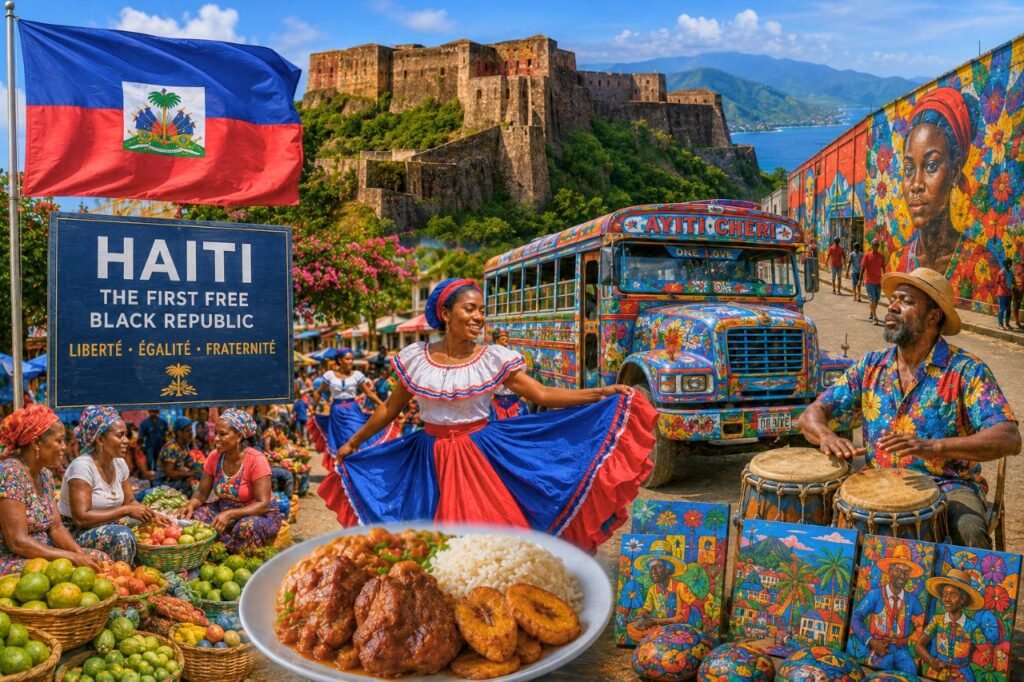
The national dress of Haiti is the Karabela dress. Crafted from lightweight, breathable blue denim or heavy blue cotton linen, the Karabela features elegant off-the-shoulder ruffles trimmed with bright red, white, or checkered fabric ribbons. It is worn during folklore dances and national heritage festivals, usually paired with a matching headwrap (mouchwa). For men, the traditional garment is a matching lightweight blue cotton button-down shirt paired with trousers, accessorized with a red neckerchief.
[ Architecture of the Haitian Coat of Arms ]
┌───────────────────────────────────┐
│ The Royal Palm │
│ (Symbol of Liberty & Triumph) │
├───────────────────────────────────┤
│ Trophy of Arms & Cannons │
│ (Readiness to Defend Freedom) │
├───────────────────────────────────┤
│ The Phrygian Cap │
│ (Symbol of Liberty) │
├───────────────────────────────────┤
│ “L’Union Fait la Force” │
│ (Unity Makes Strength Motto) │
└───────────────────────────────────┘
Iconic Symbols
- The Royal Palm Tree: Displayed prominently at the dead center of the national flag, it represents liberty and national victory.
- The Hibiscus: The official national flower, representing the vibrant beauty and resilience of the island’s flora.
Music, Dance & Art
Haiti is an artistic powerhouse. Its creative outputs are deeply original, intensely rhythmic, and globally celebrated.
Rhythms and Movement
- Konpa (Compas): The dominant modern musical genre of Haiti, popularized in the 1950s by Nemours Jean-Baptiste. It features a smooth, mid-tempo dance groove driven by a striking cowbell, rhythmic guitars, and brass arrangements.
- Rara Music: A vibrant festival music that spills onto the streets during the Easter season.
Rara processions feature musicians playing vaksen (long bamboo horn pipes that emit a single, rhythmic note), metal trumpets, and traditional drums, creating a hypnotic, high-energy parade that connects neighboring villages.
Visual Arts and Painting
Haitian art burst into the global spotlight in the 1940s through the Haitian Naive Art movement, centered around the Centre d’Art in Port-au-Prince. Master artists like Hector Hyppolite and Philomé Obin pioneered a distinct style characterized by brilliant, saturated color palettes, flat perspectives, and heavily detailed scenes of daily life, Vodou ceremonies, and historical milestones.
Haiti is also famous for Fer Forgé (cut-metal sculpture) originating from the village of Noailles. Artisans recycle oil drums, flattening them to hand-carve incredibly intricate sculptures of trees, spirits, and birds, transforming industrial waste into timeless works of fine art.
Summary
The culture of Haiti stands as a brilliant monument to human freedom, creativity, and resilience. By guarding the ancestral wisdom of their West African roots, honoring the revolutionary victories of 1804, and expressing their souls through the rhythms of Konpa and the flavors of Diri ak Djon Djon, the Haitian people have cultivated a distinct identity in North America. Haiti continues to look forward with pride, celebrating its cultural diversity and offering its deeply profound, artistic legacy to the global community.
At Best Culture Insight, we see culture as the heartbeat of every society – the way people live, connect, and express their identity.