The Cultural Blueprint of Victoria, Australia: Coffee, Creativity, and Collective Passion
Posted in :

While other Australian states are often defined by their natural geography—be it golden beaches or rugged outback horizons—Victoria is a state defined entirely by its human fabric. It is Australia’s undisputed capital of style, intellect, and creative subculture.
Anchored by Melbourne but stretching out into historic gold-rush towns and dramatic coastal edges, Victoria’s culture is densely packed, intensely collaborative, and unapologetically obsessive. Whether it is the pursuit of a mathematically perfect espresso, the frantic energy of a local football match, or the vibrant pulse of one of the world’s most successful multicultural societies, Victoria doesn’t just do culture—it lives it.
1. The Global Mecca of Coffee Culture
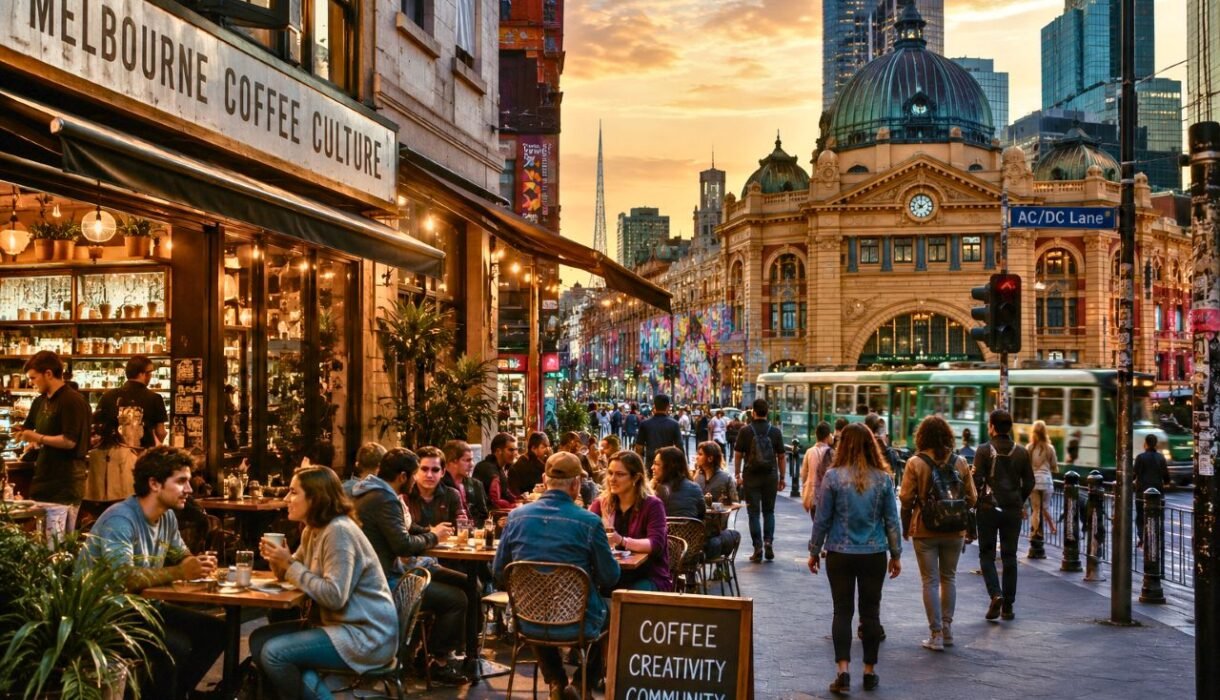
To understand Victoria, you must understand its relationship with caffeine. Melbourne’s coffee scene is not merely a morning convenience; it is a highly sophisticated, independent ecosystem that consistently ranks as the best in the world, outperforming traditional European capitals.
This cultural obsession traces its roots back to the post-WWII migration boom. Italian and Greek immigrants arrived in the 1940s and 1950s, bringing the very first espresso machines to historic inner-city spots like Lygon Street. Historic establishments, like Pellegrini’s Espresso Bar (opened in 1954), planted the seeds of what would evolve into a full-scale sensory revolution.
Post-WWII Migrants➔European Espresso Bars➔1990s Indie Café Boom➔Specialty Coffee Supremacy
Today, Victoria rejects corporate coffee chains in favor of hyper-local, independent roasters. The state is credited with pioneering and perfecting specialty drinks like the Flat White and the uniquely Victorian “Magic”—a double ristretto topped with smoothly textured steamed milk, served strictly in a 5-ounce tulip cup.
Walk through the iconic Hoddle Grid laneways, and you will find tiny, hole-in-the-wall cafés operating like high-end art laboratories, prioritizing ethically sourced beans, precise water chemistry, and micro-foam artistry.
2. The Creative Frontier: Art, Architecture, and Laneways
Victoria is the creative engine of the Southern Hemisphere. Its capital is a designated UNESCO City of Literature and an international hotspot for performance, fashion, and visual arts.
The Laneway Transformation
In the early decades of urban planning, Melbourne’s narrow cobblestone lanes were designed as utilitarian service alleys for horses and carts. Today, they form the veins of Victorian subculture. Places like Hosier Lane, ACDC Lane, and Union Lane are world-famous, ever-changing open-air galleries showcasing massive, multi-story street art murals and stencil installations.
World-Class Institutions
The state’s dedication to institutional art is anchored by the National Gallery of Victoria (NGV), Australia’s oldest and most visited public art museum. The NGV houses a monumental collection spanning classical antiquity, cutting-edge contemporary installations, and an extensive showcase of Indigenous Australian art.
Beyond the city limits, this creative spirit spills into regional Victoria. The historic gold-mining town of Ballarat and the coastal enclave of Geelong boast rich regional galleries, while the countryside hosts sweeping outdoor sculpture parks and indie music gatherings.
3. A Proud Tapestry of Deep Heritage and Multiculturalism
Victoria’s modern social identity is built upon an incredibly diverse population. Data from the Australian Bureau of Statistics highlights that roughly one-third of all Victorians were born overseas, representing over 300 distinct ancestries, speaking 290 languages, and practicing close to 200 different faiths.
First Nations Foundation
Long before European settlement, Victoria’s landscape was nurtured for over 65,000 years by its First Peoples, including the Kulin Nation. Victorian Indigenous culture is deeply anchored in the protection of Country, traditional storytelling, and craftsmanship. Today, institutions like the Koorie Heritage Trust ensure that contemporary Aboriginal art, history, and voices remain at the absolute center of the state’s public identity.
The Migration Mosaic
Wave after wave of international migration has turned Victoria into a culinary and social masterpiece. The state contains distinct geographic neighborhoods where global cultures have permanently shaped local life:
- Lygon Street (Carlton): The birthplace of Australia’s “Little Italy” and modern outdoor dining.
- Richmond & Footscray: Vibrant cultural hubs deeply influenced by Vietnamese migration, offering incredible sensory street food markets.
- Box Hill & Dandenong: Bustling centers for Chinese, Indian, and Sri Lankan communities, filling the social calendar with massive public celebrations like Diwali and Lunar New Year festivals.
4. The Sporting Obsession: A Secular Religion
It is impossible to discuss Victorian culture without addressing its fanatical obsession with sport. Victorians treat athletic pursuits with a level of devotion that borders on the religious.
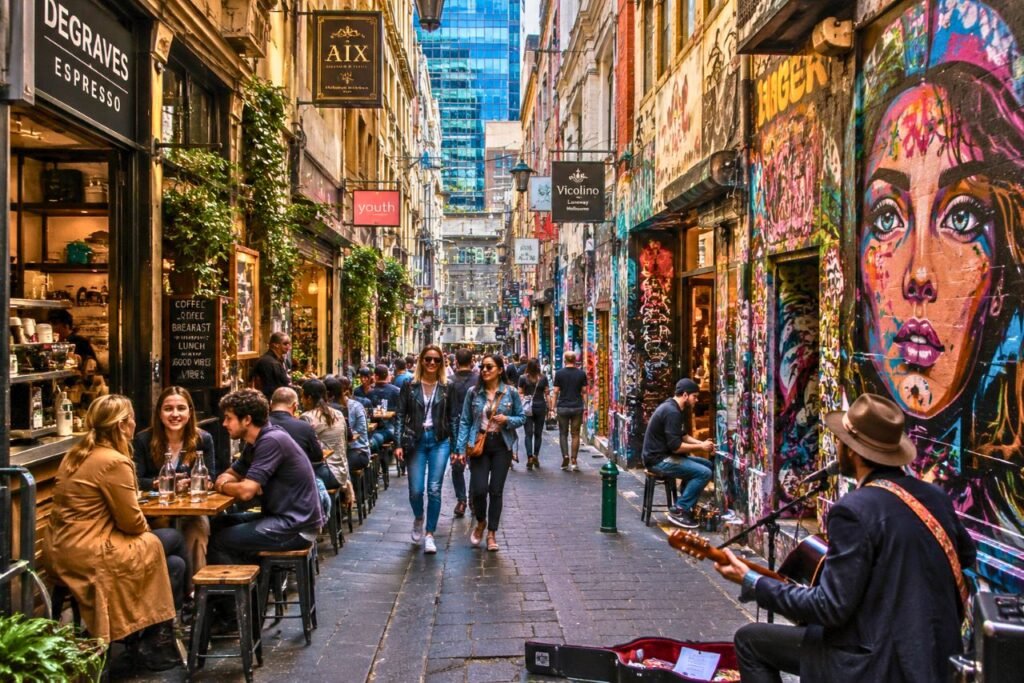
Vibrant café laneway and street art, Victoria, Australia
At the center of this universe is Australian Rules Football (AFL), a high-octane, indigenous sport born in Melbourne in 1858. During the winter months, the historic Melbourne Cricket Ground (MCG)—the largest stadium in the Southern Hemisphere—regularly fills its 100,000-seat capacity with multi-generational families dressed in their team colors.
Autumn/Winter➔Australian Rules Football (AFL)➔Dominated by the MCG & Local Footy Clubs
Spring/Summer➔Boxing Day Cricket, Australian Open Tennis, & Major Motorsport Events
Victoria is also the major event capital of Australia. It deliberately curates a year-round calendar of global sporting blockbusters, including the Australian Open (Grand Slam tennis), the Formula 1 Australian Grand Prix, and the Melbourne Cup Carnival, a horse racing event so culturally significant that the entire state receives an official public holiday for it.
5. Regional Victoria: The Preservation of Slow Living
Venture outside the urban fringe, and the frantic pace of the city dissolves into a culture focused on wellness, historical preservation, and artisan production.
Gold Rush Legacy
Towns like Bendigo and Ballarat still echo the opulence of the 1850s Victorian gold rush. The architecture here is grand, ornate, and deeply European, featuring sweeping verandas, historic theaters, and majestic town halls. Living history museums like Sovereign Hill preserve the craftsmanship, costumes, and machinery of this foundational era.
Spa Country and Artisan Produce
In the Hepburn Shire and Daylesford region, Victoria has carved out a unique “spa culture.” Home to the largest concentration of natural mineral springs in Australia, this region has become a sanctuary for wellness retreats, holistic living, and farm-to-table dining.
Similarly, regions like the Yarra Valley and the Mornington Peninsula are world-renowned for boutique cool-climate winemaking, where the weekend culture revolves around supporting independent farm gates, organic orchards, and artisan cheesemakers.
Summary for Publishers and Travelers
The culture of Victoria is an intricate, layered masterpiece. It values craftsmanship over mass production, independent expression over corporate uniformity, and communal passion over passive isolation. From the aromatic depth of a laneway flat white to the booming roar of the crowd at the MCG, Victoria offers an authentic, highly sophisticated window into the creative soul of modern Australia.
At Best Culture Insight, we see culture as the heartbeat of every society—the way people live, connect, and express their identity.