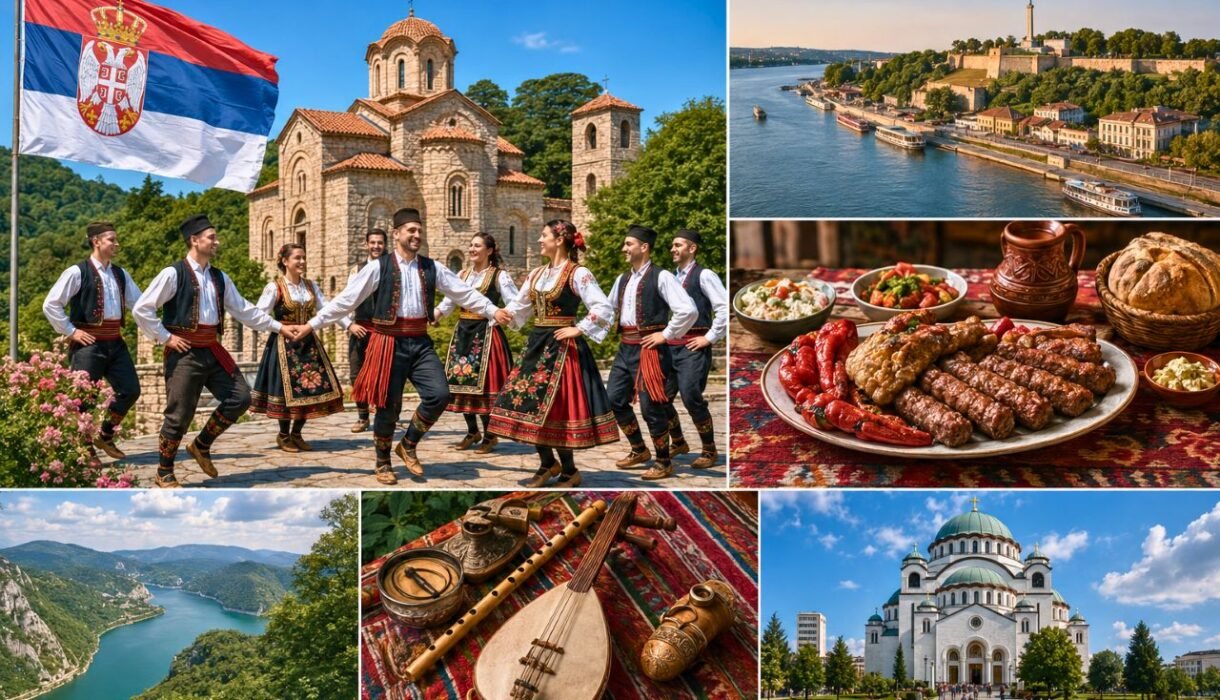

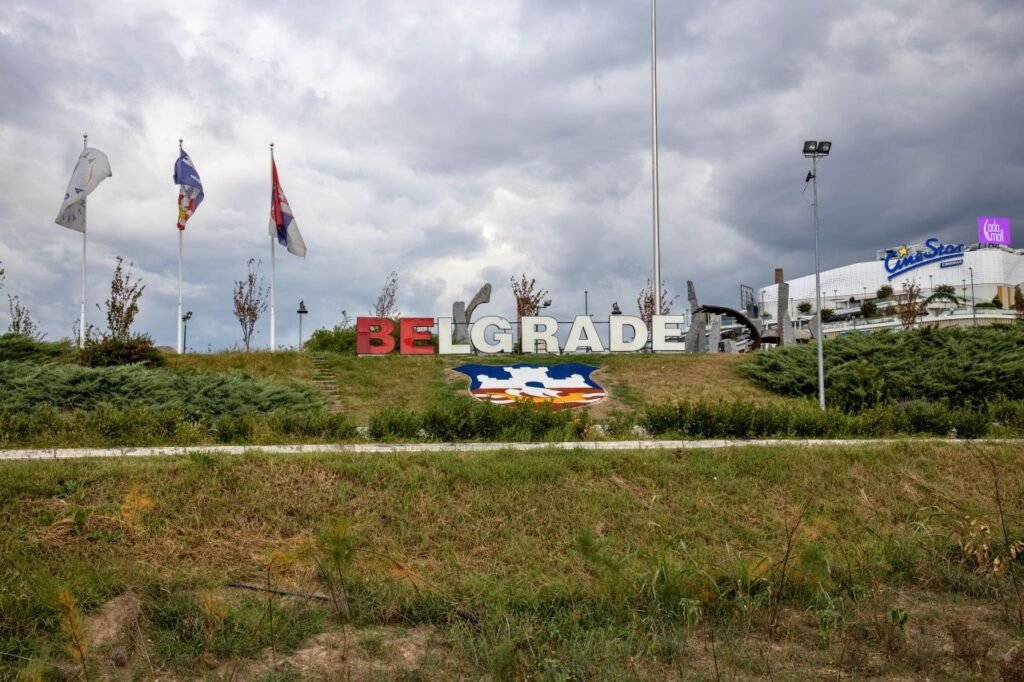
Positioned at the geographical and historical crossroads of Central and Southeastern Europe, Serbia is a nation defined by its soaring mountain ranges, vibrant river valleys, and an indomitable spirit. The vibrant Culture of Serbia is a captivating blend of Eastern Orthodox tradition, ancient Slavic folklore, and Mediterranean-Balkan vitality, refined through centuries of empires colliding along the Danube and Sava rivers. The Serbian people are celebrated globally for their exuberant hospitality (gostoprimstvo), fierce sense of personal honor, and an unwavering devotion to family and community. From the bustling, energetic streets of Belgrade to the tranquil monasteries nestled in the rural hills, Serbia offers a rich, multi-layered cultural landscape.
History & Origins
The historical development of Serbia is an epic story of medieval glory, centuries of heroic resistance, and continual rebirth.
- Slavic Migration & Christianization: Early South Slavic tribes settled the Balkan region during the 6th and 7th centuries. In the 9th century, saints Cyril and Methodius introduced Eastern Orthodox Christianity, establishing a spiritual foundation that continues to define the nation today.
- The Nemanjić Dynasty & Golden Age: Under the Nemanjić dynasty (12th to 14th centuries), Serbia reached its medieval peak, creating a powerful empire adorned with exquisite UNESCO-listed monasteries like Studenica and Sopoćani. In 1219, Saint Sava established the autocephalous Serbian Orthodox Church.
- Ottoman Conquest & Resistance: The Battle of Kosovo in 1389 became an enduring national myth of self-sacrifice and spiritual honor. For nearly five centuries, Serbia remained under Ottoman rule, maintaining its cultural identity through heroic oral poetry, folk music, and monastic preservation.
- Modern Statehood & Yugoslavia: Serbia re-emerged as an independent kingdom in the 19th century following successful uprisings. After World War I, it became the anchor of the Kingdom of Serbs, Croats, and Slovenes (later Yugoslavia). Following the turbulent dissolution of socialist Yugoslavia in the 1990s, modern Serbia emerged as an independent democratic republic.
Culture, Traditions & Customs
Slava: The Sacred Family Patron Saint Day
The undisputed cornerstone of Serbian spiritual and social life is Slava—an ancient custom inscribed on the UNESCO Intangible Cultural Heritage list. Unique to Serbs among Orthodox Christians, each family celebrates the feast day of its inherited patron saint (such as Saint Nicholas or Saint George). The celebration unites friends and family around three sacred symbols:
- Slavski Kolač: A ceremonial, heavily decorated wheat bread blessed by a priest.
- Žito (Koljivo): A dish of boiled wheat sweetened with honey and walnuts, symbolizing resurrection.
- Slavska Sveća: A tall beeswax candle kept lit throughout the day.
Weddings & Life Milestones
Serbian weddings (svadba) are legendary community events packed with joyous music and ancient folk customs. Traditional highlights include the Shooting of the Apple—where the groom must shoot an apple placed atop the highest pole in the bride’s courtyard with a rifle before entering—and the cheerful “buying” of the bride by her brother-in-law.
Festivals & Seasonal Rites
- Guča Trumpet Festival: An extraordinary annual brass band festival gathering hundreds of thousands of visitors in a small mountain town to celebrate energetic Balkan trumpet music.
- EXIT Festival: Held in Petrovaradin Fortress in Novi Sad, this world-renowned music festival showcases Serbia’s modern, youthful, and cosmopolitan side.
Languages & Communication
Language Spoken
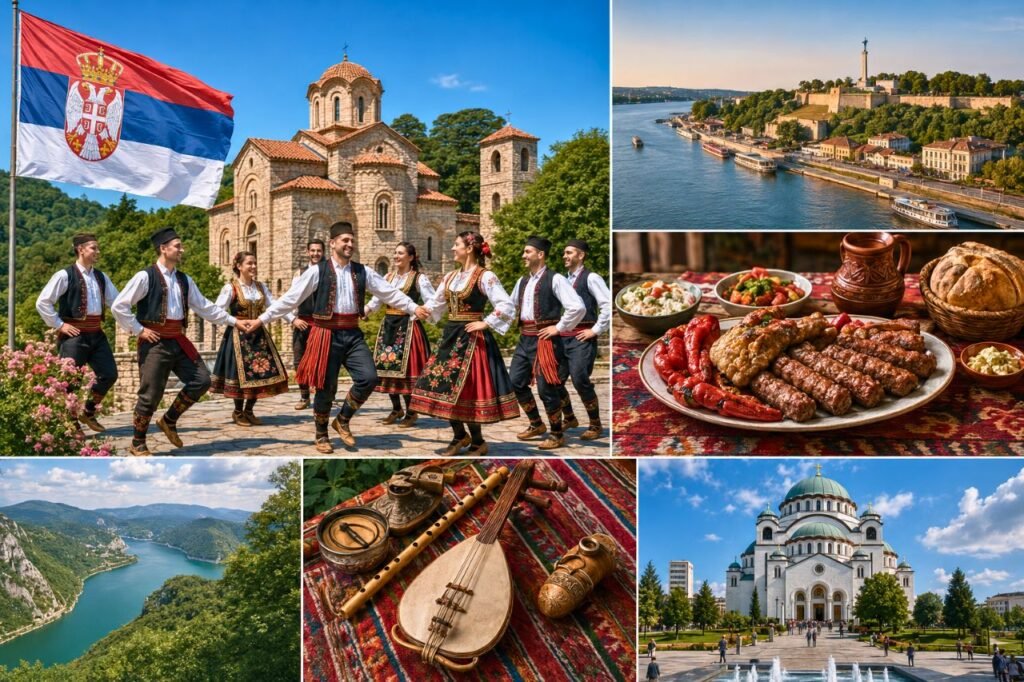
The official language is Serbian, a South Slavic language spoken by over 10 million people worldwide. Serbia is uniquely digraphic, meaning both the Cyrillic and Latin alphabets are officially used and understood by all citizens, though Cyrillic remains the historic national script.
Communication Styles & Greetings
Communication in Serbia is direct, passionate, and open. Serbs are expressive conversationalists who value sincerity over rigid formality.
- Greetings: A warm handshake paired with eye contact is standard. Among friends and family, it is customary to greet with three alternating cheek kisses (right, left, right).
- Key Expressions:
- Dobar dan (Good day)
- Hvala (Thank you)
- Živeli! (Cheers!—literally, “May we live long!”)
Proverbs & Wisdom
- “Bez alata nema zanata.”
Meaning: “Without tools, there is no craft”—valuing proper preparation and hard work.
- “Gvožđe se kuva dok je vruće.”
Meaning: “Strike while the iron is hot”—emphasizing decisiveness and taking advantage of opportune moments.
Geography
Serbia is a landlocked nation in the heart of the Balkans, featuring diverse geographical landscapes divided into distinct regions:
- Pannonian Plain (North): Home to Vojvodina, characterized by fertile, flat agricultural plains and slow-moving rivers.
- Central & Southern Highlands: A rugged area marked by rolling hills, dense oak forests (from which the central region Šumadija gets its name), and dramatic mountain chains like the Balkan Mountains, Kopaonik, and Tara National Park.
- Major Rivers: The mighty Danube flows through northern and eastern Serbia, forming the breathtaking Iron Gates gorge along the Romanian border.
Economy
Serbia has developed a dynamic market economy that acts as an industrial and logistics gateway between Western Europe and the Middle East.
Key economic pillars include a booming information technology sector, automobile manufacturing (centered in Kragujevac), heavy machinery, and metallurgy. Agriculture plays a critical role, with Serbia ranking as one of the world’s top exporters of frozen raspberries, plums, and premium wines.
Politics
Serbia is a parliamentary constitutional republic.
The Prime Minister serves as the Head of Government, holding executive authority over state administration and economic policy. The President is elected by popular vote as the Head of State, representing national unity and directing defense and foreign affairs.
Legislative power resides in the National Assembly (Narodna Skupština), a unicameral parliament consisting of 250 proportionally elected deputies. Serbia is an official candidate country for accession into the European Union.
Ethnic Groups
Serbia is an ethnically diverse nation, home to over 30 distinct national communities living in harmony.
| Ethnic Group | Population Share | Regional Focus & Context |
| Serbs | ~83% | Majority nationwide; Slavic heritage and Eastern Orthodox tradition. |
| Hungarians | ~3.5% | Concentrated in Vojvodina; rich Austro-Hungarian architectural influence. |
| Roma | ~2% | Present nationwide; rich musical and cultural contributions. |
| Bosniaks, Croats, Slovaks | ~4% | Primarily in the Sandžak region (Bosniaks) and northern plains (Slovaks/Croats). |
Beliefs & Values
Religious Life
Over 84% of the population identifies with the Serbian Orthodox Church. Religion in Serbia is deeply tied to national historical survival, with medieval monasteries acting as sacred monuments of identity. Minorities proudly practice Islam, Roman Catholicism, and Protestantism.
Core Cultural Values
- Gostoprimstvo (Hospitality): Guests are welcomed with open arms and offered Slatko (a spoonful of fruit preserves) and a glass of cold water upon entering a home.
- Inat: A famous Serbian cultural concept translating to a stubborn, defiant perseverance in the face of adversity—doing something out of pride or spirit against impossible odds.
Food & Cuisine
Serbian cuisine is a hearty, meat-forward Balkan feast heavily influenced by Central European, Mediterranean, and Turkish culinary traditions.
- Ćevapi: Small, grilled skinless sausages made from minced beef and pork, served inside a fluffy flatbread (somun) with chopped raw onions and sour cream (kajmak).
- Ajvar: A rich, savory relish made from roasted red bell peppers and eggplant, often called “Balkan caviar.”
- Sarma: Sour cabbage leaves rolled around a seasoned mixture of minced pork, beef, and rice, slow-cooked in clay pots with smoked bacon.
- Rakija: The national drink—a potent fruit brandy distilled traditionally at home, most famously made from plums (Šljivovica).
Clothing & Symbols
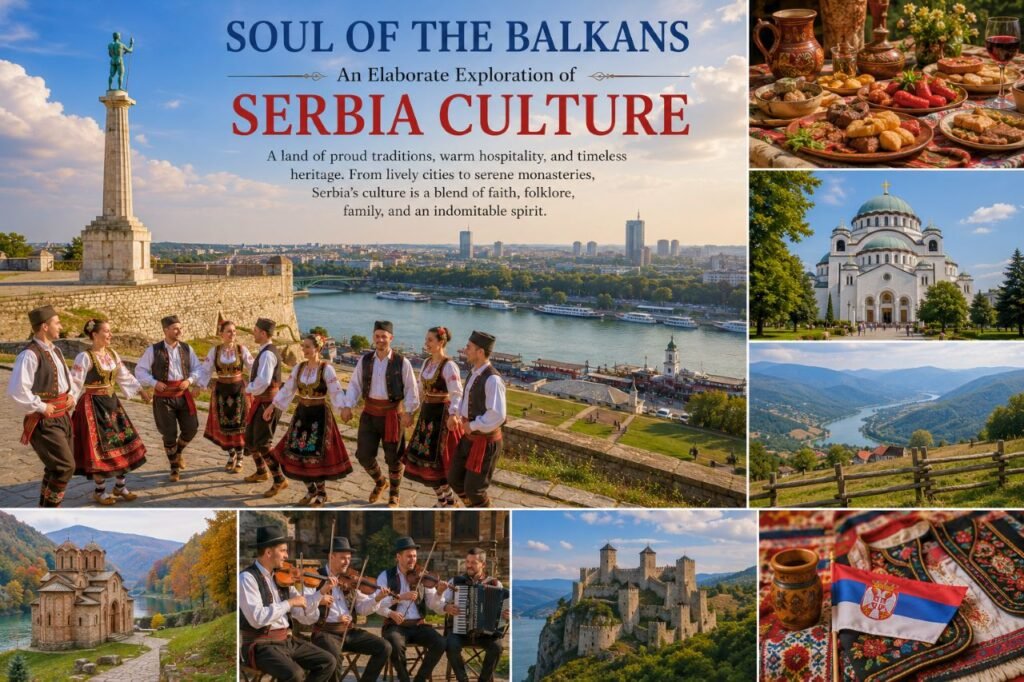
Soul of Serbia, A cultural journey
Traditional Attire (Narodna Nošnja)
Traditional Serbian folk dress reflects regional climate and history. Men traditionally wore the Šajkača—a distinctive V-shaped wool cap originating from 18th-century river border guards—paired with a vest (jelek) and Opanci (traditional leather footwear with upturned toes). Women wore intricately embroidered aprons, white linen blouses, and velvet vests adorned with gold thread.
Iconic Symbols
- The Serbian Cross (4 Cs): Featuring four Cyrillic “S” letters (С) around a cross, representing the national motto: “Samo Sloga Srbina Spasava” (“Only Unity Saves the Serb”).
- The Two-Headed Eagle: Displayed on the coat of arms, symbolizing the synthesis of secular and spiritual authority dating back to the Byzantine Empire.
Music, Dance & Art
The Kolo Dance
The Kolo is Serbia’s traditional collective circle dance, inscribed on the UNESCO Intangible Cultural Heritage list. Dancers hold hands or waists, executing fast, complex footwork to lively accordion and violin accompaniment during weddings and holidays.
Epic Poetry & The Gusle
For centuries, Serbian history was preserved orally through epic ballads sung to the accompaniment of the Gusle—a single-stringed wooden instrument carved with an eagle or ram head.
Modern Art & Architecture
Serbia boasts world-class art galleries and architectural treasures, from 13th-century Byzantine frescoes to modern avant-garde movements. Celebrated historical figures include inventor Nikola Tesla and Nobel laureate author Ivo Andrić.
Summary
In summary, Serbia Culture represents an extraordinary fusion of ancient Slavic traditions, resilient spiritual faith, and unmatched warmth. By preserving unique spiritual rituals like Slava, celebrating world-class festivals, and maintaining deep traditions of hospitality, the Serbian people have built a vibrant, proud nation. It is a country that invites travelers to share a meal, dance the Kolo, and experience the true, beating heart of the Balkans.
At Best Culture Insight, we see culture as the heartbeat of every society – the way people live, connect, and express their identity.