Sanctuary of Liberty: An Elaborate Exploration of San Marino Culture
Posted in :

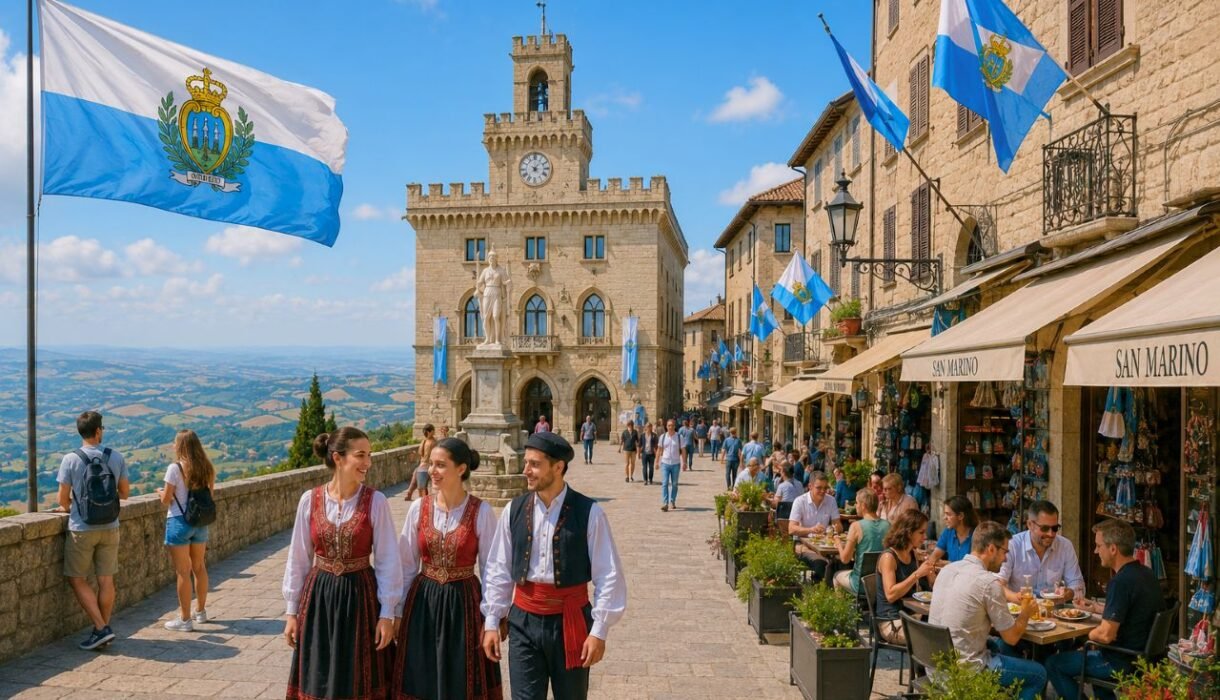
Enclaved entirely within north-central Italy near the Adriatic coast, the Most Serene Republic of San Marino is the world’s oldest surviving sovereign republic. The unique Culture of San Marino—known locally as Sammarinese culture—is defined by an fierce, centuries-old devotion to liberty, independence, and civic duty. Though visually and geographically intertwined with the surrounding Italian region of Emilia-Romagna, the people of San Marino hold a distinct national identity rooted in a legacy of neutrality and democratic governance that has endured for over 1,700 years. Perched atop the dramatic cliffs of Mount Titano, San Marino presents a living medieval sanctuary where ancient heritage seamlessly meets modern European life.
History & Origins
San Marino’s historical origin is intimately tied to a single legendary figure: Saint Marinus (San Marino), a Christian stonemason fleeing religious persecution on the island of Arba (in modern-day Croatia).
- Foundation (301 CE): According to tradition, Marinus established a monastic community atop Mount Titano on September 3, 301 CE. Before his death, he reportedly uttered the foundational words: “Relinquo vos liberos ab utroque homine” (“I leave you free from both men”—referring to both the Pope and the Holy Roman Emperor).
- Medieval Independence & Statutes: Through astute diplomacy, rugged topography, and defensive fortifications, the tiny enclave maintained its independence against neighboring feudal lords and papal forces. In 1600, the nation codified its written statutes, which continue to serve as the structural framework of its constitutional governance today.
- Preserving Sovereignty: Napoleon Bonaparte respected San Marino’s independence during his Italian campaigns, famously offering to extend its territory—an offer the republic wisely declined to avoid future political entanglements. Similarly, during World War II, San Marino maintained official neutrality, sheltering over 100,000 refugees despite its tiny size.
Culture, Traditions & Customs
Marriage & Family Customs
Family serves as the cornerstone of Sammarinese social life. Weddings are typically held in Catholic churches or historic municipal halls, bringing together close-knit networks of extended family. Celebrations feature multi-course banquets where local wines flow freely. A cherished custom includes presenting the newlyweds with traditional artisan crafts or localized heirlooms symbolising long-term stability and domestic harmony.
Festivals & National Celebrations
- Feast of Saint Marinus (September 3rd): The most critical national holiday, celebrating both the founding of the republic and its patron saint. The day features solemn religious masses, historic military parades, crossbow competitions (Palio delle Balestre), and a grand concert in the historic center.
- Investiture of the Captains Regent (April 1st and October 1st): Every six months, the republic holds a colorful, formal ceremony to inaugurate its two co-heads of state. The event features historic uniforms, civil processions, and traditional fanfares preserved since the Middle Ages.
- Medieval Days (Giornate Medievali): Every summer, the stone alleys of the capital transform into a living history festival filled with flag-throwers, archers, musicians, and medieval craft markets.
Languages & Communication
Language Spoken
The official language of San Marino is Italian. However, the traditional regional language is Sammarinese, a distinct dialect of the Romagnol language family. While modern younger generations primarily speak standard Italian, Sammarinese remains cherished by older residents and cultural preservation groups.
Greetings & Communication Style
Communication is warm, polite, and characterized by traditional Italian social grace (la bella figura).
- Greetings: Buongiorno (Good morning/day) and Buonasera (Good evening) are standard formal greetings. Ciao is reserved for close friends and family.
- Key Phrases: Grazie (Thank you), Prego (You’re welcome), and Per favore (Please).
- Titles: Addressing individuals by their professional titles (e.g., Dottore, Ingegnere) is customary in formal settings.
Geography
San Marino covers a land area of just 61 square kilometers (24 square miles), making it the third-smallest state in Europe after Vatican City and Monaco. The terrain is dominated by the limestone ridge of Mount Titano, which rises 739 meters above sea level. The capital city, also named San Marino, clings to the upper slopes of the mountain, offering panoramic views of the Apennine Mountains and the nearby Adriatic coastline.
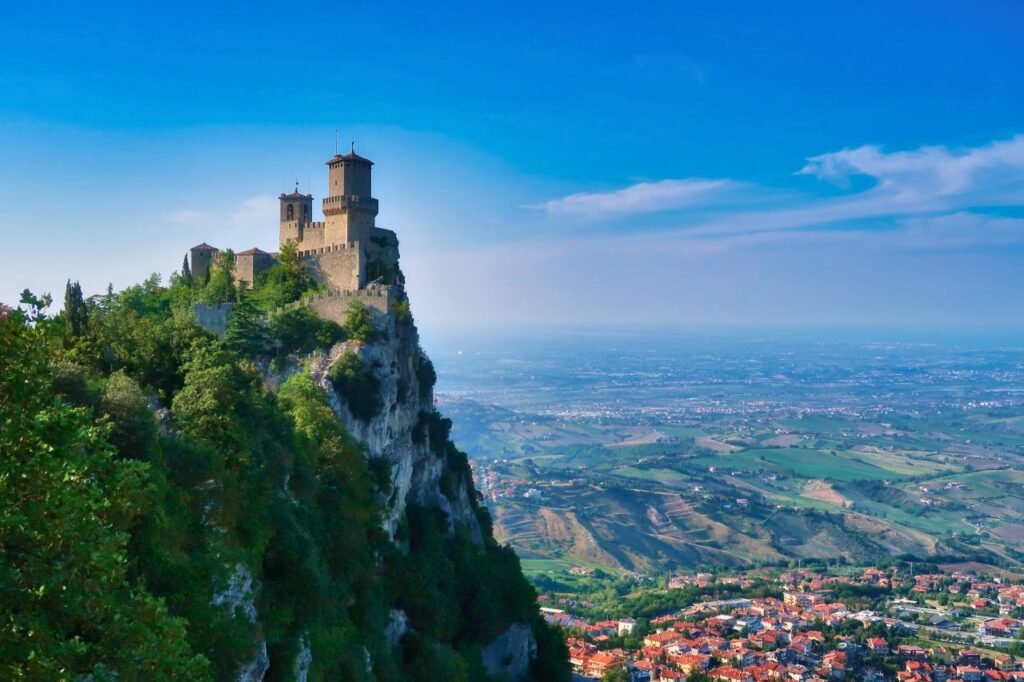
Spectacular view of the historic San Marino castle perched on a majestic cliff overlooking the valley – San Marino
The republic is divided administratively into nine municipalities known as Castelli (castles), with Dogana being the most populous commercial hub near the Italian border.
Economy
Despite its small size, San Marino boasts a high-income, stable economy with low unemployment rates. The nation is not a formal member of the European Union, but it uses the Euro as its official currency through monetary agreements.
- Tourism: Accounts for a significant portion of GDP, drawing millions of day-trippers annually to explore its UNESCO-listed historic center and duty-free shopping.
- Manufacturing & Services: Strong industrial sectors include ceramics, electronics, clothing, wine, and banking.
- Philately & Numismatics: San Marino is world-famous among collectors for its highly prized, limited-edition postage stamps and commemorative Euro coins, which generate notable national revenue.
Politics
San Marino operates under a unique parliamentary representative democratic republic framework that has remained virtually unchanged for centuries.
- Captains Regent (Capitani Reggenti): The nation has two co-heads of state elected by parliament every six months (serving from April to October and October to April). This dual-executive system prevents the concentration of power in a single individual.
- Grand and General Council (Grande e Generale Consiglio): A unicameral parliament consisting of 60 members elected by popular vote every five years.
Ethnic Groups
The population of approximately 34,000 citizens is highly homogenous. Around 84% of residents are ethnic Sammarinese, while approximately 15% are Italian citizens residing in the republic. Because of its strict citizenship laws designed to preserve civic heritage, gaining Sammarinese nationality historically required long-term ancestral ties or decades of legal residence.
Beliefs & Values
Religion & Civic Worldview
Over 90% of the population identifies as Roman Catholic, though the state guarantees complete freedom of worship. Catholic traditions are deeply integrated into national identity, as the republic’s very founder was a canonized saint.
The central moral value of Sammarinese culture is Libertas (Liberty)—a word emblazoned on the nation’s coat of arms and carved into its civic buildings. This worldview emphasizes community solidarity, peaceful conflict resolution, civic obligation, and strict political neutrality on the global stage.
Food & Cuisine
Sammarinese culinary traditions are deeply rooted in the rustic peasant cooking of the Romagna region, featuring fresh hand-rolled pasta, grilled meats, local cheeses, and olive oil.
- Piadina: A thin, unleavened flatbread cooked on a terracotta griddle, traditionally folded and stuffed with soft Squacquerone cheese, fresh prosciutto, and wild arugula.
- Nidi di Rondine: Translated as “swallow’s nests,” this dish consists of rolled fresh pasta sheets filled with ham, cheese, beef, and tomato sauce, then baked in a creamy béchamel sauce.
- Bustrengo: A dense, traditional rustic cake made from cornmeal, breadcrumbs, apples, raisins, honey, and citrus peel.
- Torta Tre Monti (Three Mountains Cake): The signature dessert of San Marino, consisting of thin, crispy wafer layers filled with chocolate and hazelnut cream, crowned with a rich chocolate border.
Clothing & Symbols
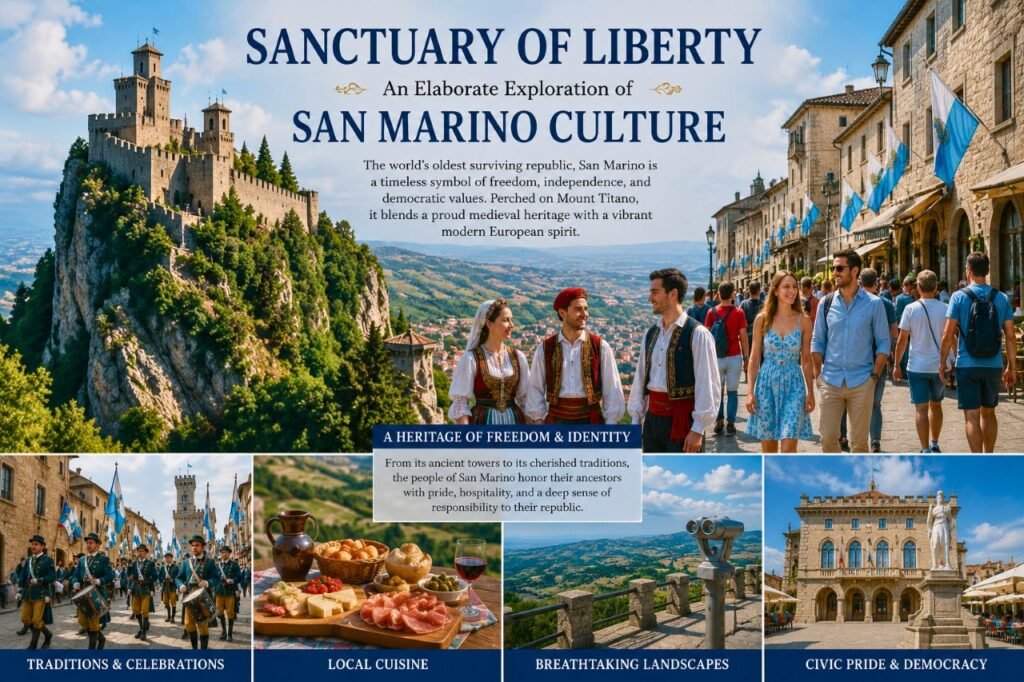
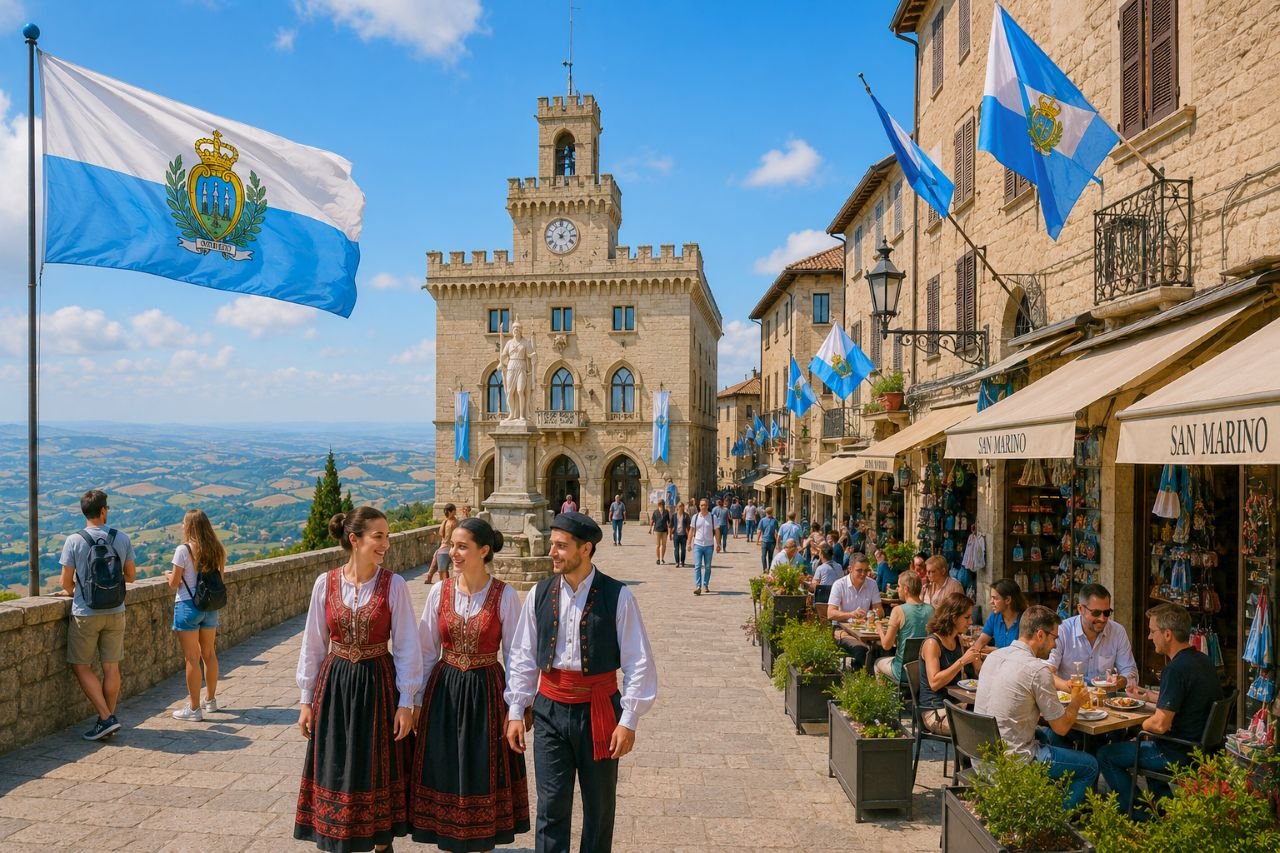
San Marino cultural exploration poster
Traditional & Ceremonial Attire
While everyday attire reflects modern Italian high fashion, traditional medieval dress is proudly preserved for official state functions. Members of the historic Guardia d’Onore (Guard of Honor) and the Crossbowmen Corps wear vibrant velvet doublets, hosed tights, feathered hats, and ceremonial swords during national holidays.
Iconic National Symbols
- The Three Towers (Tre Torri): Guaita, Cesta, and Montale—the three medieval fortress towers resting on the peaks of Mount Titano, depicted on the national flag and coat of arms.
- Statue of Liberty (Statua della Libertà): Located in the central Piazza della Libertà, this white Carrara marble statue symbolizes the republic’s enduring dedication to independence.
Music, Dance & Art
- Crossbowmen Corps (Federazione Balestrieri Sammarinese): Founded in 1956 to revive historic traditions, this group showcases precision medieval crossbow shooting and spectacular flag-waving performances (sbandieratori) set to rhythmic drumming and brass fanfares.
- Musical Heritage: San Marino hosts prestigious classical music academies and international competitions. Its historic Teatro Titano, built in the 19th century, serves as the cultural hub for theatrical and orchestral performances.
- Artisanal Crafts: The republic is renowned for hand-painted ceramics, intricate stone-carving traditions stemming from Saint Marinus himself, and fine lace-making.
Summary
In summary, San Marino Culture stands as a remarkable, living monument to human liberty and republican governance. By safeguarding its ancient medieval statutes, preserving its pristine hilltop architecture, and celebrating a distinct civic identity centered on Libertas, the people of San Marino have achieved something truly extraordinary. It remains a tranquil, proudly independent sanctuary where centuries of European history continue to thrive amidst the quiet beauty of Mount Titano.
At Best Culture Insight, we see culture as the heartbeat of every society – the way people live, connect, and express their identity.