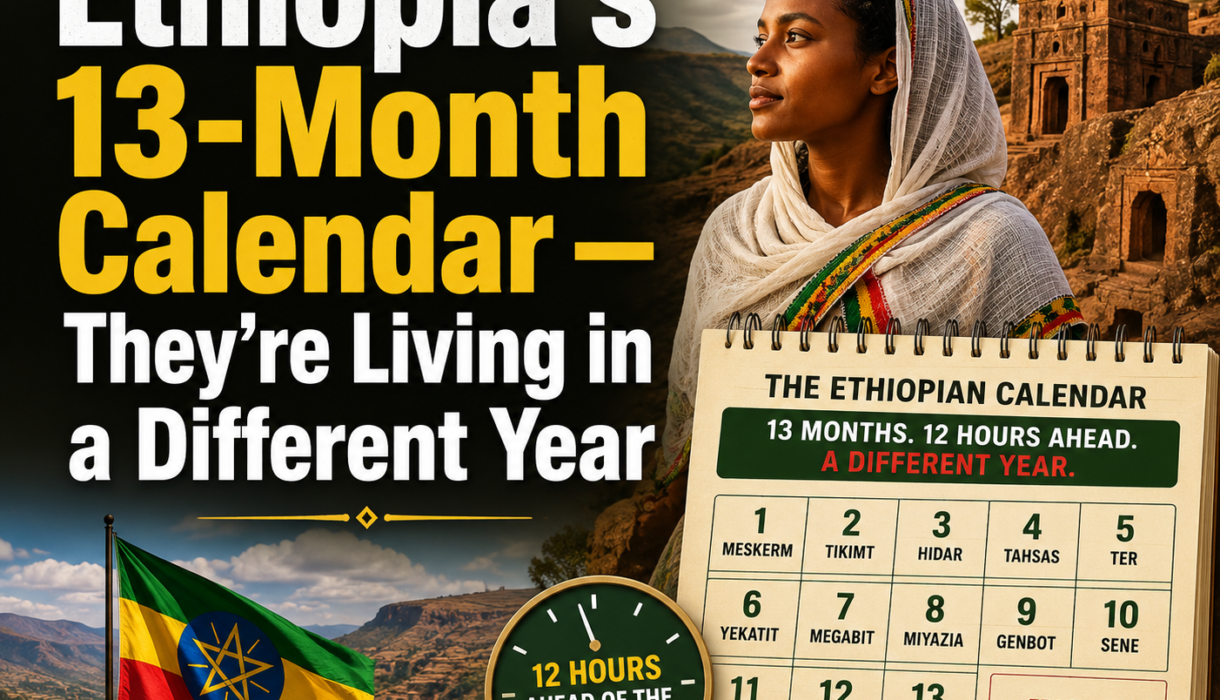

While the vast majority of the world relies on the Gregorian calendar to track the passage of time, Ethiopia proudly marches to its own rhythm. Travelers stepping off a plane in Addis Ababa are often amused and bewildered to discover that they have effectively traveled back in time. Ethiopia operates on a unique 13-month calendar, meaning the country runs seven to eight years behind the standard Western calendar. This fascinating chronological system is not a gimmick; it is an ancient, deeply respected cultural pillar that dictates everything from national holidays to daily government business.
The Math Behind the 13th Month
The Ethiopian calendar (or Ge’ez calendar) achieves its distinct rhythm through a beautifully systematic approach to the solar cycle. Unlike the Gregorian system, where months randomly alternate between 28, 30, and 31 days, the Ethiopian calendar prioritizes symmetry. It consists of exactly 12 months, with each month lasting precisely 30 days. To account for the remaining days of the solar year, a 13th month called Pagume is added at the very end. Pagume is a short, festive month that lasts just five days—or six days during a leap year—acting as a bridge before the country rings in its New Year.
Why the Year Gap Exists
The chronological gap between Ethiopia and the Western world comes down to a historic disagreement over the birth of Jesus Christ. When the Catholic Church amended its calendar calculations in 525 AD under Dionysius Exiguus, it shifted the timeline of the Annunciation. However, the Ethiopian Orthodox Tewahedo Church maintained the ancient calculations of the early Christian era. Because Ethiopia was one of the few African nations never colonized, it successfully preserved this original timeline. Consequently, while the rest of the world progresses through the late 2020s, Ethiopia is blissfully navigating the late 2010s of its own calendar.
Redefining Holidays and the New Year
Because of this distinct system, major holidays in Ethiopia do not align with global dates. The Ethiopian New Year, known as Enkutatash (“gift of jewels”), is celebrated on September 11th (or September 12th in leap years), marking the end of the heavy rainy season. Similarly, Ethiopian Christmas, or Genna, does not take place in December; it is celebrated with massive religious processions and traditional games on January 7th. For tourists, this presents an extraordinary opportunity to celebrate major milestones, like New Year’s Eve, twice in a single solar year.
A Masterclass in Cultural Preservation
Ultimately, Ethiopia’s 13-month calendar is a powerful testament to the country’s unyielding cultural independence and rich history. In an interconnected global economy dominated by standardization, Ethiopia smoothly manages international trade and diplomacy while firmly retaining its ancestral identity at home. It serves as a beautiful reminder to the rest of the world that time is entirely relative. For anyone looking to experience a country that is truly rich in culture, vibrant in heritage, and uniquely situated in its own era, Ethiopia offers an unforgettable journey.