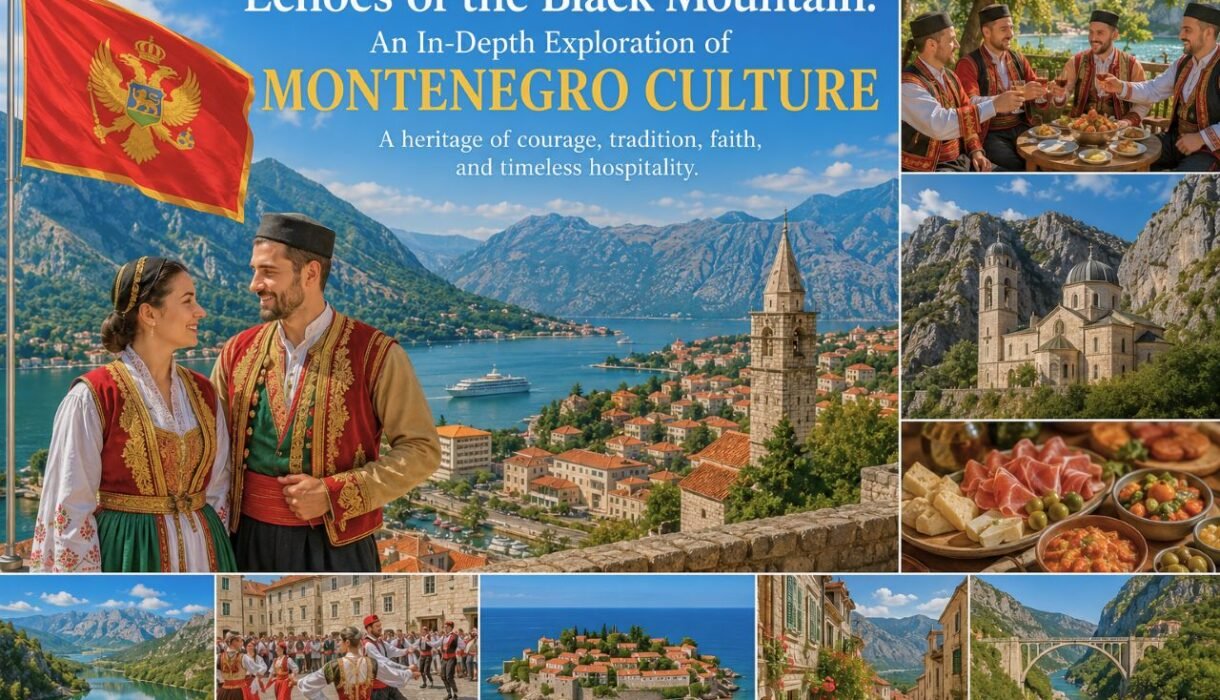
Echoes of the Black Mountain: An In-Depth Exploration of Montenegro Culture
Posted in :

Nestled along the sparkling Adriatic Sea, Montenegro—literally translating to “Black Mountain”—is a land where dramatic limestone peaks plunge directly into azure waters. While its breathtaking landscapes draw travelers from around the globe, it is the fierce, poetic, and deeply hospitable spirit of the Montenegrin people that truly defines this Balkan gem.
With a population of just over 600,000, Montenegro possesses a cultural footprint forged by centuries of defending its freedom against empires. The resulting heritage is a rich tapestry woven from Slavic roots, Orthodox Christian spirituality, and distinct Venetian, Ottoman, and Austro-Hungarian influences. This comprehensive, research-backed guide explores the vibrant traditions, customs, beliefs, and artistic expressions that make up the soul of Montenegro.
History & Origins
The history of Montenegro is a saga of survival, honor, and an unyielding desire for independence.
- Ancient Roots and Illyria: Before the Slavs arrived, the region was inhabited by ancient Illyrian tribes. Under Roman rule, the territory became part of the province of Prevalitana, with the ancient city of Doclea (near modern-day Podgorica) serving as a major hub.
- The Slavic Migration and Duklja: In the 6th and 7th centuries, Slavic tribes migrated to the Balkans. By the 11th century, the first Montenegrin state, Duklja (later known as Zeta), emerged as a powerful principality, receiving recognition as a kingdom from the Pope in 1077.
- The Age of the Prince-Bishops (The Vladikas): As the Ottoman Empire swept through the Balkans, Montenegro’s rugged, inaccessible terrain became its greatest fortress. For over two centuries (1516–1851), Montenegro was ruled by Prince-Bishops (Vladikas) from the Petrović-Njegoš dynasty, combining spiritual and secular authority to unite the fierce, independent highland clans against foreign invaders.
- Sovereignty and Modern Era: Montenegro’s independence was formally recognized globally at the Congress of Berlin in 1878. After being part of various iterations of Yugoslavia during the 20th century, Montenegro peacefully reclaimed its full independence through a referendum on May 21, 2006.
Culture, Traditions & Customs
The Clan System and the Code of Honor
At the historic core of Montenegrin society is the clan (pleme) system. Historically, loyalty to one’s clan and the defense of family honor were paramount. This birthed the cultural concept of Čojstvo i Junaštvo (translated roughly as “Humanity and Gallantry” or “Courage and Honor”).
Junaštvo means defending yourself from others; Čojstvo means defending others from yourself. This moral code dictates that a true warrior must act with absolute integrity, humility, and respect for the defenseless.
Marriage and Family Traditions
- The Wedding Caravan: Traditional weddings in Montenegro were grand, multi-day affairs. A procession of guests (svatovi), led by a flag-bearer (barjaktar), would travel to the bride’s house to “claim” her. Gunfire into the air historically signaled joy and the warding off of evil spirits.
- The Toast (Nazdravljanje): No milestone, wedding, or family gathering starts without formal, poetic toasts delivered by the elders. These toasts are deeply symbolic, wishing the family prosperity, health, and male heirs to carry on the family name.
Slava: The Patron Saint Day
The most important domestic religious tradition in Montenegro is the Slava. Each family inherits a patron saint from their ancestors. On this day, the home is opened to friends, extended family, and neighbors. A special blessed wheat dish (koljivo) and a decorative structural bread (slavski kolač) are prepared, symbolizing sacrifice, gratitude, and communal unity.
Languages & Communication
The Linguistic Landscape
The official language is Montenegrin, a South Slavic language that is part of the Shtokavian dialect system. It is mutually intelligible with Serbian, Bosnian, and Croatian. Montenegro uniquely utilizes both the Cyrillic and Latin alphabets officially, reflecting its position at the cultural crossroads of Eastern and Western Europe.
Greetings and Idioms
Montenegrins are expressive, passionate speakers who value directness and wit.
- “Dobar dan”
Meaning: “Good day”—the standard, polite daytime greeting.
- “Živjeli!”
Meaning: “Cheers!” or “May you live long!”—exclaimed during toasts with a glass of local brandy (loza).
- “Samo polako”
Meaning: “Take it easy” or “slowly, slowly”—reflecting the relaxed, unhurried Mediterranean pace of life along the coast.
Geography
Montenegro’s geography is defined by stunning, stark contrasts. Within a two-hour drive, one can travel from sun-drenched Mediterranean beaches to deep alpine canyons and ski resorts.
The country is divided into three distinct geographic regions:
- The Coastal Region: Lined with historic stone towns like Kotor, Budva, and Herceg Novi, heavily influenced by Venetian architecture.
- The Central Plain: Home to the capital city, Podgorica, and the historical royal capital, Cetinje.
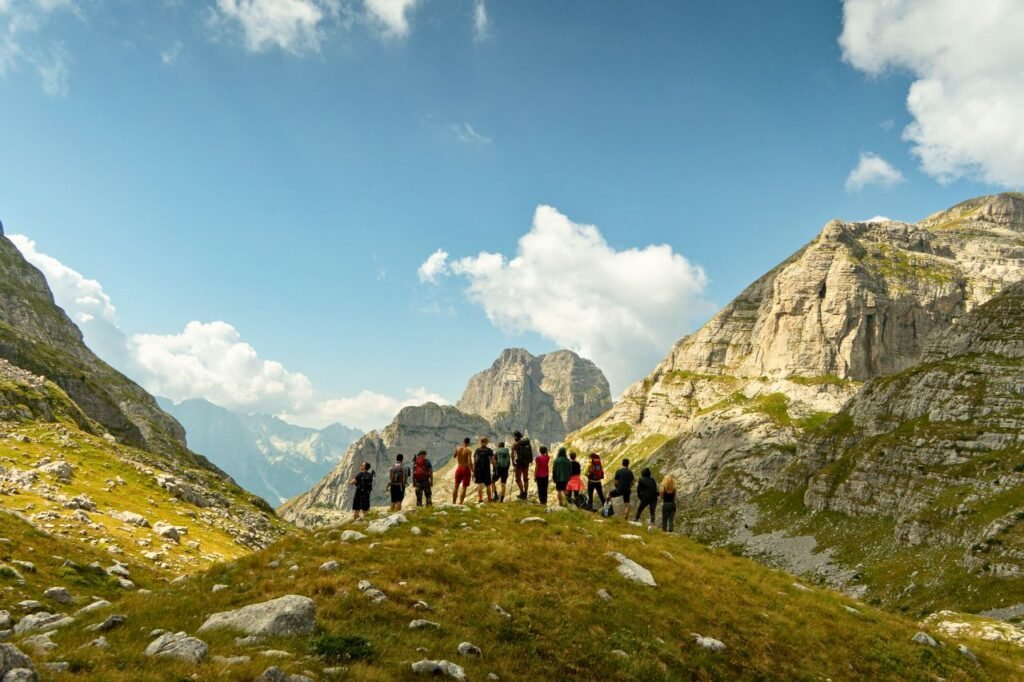
- The High Mountains: A rugged northern wilderness dominated by the Dinaric Alps, featuring the dramatic Tara River Canyon (the deepest canyon in Europe) and Durmitor National Park.
Economy
Montenegro is a developing service-based economy that transitioned away from socialist-era heavy industries to focus heavily on modern international tourism and energy.
The coast acts as a magnet for high-end luxury resort developments (such as Porto Montenegro and Sveti Stefan). Additionally, agriculture remains a vital part of the cultural fabric, particularly in the fertile central plains and mountain valleys, where boutique production of wine, olive oil, organic honey, and cured meats thrives.
Politics
Montenegro is a parliamentary republic. The political system features a President as the head of state and a Prime Minister who serves as the head of government and wields executive power.
Since gaining independence in 2006, Montenegro has pursued integration with Western institutions. It officially joined NATO in 2017 and is actively negotiating its accession to the European Union. Despite not being an official member of the Eurozone, Montenegro unilaterally adopted the Euro (€) as its de facto domestic currency.
Ethnic Groups
Montenegro is a highly diverse, multi-ethnic society, characterized by a peaceful coexistence of various communities.
| Ethnic Group | Approximate Share | Primary Regions & Cultural Notes |
| Montenegrins | ~45% | Distributed nationwide; primary preservers of the highland clan heritage |
| Serbs | ~28.7% | Predominantly in the northern highlands and Herceg Novi; share deep Orthodox ties |
| Bosniaks | ~8.6% | Concentrated in the northeastern Sandžak region; bring rich Islamic-Balkan traditions |
| Albanians | ~4.9% | Primarily along the southern border near Ulcinj and Lake Skadar; distinct language and customs |
| Other (Croats, Roma, etc.) | ~12.8% | Croats reside mainly around the Bay of Kotor, maintaining a maritime Catholic heritage |
Beliefs & Values
Religious Life
The dominant religion in Montenegro is Eastern Orthodox Christianity (adhered to by over 70% of the population). The Orthodox faith is historically represented by both the Serbian Orthodox Church and the Montenegrin Orthodox Church. Islam is the second-largest religion (accounting for roughly 19% of the population), followed by Roman Catholicism (around 1.2%).
Moral Worldview: Hospitality and Family
In Montenegro, a guest is considered a sacred entity. The historic custom of Gostoprimstvo (hospitality) dictates that even an enemy who crosses one’s threshold as a guest must be protected, fed, and treated with the utmost respect. The family remains the primary social safety net, and respect for ancestors and elders is deeply ingrained.
Food & Cuisine
Montenegrin food is robust, natural, and heavily portioned. The cuisine is split cleanly between the light, seafood-heavy Mediterranean diet of the coast and the heavy, dairy-and-meat-centric diet of the cold northern highlands.
- Njeguški Pršut: Montenegro’s most famous culinary export. This dry-cured ham is produced exclusively in the mountain village of Njeguši. The unique climate, where mountain and sea air currents meet, allows the ham to be air-dried and smoked over beech wood for months, resulting in an incredibly rich, melt-in-the-mouth texture.
- Kačamak: A hearty highland staple made from cornmeal, boiled potatoes, and massive amounts of local kolašinski lisnati sir (layered cheese) and kajmak (clotted cream), beaten together into a rich, dense porridge.
- Crni Rižot (Black Risotto): A coastal favorite heavily influenced by Italy, made with arborio rice, fresh squid or cuttlefish, and cooked in the animal’s dark ink.
Clothing & Symbols
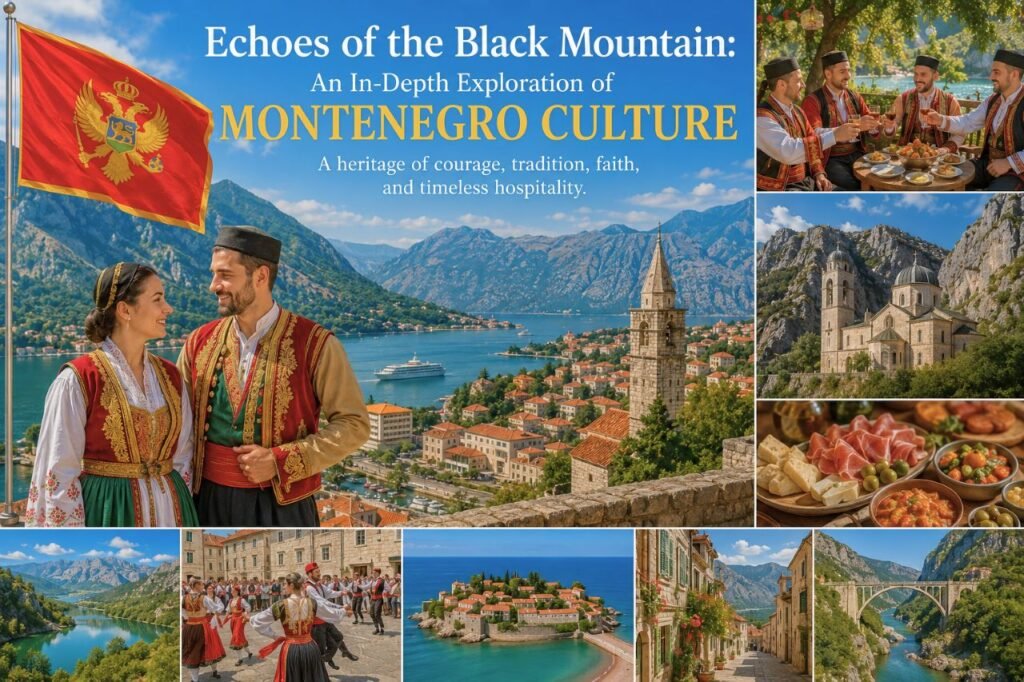
Traditional Attire: Gold and Elegance
The traditional Montenegrin folk costume (Crnogorska nošnja) is widely regarded as one of the most elegant and expensive in Europe, heavily adorned with gold embroidery.
- The Kapa: The most recognizable element is the traditional cap (crnogorska kapa). It features a black border (representing mourning for past historic struggles, particularly the Battle of Kosovo) and a crimson top (symbolizing the blood spilled for freedom) embroidered with five gold semi-circles or the national double-headed eagle.
- The Džamadan and Jelek: Men wear a red wool vest embroidered with gold thread (džamadan), while women wear a long, elegant sleeveless silk or velvet jacket (jelek or koret) over a white linen shirt, secured with a heavy silver or gold belt (ćemer).
The Double-Headed Eagle
The national coat of arms and flag features a golden double-headed eagle with wings raised, holding a scepter and a globus cruciger. The eagle represents the unity of church and state, a historic nod to the Prince-Bishops who preserved the country’s sovereignty through the dark ages of foreign occupation.
Music, Dance & Art
The Gusle: Epic Poetry in Song
The spiritual and historic voice of Montenegro is the Gusle, a single-stringed instrument carved from a single piece of maple wood, often topped with a carved eagle or ram’s head.
The player, known as a guslar, does not play complex melodies; instead, they use the instrument to accompany the dramatic, rhythmic chanting of long epic poems. These poems recount historical battles, heroic deeds, and the tragic legends of the clans, serving as an oral archive that kept the flame of freedom alive for centuries.
The Oro Dance
The Crnogorsko Oro is a high-spirited, energetic traditional dance. Dancers form a circle, singing rhythmic folk songs. The climax of the dance occurs when a group of men climbs onto the shoulders of another group of men, forming a spectacular two-tier human pyramid that symbolizes the strength, soaring heights, and eagles of the Black Mountain.
Summary
The culture of Montenegro is a testament to the enduring power of community, honor, and freedom. From the Venetian stone palaces of Kotor to the epic songs of the guslar echoing through the misty canyons of the north, Montenegro has preserved a unique way of life that values hospitality above all else. It is a culture that does not merely survive in the shadow of its imposing black mountains—it thrives, welcoming the world with open arms, robust food, and a proud, poetic soul.
At Best Culture Insight, we see culture as the heartbeat of every society – the way people live, connect, and express their identity.