Alpine Heritage and Princely Traditions: An Elaborate Exploration of Liechtenstein Culture
Posted in :

Tucked away in the heart of the European Alps, sandwiched securely between Switzerland and Austria, lies the Principality of Liechtenstein. As one of the world’s smallest and only doubly landlocked countries, Liechtenstein holds a cultural identity that far exceeds its geographical footprint.
The people of Liechtenstein, known as Liechtensteiners, possess a unique cultural identity. They seamlessly balance a highly sophisticated, ultra-modern economy with deeply cherished, localized Alpine folk traditions. This article explores the rich heritage, values, and customs of this sovereign microstate, celebrating its history and vibrant contemporary way of life.
History & Origins
The cultural fabric of Liechtenstein is rooted in ancient Germanic settlements and centuries of European geopolitical shifts.
- Alemannic Origins: The earliest cultural foundation dates back to the 5th century CE, when the Alemanni—a confederation of Germanic tribes—settled in the Rhine Valley. They displaced the Romanized local population and introduced the distinct Germanic dialect that remains the basis of the local language today.
- The Holy Roman Empire: For centuries, the territory was divided into two distinct regions within the Holy Roman Empire: the Lordship of Schellenberg and the County of Vaduz.
- The Rise of the House of Liechtenstein: In the early 18th century, the wealthy princely Liechtenstein family, originating from Lower Austria, sought a seat in the imperial parliament (Reichstag). To qualify, they purchased Schellenberg in 1699 and Vaduz in 1712. Emperor Charles VI united these lands, declaring them a sovereign Principality of the Holy Roman Empire on January 23, 1719.
- Sovereignty and Modern Resilience: Unlike many minor European territories, Liechtenstein successfully navigated the collapse of the Holy Roman Empire and the Napoleonic Wars, maintaining its total sovereignty. Initially close to the Austro-Hungarian Empire, Liechtenstein pivoted into a structural customs and monetary union with Switzerland following World War I. This pivotal alliance laid the groundwork for its stability and modern prosperity.
Culture, Traditions & Customs
National Day (Staatsfeiertag)
Celebrated annually on August 15, Liechtenstein’s National Day is a magnificent display of communal unity and heritage. The date combines the Feast of the Assumption of the High Holy Virgin Mary with the birthday of the late Prince Franz Josef II.
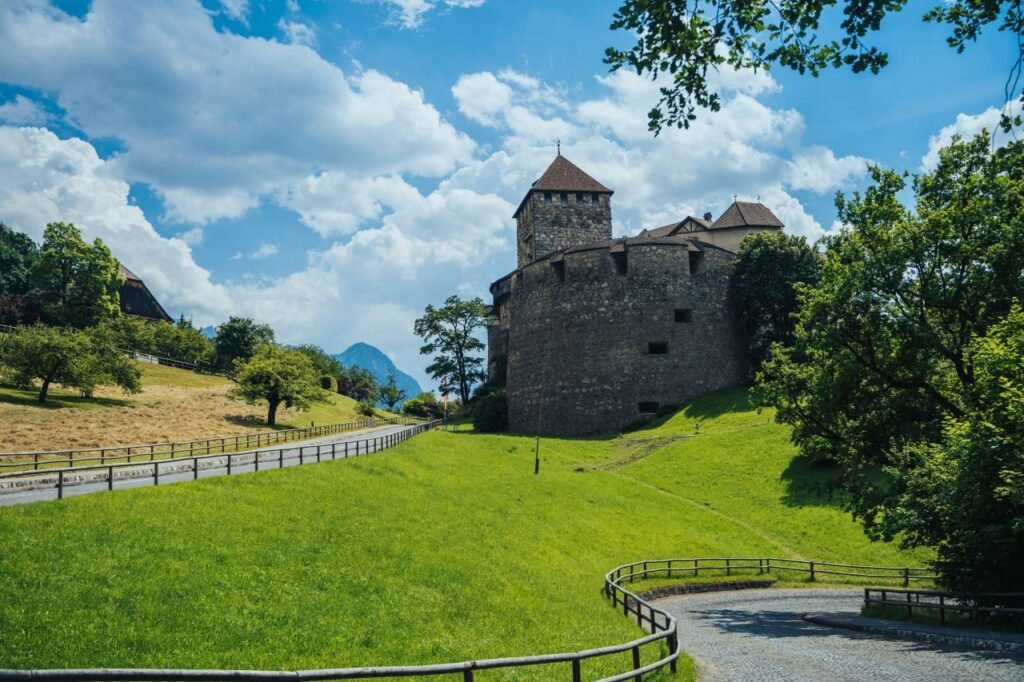
On this day, His Serene Highness the Prince invites all citizens and visitors to the grounds of Vaduz Castle for an open-air reception. Guests enjoy complimentary local wine, beer, and regional snacks while mingling directly with the Princely family. The evening concludes with a breathtaking display of fireworks echoing across the alpine peaks and bonfires lit along the mountain ridges.
The Return from Alpine Pastures (Alpabfahrt)
A cherished seasonal custom is the Alpabfahrt, or Alpabtrieb, which occurs in September. After spending the warm summer months grazing on high mountain meadows, herds of cattle are driven back down to valley farms for the winter.
For the trek, farmers decorate the cows with colorful paper flowers, ribbons, and heavy, decorative brass bells to ward off evil spirits. The procession through the villages is celebrated as a festive homecoming, complete with traditional folk music and seasonal culinary markets.
Marriage and Life Rites
Traditional weddings in Liechtenstein reflect close-knit community values. A popular pre-wedding custom is the Polterabend, a casual gathering where friends break porcelain dishware outside the couple’s home to bring good luck.
Historically, naming ceremonies and baptisms strictly follow Catholic traditions, with godparents (Gotte for godmother and Götti for godfather) playing an active, lifelong role in the child’s moral and personal development.
Languages & Communication
Language in the principality serves as a badge of local pride and a geographical marker.
The Alemannic Dialect
- High German (Hochdeutsch): This is the official written language of administration, schools, media, and formal publications.
- Liechtenstein German (Liachtaschtanerisch): In everyday speech, locals speak an Alemannic dialect of German, closely related to Swiss German and the speech of Vorarlberg, Austria. Distinctly vocalized variations exist even between the upper region (Oberland) and the lower region (Unterland), allowing residents to often pinpoint exactly which village a speaker calls home.
Greetings & Everyday Sayings
Communication in Liechtenstein is typically polite, slightly reserved, and warm once an acquaintance is established.
- “Grüass Gott!” / “Hoi!”
Meaning: “Greet God!” (a formal greeting used with elders and strangers) / “Hi!” (the universal, friendly greeting used among friends and peers).
- “Es git nüt, wo s düt.”
Proverb: “There is nothing that means nothing.” A traditional dialect phrase emphasizing that every event or action carries hidden meaning or consequence.
- “Besser e Spatz in der Hand as e Tube uf em Dach.”
Proverb: “Better a sparrow in the hand than a dove on the roof.” This classic expression reflects the practical, grounded, and realist worldview held by alpine communities.
Geography
Covering an area of just 62 square miles, Liechtenstein is nestled entirely within the scenic Rhine Valley. The western boundary is formed by the Rhine River, which serves as a natural border with Switzerland, while the dramatic, jagged peaks of the Rätikon Alpine range frame the eastern border with Austria.
The lowlands consist of fertile alluvial plains ideal for small-scale agriculture and viticulture. The highlands rise steeply into dense coniferous forests, alpine pastures, and jagged peaks, with the highest point being the Grauspitz, towering at 8,527 feet.
Economy
Liechtenstein has transformed from a quiet agricultural region into one of the world’s wealthiest, most industrialized, and technologically advanced nations.
- High-Tech Manufacturing: Despite its small size, Liechtenstein is a global industrial powerhouse. It is home to world-renowned companies specializing in precision engineering, dental implants (Ivoclar), and specialized construction tools (Hilti).
- Financial Services: Backed by legal stability and a strong customs union with Switzerland, Vaduz has evolved into a premier European hub for wealth management, private banking, and investment funds.
- Innovation and Crypto-Assets: Liechtenstein is an early pioneer in digital assets, introducing the comprehensive “Blockchain Act” to provide a transparent, secure framework for modern fintech enterprises.
Politics
Liechtenstein is a constitutional hereditary monarchy on a democratic and parliamentary basis.
The political structure uniquely balances democratic institutions with the strong constitutional authority of the Reigning Prince from the House of Liechtenstein. The prince holds significant executive powers, including the right to veto legislation, dissolve parliament, and appoint judges.
The parliament, known as the Landtag, consists of 25 members elected by proportional representation every four years. The head of government is appointed by the Prince based on recommendations from the Landtag. Liechtenstein operates a system of direct democracy, allowing citizens to propose legislation or call for referendums via popular initiatives.
Ethnic Groups
Liechtenstein’s stable economic environment has attracted an international workforce, creating a diverse demographic layout within its small population.
| Ethnic Group | Estimated Population Share | Primary Backgrounds |
| Liechtensteiners | ~66% | Native citizens of Germanic Alemannic ancestry |
| Swiss | ~10% | Integrated residents, professionals, and specialists |
| Austrians | ~6% | Border-crossing professionals and families |
| Germans | ~4% | Academic, industrial, and financial sector workers |
| Other Nationalities | ~14% | Italian, Turkish, Portuguese, and various global ex-pats |
Beliefs & Values
Religious Heritage
The Constitution explicitly designates Roman Catholicism as the state religion, and Catholic traditions remain tightly woven into the national calendar. Church bells ring regularly across the valleys, and religious holidays like Corpus Christi and All Saints’ Day are recognized as official public holidays. However, full freedom of conscience and religious practice is guaranteed to all citizens.
Discretion and Community Solidarity
Liechtensteiners deeply value personal modesty, professional discretion, and a quiet work ethic. Bragging about wealth is socially discouraged. Given the microstate’s small size, there is an intense sense of community solidarity; neighbors know one another, mutual aid is common, and civic engagement through local clubs, volunteer fire departments, and choirs is exceptionally high.
Food & Cuisine
The culinary tradition of Liechtenstein is hearty, comforting, and deeply influenced by the traditional farming culture of the high Alps.

- Käsknöpfle: The undisputed national dish. It consists of small, fresh egg pasta dumplings tossed with a rich blend of melted local cheeses—often including sharp, aged sour cheese (Sauerkäse) and Appenzeller. The dish is topped with a generous layer of sweet, crispy fried onions and traditionally served alongside a bowl of fresh applesauce (Apfelmus) to balance the savory depth.
- Ribel: An ancient, humble staple dish of the Rhine Valley made from a mixture of cornmeal and wheat semolina cooked slowly in milk and butter. The mixture is roasted in a pan until it forms small, golden, crumbly morsels, which are then dipped into hot coffee or milk for breakfast.
- Princely Viticulture: Thanks to warm southern foehn winds, the slopes of Liechtenstein produce exceptional Pinot Noir and Chardonnay wines. The Prince’s own vineyards in Vaduz are highly acclaimed by European connoisseurs.
Clothing & Symbols
Traditional Attire (Tracht)
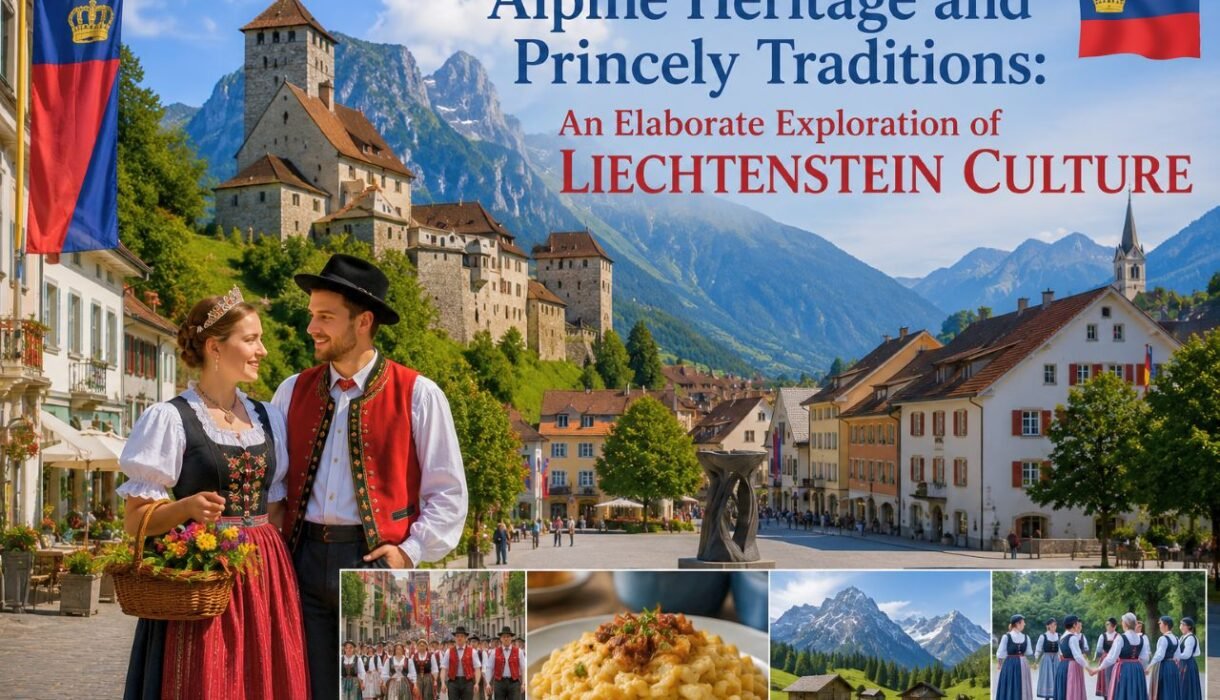
The national costume of Liechtenstein represents a proud revival of historic rural garments. The women’s Tracht features a striking black dress with a closely fitted bodice, accented by clean white lace trim at the neckline and sleeves. A colorful apron made of silk or brocade is tied around the waist, accompanied by silver jewelry and an intricate, fan-shaped headpiece. Men wear black knee-breeches, a clean white linen shirt, a colorful hand-embroidered vest, and silver-buckled shoes.
Key National Symbols
- The Princely Crown: Found on the national flag, this crown symbolizes the unity of the citizens with the sovereign House of Liechtenstein. It was officially added to the blue and red flag in 1937 to distinguish it from the flag of Haiti during the Olympic Games.
- The National Coat of Arms: A majestic, complex heraldic shield detailing the historic ancestral territories and noble matches of the House of Liechtenstein through the centuries.
Music, Dance & Art
Corporate Support and Folk Traditions
Art in Liechtenstein bridges classic folk expressions with elite global modernism. Local community brass bands (Harmoniemusik) and traditional choral societies are active in every single municipality, preserving regional songs and festive folk music.
The Kunstmuseum Liechtenstein
In stark contrast to its historic castles, downtown Vaduz features the Kunstmuseum Liechtenstein, a striking modern building of black basalt stone housing an internationally renowned collection of modern and contemporary art.
The museum frequently displays masterpieces curated directly from the private collection of the Reigning Prince—one of the oldest, largest, and most valuable private art collections in the world, featuring works spanning from the early Renaissance to the Baroque era.
Summary
The culture of Liechtenstein shines as a remarkable example of preservation and adaptability. By honoring their Alemannic dialect, maintaining centuries-old seasonal traditions like the Alpabfahrt, and respecting their historical monarchy, Liechtensteiners have built a distinct identity in a rapidly globalizing world. The tiny nation gracefully proves that a country does not need vast borders to cultivate a rich cultural heritage, an innovative economy, and a deep, lasting pride in its home.
At Best Culture Insight, we see culture as the heartbeat of every society – the way people live, connect, and express their identity.