The Aboriginal Dreamtime: The World’s Oldest Living Spiritual Tradition
Posted in :

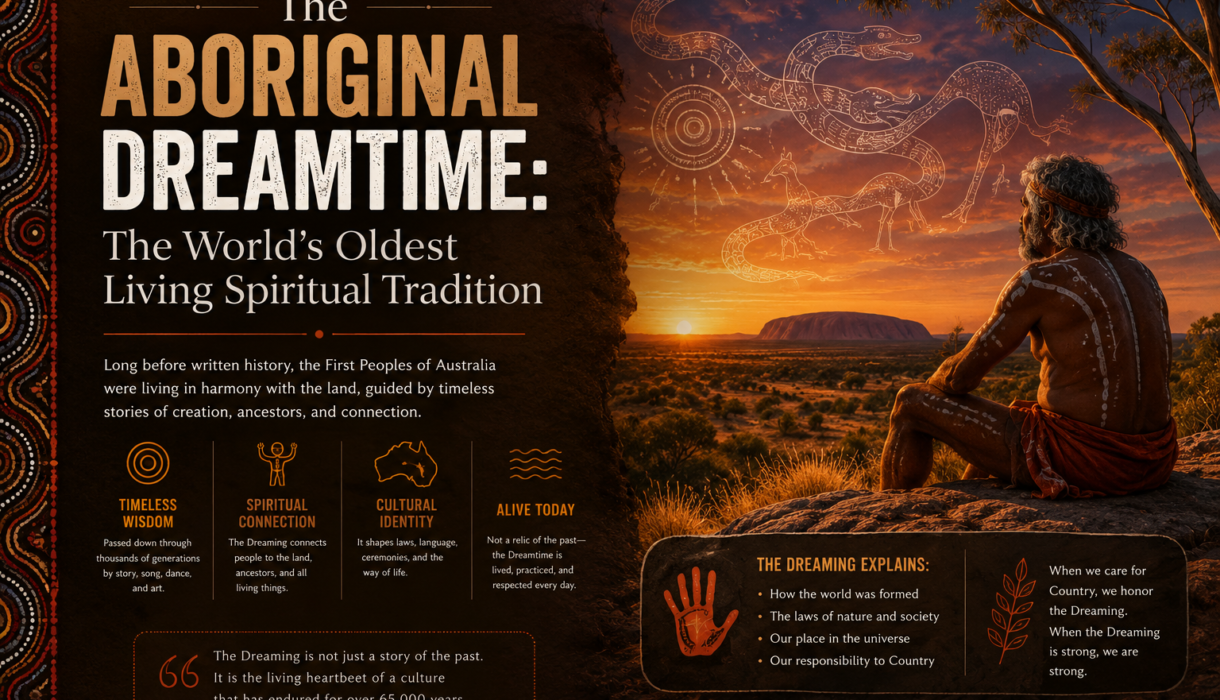
Stretching back over 65,000 years, the Aboriginal Dreamtime—known natively by terms like Jukurrpa or Altyerrenge—represents the continuous spiritual framework of Australia’s First Nations peoples. Far from a mythical fairytale or a simple collection of folklore, the Dreamtime is a complex, living worldview that explains the creation of the universe, the origins of human life, and the sacred relationship between people and the natural world. Recognized as the world’s oldest surviving spiritual continuum, it offers profound insights into environmental stewardship, communal identity, and human existence that remain entirely relevant in the modern era.
A Time Beyond Memory: Understanding Creation
In Aboriginal philosophy, the Dreamtime is not merely an ancient historical period locked in the distant past; rather, it represents a timeless, ongoing reality where past, present, and future exist simultaneously. According to creation traditions, the world was initially a featureless, dark expanse until ancestral creator spirits—such as the Rainbow Serpent, the Wandjina, and the Kangaroo Ancestors—awoke and emerged from beneath the Earth. As these divine beings traveled across the continent, their actions, battles, and movements carved out towering mountain ranges, winding river systems, and fertile valleys, infusing every rock, tree, and waterhole with their permanent spiritual essence.
Songlines: Navigating the Sacred Landscape
One of the most remarkable aspects of the Dreamtime is the concept of “Songlines,” also known as dreaming tracks. These are invisible paths crisscrossing the Australian continent that trace the exact routes taken by the ancestral spirits during creation. For tens of thousands of years, Aboriginal elders have memorized intricate song cycles, body paintings, and oral narratives that act as both spiritual scriptures and detailed topographic maps. By singing the specific verses associated with a Songline, travelers can navigate thousands of miles across harsh deserts, pinpointing vital water sources, food locations, and boundary markers with extraordinary precision.
The Sacred Duty of Environmental Custodianship
Central to the Dreamtime tradition is the conviction that humans do not own the land; instead, the land owns the people. First Nations Australians view themselves as custodians entrusted with the solemn spiritual obligation to care for Country—a holistic term encompassing land, sea, sky, and wildlife. Specific clans are assigned sacred totems, such as a particular bird, fish, or plant species, which they are spiritually forbidden from overharvesting. This deeply ingrained moral code established a sustainable, ecological balance that allowed Indigenous communities to thrive in harmony with Australia’s challenging environments for millennia.
Cultural Resilience in the Modern World
Despite enduring centuries of colonization, forced displacement, and systemic suppression, the Aboriginal Dreamtime remains a resilient and vibrant force today. Traditional stories continue to be passed down through visual dot paintings, ceremonial dances, and community storytelling, ensuring that younger generations remain tethered to their ancient roots. As contemporary global society grapples with environmental crises and cultural disconnection, the Dreamtime stands as a timeless beacon of wisdom, reminding humanity of the sacred, interdependent bond between mankind and the Earth.