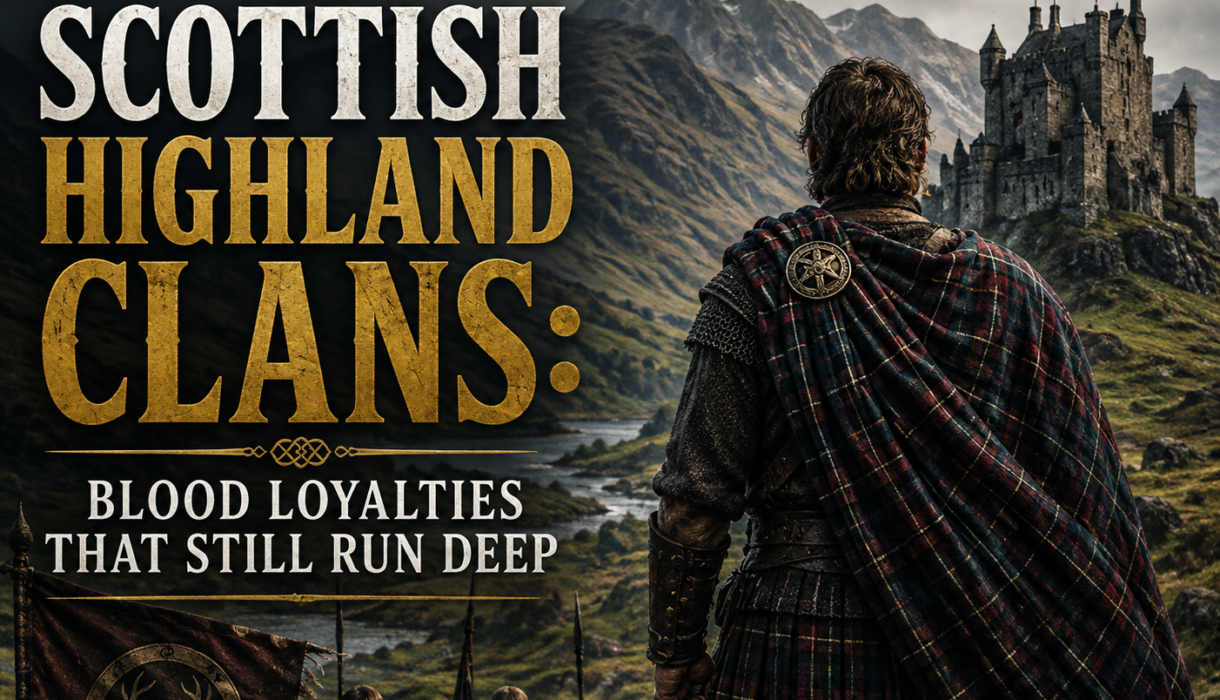

The word clan originates from the Gaelic clann, meaning “children” or “offspring,” reflecting a system of society anchored entirely in shared ancestry, sacred trust, and fiercely defended territory. For centuries across the rugged glens and wind-swept mountains of northern Scotland, the clan system provided governance, protection, and community identity long before modern nation-states emerged. Far more than simple military alliances, these clan structures functioned as extended families where even the humblest tenant shared a sense of noble kinship with the clan chief. Today, despite centuries of geopolitical upheaval, the blood loyalties and cultural symbols forged in the Highlands continue to resonate deeply across the global Scottish diaspora.
Ancient Roots and Resistance to Rome
The structural roots of Highland clanship can be traced back to the ancient Gaelic, Pictish, and Norse tribes that inhabited the northern reaches of Great Britain. When Roman legions under Governor Julius Agricola pushed into northern Britain around 84 AD, they encountered fierce, decentralized confederations of Caledonian warriors who refused to submit to imperial control. The harsh, mountainous terrain prevented Rome from establishing permanent conquest, forcing emperors to build fortification lines like Hadrian’s Wall to mark the border of their empire. This geographical isolation nurtured a self-reliant warrior ethos, laying the groundwork for medieval kindreds governed by local chieftains rather than distant monarchs.
Kinship, Chief Authority, and Mutual Obligation
At the core of classic Highland clanship was a social contract built on reciprocal duty. The clan chief held dual authority as both a hereditary patriarchal leader and a warlord responsible for securing his people’s safety and livelihoods. In exchange for military service and agricultural labor, clansmen received land access, legal protection, and hospitality during lean winter months. Identity was reinforced through distinctive physical markers, including specific plant badges pinned to bonnets, traditional heraldic crests, and unique tartan patterns that signaled allegiance to famous names like MacDonald, Campbell, Fraser, and MacLeod.
Conflict, Culloden, and the Era of Suppression
While internal rivalries over cattle, land, and political power frequently triggered bitter clan feuds, the ultimate test of Highland loyalty arrived during the Jacobite risings. The tragic Battle of Culloden in 1746 marked a catastrophic turning point, as government forces decisively defeated the Jacobite army composed largely of Highland clansmen. In the aftermath, the British Parliament enacted severe penal laws designed to dismantle the clan system entirely. Tartan attire, traditional weapons, and bagpipes were outlawed, while clan chiefs were stripped of their feudal judicial powers. This era of suppression, followed by the tragic Highland Clearances, scattered thousands of families across North America, Australasia, and beyond.
The Modern Revival of a Global Heritage
Despite systematic attempts to erase Highland customs, the spirit of clanship adapted and survived into the modern era. During the 19th century, romantic literary revivals helped restore pride in Scottish heritage, ultimately leading to the legal repeal of suppression acts and the formalized recognition of clan heraldry. Today, official clan societies, international Highland Games, and active heraldic leadership overseen by the Court of the Lord Lyon maintain these ancient connections. Millions of descendants worldwide continue to wear their clan tartans and trace their ancestral lineages, proving that the bond of Highland kinship remains unbroken across centuries and continents.