Vanuatu Culture: History, Customs, Arts, and Pacific Heritage
Posted in :

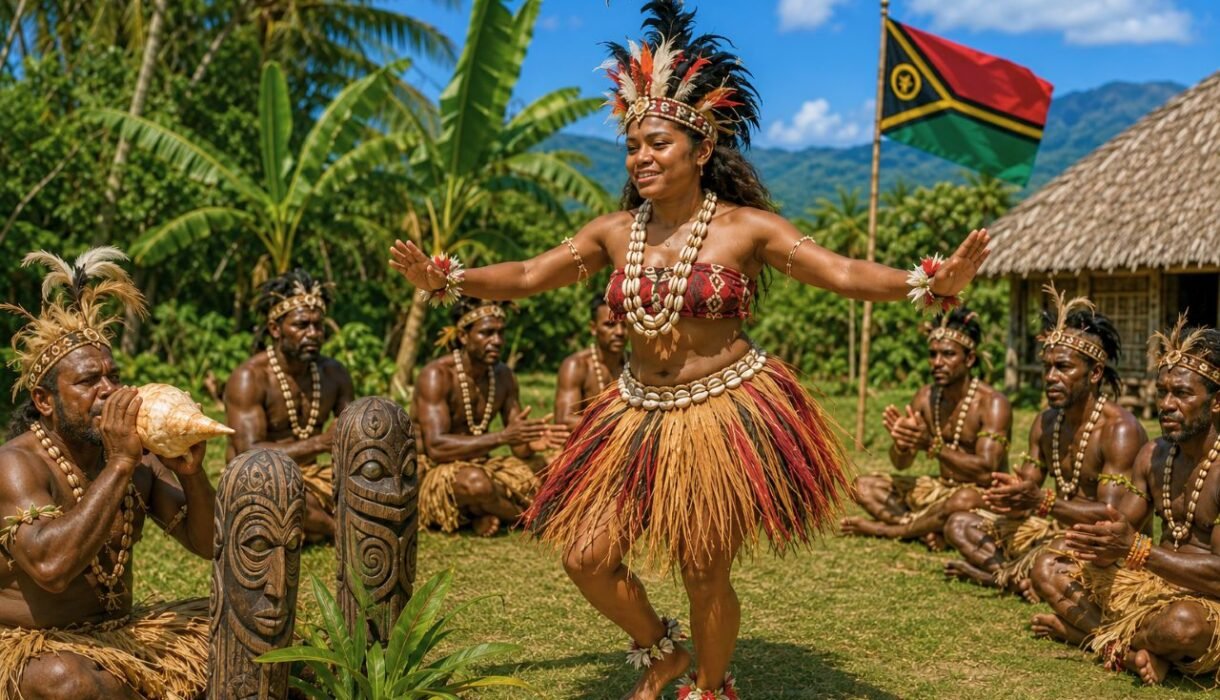
The Culture of Vanuatu stands among the most diverse, intact, and captivating indigenous ways of life in Oceania. Situated in the South Pacific within Melanesia, this Y-shaped archipelago of roughly 83 volcanic islands is home to Ni-Vanuatu people who have preserved their customary laws, known as Kastom, across millennia. Recognized per capita as one of the most culturally and linguistically diverse nations on Earth, Vanuatu seamlessly balances traditional village leadership, ancestral spiritual rituals, volcanic soil agriculture, and island hospitality. From the world-famous land diving of Pentecost Island to ceremonial kava gatherings, Vanuatu’s heritage offers an extraordinary testament to human resilience and cultural preservation.
History & Origins
Vanuatu’s rich history reflects ancient maritime migrations, complex island trade networks, and a unique colonial past:
- Ancient Lapita Seafarers (circa 3,000–1,000 BCE): The earliest inhabitants were seafaring Lapita descendants who migrated across the South Pacific. Archaeological discoveries, including ancient pottery and burial sites on Efate and the Shepherd Islands, document advanced navigation, pig husbandry, and root-crop farming.
- Chief Roi Mata’s Dominion (13th Century): Legendary Chief Roi Mata unified the warring tribes of central Vanuatu during the 1200s, introducing peaceful Kastom laws, title systems, and communal feasts. His funerary site on Artok Island is recognized as a UNESCO World Heritage site.
- European Contact & The Anglo-French Condominium:
- Spanish Contact (1606): Explorer Pedro Fernandes de Queirós was the first European to arrive, naming Espiritu Santo.
- Captain Cook (1774): British navigator James Cook charted the archipelago, naming it the New Hebrides.
- The Pandemonium (1906–1980): In an unprecedented colonial arrangement, Great Britain and France jointly ruled the islands under the Anglo-French Condominium—a dual administration colloquially dubbed the “Pandemonium” due to its overlapping legal, educational, and political systems.
- Independence (1980): Following the peaceful Vanua’aku Pati movement led by Father Walter Lini, the New Hebrides gained full sovereignty on July 30, 1980, adopting the native name Vanuatu (“Our Land Forever”).
Culture, Traditions & Customs
Daily life across Vanuatu’s islands is anchored in Kastom—unwritten customary laws governing land rights, social rank, conflict resolution, and life milestones:
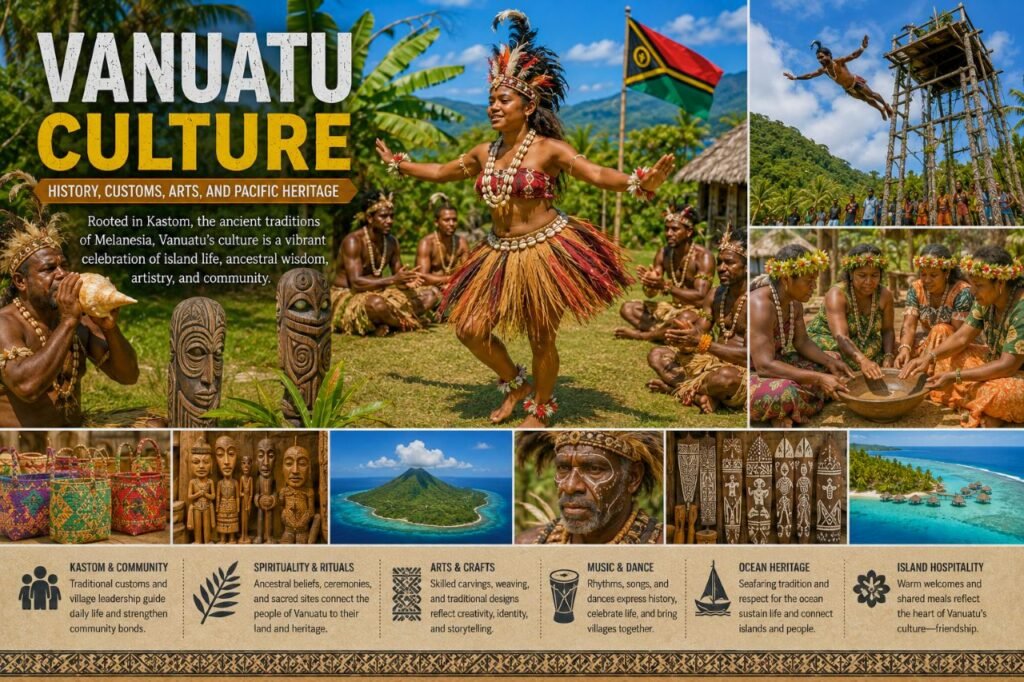
- Naghol (Land Diving): Originating on Pentecost Island, Naghol is the ancient precursor to modern bungee jumping. Every year between April and June, men and boys leap from giant wooden towers (up to 30 meters high) with forest vines tied to their ankles. This daredevil ritual blesses the annual yam harvest and proves male bravery.
- Chiefly Grade-Taking Ceremonies (Namakel): Status in Vanuatu society is earned rather than inherited. Men elevate their social standing through grade-taking ceremonies (Nakamal rituals) involving the sacrifice of valuable tusked pigs, kava drinking, and communal feasts.
- Pig Tusks as Wealth: Curled pig tusks, grown over years through careful animal husbandry, serve as traditional currency and symbols of high rank, honor, and spiritual authority.
- Marriage & Family Customs: Custom marriages involve extensive negotiations between extended clans. The groom’s family presents woven mats, yams, pigs, and woven crafts to the bride’s family to forge permanent tribal alliances.
Languages & Communication
Languages Spoken
- Indigenous Languages (130+): Vanuatu boasts the highest density of languages per capita in the world, with over 130 distinct indigenous Melanesian languages spoken across its islands.
- Bislama: An official national language and the primary creole lingua franca. Bislama combines an English-derived vocabulary with Melanesian grammar, uniting island communities.
- English & French: Both are official languages used across government, formal education, and international business due to the colonial Condominium era.
Greetings & Expressions
- “Halo” or “Gudfala morning” — Bislama for “Hello” or “Good morning.”
- “Tangkyu tumas” — “Thank you very much.”
- “Olsem wanem?” — “How are you?” or “What’s up?”
- “Lukim yu” — “See you later” / “Goodbye.”
Geography
Vanuatu is an island arc formed by active volcanic activity, featuring dramatically diverse landscapes:
- Island Composition: Comprises 83 islands (65 inhabited) stretching across 1,300 kilometers of the South Pacific Ocean. Major volcanic islands include Espiritu Santo, Malekula, Efate (site of the capital, Port Vila), Tanna, Ambrym, and Pentecost.
- Active Volcanoes: Home to accessible active volcanoes, including Mount Yasur on Tanna Island—celebrated as one of the world’s most accessible live volcanoes—and the twin craters of Ambrym.
- Tropical Forests & Coral Reefs: Lush interior rainforests, cascading waterfalls, and crystal-clear marine reserves surround the islands.
Economy
Vanuatu’s economy relies on agriculture, tourism, and sustainable offshore marine licensing:
- Subsistence Agriculture: Over 75% of Ni-Vanuatu citizens engage in rural subsistence farming, producing organic food crops for local village consumption.
- Key Cash Crops & Exports: Commercial agricultural exports include copra (dried coconut), kava root, cocoa, coffee, and organic beef.
- Tourism & Marine Resources: Eco-tourism, scuba diving (such as the SS President Coolidge wreck in Santo), and fishing licenses generate essential national foreign exchange.
- Currency: The official national currency is the Vatu (VUV).
Politics
Vanuatu operates as a stable parliamentary democracy combined with traditional governance structures:
- Executive & Legislative: A unicameral 52-member Parliament is elected every four years. The Prime Minister serves as Head of Government, while a President is elected by Parliament and provincial council presidents to fulfill ceremonial duties.
- Malvatumauri (National Council of Chiefs): A constitutionally mandated body of supreme customary chiefs that advises the national government on all matters concerning Kastom, indigenous language, and land tenure.
Ethnic Groups
- Ni-Vanuatu Majority (~98%): Indigenous Melanesian people constitute the vast majority of the population.
- Minority Communities (~2%): Includes small populations of other Pacific Islanders, Europeans (primarily French and British), Chinese, and Vietnamese descendants.
Beliefs & Values
Religion & Spirituality
- Christianity (82%+): European missionaries introduced Christianity in the 19th century. Major denominations include the Presbyterian Church, Roman Catholicism, the Anglican Church of Melanesia, and Seventh-day Adventist.
- Cargo Cults: Tanna Island is home to unique cultural movements, most notably the John Frum Movement, where followers incorporate ritual drills and flags, awaiting a mythical figure who will bring material abundance while preserving native customs.
- Kastom Spirituality: Belief in ancestral spirit protection, sacred taboos (Tabu), and nature spirits remains deeply interwoven with everyday Christian practices.
Core Values
- Komunitos (Community Unity): Mutual help, shared labor, and communal decision-making shape village life.
- Respect for Elders & Chiefs: Customary chiefs (Jifs) hold ultimate moral authority and resolve village disputes peacefully without court litigation.
Food & Cuisine
Traditional Ni-Vanuatu food centers around fresh, organic root crops, leafy greens, coconut milk, and seafood cooked using underground hot-stone ovens.
- Key Dishes & Delicacies:
- Laplap: The iconic national dish. Grated taro, yam, cassava, or green bananas are mixed with fresh coconut cream, wrapped tightly in wild banana leaves, and slow-baked over hot volcanic stones in an underground oven (Umu). It is often topped with chicken, fish, or island pork.
- Simboro: Grated root crops rolled into long, banana-leaf cylinders, boiled in coconut cream.
- Tuluk: A popular street food in Port Vila made of seasoned minced pork wrapped inside cassava dough and steamed in banana leaves.
- Kava: A traditional ceremonial beverage brewed from the ground roots of Piper methysticum. Drunk at night in village Nakamals (gathering halls), kava induces tranquil relaxation and plays a crucial role in customary discussions.
Clothing & Symbols
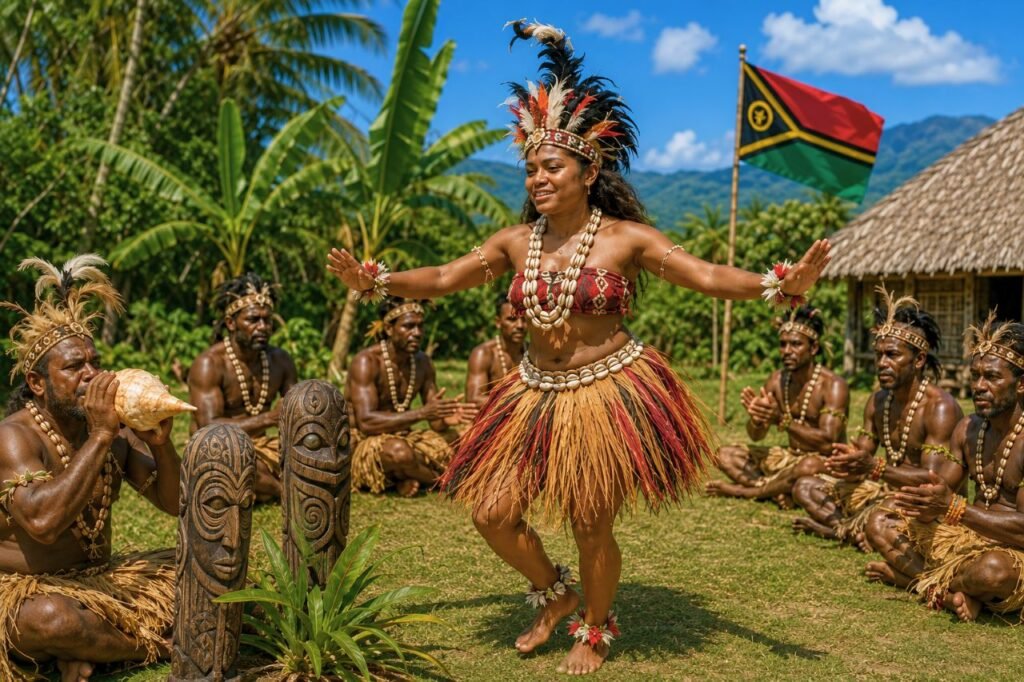
Traditional Attire
- Namba: Customary woven loincloths worn by men in traditional villages (such as the Big Nambas and Small Nambas tribes of Malekula).
- Grass Skirts & Island Dresses: Women traditionally wore woven grass or fiber skirts. Today, colorful cotton “Island Dresses” (Mother Hubbard dresses) with frilled sleeves are standard attire for everyday life and formal events.
Cultural Symbols
- Curled Pig Tusk: Symbolizes wealth, high chief status, and honor; featured prominently on the national flag and emblem.
- Namele Leaves: Crossed fronds of the native Namele palm represent peace, customary law, and traditional protection (Tabu).
Music, Dance & Art
- Rom Dance of Ambrym: A sacred, mysterious ritual dance where performers wear tall, painted banana-fiber masks and dry leaf costumes to invoke ancestral spirits.
- String Bands: A beloved musical style across Vanuatu. Musicians play handmade wooden bush basses, acoustic guitars, and ukuleles, singing joyous polyphonic harmonies about island history and daily life.
- Sand Drawing (UNESCO Heritage): Recognized as a Masterpiece of the Intangible Heritage of Humanity, elders draw intricate, single-line geometric patterns in sand using a finger. These drawings serve as graphic stories, mnemonic devices, and historical records across islands.
Summary
Vanuatu Culture remains a vibrant, living showcase of Melanesian heritage, ancestral wisdom, and community harmony in Oceania. Guided by the enduring principles of Kastom, the sacred tradition of Naghol, and the peaceful gatherings of the Nakamal, Vanuatu continues to celebrate its unique heritage while inspiring the global community.
At Best Culture Insight, we see culture as the heartbeat of every society – the way people live, connect, and express their identity.