Solomon Islands Culture: History, Traditions, Arts, and Pacific Heritage
Posted in :

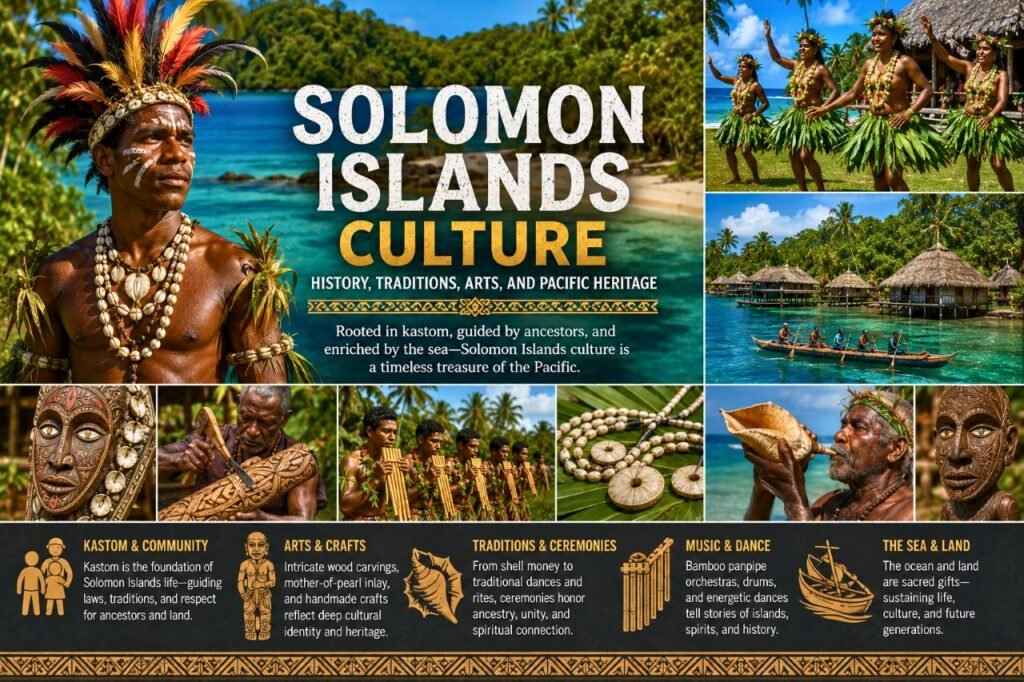
The Culture of the Solomon Islands represents one of the most vibrant, resilient, and multi-faceted indigenous heritages in Oceania. Nestled in the southwestern Pacific Ocean within Melanesia, this archipelagic nation is home to over 900 islands and scores of distinct ethnolinguistic groups. Defined by Kastom—the sacred body of traditional laws, spiritual beliefs, and ancestral customs—Solomon Islanders maintain a profound reverence for tribal lineage, island land rights, traditional shell money, and marine stewardship. From world-renowned wood carvings inlaid with mother-of-pearl to the hypnotic rhythms of bamboo panpipe orchestras, Solomon Islands society stands as an extraordinary celebration of Pacific diversity.
History & Origins
The historical tapestry of the Solomon Islands spans thousands of years of seafaring, isolation, and complex colonial contact:
- Ancient Migration (circa 30,000–50,000 BCE): The earliest Papuan-speaking ancestors migrated from Southeast Asia across island stepping-stones during the Pleistocene era, settling the larger volcanic islands such as Guadalcanal, Malaita, and Choiseul.
- Austronesian & Lapita Seafarers (circa 4,000–3,000 BCE): A second wave of seafaring Austronesian migrants arrived with advanced outrigger canoe navigation, agricultural techniques, and ceramic traditions (Lapita pottery), blending with existing populations across the island archipelago.
- European Contact (1568): Spanish navigator Álvaro de Mendaña became the first European to visit the archipelago in 1568. Finding traces of gold on Guadalcanal, he named the islands after the legendary biblical King Solomon, believing he had uncovered his source of wealth.
- Colonial Period & World War II:
- British Protectorate (1893): Great Britain established a protectorate over the southern Solomon Islands to halt “blackbirding” (forced labor recruitment for Australian sugar plantations), later expanding control over the northern islands.
- Battle of Guadalcanal (1942–1943): During WWII, the Solomon Islands became the scene of fierce land, sea, and air battles between Allied forces and Imperial Japan, leaving a profound impact on local infrastructure and modern history.
- Independence (1978): The Solomon Islands peacefully gained full national independence from Great Britain on July 7, 1978, establishing a sovereign parliamentary democracy.
Culture, Traditions & Customs
Daily life across the archipelago is governed by Kastom—the unwritten customary law system that dictates social obligations, land ownership, and conflict resolution:
- Land Ownership & Clan Lineage: Land is sacred in the Solomon Islands and is almost entirely held under customary land tenure (over 85%). Lineage structures vary by island: while Malaita and parts of San Cristobal follow patrilineal inheritance (father to son), Guadalcanal, Isabel, and New Georgia operate on strict matrilineal lines, where tribal land rights pass down through women.
- Shell Money (Bata or Tafuli’ae): Shell currency remains an active, revered form of wealth, particularly in Malaita and the Langa Langa Lagoon. Strips of smoothed red, white, and black seashells are painstakingly drilled, polished, and strung together. Shell money is used for bride prices, land settlements, ceremonial feasts, and resolving tribal disputes.
- Bride Price Customs: Marriage ceremonies involve substantial customary gift exchanges between extended families. The groom’s clan offers shell money, pigs, food crops, and modern currency to compensate the bride’s family for her transition and to seal an enduring alliance between clans.
- Rites of Passage:
- Youth Initiations: In traditional communities, boys undergo rites of passage involving period isolations in spirit houses or specialized fishing camps where elders teach customary navigation, fishing, and tribal lore.
- Death & Ancestral Rituals: Funerals are major communal events involving clan gatherings, ritual chanting, and ceremonial feasts to honor the deceased’s spirit (Akalo).
Languages & Communication
Languages Spoken
- Indigenous Languages (70–80+): The Solomon Islands is one of the world’s most linguistically dense nations, featuring scores of Papuan and Austronesian languages across its various island provinces.
- Pijin (Solomon Islands Pijin): The national creole lingua franca spoken by virtually all citizens. While based on English vocabulary, its grammar and sentence structure reflect Melanesian patterns.
- English: Official national language used in parliamentary proceedings, formal education, legal administration, and national newspapers.
Greetings, Expressions & Expressions
- “Halo” or “Gud moaning” — Pijin for “Hello” or “Good morning.”
- “Tagio tumas” — Pijin for “Thank you very much.”
- “Nem blong mi…” — “My name is…”
- “Lukuluku gut” — “Take care” or “Look after yourself.”
Geography
The Solomon Islands forms a double chain of volcanic islands and low-lying coral atolls in Melanesia, east of Papua New Guinea:
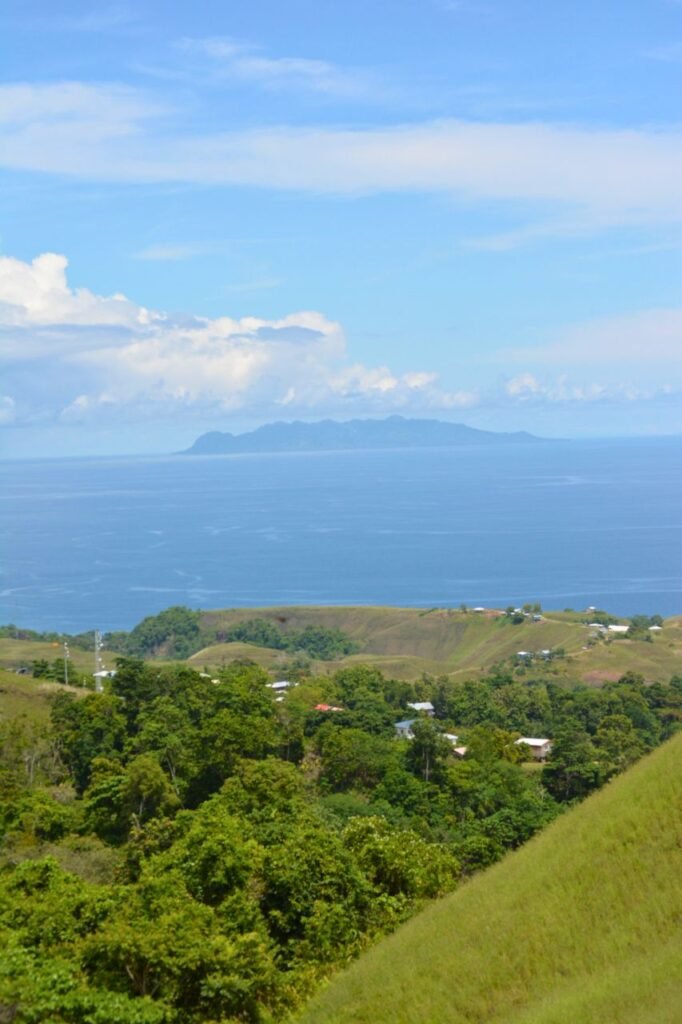
- Major Volcanic Islands: Includes six major mountainous island chains—Guadalcanal, Malaita, Choiseul, New Georgia, San Cristobal (Makira), and Santa Isabel.
- Natural Landscapes: Dense tropical rainforests cover interior mountain ranges, featuring Mount Popomanaseu (2,335 meters) on Guadalcanal as the nation’s highest peak.
- Lagoons & Atolls: Home to spectacular marine ecosystems, including Marovo Lagoon (the world’s largest double-barrier coral lagoon) and Rennell Island, a UNESCO World Heritage site featuring Lake Tegano.
Economy
The Solomon Islands economy centers on natural resources, agricultural exports, and rural village subsistence:
- Agriculture & Forestry: The majority of rural Solomon Islanders rely on subsistence farming. Primary commercial cash exports include timber, palm oil, cocoa, copra (dried coconut meat), and coconut oil.
- Fisheries & Marine Resources: Tuna fishing and marine harvesting (such as sea cucumber and trochus shell) provide critical income and export revenue.
- Currency: The national currency is the Solomon Islands Dollar (SBD).
Politics
The Solomon Islands is a constitutional monarchy operating as a parliamentary democracy:
- Governance Structure: The national Parliament consists of 50 members elected for four-year terms. Executive leadership is headed by the Prime Minister, while King Charles III serves as the constitutional Head of State, represented locally by a native Governor-General.
- Provincial Administration: Divided into nine administrative provinces (Central, Choiseul, Guadalcanal, Isabel, Makira-Ulawa, Malaita, Rennell and Bellona, Temotu, and Western) plus the Honiara Capital Territory.
Ethnic Groups
- Melanesian Majority (~95%): The vast majority of citizens are indigenous Melanesians inhabiting the major volcanic island chains.
- Polynesian Minorities (~3%): Polynesian communities reside on outlying atolls such as Rennell, Bellona, Tikopia, Ontong Java, and Sikaiana.
- Micronesian & Other Groups (~2%): Includes I-Kiribati families relocated during the mid-20th century, alongside small Chinese, European, and Australian communities.
Beliefs & Values
Religion & Spirituality
- Christianity (90%+): Introduced by 19th-century European missionaries, Christianity is a central pillar of modern Solomon Islands society. Major denominations include the Anglican Church of Melanesia, Roman Catholicism, the South Sea Evangelical Church, Seventh-day Adventist, and Uniting Church.
- Kastom & Ancestral Spirits: Pre-Christian beliefs in ancestral spirits (Akalo) and spiritual energy (Mana) remain woven into daily life, especially in rural areas where customary taboos (Abu) govern sacred sites, fishing grounds, and forests.
Core Values
- Reciprocity & Community: Extended family networks share resources freely; food, labor, and housing are collectively supported.
- Respect for Elders & Chiefs: Paramount deference is shown to traditional village chiefs (Alafa) and tribal elders who hold wisdom regarding ancestral history and Kastom.
Food & Cuisine
Traditional Solomon Islands cuisine relies on local root crops, fresh tropical fruits, coconut cream, and ocean catches.
- Key Dishes & Staples:
- Cassava, Taro & Yams: The fundamental root vegetable staples of every meal, boiled, baked, or fried.
- Poi: A traditional dish made from fermented taro or banana mashed into a smooth, comforting paste.
- Poi-Poi / Custom Cakes: Root crops grated, mixed with coconut cream, wrapped in banana leaves, and slow-baked in underground stone ovens.
- Seafood: Coral trout, red snapper, tuna, mud crab, and crayfish cooked in fresh coconut milk with local greens (Slippery Cabbage / Aibika).
Clothing & Symbols
Traditional Attire
- Customary Dress: Traditionally, men wore barkcloth loincloths (Maru) made from beaten paper mulberry trees, while women wore woven grass skirts crafted from hibiscus fiber or palm leaves.
- Modern Clothing: Light, casual clothing (shorts, t-shirts, and cotton dresses) is standard today. Formal occasions feature men in collared shirts and women in colorful tropical dresses.
Cultural Symbols
- Frigatebird & Dolphin: Sacred marine symbols representing guidance, fishing prowess, and sea spirits, widely depicted in traditional art and shell inlays.
- Nguzonguzo: A carved wooden canoe prow figurehead with large eyes and inlay mother-of-pearl, traditionally attached to warrior war canoes (Tomoko) to ward off evil sea spirits and bring good fortune.
Music, Dance & Art
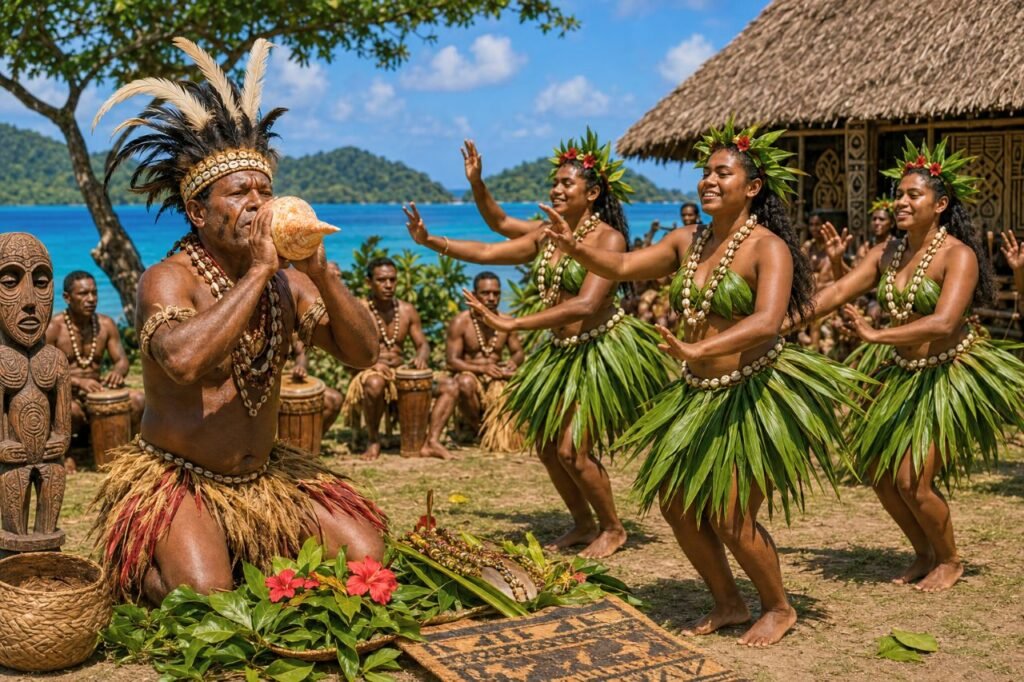
- Bamboo Bands: A iconic musical innovation of the Solomon Islands. Musicians use varied lengths of open bamboo pipes struck on their open tops with rubber sandals or flip-flops to produce rich, bass-heavy melodic rhythms accompanied by vocal harmonies.
- Woodcarving & Shell Inlay: Renowned across the Pacific for exceptional carving mastery. Artists in the Western Province craft detailed human statues, bowls, and marine creatures from ebony or kerosene wood, inlaid with shimmering mother-of-pearl shells.
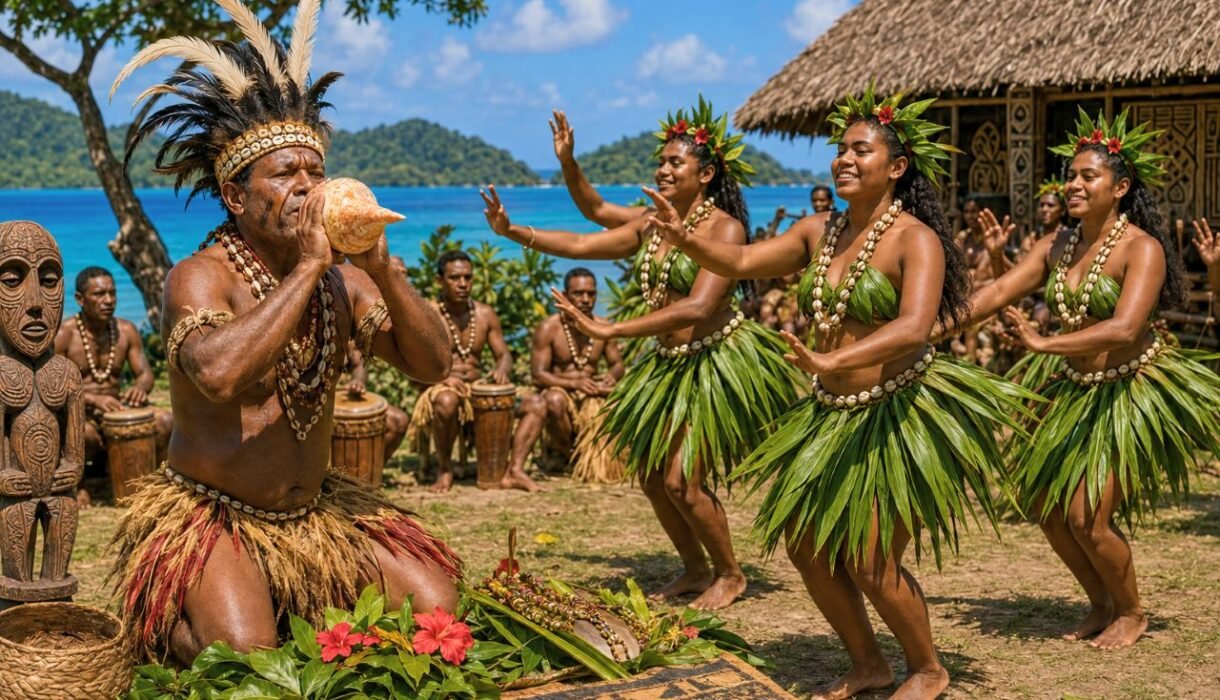
- Custom Dances (Churu): Choreographed group dances featuring rhythmic foot stomping, seed-pod leg rattles, and bamboo flutes, telling stories of ancient battles, ocean voyages, and village legends.
Summary
Solomon Islands Culture stands as an extraordinary celebration of Melanesian heritage, ancestral wisdom, and island unity. Guided by the enduring principles of Kastom, shell money traditions, and vibrant artistic expression, the Solomon Islands continues to preserve its distinct cultural identity while welcoming the modern world across the Pacific.
At Best Culture Insight, we see culture as the heartbeat of every society – the way people live, connect, and express their identity.