Tonga Culture: History, Traditions, Arts, and Pacific Heritage
Posted in :

The Culture of Tonga (Anga Faka-Tonga, literally “The Tongan Way”) is a proud, ancient, and deeply dignified Polynesian heritage that stands unique in the South Pacific. As the only Pacific island nation to have successfully avoided formal European colonization, the Kingdom of Tonga has preserved a continuous sovereign monarchy and an unbroken social hierarchy stretching back over a thousand years. Anchored by extended family obligations (Famili), respectful deference to royalty and nobility, communal land tenure, and Christian faith, Tongan society offers a compelling glimpse into Polynesian life where ancestral customs remain central to modern daily existence.
History & Origins
Tonga’s history is characterized by maritime empire-building, early Polynesian navigation, and royal longevity:
- Lapita Settlement (circa 1500–1000 BCE): The original ancestors of Tongans were seafaring Lapita navigators who crossed vast stretches of the Pacific Ocean in double-hulled canoes (Kalia). The ancient site of Pea on Tongatapu contains some of the earliest Lapita pottery shards discovered in Polynesia.
- The Tu’i Tonga Empire (10th to 15th Century CE): At its peak, the sacred Tongan maritime empire—ruled by the Tu’i Tonga dynasty—exerted political dominance and cultural influence across a vast expanse of Oceania, extending to Fiji, Samoa, Niue, Tokelau, and parts of Kiribati.
- Megalithic Wonders: During the height of the empire, monumental coral limestone structures were erected, including the famous Ha’amonga ‘a Maui (a massive 40-ton trilithon archway constructed around 1200 CE) and ancient royal burial mounds (Langi).
- European Contact & The Uncolonized Kingdom:
- Dutch & British Voyages: Dutch explorers Willem Schouten and Jacob Le Maire visited in 1616, followed by British Captain James Cook in 1773 and 1777, who famously dubbed Tonga the “Friendly Islands” due to the warm hospitality extended by locals during the Inasi festival.
- King George Tupou I (1845): Paramount chief Taufa’ahau united all Tongan island groups under his rule, taking the name King George Tupou I. In 1875, he proclaimed Tonga’s constitution, protecting land rights from foreign ownership and establishing a constitutional monarchy that endures today.
Culture, Traditions & Customs
Daily life in Tonga is guided by Anga Faka-Tonga—a set of customary values governing familial relationships, social conduct, and village organization:
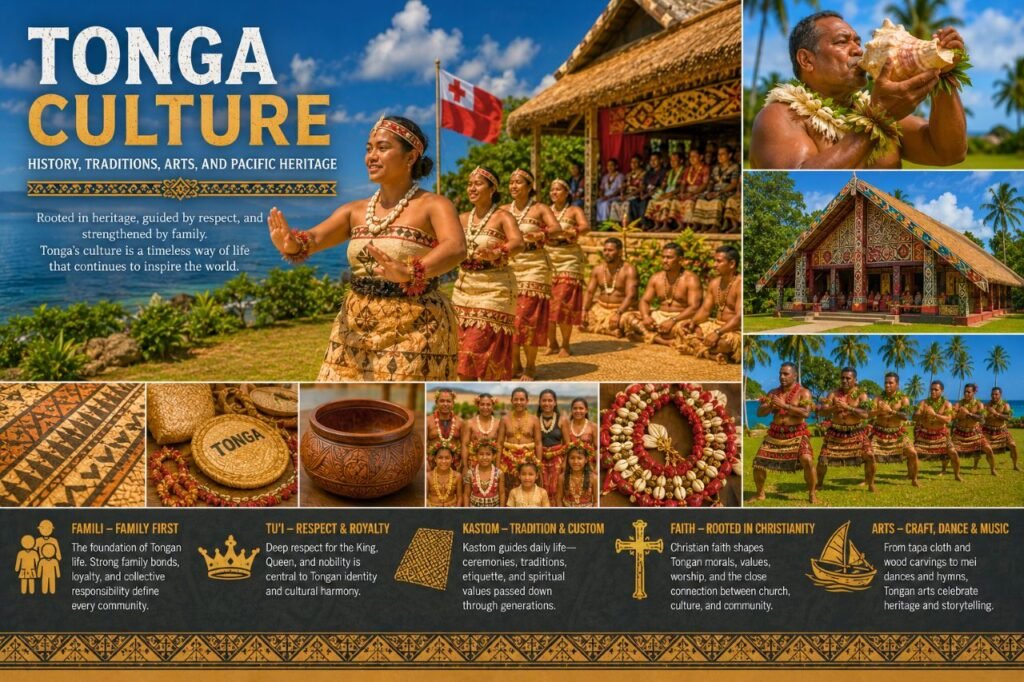
- Social Hierarchy & Kinship (Famili): Tongan family dynamics operate on structured respect (Faka’apa’apa). Within extended families, a father’s sister held the elevated status of Mehekitanga, possessing great spiritual authority over her brother’s children.
- Royal & Noble Reverence: High deference is accorded to the ruling Sovereign and hereditary nobility. Citizens show respect through specialized language, physical postures, and offering first-fruits of agricultural harvests (Polopolo) to nobility.
- The Royal Kava Ceremony (Taumafa Kava): Reserved for monarchical coronations, noble title installations, and national gatherings. High chiefs sit in a formal circle (Alofi) strictly according to traditional rank, drinking the prepared kava root beverage to solemnize their sacred duties.
- Rites of Passage:
- Fakafe’iloaki (Weddings): Tongan weddings feature months of preparation, involving exchanges of fine woven mats (Kie Hingoa) and barkcloth (Tapa or Ngatu), followed by communal feasts.
- Funerals (Lauaitu): Funerals are profound cultural events lasting several days. Mourners wear black clothing wrapped with worn, oversized waist mats (Ta’ovala) as a symbol of deep respect and humility.
Languages & Communication
Languages Spoken
- Tongan (Lea Faka-Tonga): An official language belonging to the Polynesian branch of Austronesian languages. It features distinct phonetic registers, including specialized vocabulary used exclusively when addressing the King or members of the royal family.
- English: Official language widely used in secondary education, civil service administration, commerce, and international diplomacy.
Greetings, Expressions & Proverbs
- “Mālō e lelei” — The classic Tongan greeting meaning “Hello” or “Good day.”
- “Mālō ‘aupito” — “Thank you very much.”
- “Ofa atu” — “With love” or “Best wishes” (used as a warm farewell).
- “Tonga mo’unga ki he loto” — A famous Tongan proverb meaning “Tonga’s mountains are inside her people”—underscoring that Tongan strength lies in internal resolve and character rather than physical terrain.
Geography
The Kingdom of Tonga comprises an archipelago of 171 islands (45 inhabited) spread across four primary geographic clusters in Polynesia:
- Tongatapu Group: The main southern volcanic and limestone island group, housing the capital city of Nuku’alofa, the Royal Palace, and over 70% of the national population.
- Ha’apai Group: A central cluster of low-lying coral atolls and active volcanic islands surrounded by turquoise lagoons.
- Vava’u Group: A northern paradise of high forested islands, sheltered waterways, and coral reefs, world-renowned as a migratory breeding ground for Humpback whales.
- The Niuas: Remote, isolated volcanic islands located in the far north toward Samoa.
Economy
Tonga’s economy is anchored by agriculture, offshore remittances, and growing eco-tourism:
- Agriculture & Cash Crops: Farming forms the backbone of village life. Major agricultural exports include squash, vanilla beans, root crops (taro, yams, cassava), coconuts, and kava.
- Remittances & Tourism: Financial remittances sent home by the large Tongan diaspora living in New Zealand, Australia, and the United States contribute significantly to household incomes, alongside seasonal whale-watching tourism.
- Currency: The national currency is the Pa’anga (TOP).
Politics
Tonga is the only constitutional monarchy in Oceania:
- Governance System: Executive authority is held by the Prime Minister and Cabinet, while King Tupou VI serves as Head of State. Following historic political reforms in 2010, the majority of seats in the 26-member Legislative Assembly (Fale Alea) are directly elected by common citizens, alongside 9 seats chosen by hereditary nobles.
Ethnic Groups
- Tongan Majority (~97%): Indigenous Polynesians form the vast majority of the population.
- Minority Communities (~3%): Includes individuals of mixed Tongan and European/Asian heritage, along with small communities of other Pacific islanders, Australians, and Chinese expatriates.
Beliefs & Values
Religion & Spirituality
- Christianity (98%+): Christianity plays a paramount role in Tongan life. The Free Wesleyan Church of Tonga is the official state church, alongside Roman Catholic, Latter-day Saints, and Free Church of Tonga congregations.
- The Sacred Sunday: Sunday in Tonga is strictly protected by national constitutional law. Businesses close, commercial activities pause, and families devote the day entirely to church services, rest, and communal feasting.
Core Values (Fā’i Kavei Koula)
- Faka’apa’apa: Respect and deference toward elders, leaders, and traditional hierarchy.
- Tauhi Vā: Nurturing and maintaining harmonious interpersonal relationships.
- Mamahi’i Me’a: Loyalty, devotion, and willingness to sacrifice for family, church, and country.
- Lotofōtō: Humility, patience, and generosity of spirit.
Food & Cuisine
Traditional Tongan cuisine centers around fresh root vegetables, tropical fruits, seafood, and underground stone cooking.
- Key Dishes & Delicacies:
- Umu: The traditional underground earth oven lined with hot volcanic stones and banana leaves, used to slow-roast pork, yams, and fish.
- Lu Pulu: A favorite Tongan dish made of corned beef, onions, and rich coconut cream wrapped tightly in young taro leaves and baked in the Umu.
- Otai: A refreshing seasonal fruit drink made from shredded watermelon, mango, or pineapple blended with coconut milk and fresh coconut water.
- Sipi: Roasted lamb or mutton chops served alongside boiled taro (Talo) and sweet potatoes (Kumala).
Clothing & Symbols
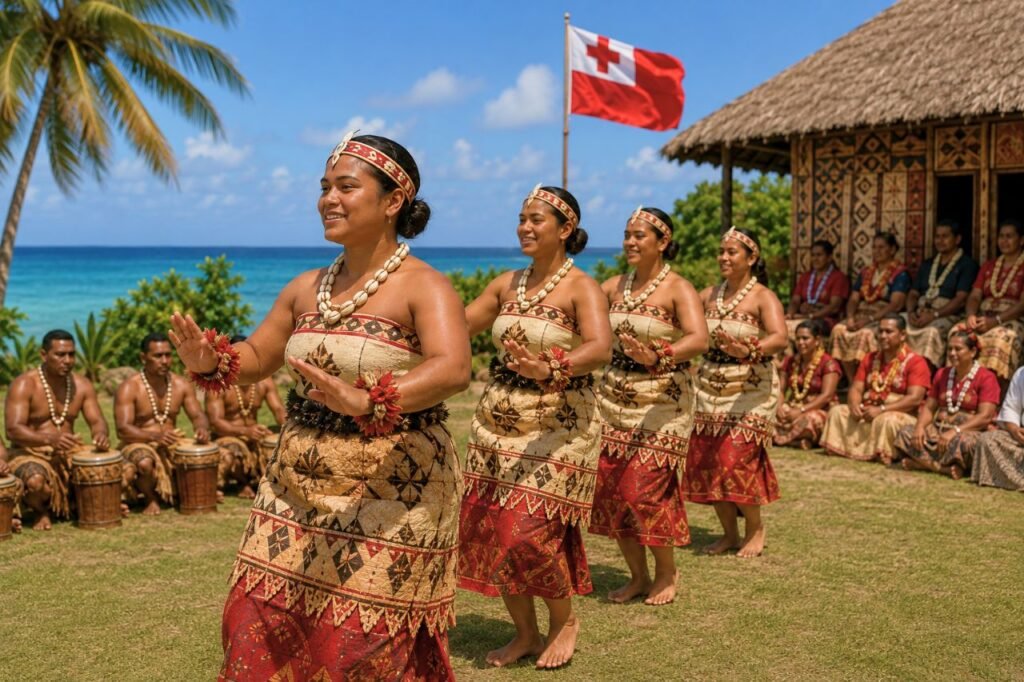
Traditional Attire
- Ta’ovala: A traditional woven pandanus leaf mat wrapped around the waist and secured with a coconut-fiber cord (Kafa). Worn by both men and women over trousers or skirts as a universal sign of respect, mandatory for church, formal occasions, and government offices.
- Kiekie: A decorative woven waist fringe worn specifically by women for semi-formal occasions as a lightweight alternative to the Ta’ovala.
Cultural Symbols
- Royal Palace: A striking white-and-red wooden Victorian palace built in Nuku’alofa in 1867, serving as the official residence of the Tongan Royal Family.
- Tonga Coat of Arms: Features the Royal Crown, three cross swords representing royal lineages, a dove with an olive branch symbolizing peace, and stars representing the main island groups.
Music, Dance & Art
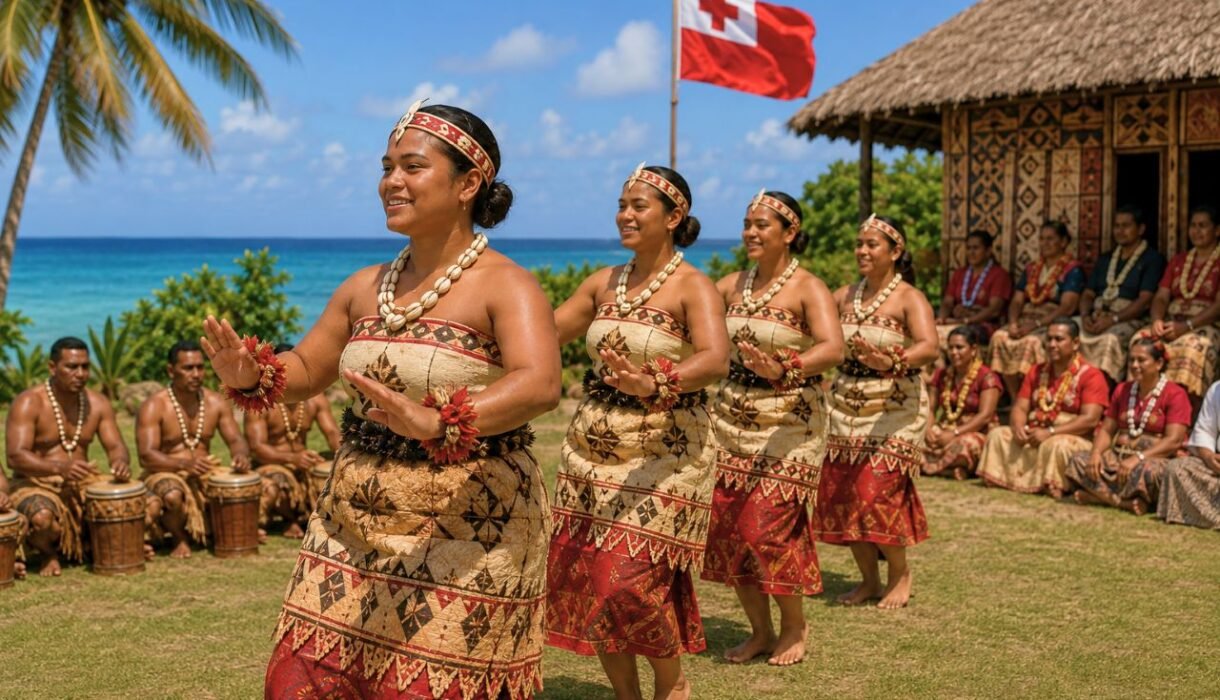
- Lakalaka: The magnificent national group dance of Tonga, declared an Intangible Cultural Heritage of Humanity by UNESCO. Hundreds of men and women perform synchronized choral singing and poetic gestures telling stories of national history and legends.
- Tau’olunga: A elegant solo or small-group dance performed by young women, highlighting graceful hand movements (Haka) and wrist flexions set to melodic acoustic guitars and ukuleles.
- Ngatu (Barkcloth Art): Strips of paper mulberry bark (Hiapo) are beaten with wooden mallets (Tuturu) and hand-painted with natural brown and black dyes using traditional geometric patterns depicting royal lineages and historical events.
Summary
Tonga Culture stands as a proud symbol of Polynesian sovereignty, monarchical tradition, and enduring Christian faith in Oceania. Through the timeless practice of Anga Faka-Tonga, the wearing of the Ta’ovala, and the grandeur of the Lakalaka, Tonga continues to preserve its distinct identity while welcoming the future across the South Pacific.
At Best Culture Insight, we see culture as the heartbeat of every society – the way people live, connect, and express their identity.