Samoa Culture: History, Traditions, Arts, and Pacific Heritage
Posted in :

The Culture of Samoa (Fa’a Samoa, literally “The Samoan Way”) is an ancient, living social system that has governed life in the Polynesian heartland for over 3,000 years. Centered around the principles of extended family unity (Aiga), communal chieftainship (Matai), customary service (Tautua), and deep religious faith, Samoa represents one of the most unbroken traditional societies in Oceania. From the ceremonial reverence of the ‘Ava kava ritual to the intricate artistry of full-body traditional tattooing (Tatau), Samoans have preserved an extraordinarily resilient cultural framework that continues to thrive in harmony with modern governance across the South Pacific.
History & Origins
Samoa is widely regarded by historians and oral traditions as the ancestral “Cradle of Polynesia”:
- Lapita Ancestors & Settlement (circa 1000–1500 BCE): The original settlement of Samoa occurred over 3,000 years ago when seafaring Lapita peoples navigated double-hulled canoes across the Pacific. Archaeological sites like Mulifanua on Upolu Island contain ancient Lapita pottery shards dating back to this era.
- The Cradle of Polynesian Voyagers: From Samoa and neighboring Tonga, skilled navigators expanded eastward, populating the rest of Polynesia including Tahiti, Hawaii, the Marquesas, and Aotearoa (New Zealand).
- The Reign of Queen Salamasina (16th Century): Samoan oral history is rich with tribal lineages and conflicts. Paramount chieftainess Tafa’ifa Salamasina united the major ruling titles of Samoa in the 16th century, establishing a period of peace and strengthening the Fa’a Samoa code of governance.
- Colonial Partition & The Mau Movement:
- Partition (1899): Under the Tripartite Convention of 1899, the Samoan archipelago was divided between the United States (Eastern Samoa, now American Samoa) and Germany (Western Samoa).
- The Mau Movement: Following World War I, New Zealand administered Western Samoa under a League of Nations mandate. Samoans formed the peaceful Mau movement (“Opinion” or “Firm Movement”), campaigning under the slogan “Samoa mo Samoa” (Samoa for Samoans).
- Independence (1962): On January 1, 1962, Western Samoa became the first Pacific island nation to gain independence in the 20th century (officially dropping “Western” from its name in 1997).
Culture, Traditions & Customs
At the core of Samoan society is Fa’a Samoa—a socio-political and moral code that dictates daily conduct, village organization, and interpersonal relationships:
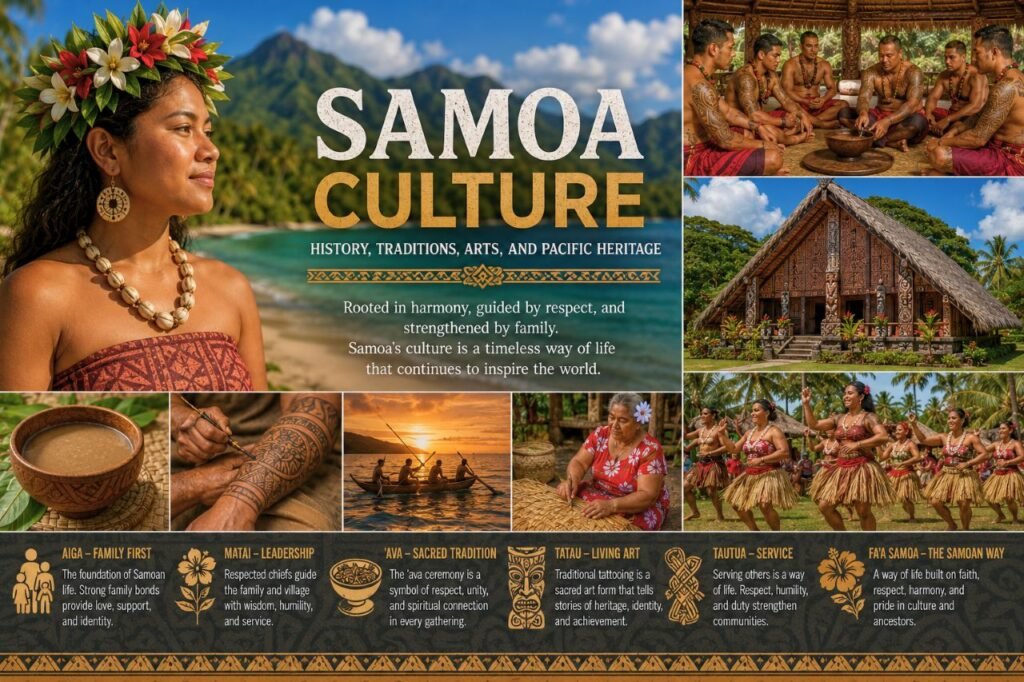
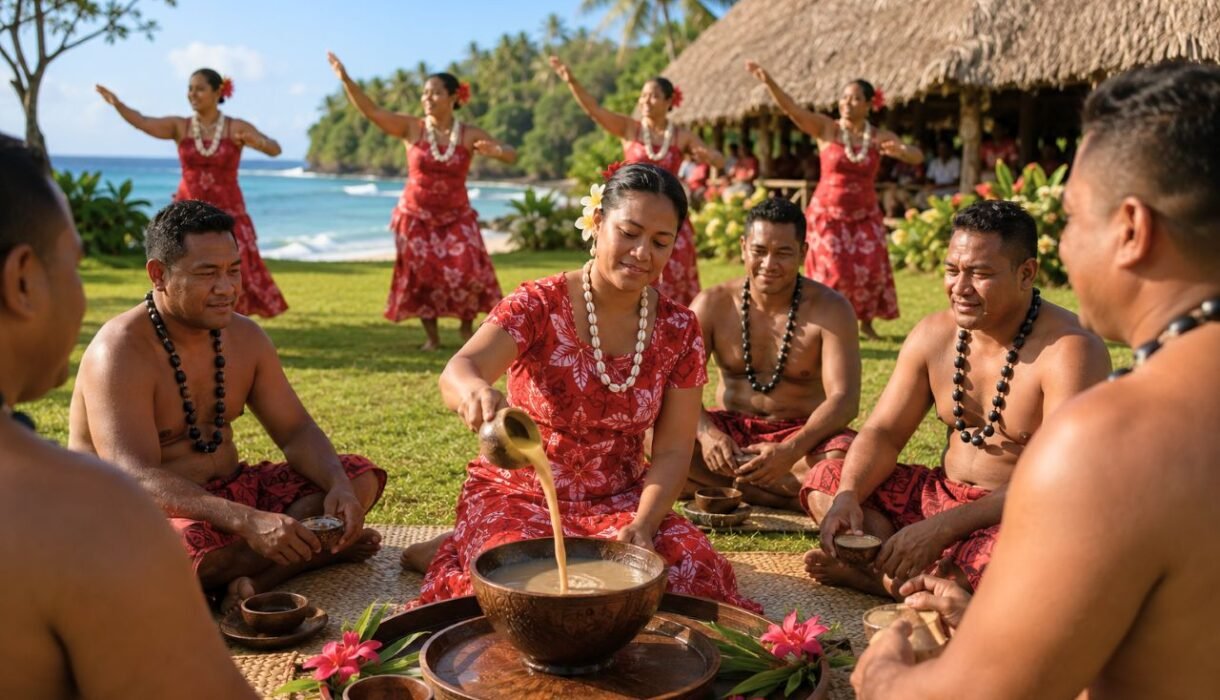
- The Aiga (Extended Family): Samoan society is organized into extended family units (Aiga), which can include hundreds of individuals connected by blood, marriage, or adoption. Land, resources, and decisions belong to the collective family rather than individual owners.
- The Matai System (Chieftainship): Each Aiga selects one or more Matai (chiefs) to lead them. Matai represent the family on village councils (Fono), manage customary land, resolve disputes, and ensure the family’s well-being.
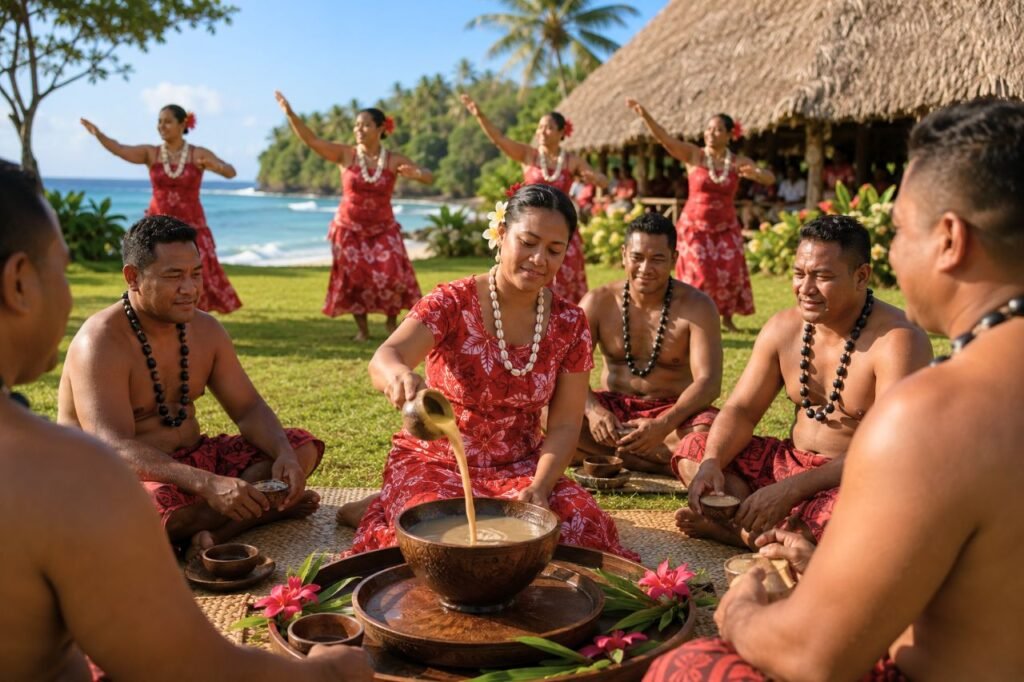
- The ‘Ava Ceremony: The most sacred ritual in Samoa. Prepared from the dried roots of the kava plant (Piper methysticum), the beverage is brewed in a large wooden bowl (Tanoa) and presented strictly according to traditional rank during chieftain titles, diplomatic meetings, and major life celebrations.
- Rites of Passage & Life Events:
- Fa’amasei’au (Marriage Traditions): Traditional Samoan weddings involve exchanges of fine woven mats (Ie Toga) from the bride’s family and financial gifts or food from the groom’s family.
- Sa Ceremony (Evening Prayer): Every evening around sunset, villages observe Sa—a 10-to-20-minute period of quiet family prayer and quietude, signaled by the beating of a hollow wooden drum (Lali).
Languages & Communication
Languages Spoken
- Samoan (Gagana Samoa): An official language belonging to the Polynesian sub-branch of Austronesian languages. It is notable for its formal registers; a distinct honorific language vocabulary is used exclusively when addressing Matai chiefs and high officials.
- English: Official language widely used in secondary education, government legislation, commerce, and international trade.
Greetings, Expressions & Proverbs
- “Talofa” — The universal Samoan greeting meaning “Hello” or “Welcome.”
- “Fa’afetai” — “Thank you.”
- “Malo” — “Well done” or “Good health.”
- “E pala le ma’a, ae lē pala le ‘upu” — A famous Samoan proverb meaning “Even stones decay, but words endure”—underscoring the binding weight of oral promises and tradition.
Geography
Samoa comprises two main large volcanic islands (Upolu and Savai’i) alongside eight small islets, located south of the Equator in Polynesia:
- Savai’i Island: The larger, more rugged island characterized by volcanic peaks, active lava fields (Mt. Matavanu), rainforest reserves, and blowholes.
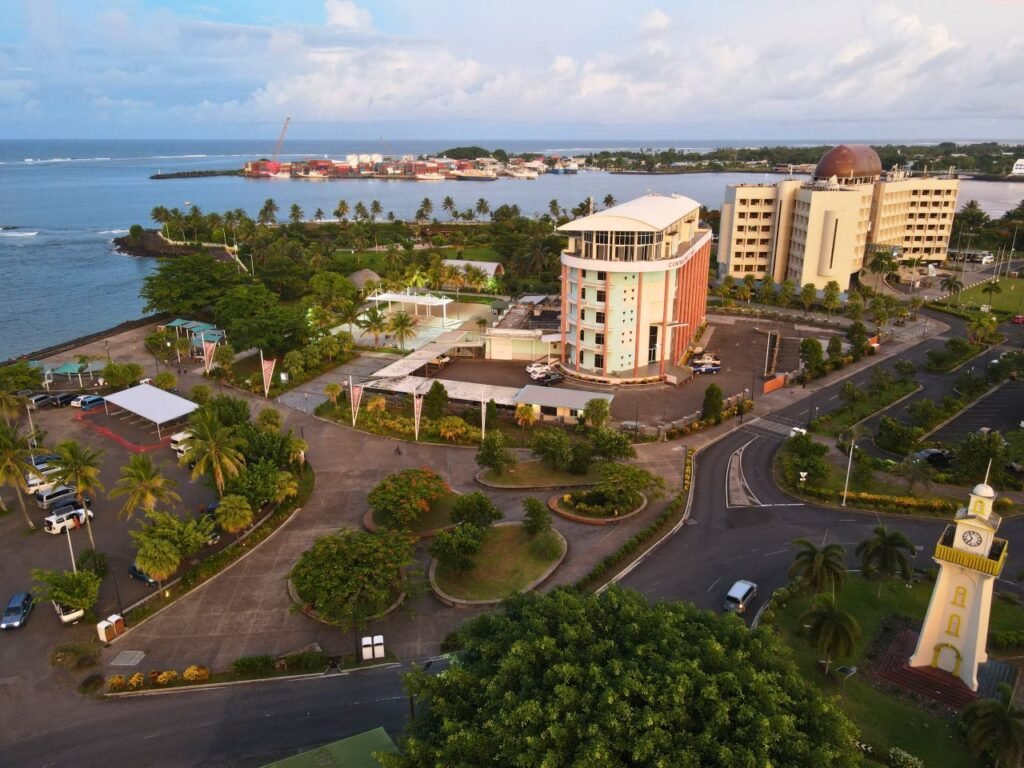
- Upolu Island: Home to the majority of Samoa’s population, tropical waterfalls, the vibrant capital city of Apia, and iconic natural features like the To Sua Ocean Trench.
Economy
Samoa’s economy balances traditional village agriculture with modern service sectors and international remittances:
- Agriculture & Fisheries: Key exports include coconut products (coconut cream and oil), taro (Talo), cocoa (Koko Samoa), and fresh fish.
- Remittances & Tourism: Financial support sent home by the large Samoan diaspora living in New Zealand, Australia, and the United States forms a major pillar of the economy, alongside eco-tourism centered on pristine beaches and cultural villages.
- Currency: The national currency is the Tālā (SAT).
Politics
Samoa operates as a parliamentary democracy anchored by traditional chiefdom representation:
- Governance Framework: The nation features a 51-member Legislative Assembly (Fono). Under Samoan electoral law, candidate eligibility for most parliamentary seats is reserved exclusively for holders of Matai chief titles.
- Head of State (O le Ao o le Malo): Elected by the parliament for five-year terms, selected from among the high ceremonial paramount chiefs (Tama-a-‘Aiga).
Ethnic Groups
- Samoan Majority (~92–96%): Indigenous Polynesians who form the vast majority of the population.
- Euronesians & Minorities (~4–8%): Individuals of mixed Samoan and European/Asian heritage, along with small communities of other Pacific islanders and expatriates.
Beliefs & Values
Religion & Spirituality
- Christianity: Introduced by missionary John Williams of the London Missionary Society in 1830, Christianity was rapidly adopted across Samoa. Today, over 97% of the population practices Christianity (Congregational, Roman Catholic, Methodist, Latter-day Saints, and Assemblies of God).
- Motto of Samoa: The national motto reflects this deep spiritual synthesis: “Fa’avae i le Atua Samoa”—“Samoa is founded on God.”
Core Values
- Alofa (Love & Compassion): Expressed through unselfish giving and care for family and neighbors.
- Fa’aaloalo (Respect): Paramount respect shown to elders, parents, church ministers, and village chiefs.
- Tautua (Service): The foundational principle that one must serve their family and village faithfully before rising to leadership (“O le ala i le pule o le tautua” – The path to leadership is through service).
Food & Cuisine
Traditional Samoan cooking centers around fresh tropical produce, coconut milk, seafood, and the subterranean earth oven (Umu).
- Key Dishes & Delicacies:
- The Umu: Food slow-roasted on hot volcanic stones above ground and covered with banana leaves. Prepared every Sunday morning by the young men (Aumaga) of the village.
- Palusami: Young taro leaves filled with rich coconut cream, onions, and wrapped into parcels before baking in the Umu.
- Oka l’a: Fresh raw fish (often tuna or snapper) marinated in citrus juice and served in cold, seasoned coconut milk.
- Koko Samoa: A rich, warm drink made from crushed locally roasted cacao beans and boiled water.
Clothing & Symbols
Traditional & Modern Attire
- Puletasi: The elegant formal dress worn by Samoan women, consisting of a matching fitted tunic top and long floor-length skirt.
- Lavalava: A versatile wrap-around sarong worn by both men and women for casual, formal, and work environments.
- Fue & To’oto’o: The ceremonial fly-whisk (Fue) and talking staff (To’oto’o) held by Samoan Orator Chiefs (Tulafale) during public declarations.
The Sacred Art of Tatau
- Pe’a (Men’s Tattoo): A dense, geometric full-body tattoo applied from the waist down to the knees using bone combs and mallet chisels. Completing the Pe’a demonstrates supreme physical courage, endurance, and devotion to duty.
- Malu (Women’s Tattoo): A delicate, intricate tattoo covering the thighs from beneath the knee up to the lower hips, featuring symbolic motifs representing shelter and grace.
Music, Dance & Art
- Siva Samoa: The traditional Samoan dance characterized by graceful, fluid hand movements and gentle storytelling steps, performed by a solo female dancer (Taupou) or groups.
- Fa’ataupati (Slap Dance): An energetic, rhythmic dance performed exclusively by men, involving precise high-speed clapping and body slapping mimicking the clearing of stinging insects.
- Fire Knife Dance (Siva Afi): A spectacular performance derived from traditional warfare skills, where dancers spin wooden staffs wrapped in flaming cloth at high speeds.
- Siapo (Barkcloth Art): Traditional Samoan art crafted from the beaten inner bark of the paper mulberry tree, painted with intricate natural dyes and geometric clan motifs.
Summary
Samoa Culture is a shining beacon of Polynesian tradition, communal unity, and unbroken heritage in Oceania. Guided by Fa’a Samoa, the sacred Tatau, and an unwavering spirit of service (Tautua), Samoa offers a inspiring model of how ancient customary values and modern democratic living can thrive side by side.
At Best Culture Insight, we see culture as the heartbeat of every society – the way people live, connect, and express their identity.