Papua New Guinea Culture: History, Traditions, Arts, and Pacific Heritage
Posted in :

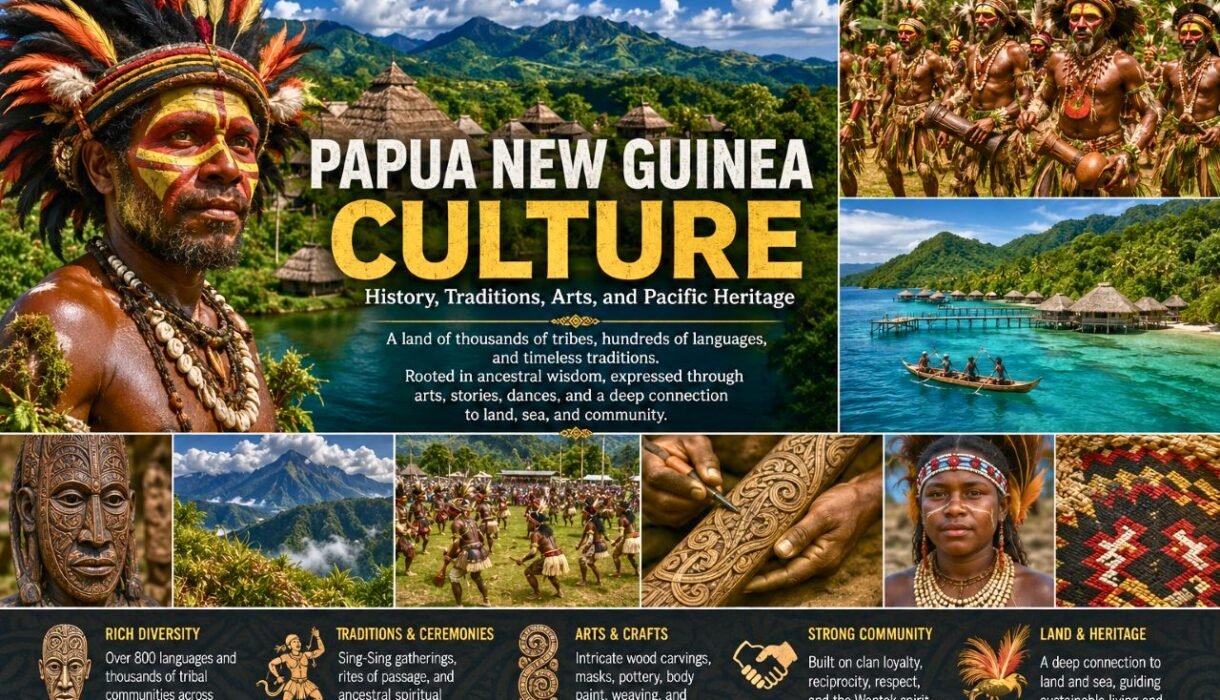
The Culture of Papua New Guinea (PNG) is one of the most diverse, complex, and fascinating indigenous tapestries in Oceania and the entire world. Home to over 600 distinct islands, rugged mountain ranges, and dense equatorial rainforests, Papua New Guinea harbors more than 800 distinct languages and thousands of individual tribal communities. Known collectively as Wantoks (meaning “one tongue” or family kin), Papua New Guineans have preserved an ancient way of life defined by ancestral spiritualism, elaborate Sing-Sing gatherings, intricate wood carvings, and strong clan-based reciprocity. Despite rapid modern development, PNG remains a living mosaic where ancient tribal traditions continue to shape daily civic, spiritual, and social life.
History & Origins
Papua New Guinea boasts one of the longest continuous human histories outside of Africa:
- Ancient Migration (circa 50,000–60,000 Years Ago): The initial ancestors of modern Papuans crossed land bridges and shallow ocean channels from Southeast Asia during the Ice Age when Australia and New Guinea formed a single landmass known as Sahul.
- Pioneering Agriculturalists (circa 7,000 BCE): Archaeological evidence at Kuk Early Agricultural Site in the Highlands reveals that ancient Papuans were among the world’s earliest agricultural innovators, independently developing drainage systems to cultivate taro, bananas, and sugar cane long before European contact.
- Austronesian Arrival (circa 1500 BCE): Seafaring Austronesian traders settled along PNG’s coastal regions and offshore island chains (such as the Bismarck Archipelago), bringing outrigger canoe technology, pottery (Lapita culture), and distinct linguistic elements.
- Colonial Partition & World War II:
- Divided Territory: In 1884, the island of New Guinea was carved up by European powers; Germany claimed the northern half (German New Guinea), while Great Britain established a protectorate over the southern region (British New Guinea, later transferred to Australia as Papua).
- Battleground of the Pacific: During World War II, Papua New Guinea became a critical combat theater between Japanese forces and Allied troops (notably along the famous Kokoda Track).
- Independence (1975): Papua New Guinea peacefully achieved full national independence from Australian administration on September 16, 1975, establishing a united constitutional democracy.
Culture, Traditions & Customs
Social structure in Papua New Guinea revolves around ancestral clan networks and customary gift exchanges:
- The Wantok System: Derived from the Tok Pisin phrase for “one talk,” the Wantok system is the foundation of Papuans’ social safety net. Anyone who shares the same language or village is considered family. Members are bound by customary duty to offer shelter, food, financial aid, and protection to fellow Wantoks.
- Bride Price (Paiim Meri): Traditional marriage involves a ceremonial exchange of wealth from the groom’s family to the bride’s family. Goods traditionally include pigs (pik), shell money (Kina), feathered adornments, and modern currency. Rather than a purchase, it serves as compensation to the bride’s clan for losing her labor and to symbolize the joining of two family lineages.
- The Big Man System: Traditional leadership in PNG is rarely hereditary. Instead, status as a “Big Man” (Bikman) is earned through public speaking ability, mediation skills, bravery, and above all, generosity in distributing wealth during elaborate ceremonial feasts.
- Rites of Passage:
- Initiation Ceremonies: In Sepik River communities, young men undergo scarification rituals inside sacred spirit houses (Haus Tambaran), receiving skin cuts that heal into raised scars mimicking crocodile scales—symbolizing strength, endurance, and spirit connection.
- Mortuary Feasts: Funerals are major events involving days of communal weeping, ceremonial pig slaughter, and exchanges of shell valuables to restore harmony between clans.
Languages & Communication
Languages Spoken
- Indigenous Languages (800+): PNG contains nearly 12% of the world’s total living languages, divided between Papuan (indigenous) and Austronesian language families.
- Tok Pisin: An official language and the most widely spoken creole lingua franca connecting diverse ethnic groups across the country.
- Hiri Motu: An official regional trade language historically spoken around the southern coastal region surrounding Port Moresby.
- English: Official language of government, higher education, legal proceedings, and national press.
Greetings, Expressions & Slang
- “Apinun” — Tok Pisin for “Good afternoon” or “Hello.”
- “Tenkyu tru” — “Thank you very much.”
- “Nogat samting” — “You’re welcome” or “No problem.”
- “Em nau!” — An emphatic exclamation meaning “That’s right!” or “Exactly!”
Geography
Papua New Guinea occupies the eastern half of New Guinea island plus several offshore island groups (New Britain, New Ireland, Bougainville, and Manus):
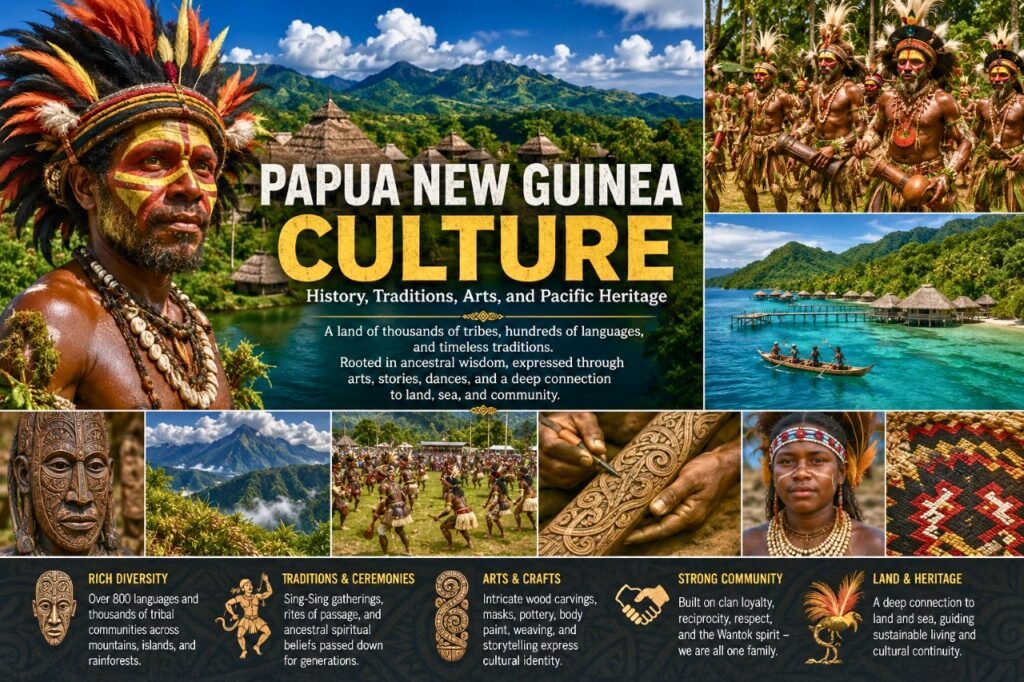
- The Rugged Highlands: A dramatic spine of high-altitude mountain ranges, fertile valleys, and cloud forests running through the interior island, home to Mount Wilhelm (4,509 meters).
- Lowland River Basins: Dominated by vast tropical rainforests and major winding rivers like the Sepik and Fly rivers.
- Islands and Coral Atolls: Pristine volcanic islands, coral reefs, and volcanic caldera bays (such as Rabaul).
Economy
PNG possesses a dual economy composed of a modern extractive sector and a vast rural subsistence sector:
- Extractive Resources: Mining (gold, copper, nickel) and energy projects (liquefied natural gas – LNG) generate the majority of export revenue.
- Agriculture & Cash Crops: Roughly 80% of the population relies on subsistence farming and cash-crop cultivation, exporting high-quality Arabica coffee, cocoa, palm oil, coconut products (copra), and vanilla.
- Currency: The national currency is the Kina (PGK), named after the valuable mother-of-pearl shells traditionally traded as money.
Politics
Papua New Guinea is an independent parliamentary democracy and a Commonwealth realm:
- Parliamentary System: The unicameral National Parliament consists of 118 members elected via a Limited Preferential Voting (LPV) system. The head of state is King Charles III (represented locally by the Governor-General), while executive authority rests with the Prime Minister.
- Provincial Autonomy: PNG is organized into 22 provinces, plus the National Capital District (Port Moresby) and the Autonomous Region of Bougainville.
Ethnic Groups
Papua New Guinea’s population is broadly categorized into two main ancestral lineages, divided into thousands of distinct tribes:
- Papuans (~84%): Descendants of the island’s earliest Ice Age inhabitants, residing primarily in the interior Highlands and southern river regions.
- Melanesian / Austronesians (~15%): Settled primarily along coastal corridors, island chains, and archipelagoes.
- Small Expatriate Communities: Includes Australians, Chinese, Southeast Asians, and Europeans engaged in commerce, missions, and resource projects.
Beliefs & Values
Religion & Spirituality
- Christianity (95%+): The vast majority of Papuans are practicing Christians (Protestant, Roman Catholic, Lutheran, and Seventh-day Adventist).
- Animism & Ancestral Veneration: Traditional beliefs remain deeply blended with Christian faith. Belief in spirit ancestors (Tumbuna), sacred wooden masks, land spirits, and traditional medicinal practices (Sanguma) continues to exert strong influence in rural villages.
Core Values
- Gutpela Sindaun (Harmonious Living): Peace, balance, and cooperative living within one’s community.
- Reciprocity & Sharing: Generosity with food, land, and resources is prized, while greed or hoarding brings social dishonor.
Food & Cuisine
Traditional PNG cuisine is healthy, grounded in root vegetables, tropical fruits, and subterranean steam cooking:
- Key Dishes & Staples:
- The Mumu Feast: The signature cooking technique of Papua New Guinea. Earth, hot stones, and pit ovens are lined with banana leaves to slow-roast pork, sweet potatoes (Kaukau), taro, yams, cassava, and greens in rich coconut cream.
- Sago: A starchy staple extracted from the pith of sago palm trees, prepared as pancakes, porridge, or savory dumplings in lowland and river regions.
- Kaukau (Sweet Potato): The fundamental staple food of the PNG Highlands, cultivated in dozens of unique regional varieties.
- Fresh Seafood: River fish, mud crabs, reef fish, and prawns cooked with coconut milk and leafy greens (Aibika).
Clothing & Symbols
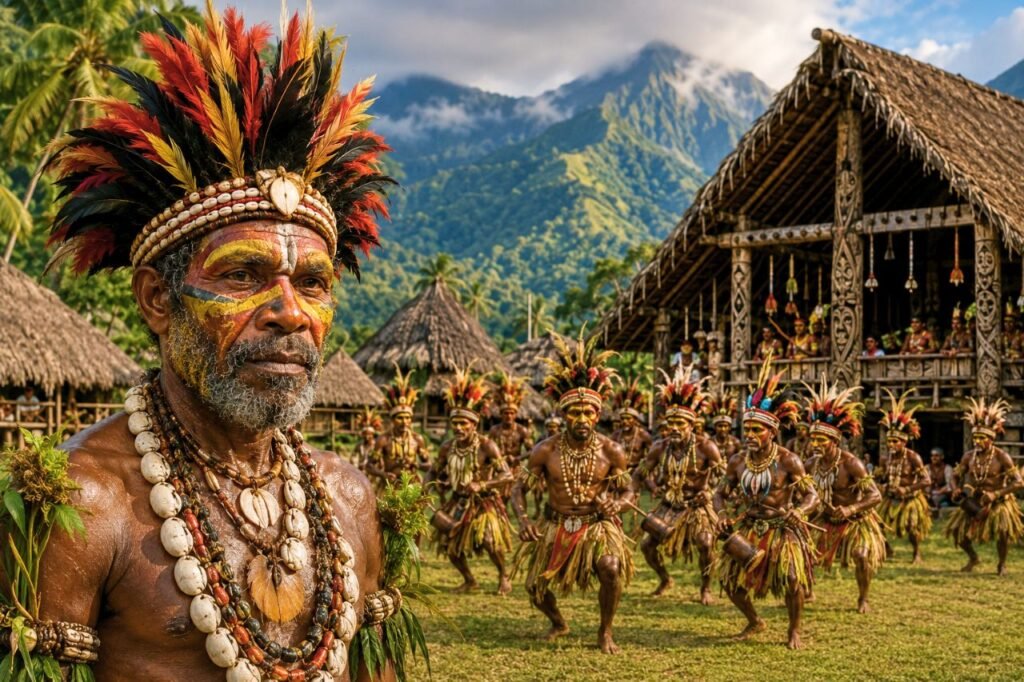
Traditional Attire (Bilas)
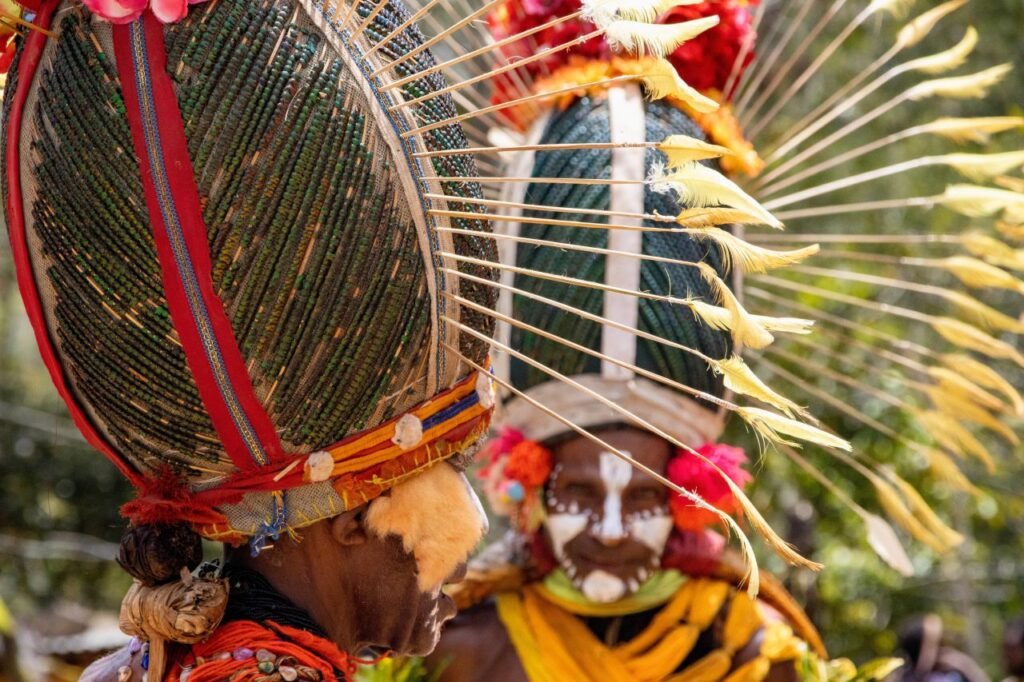
- Bilas (Cultural Body Decoration): Worn during ceremonial gatherings. Includes elaborate headdresses crafted from Bird of Paradise feathers, woven fiber skirts, shell necklaces, face painting made from natural clay dyes, and armbands decorated with aromatic leaves.
National Symbols
- Bird of Paradise (Kumul): The national emblem of PNG, featured prominently on the national flag and coat of arms to symbolize freedom, beauty, and cultural identity.
- Kundu Drum: Hourglass-shaped wooden drums capped with lizard skin, representing the beat of national identity.
Music, Dance & Art
- Sing-Sing Cultural Festivals: World-famous cultural gatherings (such as the Goroka Show and Mount Hagen Cultural Show) where hundreds of rival tribes assemble in peace, competing through spectacular displays of dance, drumming, and ancestral body art.
- Musical Instruments:
- Kundu Drum: Beaten rhythmically during traditional chants and dances.
- Garamut Drum: Large carved wooden slit-drums used for long-distance communication and ceremonial signaling in Sepik and coastal regions.
- Visual Arts & Carvings: Sepik River wooden ancestral masks, spirit hooks, carved canoes, and colorful woven string bags (Bilum) worn across the forehead or shoulders by men and women nationwide.
Summary
Papua New Guinea Culture stands as a monumental testament to indigenous diversity, communal resilience, and living ancestral tradition. Through the enduring strength of the Wantok system, the beauty of the Sing-Sing, and a deep connection to land and family, Papua New Guinea continues to shine as one of Oceania’s most authentic cultural treasures.
At Best Culture Insight, we see culture as the heartbeat of every society – the way people live, connect, and express their identity.