Cuba’s Santería — When African Gods Wear Catholic Costumes
Posted in :

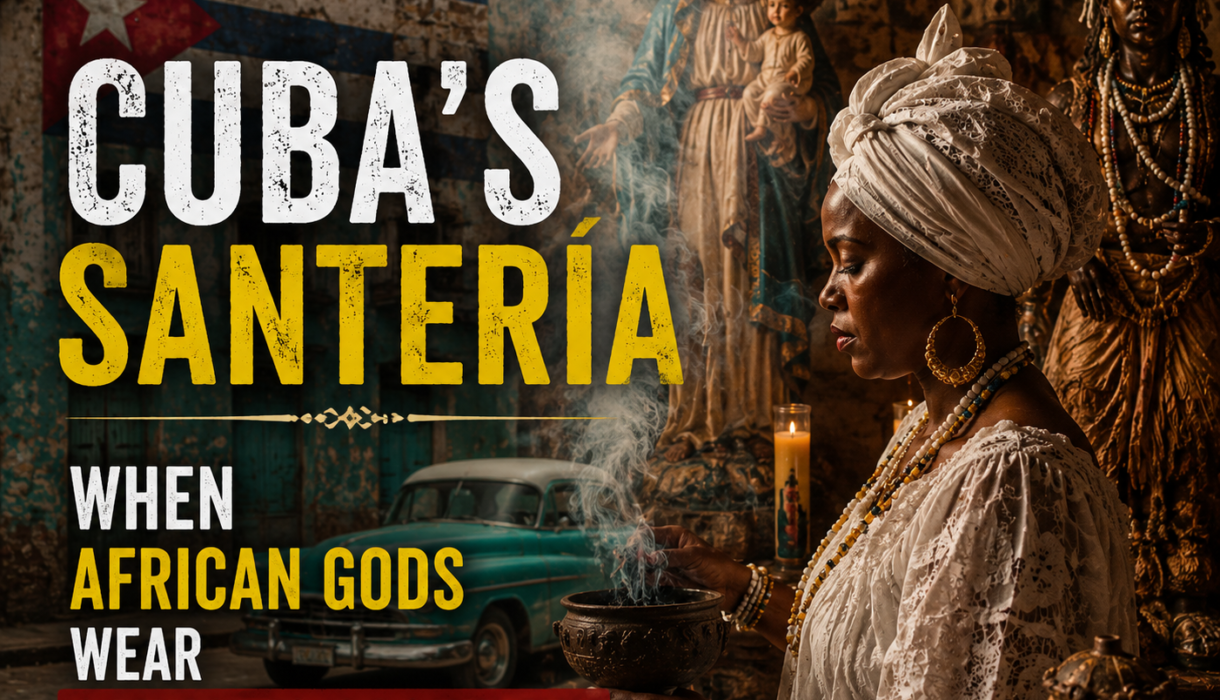
In the heart of Cuba, behind the colorful colonial facades and vintage cars, thrives Santería—an enigmatic, soul-stirring faith where West African spiritual traditions seamlessly blend with Spanish Catholicism. Known formally as La Regla de Ocha, Santería emerged not out of choice, but out of sheer survival during the transatlantic slave trade. Today, it stands as one of the most vibrant afro-syncretic religions in the world, practiced by millions who seek harmony, divine protection, and connection to their ancestors. At its core, Santería is a masterclass in cultural resilience, illustrating how ancient African deities managed to survive centuries of oppression by adopting the outer garb of Catholic saints.
The Birth of Syncretism: Faith as a Mask
When millions of enslaved Yoruba people were brought from West Africa to Cuban sugar plantations between the 16th and 19th centuries, Spanish colonial laws forced them to convert to Roman Catholicism. Openly worshipping their native gods, known as Orishas, was strictly forbidden and punishable by death. In response, the Yoruba ingeniously mapped their deities onto Catholic saints based on shared symbols, colors, and virtues. To the Spanish masters, an enslaved person praying before a statue of Saint Barbara appeared to be a devout Catholic; in reality, the worshipper was invoking Chango, the fierce Yoruba Orisha of thunder, drumming, and fire who shared Saint Barbara’s iconic red robes.
Meeting the Orishas: The Divine Spirits
In Santería, the Orishas are not distant, abstract beings, but active forces of nature that govern human emotions, health, and destiny. Each Orisha possesses a distinct personality, favorite foods, specific rhythms, and a dual Catholic identity. For instance, Yemayá, the motherly goddess of the ocean, is venerated alongside Our Lady of Regla, the patron saint of Havana’s bay. Ochún, the deity of sweet waters, love, and fertility, is paired with Our Lady of Charity (La Virgen de la Caridad del Cobre), Cuba’s patron saint. Eleguá, the tricky messenger who holds the keys to all roads and choices, is syncretized with the Holy Infant of Atocha.
Rituals, Rhythms, and Divine Communication
Unlike orthodox Western religions built around centralized churches and formal texts, Santería is an oral, community-centered practice conducted in private homes known as ilés. Devotees interact with the Orishas through divination, offerings of fresh fruit and plants, and vibrant drumming ceremonies known as bembés. During a bembé, sacred Batá drummers play intricate polyrhythmic patterns tailored to specific Orishas, inducing trance states where the spirits possess chosen practitioners to deliver direct wisdom, healings, and warnings to the gathered community.
A Modern Living Tradition
Over two centuries after its formation, Santería has transcended its secretive origins to become an essential pillar of contemporary Cuban identity and global diaspora culture. Initiates, identifiable by their pristine white clothing (iyawo) worn for a full year after initiation, walk the streets of Havana alongside tourists and Catholic priests. Santería proves that spiritual identity is not rigid; it adapts, evolves, and overcomes. By wrapping their ancient sacred knowledge in the visual cloak of Catholic iconography, the ancestors of Santería ensured that their gods were never forgotten—they simply learned to wear new costumes.