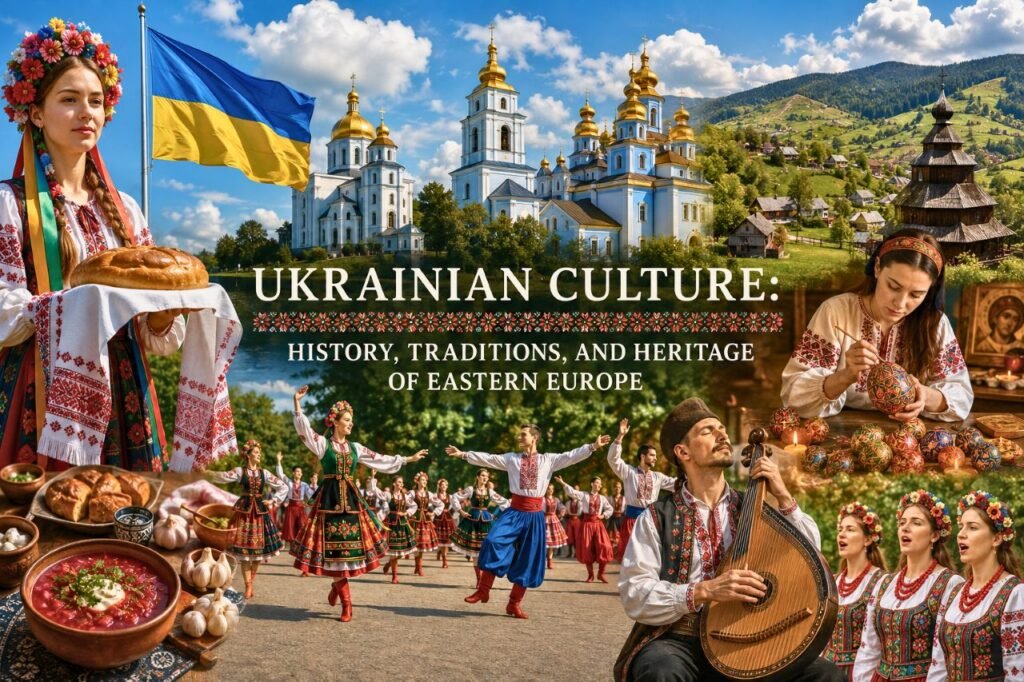
The culture of Ukraine is a vibrant and resilient tapestry woven from centuries of rich history, deep-rooted agricultural traditions, and an enduring artistic spirit. Situated at the crossroads of Eastern Europe and Western Asia, Ukraine is home to a warm, hospitable people whose identity has been shaped by the fertile steppes, dense forests, and historic waterways of the region. From intricate folk embroidery to soulful polyphonic singing, Ukrainian cultural heritage reflects an unyielding commitment to community, freedom, and self-expression. Understanding Ukrainian life provides a profound glimpse into a civilization that has continually preserved its unique identity through times of prosperity and historic hardship.
History & Origins
Ukrainian culture traces its origins back thousands of years. Early civilizations, such as the Neolithic Trypillian culture (5500–2750 BCE), laid the foundations of agrarian living, pottery, and symbolic art in the region. During antiquity, Scythian nomads and Greek traders inhabited the Black Sea coast, leaving behind elaborate gold artifacts and cultural influences.

Scenic view of traditional thatched roof houses in rural Kyiv, Ukraine during sunset.
The golden age of early Ukrainian identity emerged with the establishment of Kievan Rus in the 9th century. centered around the capital city of Kyiv, this powerful medieval state unified East Slavic lands. The adoption of Orthodox Christianity by Grand Prince Volodymyr the Great in 988 CE transformed the architectural, literary, and spiritual landscape of the region.
Following the Mongol invasions of the 13th century and subsequent periods under the Polish-Lithuanian Commonwealth, the Cossack era (16th–18th centuries) arose as a central pillar of Ukrainian national consciousness. The Zaporozhian Cossacks—free democratic warriors operating along the Dnieper River—became enduring symbols of liberty and independence.
Despite centuries of foreign rule under the Russian Empire, the Austro-Hungarian Empire, and later the Soviet Union, Ukrainian artists, writers, and scholars persistently safeguarded their cultural heritage. Modern Ukraine re-established its full independence in 1991, continuing to celebrate and defend its distinct national identity on the global stage.
Culture, Traditions & Customs
Ukrainian social life is rich with customs that blend ancient pagan rituals with Christian traditions.
- Marriage Traditions: Traditional Ukrainian weddings (Vesillya) are multi-day celebrations filled with music, dancing, and elaborate rituals. A central component is the Korovai, a sacred embroidered bread decorated with dough birds and flowers, symbolizing unity and blessing. Couples often step on a traditional embroidered towel (Rushnyk) during the ceremony; tradition holds that whoever steps on it first will be the head of the household.
- Naming Ceremonies & Birth Rites: Children are traditionally baptized in the Christian faith soon after birth. Godparents (Kumy) play a crucial, lifelong role in spiritual and moral guidance.
- Festivals & Seasonal Holidays:
- Pysanky (Easter): Ukrainian Easter (Velykden) is famed for Pysanky—eggs decorated with detailed wax-resist batik patterns using sacred geometric and floral symbols representing rebirth and protection.
- Kupala Night (Ivan Kupala): Celebrated during the summer solstice, this ancient pagan ritual involves weaving flower crowns, jumping over bonfires for purification, and searching for the mythical fern flower.
- Svyat Vechir (Christmas Eve): Celebrated with a sacred 12-dish meatless dinner representing the twelve apostles, starting when the first evening star appears.
- Rites of Passage: High school graduation (Ostanniy Dzvin or “Last Bell”) and traditional harvest festivals (Obzhynky) mark significant personal and community milestones.
Languages & Communication
- Languages Spoken: Ukrainian is the official state language, belonging to the East Slavic group of the Indo-European language family. Written in a modified Cyrillic alphabet, Ukrainian is renowned for its melodic phonetics. Russian is also spoken by a portion of the population, and bilingualism is common.
- Greetings & Etiquette:
- “Dobroho dnya” (Good day) and “Pryvit” (Hi/Hello) are standard greetings.
- A warm handshake with direct eye contact is typical among acquaintances.
- Hospitality is paramount: guests are traditionally welcomed with bread and salt (Khlib-Sil), a symbol of goodwill and respect.
- Proverbs & Expressions:
- “Slovo ne horobets, vyletyt — ne spijmash” (“A word is not a sparrow; once it flies out, you cannot catch it”) — highlighting the value of thoughtful speech.
- “Shcho posiyesh, te y pozhnesh” (“What you sow, that you shall reap”).
Geography
Ukraine is the second-largest country in Europe by land area, occupying a strategic location in Eastern Europe along the northern coast of the Black Sea and the Sea of Azov.
- Terrain: The geography is dominated by vast, fertile plains (steppes) and plateaus. The country is renowned for its Chernozem (“black soil”), among the most fertile agricultural land in the world.
- Mountains & Waters: The Carpathian Mountains in the west offer dense pine forests, alpine meadows, and unique highland subcultures (such as the Hutsuls). The Dnieper (Dnipro) River, one of Europe’s major waterways, bisects the country from north to south before emptying into the Black Sea.
Economy
Historically known as the “Breadbasket of Europe,” Ukraine’s economy has long been anchored in agriculture, exporting wheat, corn, barley, and sunflower oil globally.
- Key Sectors: In addition to heavy industries like metallurgy, mining, and machine manufacturing, Ukraine has rapidly emerged as a prominent global IT and technology hub, boasting a large workforce of software developers and digital startups.
- Crafts & Tourism: Rural eco-tourism, traditional handicrafts, and cultural heritage sites contribute significantly to regional micro-economies.
Politics
Ukraine is a unitary semi-presidential representative democratic republic.
- Governance: The President serves as the head of state, while the Prime Minister leads the Cabinet of Ministers as head of government. Legislative power is vested in the unicameral parliament, known as the Verkhovna Rada.
- Civic Values: Modern Ukrainian political culture is heavily characterized by strong civic engagement, democratic aspiration, and a commitment to European integration.
Ethnic Groups
While ethnic Ukrainians form the vast majority of the population (over 77%), Ukraine is a multi-ethnic nation home to diverse communities:
- Key Minorities: Native minority populations include Crimean Tatars (the indigenous Turkic people of Crimea), ethnic Moldovans, Bulgarians, Hungarians, Poles, Romanians, and Jewish communities.
- Cultural Subgroups: Within the Ukrainian ethnicity, distinct ethnographic subgroups retain unique folklore and dialects, such as the Hutsuls, Boykos, and Lemkos of the Carpathian mountain regions.
Beliefs & Values
- Religion & Spirituality: The predominant faith is Eastern Orthodox Christianity, divided primarily under the Autocephalous Orthodox Church of Ukraine. Ukrainian Greek Catholicism is widely practiced in western regions. Small communities of Protestants, Roman Catholics, Muslims (particularly Crimean Tatars), and Jewish adherents also contribute to the nation’s spiritual life.
- Moral Values & Worldview: Ukrainian worldview prioritizes family unity, deep attachment to the land, respect for elders, and personal freedom (Volya). Social life revolves around strong neighborly support systems and generosity toward guests.
Food & Cuisine
Ukrainian cuisine is hearty, flavorful, and deeply tied to the land’s agricultural yield.
- Iconic Dishes:
- Borscht: A rich beet-based soup made with vegetables, meat, and garlic, served hot with a dollop of sour cream (Smetana) and garlic rolls (Pampushky). UNESCO recognized Ukrainian borscht-making on its List of Intangible Cultural Heritage.
- Varenyky: Dumplings stuffed with various savory or sweet fillings, including mashed potatoes, sauerkraut, cottage cheese, cherries, or blueberries.
- Holubtsi: Cabbage rolls stuffed with seasoned rice and minced meat, slow-cooked in tomato sauce.
- Salo: Cured pork fatback, traditionally sliced thin and eaten with rye bread, garlic, and green onions.
- Cultural Meaning: Food is an expression of love and hospitality. Leaving a table hungry in a Ukrainian home is considered almost impossible, as hosts take pride in abundant offerings.
Clothing & Symbols
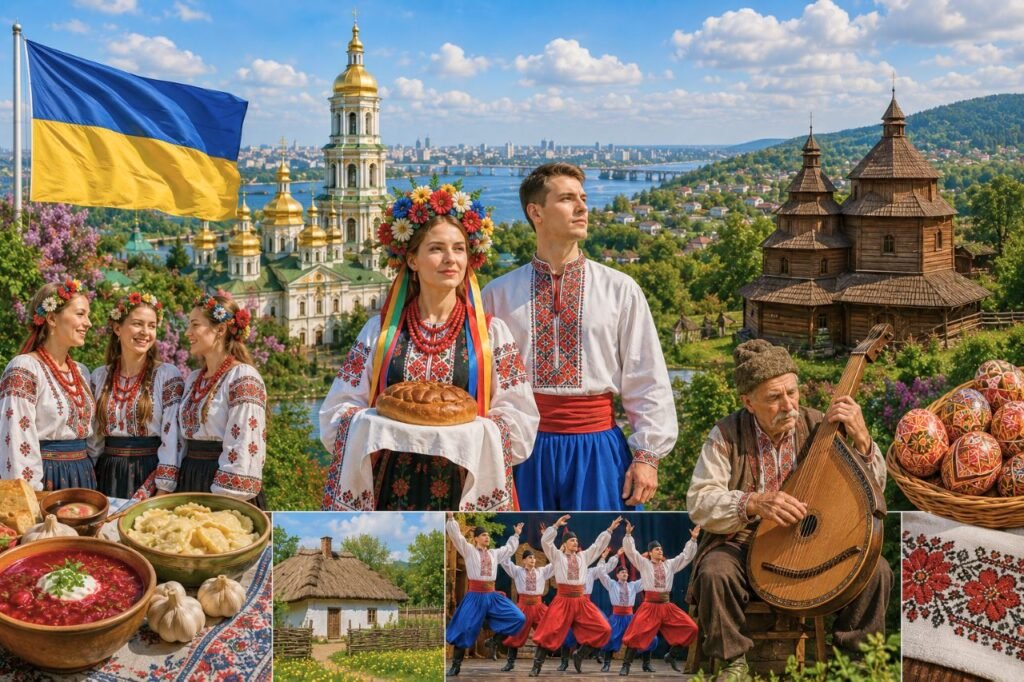
- Vyshyvanka: The traditional embroidered shirt or dress, known as the Vyshyvanka, is the national symbol of Ukraine. The geometric and floral patterns, as well as the thread colors (red for love, black for land/sorrow, white for purity), vary by region and act as protective talismans (Oberih).
- Vinok: The traditional Ukrainian flower wreath, worn by young women during celebrations, adorned with colorful ribbons representing youth and purity.
- National Symbols:
- Tryzub (Trident): The coat of arms of Ukraine, dating back to the grand princes of Kievan Rus.
- Colors: Blue (representing the clear sky) and Yellow (representing fields of wheat).
- Grave/Plant Symbols: The Kalyna (guelder-rose bush) symbolizes national identity, female beauty, and homeland.
Music, Dance & Art
- Instruments: The Bandura, a traditional multi-stringed plucked instrument combining elements of a lute and zither, is central to Ukrainian folk music. Historically, blind itinerant bards (Kobzars) traveled the countryside singing epic historical ballads (Dumy).
- Folk Dance: The Hopak, known as the national dance of Ukraine, originated among the Cossacks. It features acrobatic leaps, high kicks, and energetic group formations performed in vibrant traditional attire.
- Art & Painting:
- Petrykivka Painting: A decorative folk-art painting style characterized by vivid floral motifs executed with fine brushes (often made from cat hair). It is recognized by UNESCO as Intangible Cultural Heritage.
- Naive Art: World-renowned folk artists like Maria Prymachenko gained international acclaim for imaginative, colorful depictions of mythical beasts and village life.
Summary
Ukrainian culture is a profound testament to human resilience, creativity, and communal warmth. Rooted in ancient agricultural traditions and medieval statehood, Ukraine has cultivated a distinct heritage marked by artistic expression, rich culinary art, and an unwavering love for freedom. Whether through the vibrant stitches of a Vyshyvanka, the rhythmic strings of a Bandura, or the welcoming aroma of homemade Borscht, the traditions of Ukraine continue to inspire, educate, and enrich global cultural diversity.
At Best Culture Insight, we see culture as the heartbeat of every society – the way people live, connect, and express their identity.