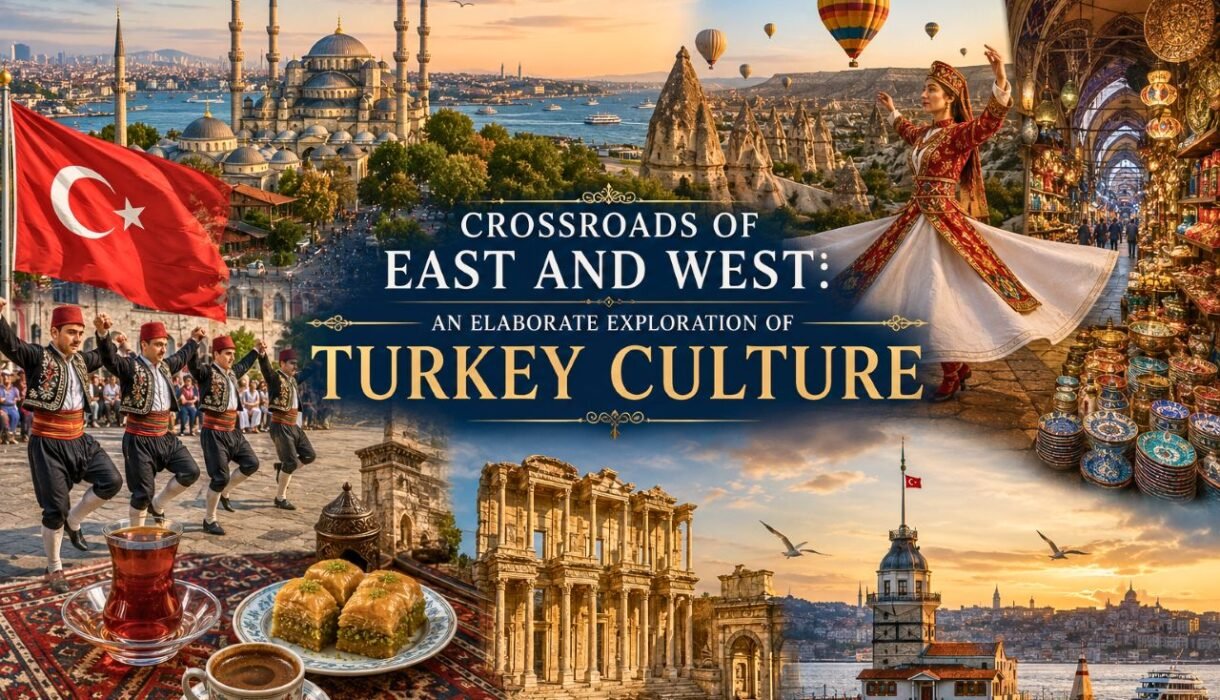

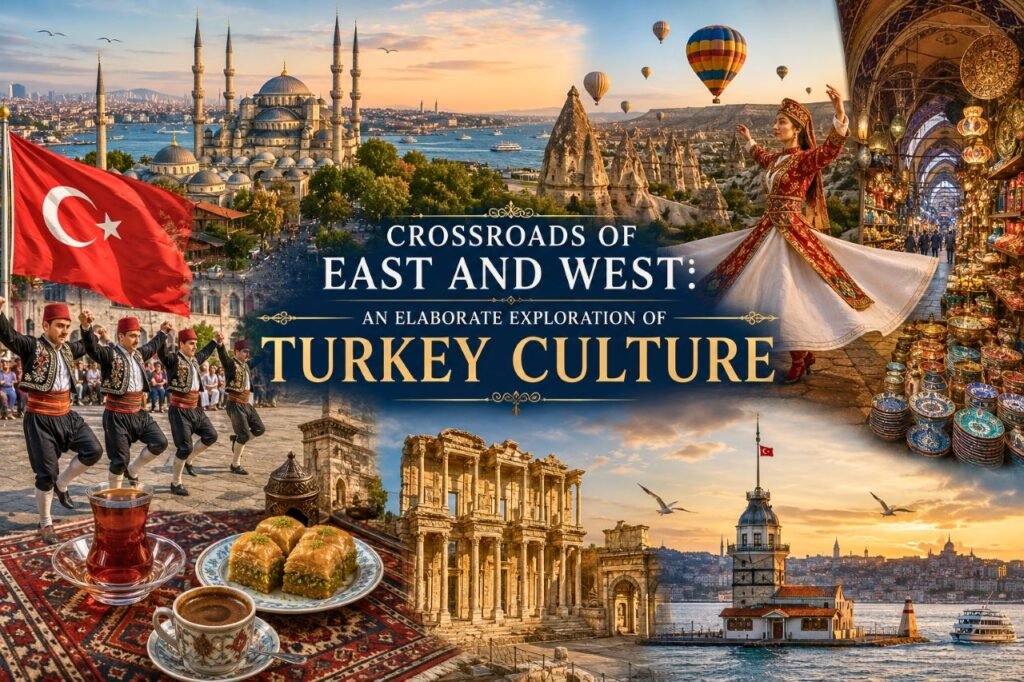
Straddling two continents where Southeastern Europe meets Western Asia, Turkey is a transcontinental nation rich in historical splendor, natural diversity, and artistic brilliance. The multi-layered Culture of Turkey—known natively as Türk kültürü—is a magnificent fusion of ancient Anatolian civilizations, Central Asian Turkic heritage, Byzantine majesty, and the expansive influence of the Ottoman Empire. Positioned along historic trade routes like the Silk Road, the Turkish people are celebrated around the globe for their legendary hospitality (misafirperverlik), vibrant culinary mastery, deep familial devotion, and a seamless blend of traditional customs with modern European life. From the historic minarets and bustling bazaars of Istanbul to the fairy chimneys of Cappadocia, Turkey offers an enchanting cultural journey across time.
History & Origins
Turkey’s cultural heritage spans thousands of years of human civilization, evolving through sequential empires that shaped the Mediterranean and Near Eastern worlds.
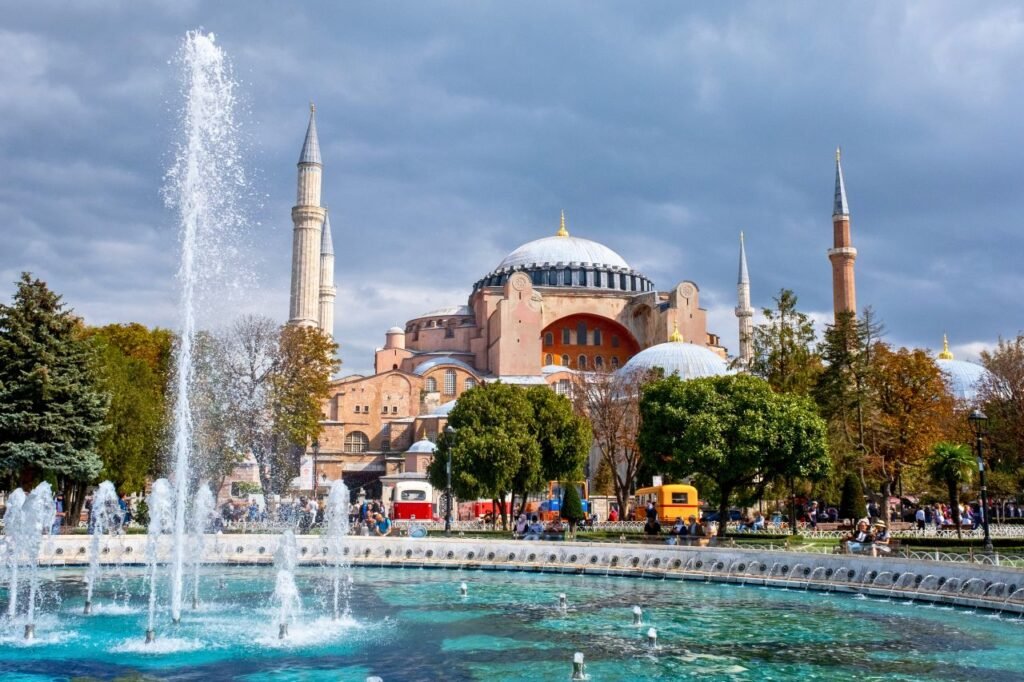
- Ancient Anatolian Cradle: Anatolia (the Asian peninsula of Turkey) is home to some of humanity’s earliest settlements, including Göbekli Tepe (dating back to 9600 BCE, recognized as the world’s oldest known temple complex), Çatalhöyük, and the legendary city of Troy. Empires such as the Hittites, Phrygians, Lydians, and Greeks flourished here.
- The Byzantine Era: As part of the Roman Empire, Emperor Constantine founded Constantinople (modern Istanbul) in 330 CE as the new Roman capital. For over a millennium, the Byzantine Empire made the region a radiant center of Eastern Orthodox Christianity and Classical learning.
- Turkic Migration & Seljuk Dynasty: During the 11th century, nomadic Turkic tribes migrated westward from Central Asia into Anatolia. Following the victory at the Battle of Manzikert (1071), the Seljuk Empire established Islamic Turkic culture, blending Central Asian customs with Persian art and Islamic philosophy.
- The Ottoman Empire (1299–1922): Founded by Osman I, the Ottoman Empire grew into a global superpower spanning Southeastern Europe, Western Asia, and North Africa. Following the conquest of Constantinople in 1453 by Sultan Mehmed II, the city became the heart of an empire that fostered imperial architecture, calligraphy, and diverse multi-ethnic traditions.
- The Republic of Turkey: Following World War I and the War of Independence, Mustafa Kemal Atatürk founded the secular Republic of Turkey in 1923. Atatürk initiated sweeping modernizing reforms—including adopting the Latin alphabet, granting women full political rights, and establishing a European-style legal system.
Culture, Traditions & Customs
Legendary Hospitality (Misafirperverlik)
In Turkish custom, a guest is viewed as a “guest from God” (Tanrı misafiri). Hosts go to extraordinary lengths to ensure visitors are comfortable, offering endless glasses of tulip-shaped black tea (çay), Turkish coffee, and sweet delicacies. Refusing hospitality is uncommon; even casual business visits begin with warm tea and conversation.
Marriage & Life Milestones
Turkish weddings (düğün) are vibrant, multi-day celebrations filled with music and folk dancing:
- Kına Gecesi (Henna Night): Held the night before the wedding, the bride, her female relatives, and friends gather wearing traditional embroidered dresses (bindallı). Henna is applied to the bride’s palms accompanied by folk songs that balance joyful celebration with touching farewells to her maiden home.
- Wedding Celebrations: On the wedding day, a convoy of cars decorated with flowers and ribbons gathers to pick up the bride. Guests pin gold coins and jewelry onto red silk ribbons draped over the newlyweds as gifts for their future home.
Rites of Passage: Sünnet Ceremonies
For young boys, the circumcision ceremony (Sünnet Töreni) is a major religious and family milestone. The child wears a elaborate satin prince outfit with a cape and scepter, celebrated with family feasts, music, and gifts.
Languages & Communication
Language Spoken
The official national language is Turkish (Türkçe), a Turkic language spoken by over 85 million people worldwide. Turkish features vowel harmony and agglutination (building words by adding suffixes to root words). The shift from Ottoman Arabic script to the Latin alphabet in 1928 dramatically increased literacy rates and modernized national communication.
In Eastern and Southeastern regions, Kurdish (Kurmanji) is widely spoken, alongside minority languages like Arabic, Laz, Armenian, and Greek. English, German, and French are widely spoken in major tourist cities and business sectors.
Communication Etiquette
Communication in Turkey is expressive, polite, and respectful of social hierarchy. Respect for elders is paramount.
- Greetings: A warm handshake paired with direct eye contact is standard. Among close friends and family, greetings include two cheek kisses or gently touching temples. A traditional sign of deep respect toward elders involves kissing the back of their right hand and touching it to one’s forehead (el öpmek).
- Key Expressions:
- Merhaba (Hello)
- Teşekkür ederim (Thank you)
- Hoş geldiniz (Welcome—to which the response is Hoş bulduk, “We feel welcomed”)
- Afiyet olsun (Bon appétit / May it bring health)
Proverbs & Wisdom
- “Bir fincan kahvenin kırk yıl hatırı vardır.”
Meaning: “A single cup of coffee is remembered for forty years”—emphasizing that even small acts of friendship create lifelong bonds.
- “Komşu komşunun külüne muhtaçtır.”
Meaning: “A neighbor needs even the ashes of a neighbor”—highlighting community solidarity and reliance on those nearby.
Geography
Covering 783,562 square kilometers, Turkey boasts a unique transcontinental location connecting Eastern Europe (East Thrace) and Western Asia (Anatolian peninsula), separated by the Turkish Straits (the Bosphorus, Sea of Marmara, and Dardanelles).
- Coastal Regions: Ringed by three seas—the Black Sea to the north, the Aegean Sea to the west, and the Mediterranean Sea to the south—offering turquoise coastlines, olive groves, and temperate maritime climates.
- Anatolian Plateau: The vast interior features rolling steppes, volcanic landscapes, and high mountain ranges like the Taurus and Pontic mountains, culminating in Mount Ararat (5,137 meters) in the east.
- Natural Wonders: Includes the white travertine thermal terraces of Pamukkale and the surreal rock valleys and underground cities of Cappadocia.
Economy
Turkey possesses an emerging market economy driven by industrial manufacturing, agricultural exports, services, and world-class tourism.
Key industrial pillars include automobile manufacturing, textile and garment production, consumer electronics, shipbuilding, and construction engineering. Turkey is also the world’s leading exporter of hazelnuts, figs, apricots, and raisins. As one of the top tourist destinations in the world, cities like Istanbul, Antalya, and Bodrum welcome tens of millions of international visitors annually.
Politics
Turkey is a presidential republic.
- President of the Republic: Serves as both the Head of State and Head of Government, holding executive authority.
- Grand National Assembly of Turkey (Türkiye Büyük Millet Meclisi): A 600-member unicameral parliament elected by popular vote through proportional representation for five-year terms, holding legislative duties.
- Administrative Structure: The nation is divided into 81 provinces (il), organized within seven geographical regions.
Ethnic Groups
Turkey’s demographic makeup reflects a rich historical mosaic formed over centuries of empire and migration:
| Ethnic Group | Population Context | Cultural Heritage |
| Turks | ~70–75% majority nationwide | Turkic language base; Islamic traditions blended with modern European lifestyle. |
| Kurds | ~18–20% concentrated in East/Southeast | Rich Indo-European linguistic heritage (Kurmanji); distinct folk music and Newroz celebrations. |
| Arabs | Southern border provinces (Hatay, Şanlıurfa) | Arabic language traditions; historic Levant culinary and cultural influences. |
| Laz, Circassians, Georgians, Balkan Turks | Black Sea and Marmara regions | Caucasian and Balkan folk dances, vibrant music traditions, and distinct local cuisines. |
Beliefs & Values
Religious Landscape
The overwhelming majority (~98%) of the population identifies as Muslim, predominantly Sunnis alongside a significant Alevi community. Modern Turkey is constitutionally a secular state, guaranteeing freedom of worship to religious minorities, including Greek Orthodox, Armenian Apostolic, Syriac Christians, and Jewish communities.
Core Cultural Values
- Family & Community Focus: Family forms the core pillar of social life. Multi-generational gatherings, Sunday family breakfasts, and caring for elderly relatives are central duties.
- Nazar Boncuğu (The Evil Eye Protection): The famous blue glass bead featuring concentric circles resembling an eye is ubiquitous across homes, cars, and jewelry. It is believed to ward off envious glances and bring good luck.
Food & Cuisine
Turkish cuisine (Türk mutfağı) is a world-renowned culinary art form inherited from Ottoman court kitchens, blending Central Asian, Middle Eastern, Balkan, and Mediterranean cooking styles.
- Kahvaltı (Turkish Breakfast): A lavish morning feast featuring fresh cheeses (white cheese, kaşar), olives, cucumbers, tomatoes, butter, honey with clotted cream (kaymak), eggs with spicy sausage (sucuklu yumurta), and fresh bread (simit).
- Kebabs & Meze: Ranging from Döner Kebab to region-specific delights like Adana Kebab (minced spiced lamb on flat skewers) and İskender Kebab. Meals often begin with Meze—small cold appetizers such as hummus, haydari (garlic yogurt dip), and stuffed grape leaves (sarma).
- Baklava & Turkish Delight (Lokum): Layers of paper-thin phyllo pastry filled with finely chopped pistachios or walnuts, sweetened with sugar syrup.
- Turkish Coffee (Türk Kahvesi): Inscribed on the UNESCO Intangible Cultural Heritage list, finely ground coffee is simmered in a copper pot (cevze) and served unfiltered in small cups, accompanied by a glass of water and Turkish delight.
Clothing & Symbols
Traditional Attire & Folk Dress
While daily fashion in modern Turkey matches European and global urban trends, traditional folk costumes (Yöresel Kıyafetler) shine during regional festivals:
- Efe & Zeybek Costume: From the Aegean region, featuring baggy knee-length trousers (şalvar), embroidered waistcoats, sash belts, and wrapped headpieces (fez or poşu).
- Bindallı: Luxurious velvet gowns intricately embroidered with silver or gold metallic threads (maraş işi), traditionally worn by brides during Henna Night.
Iconic Symbols
- The Tulip (Lale): Originally wild flowers from Central Asia cultivated into delicate art forms during the Ottoman Empire, the tulip remains an emblem of beauty and elegance in Turkish tilework and design.
- The Crescent and Star: Displayed proudly on the crimson national flag (Türk Bayrağı), representing national independence, sovereignty, and history.
Music, Dance & Art
Performing Arts & Instruments
Turkish music spans soulful traditional folk songs (Halk Müziği) to Classical Ottoman court compositions and modern Turkish pop:
- Traditional Instruments: The Saz or Bağlama (a long-necked plucked lute, considered the national instrument), the reed flute (Ney), frame drum (Def), and double-reed Zurna.
- Whirling Dervishes (Sema): A spiritual Sufi ritual inspired by the 13th-century mystic poet Jalal al-Din Muhammad Rumi. Dervishes spin in rhythmic grace wearing white robes to attain spiritual transcendence and divine love.
Folk Dances (Halk Oyunları)
- Zeybek: A heroic Aegean dance featuring slow, powerful movements and sudden leaps.
- Horon: A fast-paced Black Sea coastal dance characterized by rapid shoulder movements and footwork mirroring the movement of anchovies in fishnets.
- Halay: A energetic circle and line dance performed across Anatolia during weddings, where dancers link fingers and step in unison to the beat of drum and zurna.
Visual Arts & Crafts
- Ebru (Marble Painting): The art of creating colorful patterns by floating oil dyes on water and transferring them onto paper.
- Tilework (Çini): World-famous hand-painted ceramic tiles from İznik and Kütahya, featuring cobalt blue, turquoise, and coral red floral designs adorning historic mosques and palaces.
Summary
In summary, Turkey Culture represents an extraordinary bridge between continents, empires, and eras. By preserving ancient traditions of hospitality, honoring rich culinary and artistic heritage, and fostering vibrant community life, the Turkish people offer an inspiring example of cultural resilience and synthesis. Turkey warmly welcomes travelers to share a cup of tea, witness centuries of architectural beauty, and experience the timeless spirit of Anatolia.
At Best Culture Insight, we see culture as the heartbeat of every society – the way people live, connect, and express their identity.