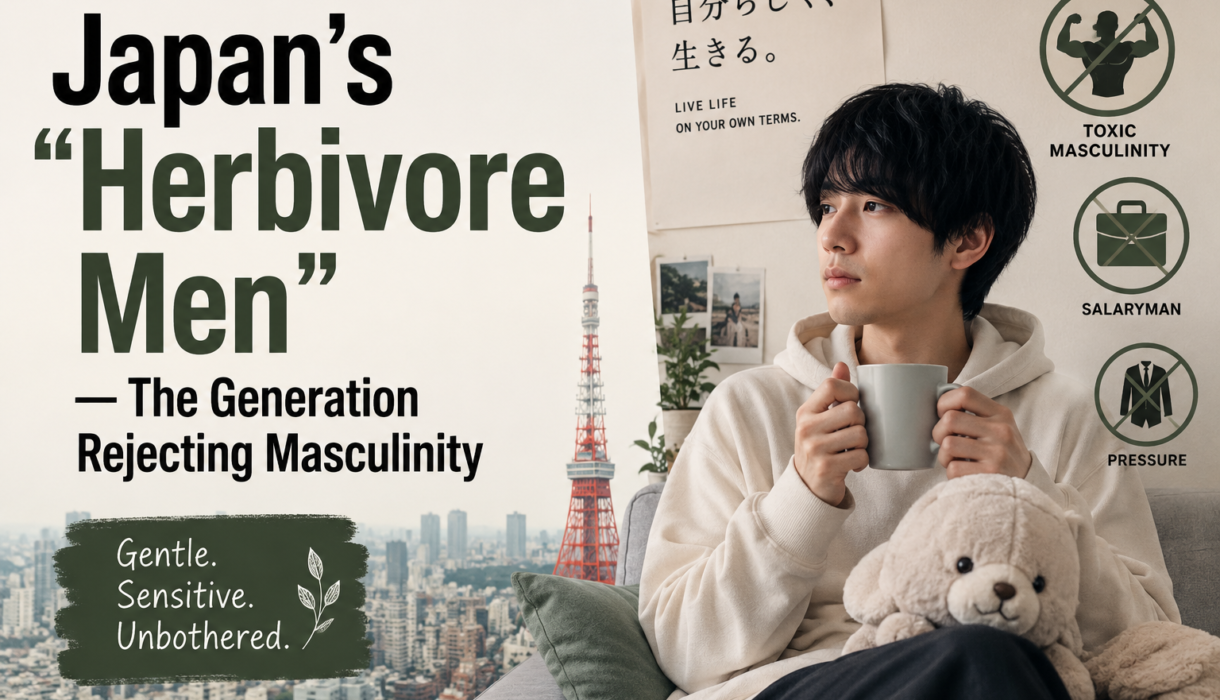

In Japan, a fascinating demographic shift has quietly dismantled decades of deeply entrenched gender expectations. Coined as sōshoku-kei danshi (literally meaning “grass-eating” or “herbivore men”), this term describes a generation of young men who have consciously chosen to step away from traditional expectations of male dominance. Unlike their fathers, who defined their manhood through corporate ambition, financial dominance, and aggressive courtship, herbivore men are characterized by their gentle demeanor, passivity in romance, and preference for personal peace over societal competition. This phenomenon is not merely a fleeting youth subculture; it represents a profound, structural evolution in how modern masculinity is defined in East Asia.
Escaping the Shadow of the “Salaryman”
To understand the rise of the herbivore man, one must look at the grueling lifestyle of the generation that preceded them. For decades, the ideal Japanese male was embodied by the “salaryman”—a dedicated corporate warrior who sacrificed his health, personal life, and family time for lifetime employment and societal status. Having witnessed their fathers suffer from extreme burnout and karōshi (death by overwork), younger men have flatly rejected this high-stress blueprint. By choosing less demanding careers and refusing to tie their self-worth to a corporate ladder, herbivore men are prioritizing mental well-being and personal freedom over institutional loyalty.
Redefining Romance and Male Consumerism
Perhaps the most visible trait of herbivore men is their passive approach to romance and relationships. Traditional “carnivorous” dating expectations placed the entire burden of pursuit, financial provision, and marriage proposal on the man. Opting out of this high-pressure dynamic, herbivore men often choose platonic friendships, singlehood, or a “wait-and-see” approach to dating. This shift has redirected their disposable income away from expensive dates and status symbols like luxury cars, funneling it instead into self-care, personal grooming, and fashion. Consequently, they have driven an economic boom in male cosmetics and gender-neutral fashion, proving that modern masculinity can be soft, expressive, and nurturing.
The Economic Catalyst and Demographic Reality
While critics frequently accuse herbivore men of accelerating Japan’s declining birth rate, sociologists argue that their lifestyle is a rational response to decades of economic stagnation. Following the collapse of Japan’s economic bubble in the 1990s, the guarantee of stable, high-paying lifetime employment vanished, leaving many young men with contract or part-time work. Because Japanese cultural expectations still heavily pressure husbands to be the primary breadwinners, those lacking financial security simply choose to avoid dating and marriage entirely. In this light, “grass-eating” is not a sudden loss of virility, but rather a pragmatic adaptation to a rigid social structure that has failed to adapt to modern economic realities.
A New Path Forward for Global Masculinity
Ultimately, the emergence of Japan’s herbivore men serves as a mirror for global conversations regarding the pressures of modern manhood. Far from being a localized oddity, this generation is pioneering a lifestyle where vulnerability, personal happiness, and self-care take precedence over rigid societal scripts. By gracefully walking away from the exhausting demands of hyper-masculinity, these men are demonstrating that success and fulfillment do not require a constant state of competition. As societies worldwide continue to grapple with evolving gender dynamics, Japan’s quiet revolution offers a powerful blueprint for a gentler, more individualized future.