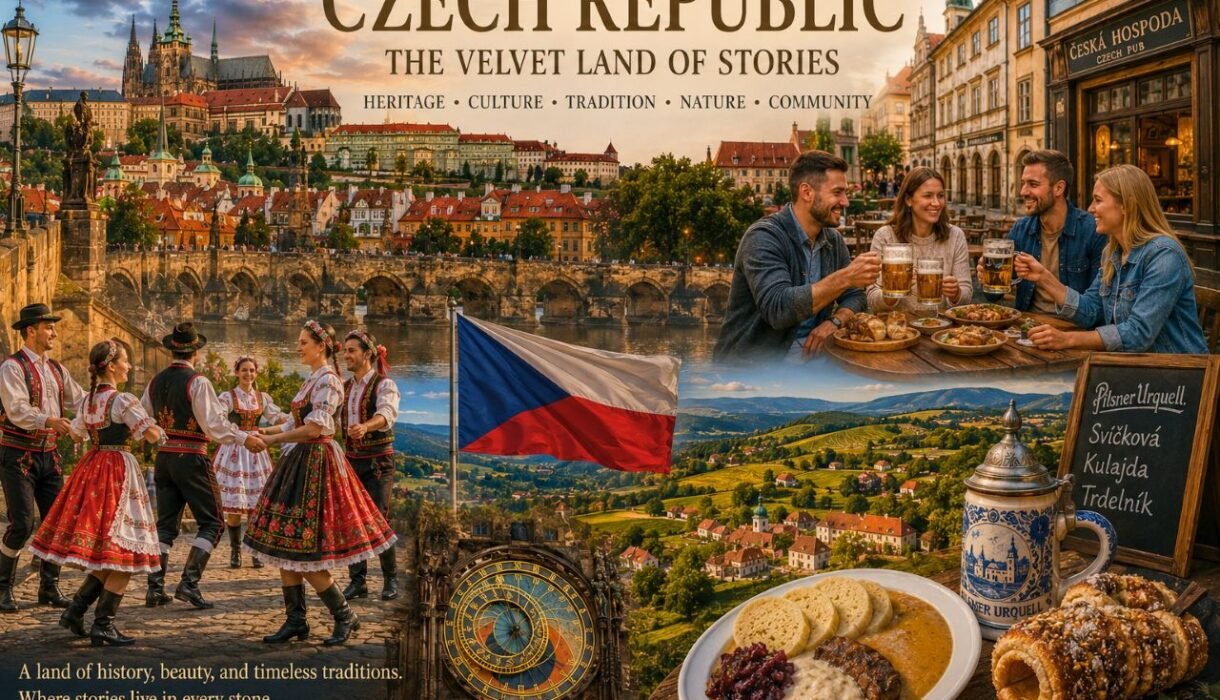
The Velvet Land of Stories: An Elaborate Exploration of Czech Republic Culture
Posted in :

Nestled in the absolute geographic center of Europe, the Czech Republic (Česko) represents a cultural landscape where Central European intellect meets a deeply rooted Slavic soul. The Czech people (Češi) are heirs to a heritage that has quietly witnessed the rise and fall of the Holy Roman Empire, the sophisticated heights of the Bohemian Renaissance, and the complex ideological shifts of the 20th century. – Culture
Known for their dry wit, masterful craftsmanship, and a relaxed philosophy toward daily life, Czechs have cultivated a society that prizes quiet intellectualism alongside an unparalleled love for nature and community gatherings. From the fairy-tale spires of Prague to the rolling vineyard hills of Moravia, Czech culture is defined by its ability to protect ancient traditions while operating as an innovative, forward-thinking European state.
History & Origins
The evolution of Czech culture is a dramatic saga of regional kingdom-building, religious reformation, and peaceful democratic transitions.
[Slavic Settlement 6th C.]➔[Great Moravian Empire]➔[Kingdom of Bohemia & Golden Age]➔[Habsburg Rule]➔[Czechoslovak Republic]➔[Velvet Revolution & Modern Sovereign State]
- The Slavic Dawn and the Crown of Bohemia: West Slavic tribes settled the fertile Bohemian basin in the 6th century. By the 14th century, the Kingdom of Bohemia reached its golden zenith under Holy Roman Emperor Charles IV. He transformed Prague into an imperial capital, establishing Central Europe’s first university in 1348 and constructing the iconic Charles Bridge.
- The Fires of Reformation and Foreign Rule: Long before Martin Luther, the Czech priest Jan Hus initiated a powerful religious reform movement in Prague. His martyrdom in 1415 triggered the Hussite Wars, cementing a historic local identity defined by independent thought and resistance to outside religious pressure. Following the Battle of White Mountain in 1420, the Czech lands were absorbed into the Catholic Austro-Hungarian Habsburg Empire for nearly 300 years.
- The 20th Century and the Velvet Spirit: Following the collapse of the empire in 1918, Czechs joined Slovaks to form democratic Czechoslovakia. After surviving Nazi occupation and forty years of Soviet-aligned Communist rule, the nation captured global admiration in 1989 with the Velvet Revolution—a remarkably peaceful, student-led democratic uprising led by the dissident playwright-philosopher Václav Havel. In 1993, Czechoslovakia peacefully split into two separate nations, creating the modern Czech Republic.
Culture, Traditions & Customs

Marriage & Family Milestones
Family structure in the Czech Republic centers on small nuclear units, with a heavy emphasis on personal independence and practical values. Traditional weddings (Svatba) feature several lighthearted customs designed to test the newlyweds.
Upon arriving at the wedding reception, a plate is intentionally broken at the couple’s feet; they must sweep up the shards together to prove their willingness to cooperate in marriage. They are then fed a traditional bowl of noodle soup using a single spoon while tied together in a single cloth banner, symbolizing their shared future.
Seasonal Festivals and Rites
- Velikonoce (Easter): Czech Easter features unique folk customs. Men weave decorative whips out of fresh willow twigs, called a pomlázka, and playfully whip women’s legs while singing carols. This ancient pre-Christian tradition is meant to bring health, youth, and vitality for the spring. In return, women gift the men beautifully hand-painted eggshells (kraslice).
- St. Nicholas Eve (Mikuláš): On December 5, a trio consisting of St. Nicholas (Mikuláš), an Angel (Anděl), and a Devil (Čert) walks through villages and cities. They ask children if they have been good throughout the year. Well-behaved children receive sweets and fruit, while mischievous ones receive a symbolic piece of coal.
Languages & Communication
The official language is Czech (Čeština), a highly complex and expressive West Slavic language written in the Latin alphabet.
Linguistic Heritage and Characteristics
The Czech language is famous for its use of diacritics (hooks and accents like č, š, ž) introduced by religious reformer Jan Hus to simplify spelling. It features the unique consonant sound ř, which is notoriously difficult for non-native speakers to pronounce.
The language serves as an essential source of historical identity, having been systematically revived by poets and scholars during the 19th-century Czech National Revival after centuries of official German-language dominance under Habsburg rule.
Proverbs & Communication Style
Czechs appreciate direct, understated, and polite communication. They value privacy and typically use formal titles until a close relationship is established.
- “Kolik jazyků znáš, tolikrát jsi člověkem.”
Translation: “You are as many times human as the number of languages you speak.” This proverb reflects the deep national value placed on foreign education and language acquisition.
Geography
The Czech Republic is a landlocked nation defined by a distinct geographical layout. It is historically and culturally divided into three traditional regions: Bohemia in the west, Moravia in the southeast, and a small sliver of Silesia in the northeast.
The central Bohemian landscape forms a massive low basin surrounded by an elevated ring of mountain ranges, including the Krkonoše (Giant) Mountains. The country’s primary waterways include the Vltava River (which bisects Prague) and the Labe (Elbe). Moravia features rolling hills and a milder climate, making it highly suitable for agricultural production and extensive winemaking.
Economy
The Czech Republic operates an advanced, high-income social market economy with a strong industrial tradition. It maintains the lowest unemployment rates in the European Union and boasts a highly skilled workforce. Key economic drivers include:
- Automotive Industry: Led by the historic native brand Škoda Auto, vehicle manufacturing forms the backbone of export trade.
- Precision Engineering and Metallurgy: Deeply rooted in cities like Brno and Ostrava.
- Information Technology: Producing globally successful software firms, notably in the cybersecurity sector (such as Avast).
- Brewing and Tourism: Generating immense revenue through agricultural exports and millions of international visitors drawn to historic preservation sites.
Politics
The Czech Republic is a multi-party parliamentary constitutional republic. The legislative branch consists of a bicameral Parliament: the Chamber of Deputies (200 members) and the Senate (81 members). Executive power is held by the Prime Minister, who serves as the head of government and manages the domestic cabinet.
The President serves as the formal head of state, representing the nation internationally and appointing constitutional court judges. The country became a member of NATO in 1999 and officially joined the European Union in 2004, maintaining full diplomatic integration within Western democratic institutions.
Ethnic Groups
The population displays a high degree of cultural continuity, with approximately 64% identifying as ethnically Czech and an additional 26% leaving the question optional but identifying within mainstream Czech culture.
The Moravians constitute the largest regional sub-group, representing roughly 5% of the population with a distinct pride in their southeastern folklore. The most significant historical minority communities include Ukrainians, Slovaks (who share close linguistic ties), Vietnamese (who arrived as guest workers during the socialist era and have built a thriving entrepreneurial community), and Roma people.
Beliefs & Values
Secularism and Freedom of Thought
The Czech Republic is historically recognized as one of the most secularized and non-religious nations in the world, with over 70% of the population identifying as atheists, agnostics, or non-believers. This widespread skepticism toward organized religion is a direct legacy of historical trauma, including forced counter-reformations under Habsburg rule and decades of official state atheism during the Communist regime.
The Švejkian Humor and Worldview
Rather than looking to religious institutions, Czechs guide their lives through a deep system of moral humanism, love for high education, and a unique coping mechanism known as Švejkian humor.
Named after the fictional character Josef Švejk from Jaroslav Hašek’s famous satirical novel, this worldview uses dark irony, absurd humor, and quiet sarcasm to deal with complex political situations or hardships, valuing personal freedom and common sense over dogmatic authority.
Food & Cuisine
Traditional Czech cuisine (Česká kuchyně) is hearty, comforting, and designed to balance the cool Central European climate. It focuses on meat dishes, thick sauces, and specialized doughs.
[Roasted Pork / Beef] + [Thick Root Vegetable Sauce] + [Steamed Bread Dumplings] = Traditional Czech Feast- Svíčková na Smetaně: The ultimate celebration dish. It consists of beef sirloin marinated and slow-roasted with root vegetables, which are then pureed into a velvety, creamy sauce. It is served with a dollop of cranberry sauce, whipped cream, and traditional Czech dumplings.
- Vepřo-Knedlo-Zelo: Considered the national dish, this classic combination features roasted pork served alongside yeast dumplings (knedlíky) and stewed sour cabbage (sauerkraut).
- Knedlíky (Dumplings): The essential side dish of Czech gastronomy. These are not small dumplings, but large loaves of leavened bread or potato dough that are steamed and sliced into discs, designed to soak up rich meat gravies.
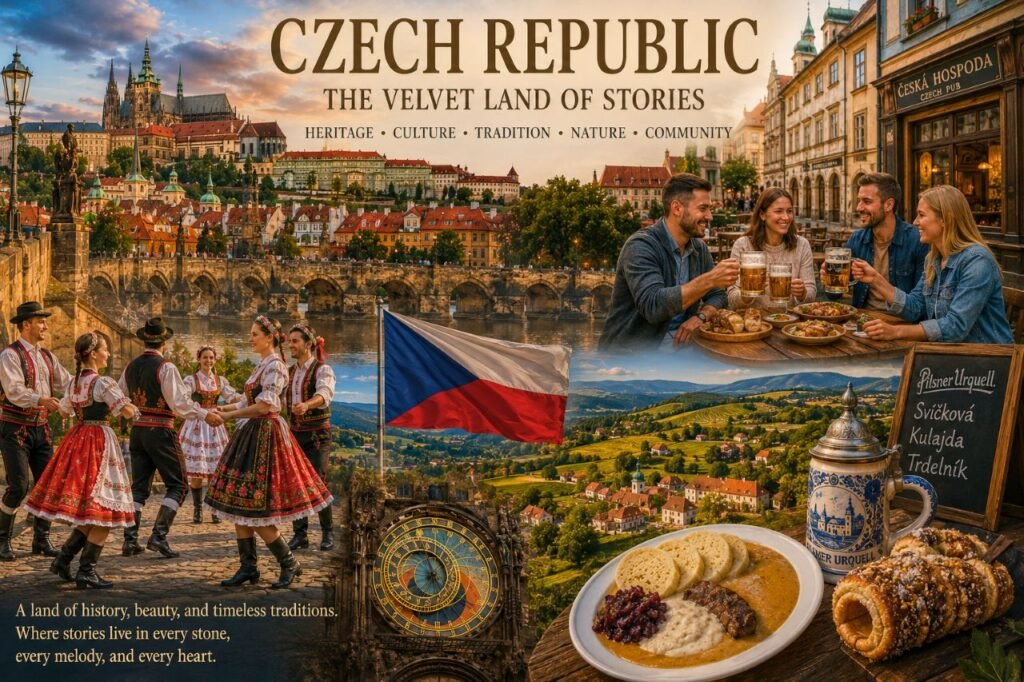
- The Liquid Bread (Pivo): Beer (pivo) is a fundamental element of Czech cultural identity. The nation invented the clear, golden Pilsner lager in the city of Plzeň in 1842. Czechs consume more beer per capita than any other nation on earth, treating local pubs (hospoda) as essential democratic meeting spaces for community discussion.
Clothing & Symbols
Traditional Attire (Kroj)
Traditional Czech folk costumes, known as Kroj, are highly complex and differ drastically by village. In Bohemia, costumes are relatively simple and functional, reflecting Central European styles.
However, in the southeastern region of Moravian Slovakia (Slovácko), the kroj remains a living art form. These festive costumes feature billowing white linen sleeves, intricate floral hand-embroidery, massive pleated skirts, and vibrant red ribbons, worn proudly during annual harvest festivals.
National Symbols
The national flag consists of a white horizontal band over a red band, with a blue wedge extending from the hoist to the center, representing the historical regions of Bohemia, Moravia, and Silesia. The grand coat of arms features a double-tailed silver lion rampant on a red field, displaying a proud crown to symbolize historical Bohemian sovereignty and independence.
Music, Dance & Art
Classical Masters and Literary Giants
Czech culture has made monumental contributions to global classical music. Composers like Bedřich Smetana (who captured the nation’s soul in his symphonic poem Má vlast / My Homeland) and Antonin Dvořák used traditional folk melodies within classical orchestration.
In literature, Prague was the cradle of Franz Kafka’s surrealist existential masterpieces, while the 20th century was defined by Milan Kundera’s deep philosophical examinations of human memory and freedom.
Marionette Theater and Bohemian Glass
- Puppetry Art: Czech marionette theater is a protected UNESCO cultural heritage practice. During the National Revival, traveling puppet masters kept the Czech language alive in rural villages.
- Bohemian Crystal: For centuries, Czech glass blowers in northern Bohemia have been globally famous for creating exceptional crystal glass, celebrated for its intricate hand-cutting, brilliant clarity, and innovative designs.
Summary
The culture of the Czech Republic stands as an admirable example of intellectual independence and cultural resilience. By protecting their unique Slavic language through centuries of imperial dominance and maintaining a peaceful approach to political self-determination, the Czech people have fostered an exceptionally stable and artistic society. From the precise craft of Pilsner brewing to the brilliant melodies of Dvořák and the vibrant folklore of Moravia, the Czech Republic offers the world a cultural landscape where history is deeply preserved, intellect is valued, and community life is treasured.
At Best Culture Insight, we see culture as the heartbeat of every society – the way people live, connect, and express their identity.