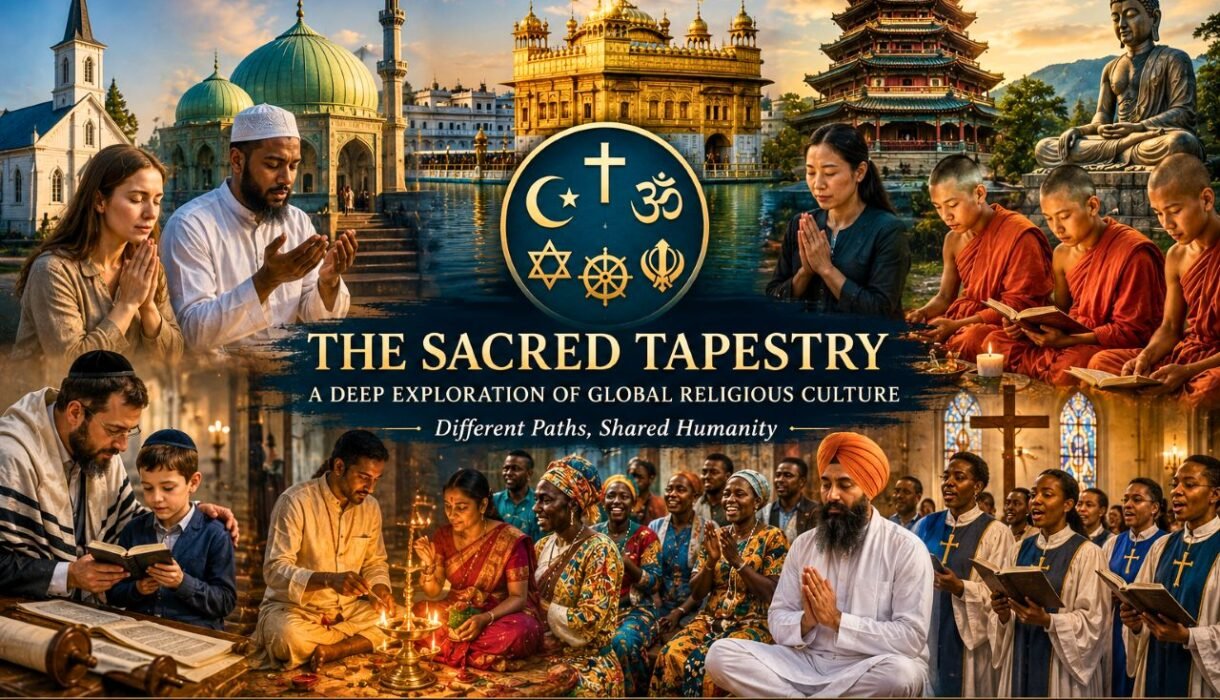
The Sacred Tapestry: A Deep Exploration of Global Religious Culture
Posted in :

Religion is one of the most powerful forces shaping human civilization. Far beyond a collection of isolated texts or private rituals, religion functions as a living, breathing culture. It is an overarching framework that dictates how millions of people dress, eat, speak, organize their societies, and view their place in the universe.
Introduction
Religious culture is the collective expression of human spirituality. It encompasses the shared values, symbols, behavioral patterns, and institutions built around a society’s understanding of the divine or sacred.
Across the globe, religious culture manifests in the architecture of our cities, the rhythms of our calendars, and the moral codes of our laws. To explore religious culture is to explore the deep-seated human need for meaning, community, and continuity across generations.
History & Origins
The culture of religion has co-evolved with human consciousness since the dawn of history.
[Animism & Shamanism]➔[Polytheistic State Cults]➔[The Axial Age: Monotheism & Philosophy]➔[Globalized Organized Faiths]
- Primal Foundations: Early human groups practiced animism—the belief that spiritual essence inhabits natural entities like rivers, animals, and trees. Shamanic figures served as the early mediators between the physical and metaphysical worlds.
- The Axial Age: Between 800 and 200 BCE, a monumental transformation occurred across Eurasia. This period saw the rise of foundational spiritual philosophies and monotheistic frameworks—including Buddhism in India, Confucianism in China, and Monotheism in the Levant—shifting religion toward personal ethics and universal truths.
- Expansion & Adaptability: Over the millennia, trade routes like the Silk Road and maritime pathways facilitated the spread of major world religions. As faiths moved, they underwent syncretism—blending with local folk customs to create unique regional subcultures.
Geography
Religious culture is deeply tied to geography. Space itself is often categorized into the sacred and the profane.
- Sacred Cartography: Cities like Jerusalem, Varanasi, Mecca, and Lhasa serve as geographic centers of gravity, drawing millions of pilgrims annually.
- Environmental Adaptation: Geography dictates how rituals are performed. For example, the emphasis on ritual bathing and water purification in Hinduism is intimately tied to the river systems of the Indian subcontinent, while the desert origins of Abrahamic faiths influenced their structural narratives.
Economy
The intersection of faith and economics is vast, driving markets and shaping financial philosophies.
| Aspect | Manifestation | Cultural & Economic Impact |
| Ethical Finance | Islamic Banking (Sharia-compliant), Christian stewardship | Prohibits usury (unjust interest), giving rise to profit-sharing financial systems. |
| Sacred Tourism | Pilgrimages (The Hajj, Camino de Santiago, Kumbh Mela) | Generates billions of dollars annually in travel, hospitality, and local heritage infrastructure. |
| Dietary Markets | Halal, Kosher, and Vedic Vegetarian certifications | Dictates multi-billion-dollar global supply chains for food production and logistics. |
Politics
Historically and contemporaneously, religious culture has provided the moral framework for governance, legal codes, and civic behavior. From the divine right of kings to modern Christian democracy in Europe or secularist frameworks modeled to protect religious minorities, the relationship between church and state remains highly influential. Even within secular republics, religious values frequently shape public debates around human rights, social welfare, and international diplomacy.
Ethnic Groups
While major world religions transcend borders, they are often deeply intertwined with specific ethnic identities.
For instance, Judaism functions as both a religion and an ethno-religious identity. Similarly, across many indigenous communities globally, spirituality is inseparable from tribal ancestry, language, and ancestral lands. However, the global spread of faiths like Christianity and Islam has shown that a single religious culture can adapt seamlessly across thousands of distinct ethnic groups, creating localized variations of a shared global faith.
Beliefs & Values
Religious cultures establish the core values and moral baselines of human societies:
- The Golden Rule: A near-universal value found across almost all major world religions—from the Analects of Confucius to the Christian Sermon on the Mount—mandating that one must treat others as they wish to be treated.
- Cosmology and Purpose: Religion provides a worldview (Weltanschauung) that answers existential questions: Where did we come from? What happens when we die? This grounding anchors individual mental health and communal resilience during times of crisis.
- Asceticism vs. Celebration: Religious cultures balance the values of self-restraint (fasting, meditation, modesty) with communal joy, teaching that life is a sacred balance of discipline and gratitude.
Culture, Traditions & Customs
Rites of Passage
Religious cultures construct elaborate milestones to transition individuals through the phases of life:
- Birth & Naming: Ceremonies like Christian baptisms, Jewish bris, or Islamic Aqiqah welcome newborns into the spiritual community, dedicating them to a life of virtue.
- Adulthood: Rites such as the Hindu Upanayana (sacred thread ceremony) or Jewish Bar/Bat Mitzvahs signal that a youth has reached the age of moral responsibility.
- Marriage & Death: Weddings are treated as sacred covenants or karmic bonds, while funeral rituals—varying from cremation to sky burials or strictly structured internments—are designed to shepherd the soul safely into the afterlife.
Languages & Communication
Religion has been the primary driver behind the preservation of ancient languages.
- Sacred Dialects: Classical Arabic (Islam), Biblical Hebrew (Judaism), Sanskrit (Hinduism), and Latin or Ge’ez (Christianity) are preserved and spoken in liturgical settings long after evolving out of everyday use.
- Proverbs & Idioms: Daily vocabulary is saturated with religious origins. Phrasings like “God bless you,” the Arabic “Inshallah” (If God wills), or the Buddhist use of the word “Karma” to describe everyday cause and effect demonstrate how spiritual concepts anchor human linguistics.
Food & Cuisine
What we put on our plates is heavily policed and blessed by religious culture, carrying deep metaphysical meanings.
[ Cultural Meanings of Sacred Food ] ┌───────────────────────────────────────────────────────────────────────────┐ │ FASTING ── Purifies the spirit, builds empathy for the poor │ │ (e.g., Ramadan in Islam, Lent in Christianity). │ ├───────────────────────────────────────────────────────────────────────────┤ │ TABOOS ── Establishes community boundaries and spiritual purity │ │ (e.g., Avoidance of beef in Hinduism, pork in Judaism/Islam). │ ├───────────────────────────────────────────────────────────────────────────┤ │ RITUALS ── Acts as an intersection of the physical and divine │ │ (e.g., The Christian Eucharist, Hindu Prasada). │ └───────────────────────────────────────────────────────────────────────────┘Clothing & Symbols
Traditional attire and religious iconography serve as a visual shorthand for an individual’s spiritual worldview.
- Modesty and Identity: Garments like the Buddhist saffron robes, the Islamic hijab or thobe, the Jewish kippah, and the Sikh turban are outward signs of internal devotion and communal alignment.
- Sacred Geometry: Symbols like the Christian Cross, the Islamic Star and Crescent, the Hindu Om, and the Buddhist Wheel of Dharma are loaded with theological meaning, serving as protective amulets and focal points for deep meditation.
Music, Dance & Art
Humanity’s finest artistic achievements have been commissioned by, and dedicated to, the divine.
- Acoustic Devotion: From the hauntingly complex vocal structures of Gregorian chants and the rhythmic call of the Islamic Adhan to the ecstatic, syncopated energy of Gospel music and Hindu Bhajans, music serves as a fast track to emotional spiritual experiences.
- Visual & Architecture: The soaring spires of Gothic cathedrals, the geometric perfection of Islamic calligraphy, and the intricate carven mandalas of Asian temples are designed to make the human viewer feel small, inspired, and connected to something vast and eternal.
Summary
Religious culture is a complex, beautiful reflection of humanity’s eternal search for the divine. While specific dogmas and practices differ significantly across geographic lines, the underlying drivers remain identical: a desire for moral order, communal solidarity, and a framework to navigate the mysteries of existence. Celebrating and preserving global religious culture allows us to appreciate the vast diversity of human thought while recognizing the shared spiritual heartbeat of our global family.
At Best Culture Insight, we see culture as the heartbeat of every society – the way people live, connect, and express their identity.