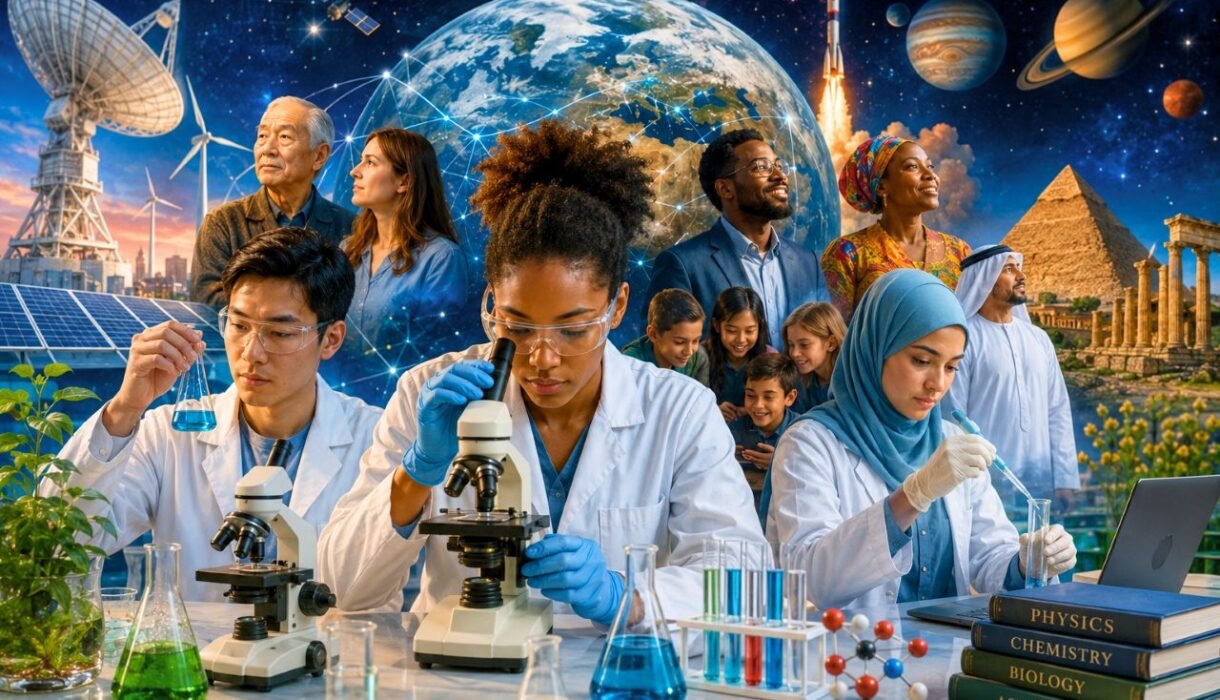

When we think of “culture,” we often visualize traditional dances, regional cuisines, or ancient historical markers. Yet, one of the most powerful, pervasive, and unifying cultures in human history is the Culture of Science.
Science is more than a list of facts found in textbooks or complex equations; it is a profound human practice—a set of values, shared languages, and community-driven behaviors that transcend national borders. It is a culture built on the universal pursuit of truth, skepticism, and the relentless desire to understand the mechanics of the natural world.
Defining Science as a Culture
At its core, science as a culture is a community of practice. Like any cultural group, scientists share:
- A Shared Language: From the precise nomenclature of taxonomy to the universal notation of mathematics, science allows humans from Tokyo to Toronto to share ideas without ambiguity.
- A System of Values: Science operates on a moral code of integrity, transparency, and reproducibility. It values the idea that the best idea should win, regardless of who proposed it.
- Rites of Passage: The path from student to researcher—marked by the thesis defense, peer review, and academic publishing—functions as a formal initiation process into the cultural community.
History & Origins: The Evolution of Knowledge
The “Culture of Science” did not appear overnight. It evolved from centuries of global intellectual cross-pollination.
[Ancient Foundations]➔[The Scientific Revolution]➔[Institutionalization]➔[The Digital/Global Age]
- Ancient Foundations: Astronomy, mathematics, and medicine were pioneered by ancient Mesopotamian, Egyptian, Indian, and Chinese civilizations, long before the term “scientist” existed.
- The Enlightenment: The 17th and 18th centuries saw the birth of the Scientific Method—the cultural framework where hypothesis, experimentation, and evidence-based reasoning became the gold standard for truth.
- Global Institutionalization: The rise of Royal Societies and the University system transformed science from a hobby for the elite into a structured, global profession with its own norms, professional societies, and communication ethics.
Geography: The Global Lab
Science is arguably the first truly global culture. While regional scientific communities (such as European physics or American tech research) often have specific localized priorities, the broader culture is defined by international cooperation.
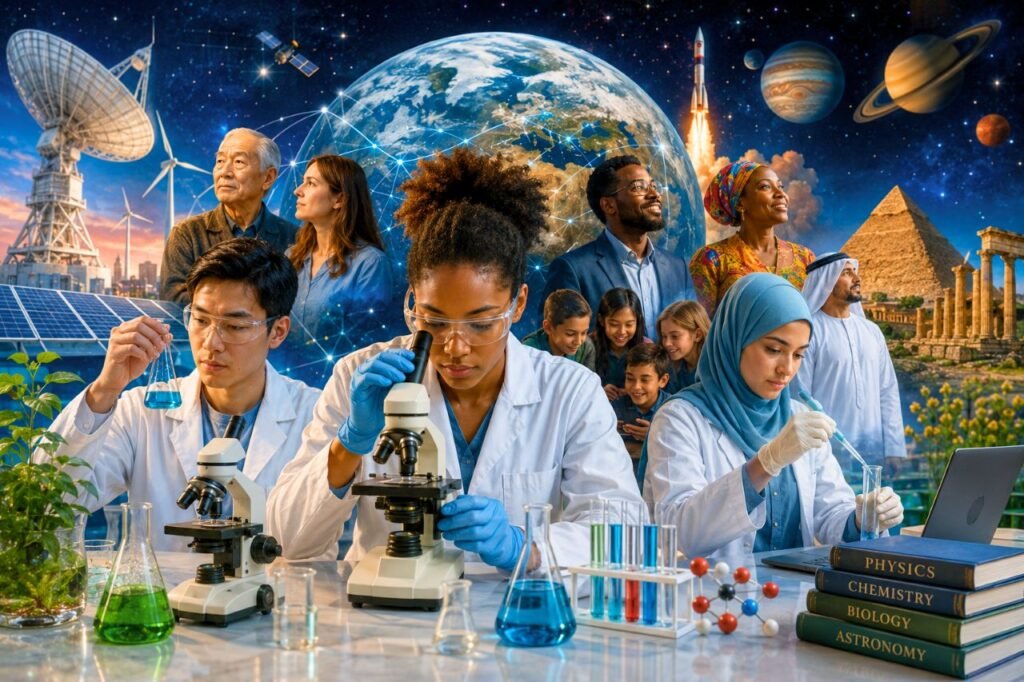
Global collaboration in scientific discovery
Major scientific endeavors—like the International Space Station, the Human Genome Project, or global climate monitoring networks—are inherently trans-boundary. They prove that scientific inquiry operates in a “geography of curiosity,” where data flows freely across political maps, creating a shared world where challenges like climate change or pandemics are treated as collective human problems.
Beliefs & Values: The Scientific Worldview
The culture of science is built upon a distinct worldview that shapes how its practitioners interact with reality:
- Skepticism as a Virtue: In science, questioning is not disrespectful—it is mandatory. The culture thrives on the idea that every theory is subject to revision if new, better evidence emerges.
- Intellectual Humility: Scientific practitioners accept that our current understanding is always “provisional.” The culture encourages admitting ignorance, which is often the first step toward discovery.
- Collaborative Meritocracy: While competitive, the scientific culture is inherently collaborative. Discoveries are meant to be shared, analyzed, and built upon by others to accelerate progress for everyone.
Language & Communication: The Universal Dialect
Science maintains its own internal dialects and modes of communication.
- Mathematical Language: $E = mc^2$ is not just an equation; it is a piece of universal cultural shorthand that conveys complex physics instantly, regardless of the reader’s native tongue.
- Peer Review: This is the culture’s primary social mechanism. Before any “truth” is accepted into the corpus of scientific knowledge, it must be vetted by peers—a formal process of critical dialogue.
- Proverbs of Practice:
- “Extraordinary claims require extraordinary evidence.” (The core skepticism mantra).
- “Standing on the shoulders of giants.” (The recognition that all scientific discovery is a team effort across generations).
Celebrating Diversity in Science
The history of science is often wrongly depicted as the work of a single demographic. In reality, science has always relied on the diversity of perspectives.
- Indigenous Knowledge: Modern climate science and ecology frequently validate traditional ecological knowledge held by indigenous groups for millennia regarding weather patterns, botany, and sustainable land management.
- Global Contributions: Today, global science thrives because of the diversity of the contributors. When scientists from different cultural backgrounds approach the same problem, they bring unique methodologies and life experiences, often leading to more innovative solutions.
Summary: A Culture for the Future
The “Culture of Science” is perhaps the most inclusive culture we have. It welcomes anyone willing to learn its language and adopt its values of evidence-based inquiry. By celebrating science as a culture, we don’t just learn about molecules and stars; we cultivate a mindset of resilience, curiosity, and global cooperation. As we face the challenges of the 21st century, fostering this culture—where evidence, truth, and critical thinking are valued—is essential for the preservation and progress of human civilization.
At Best Culture Insight, we see culture as the heartbeat of every society – the way people live, connect, and express their identity.