The Crossroads of the World: An In-Depth Exploration of Panama Culture
Posted in :

Panama, positioned as the narrow, serpentine land bridge connecting North and South America, occupies a unique place in the global cultural landscape. Historically functioning as a natural geographic transit zone, it has evolved into one of the world’s most dynamic cultural crossroads. – Culture

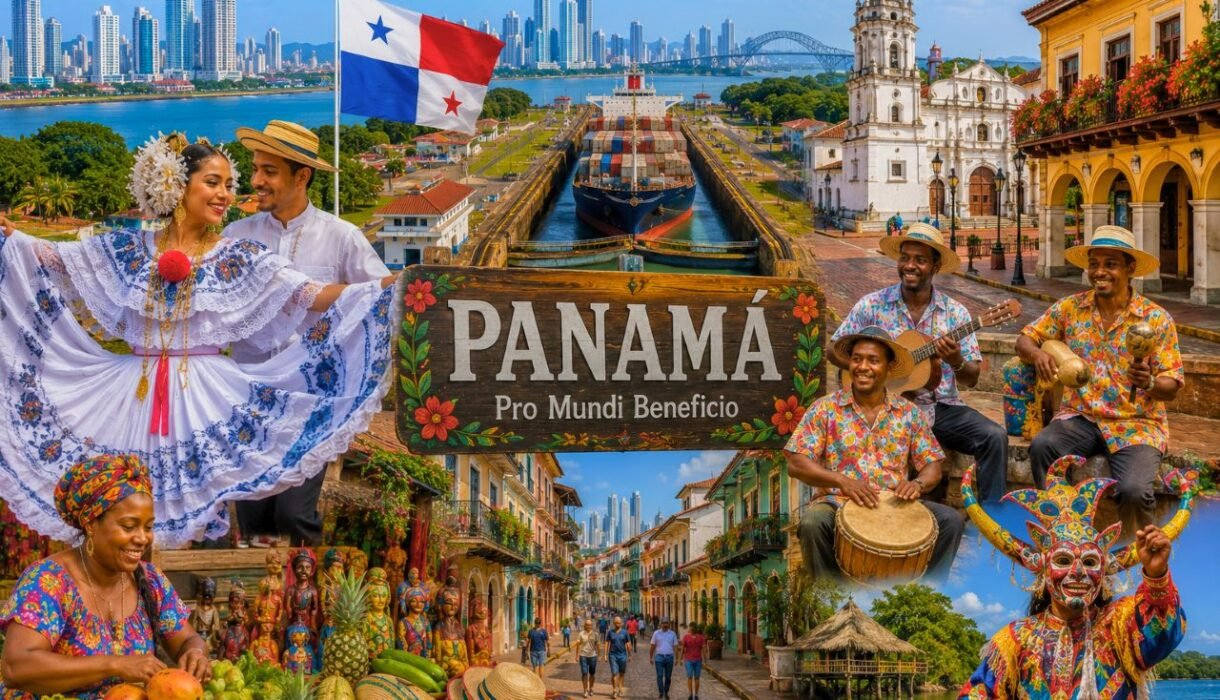
The culture of Panama is defined by its national motto: “Pro Mundi Beneficio” (For the Benefit of the World). The people of Panama, proudly known as Panameños, possess a cosmopolitan, open, and intensely celebratory spirit born from centuries of international interaction.
Panama’s cultural landscape functions as a brilliant crisol de razas (melting pot of races). It blends the deep, earth-rooted traditions of its autonomous indigenous nations with the rich Spanish colonial architecture of the interior and the energetic Afro-Caribbean rhythms of its coastal ports. Panama is far more than a canal; it is a living, breathing laboratory of human migration, resilience, and celebratory harmony.
History & Origins
The historical framework of Panama is a compelling story of geographic destiny, colonial ambition, and structural engineering.
[Pre-Columbian Indigenous Eras] ➔ [1501: Spanish Colonial Transit Hub] ➔ [1821: Union with Colombia] ➔ [1903: Republic Foundation & Canal Era]
Long before European contact, Panama was a vital trade corridor populated by diverse Chibchan and Mesoamerican indigenous groups, who left behind a legacy of exquisite goldsmithing and pottery. In 1501, Rodrigo de Bastidas explored the coast, followed by Vasco Núñez de Balboa, who crossed the isthmus in 1513 to become the first European to view the Pacific Ocean from the New World. The Spanish quickly transformed Panama into the critical transit hub of their empire, moving South American silver across the isthmus to waiting Atlantic galleons.
Following independence from Spain in 1821, Panama voluntarily joined Gran Colombia. However, its geographic destiny took a definitive turn on November 3, 1903, when the nation declared full independence as a sovereign republic, backed by the United States. The subsequent construction and opening of the Panama Canal in 1914 rewrote the country’s demographic history, drawing hundreds of thousands of Afro-Caribbean, Chinese, European, and South Asian laborers to its shores, forever encoding global multiculturalism into the Panamanian DNA.
Geography
Panama is an elongated, horizontal S-shaped isthmus in North America, bordered by Costa Rica to the west, Colombia to the southeast, the Caribbean Sea to the north, and the Pacific Ocean to the south.
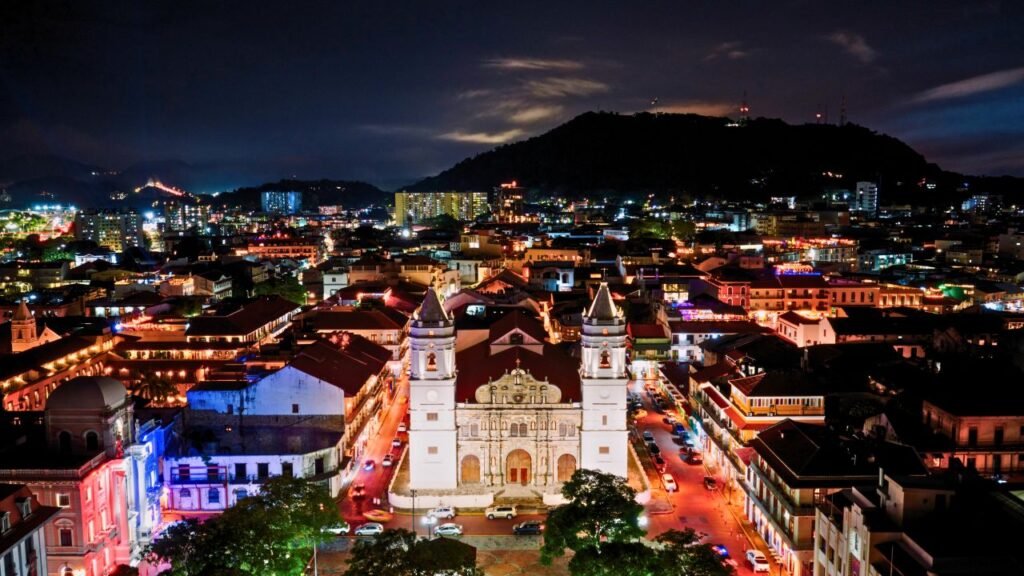
The country’s interior is defined by a backbone of rugged, jungle-covered mountain ranges, including the Cordillera Central, which peaks at the active, cloud-shrouded Barú Volcano ($3,475\text{ meters}$ or $11,401\text{ feet}$). Panama is unique for its dense tropical rainforests that grow directly up to the edges of major urban centers, flanked by more than 1,400 islands, including the idyllic San Blas (Guna Yala) archipelago in the Caribbean and the Pearl Islands in the Pacific.
Economy
Panama operates a highly sophisticated, service-driven market economy that ranks among the most prosperous and competitive in Latin America.
The core economic pillars include:
- The Panama Canal: A critical artery of global maritime trade that generates billions of dollars in annual transit tolls.
- Logistics and Financial Services: Centered on the Colon Free Trade Zone (the second largest free port in the world) and a robust international banking sector in Panama City.
- The Hub of the Americas: Driven by a world-class aviation network connecting North, Central, and South America seamlessly.
The country utilizes the United States Dollar as its primary paper currency alongside its official national coin, the Balboa (pegged at a strict 1:1 ratio), providing a level of macroeconomic stability unique to the Central American corridor.
Politics
Panama is a stable, constitutional presidential representative democratic republic. Executive authority is exercised by the President, who is elected by popular vote for a single five-year term. Legislative power is held by the unicameral National Assembly (Asamblea Nacional), composed of 71 deputies representing regional circuits.
The modern political era is defined by the historic Torrijos-Carter Treaties, which led to the full transfer of the Panama Canal from United States administration to total Panamanian sovereignty on December 31, 1999. Today, politics focuses heavily on expanding the maritime logistics cluster, investing in sustainable eco-tourism, and strengthening educational access across rural and indigenous provinces.
Ethnic Groups
The population of Panama reflects its history as an international crossroads:
| Ethnic Group | Population Share | Cultural Footprint |
| Mestizo | ~65% | Blended Spanish and Indigenous ancestry; forms the linguistic, agricultural, and commercial baseline of the country. |
| Afro-Panamanian | ~14% | Divided into Afro-Coloniales (Spanish colonial roots) and Afro-Antillanos (West Indian Canal workers); introduced calypso, reggae, and coastal seafood. |
| Indigenous | ~12% | Seven officially recognized distinct nations (including the Guna, Emberá, Ngäbe, and Wounaan) possessing autonomous territories (comarcas). |
| Other Diasporas | ~9% | Vibrant, deeply integrated communities of Chinese, European, South Asian, and Middle Eastern heritages. |
Languages & Communication
Spanish is the official and universal language of Panama. The local dialect, Panamanian Spanish, is distinctly Caribbean in flavor, characterized by a rapid cadence, the dropping of the final “s” sound, and a heavy blending of foreign words.
Local Idioms & Expressions
- “¿Qué xopá?” (or ¿Qué sopa?): A mirror inversion of the Spanish phrase “¿Qué pasó?”, functioning as the ultimate urban street greeting meaning “What’s up?”.
- “Chifriar”: To ignore someone or intentionally avoid a situation.
- “Ayala vida”: A ubiquitous exclamation used to express shock, surprise, or frustration.
- “Pritty”: A direct adaptation of the English word, used locally to describe something exceptionally cool or excellent.
Indigenous and Regional Tongues
Alongside Spanish, Panama legally recognizes and protects its native languages. Ngäbere, Guna, and Embera are actively spoken within their autonomous territories. Furthermore, English is widely spoken as a second language across corporate sectors, urban centers, and among Afro-Antillano families in the Bocas del Toro province.
Beliefs & Values
Panamanian culture is anchored by an emphasis on personal relationships, multi-generational family loyalty, and a flexible, relaxed approach to time known colloquially as mañana time.
Religious Landscapes
While freedom of worship is constitutionally guaranteed, Roman Catholicism remains the predominant spiritual force, directly influencing municipal geography, public holidays, and national festivals.
A prime manifestation of Panamanian faith is the devotion to the Black Christ of Portobelo (El Cristo Negro). Every October, tens of thousands of pilgrims, many dressed in purple robes, walk miles to the coastal town of Portobelo to pray before the life-sized dark wooden statue of Christ, which is credited with numerous local miracles.
Indigenous Worldviews
Among Panama’s indigenous populations, deep animistic and earth-centric spiritualities remain vibrant. The Guna people follow the teachings of Baba and Nana (the Great Mother and Father), viewing the earth as a living, sacred maternal organism.
Culture, Traditions & Customs
National Festivals and the Carnival
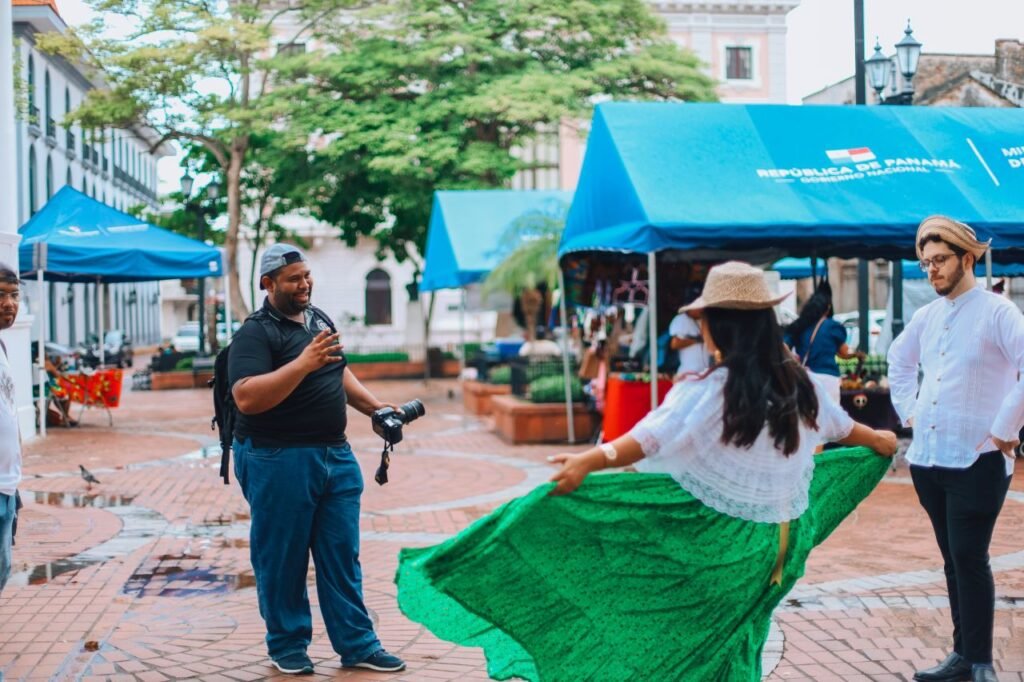
The pinnacle of Panamanian celebratory life is Carnival, held annually during the four days preceding Ash Wednesday. The most iconic celebrations occur in Las Tablas, where a historic rivalry plays out between two factions of the town: Calle Arriba (High Street) and Calle Abajo (Low Street). Each side constructs magnificent floats and crowns a Carnival Queen, engaging in a battle of elaborate costumes, satirical songs, and culecos (trucks that spray water over cheering crowds).
Marriage and Passages
- Weddings: Traditional weddings in the central provinces are large, community-wide festivals. The bride frequently wears a modified version of the national dress, and the reception features a non-stop rotation of folk music, local rums, and a rich traditional stew.
- The Fiesta de la Novatada: A community milestone across rural areas where youth transitioning into adulthood are welcomed into agricultural work cooperatives through music and shared feasting.
Food & Cuisine
Panamanian cuisine, or Comida Criolla, is a savory, tropical culinary tradition centered on corn, root vegetables like yuca and ñame, fresh coconut, and expertly seasoned meats.
Sancocho: The Ultimate Comfort Food
The absolute national dish of Panama is Sancocho de Gallina Panameño. It is much more than a chicken soup; it is a cultural ritual eaten at family gatherings and a legendary cure for hangovers:
- The Secret: The signature flavor of authentic Sancocho comes from culantro, a tropical herb that tastes similar to cilantro but is much stronger and more pungent.
- The Composition: Free-range chicken is slow-simmered alongside large chunks of ñame (a starchy root vegetable that melts slightly to naturally thicken the broth), corn on the cob, garlic, and onions, resulting in a rich broth served with a side of white rice.
Other Traditional Delicacies
- Carimañolas: Torpedo-shaped yuca fritters stuffed with savory ground beef and fried until golden brown and crispy.
- Arroz con Pollo: A beloved party staple of shredded chicken mixed with rice, peas, olives, capers, and sweet peppers, cooked with a touch of achiote for a bright orange color.
Clothing & Symbols
The La Pollera Dress
Panama possesses one of the most exquisite national folk costumes in the world: the La Pollera. Worn by women during national holidays, it is a two-piece white cotton dress decorated with hand-stitched embroidery depicting local flora and fauna.
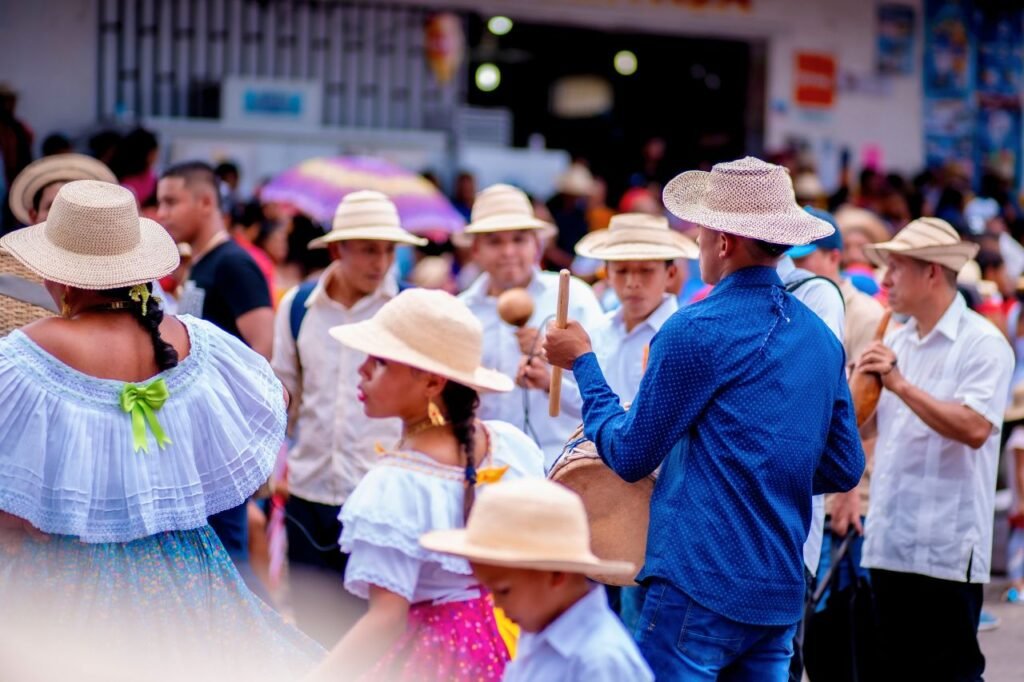
A single Pollera can take up to a year to hand-craft, requiring thousands of hours of work. It is worn with a series of heavy solid-gold chains and an intricate headpiece made of tembleques—delicate, shimmering hairpins made of pearls, beads, and crystals that bounce gracefully when the wearer dances. Men wear the Montuno, a simple embroidered white shirt paired with short trousers and a hand-woven Sombrero Pintao hat.
Iconic Symbols
- The Mola: Hand-woven textile panels created by Guna women using a complex reverse-applaque technique. They feature bold geometric shapes, wildlife patterns, and historical narratives, serving as a globally recognized symbol of indigenous rights.
- The Harpy Eagle: The majestic national bird of Panama, representing the untamed beauty of its virgin rainforests.
Music, Dance & Art
The Rhythms of El Tamborito and Tipico
Music is the acoustic heartbeat of Panama, flowing through a variety of unique genres:
- El Tamborito: The undisputed national dance of Panama, dating back to the 17th century. It features a solo female vocalist leading an interactive call-and-response song (la cantalante), backed entirely by the percussive rhythms of traditional wooden drums and synchronized handclaps from the community.
- Música Típica: The popular dance music of the interior, driven by the button accordion, acoustic guitars, and a high-pitched vocal style known as the saloma. Legendary artists like Samy and Sandra Sandoval have brought this rural folk style to massive stadium audiences.
Visual Arts
Panama boasts a dynamic contemporary art scene. Master painters like Guillermo Trujillo and Alfredo Sinclair pioneered a unique modern style that fuses international modernism with indigenous mythology, stone glyph shapes, and tropical colors. Today, the streets of Panama City and Colon double as open-air galleries, decorated with vibrant street murals that celebrate the diverse contributions of the country’s multi-ethnic working class.
Summary
The culture of Panama stands as a brilliant monument to human connectivity, resilience, and artistic innovation. By safeguarding thousands of years of indigenous wisdom, honoring their complex Afro-Caribbean and Spanish colonial heritage, and coming together around the comfort of a warm bowl of Sancocho and the intricate beauty of the Pollera, the Panamanian people have forged an unforgettable identity. Panama continues to stride forward with pride—celebrating its cultural diversity and offering its deeply profound, syncopated soul to the global family.
At Best Culture Insight, we see culture as the heartbeat of every society – the way people live, connect, and express their identity.