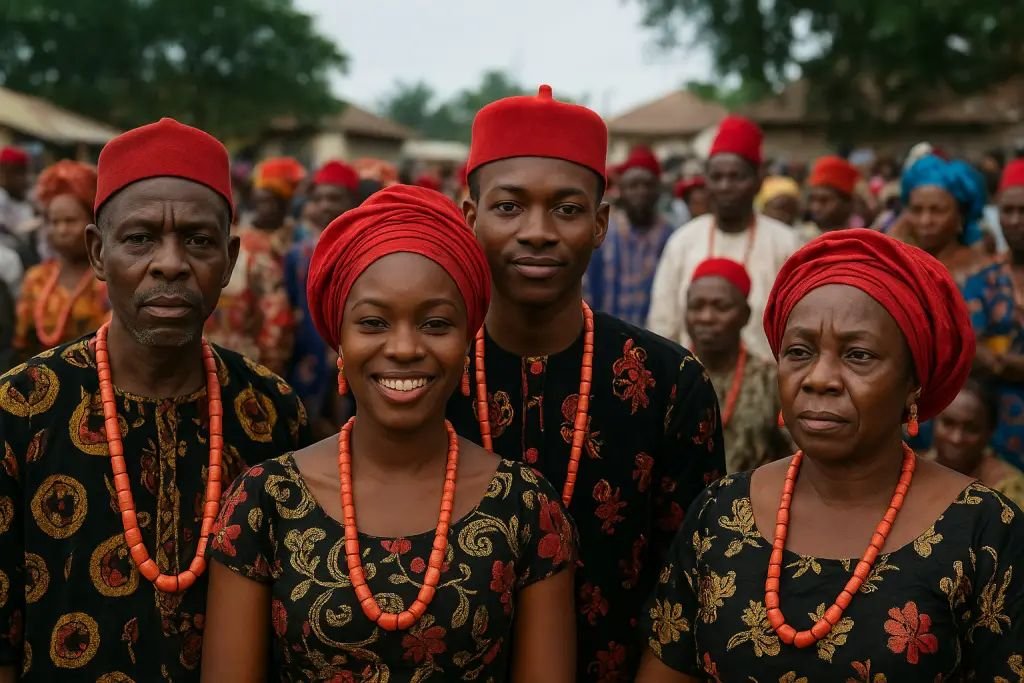
History of the Igbo People
Posted in :

The story of the Igbo people of southeastern Nigeria is a powerful narrative of resilience, democratic governance, and profound cultural identity. As one of Africa’s most dynamic and influential ethnic groups, the Igbo have shaped the social and economic landscape of West Africa for millennia. Their history is not defined by massive royal conquests or all-powerful monarchs, but rather by decentralized, highly organized communities that valued individual achievement, egalitarianism, and a deep spiritual connection to the land.
1. Ancient Roots and Technological Foundations
Archaeological evidence, particularly from the ancient city of Igboukwu, reveals that Igbo civilization was highly advanced as far back as the 9th century CE. Excavations uncovered sophisticated bronze castings, ironwork, and intricate glass beads, proving that the ancestors of the modern Igbo were skilled artisans and active participants in long-distance trade networks. Unlike neighboring empires, early Igbo society thrived on a decentralized system of governance called Ohacracy—a form of communal democracy where decisions were made collectively by councils of elders, titled men (Nze na Ozo), and age grades, ensuring that absolute power never rested with a single ruler.
2. The Nri Kingdom and Spiritual Sovereignty
Around the 10th century, the Kingdom of Nri emerged as the prominent religious and political authority in Igboland. Uniquely, the Nri hegemony was not maintained through military force or standing armies, but through spiritual influence and diplomatic prestige under the leadership of the Eze Nri (sacred king). The Nri kingdom served as a sanctuary for runaway slaves and a center for purifying communities of cultural taboos (Alu). This era solidified foundational Igbo concepts, including the worship of the supreme deity Chukwu, the veneration of the earth goddess Ala, and the belief in Chi—the personal guardian spirit that governs individual destiny.
3. The Tragic Era of the Transatlantic Slave Trade
The 17th to 19th centuries marked a dark and disruptive epoch in Igbo history due to the Transatlantic slave trade. The rise of the militarized Aro Confederacy, an Igbo subgroup utilizing the powerful Long Juju oracle of Arochukwu, dominated regional trade routes and facilitated the capture of millions of hinterland Africans. Enslaved Igbo people were transported in massive numbers to the Americas, notably to Jamaica, Haiti, and Virginia. Despite the horrors of captivity, their cultural imprint endured; historical events like the famous “Igbo Landing” of 1803 in Georgia, USA, became lasting symbols of African resistance and the unbreakable desire for freedom.
4. Colonial Disruption and Contemporary Resilience
The late 19th century brought British colonial rule, which fundamentally altered Igbo society by introducing Christianity, western education, and the flawed system of “warrant chiefs” to forcefully centralize power. The Igbo quickly adapted to these changes, using education as a tool for rapid socio-economic advancement, which positioned them as key leaders in Nigeria’s independence movement by 1960. Following the tragic devastation of the Nigerian Civil War (1967–1970), the Igbo demonstrated extraordinary resilience, rapidly rebuilding their communities from scratch. Today, the Igbo people remain global symbols of entrepreneurship, academic excellence, and cultural pride, continuously honoring their ancient heritage while shaping the modern world.