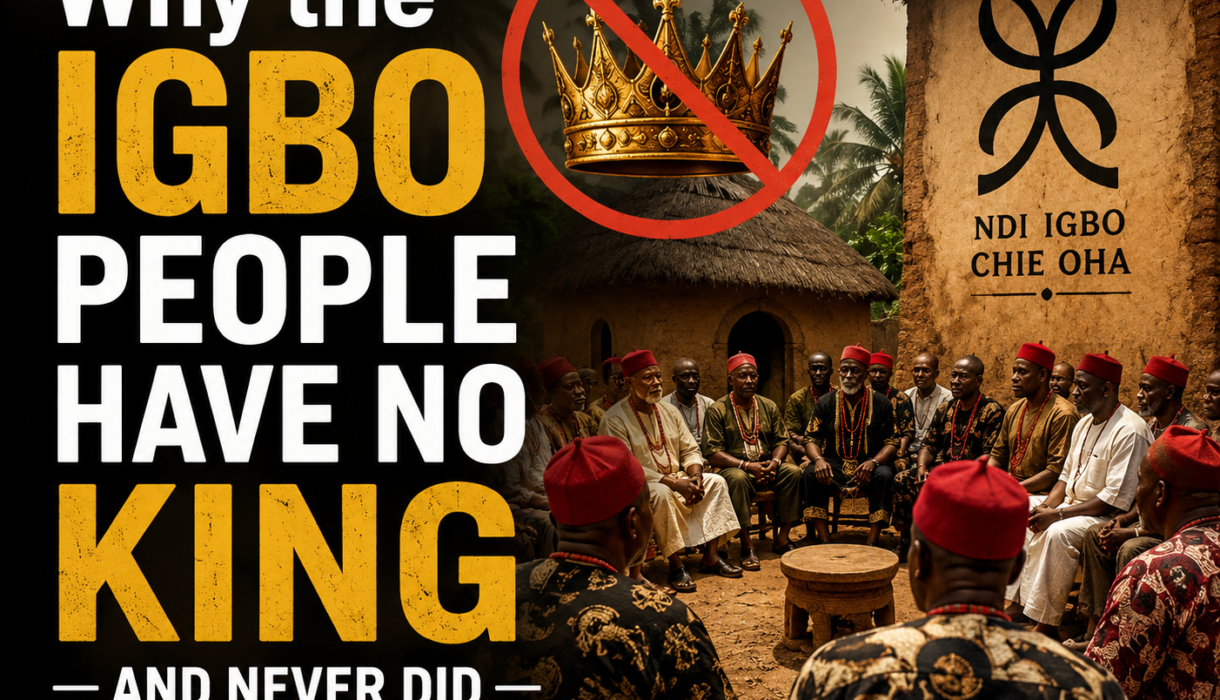

In the rich tapestry of West African history, many prominent ethnic groups built their civilizations around centralized empires ruled by absolute monarchs, such as the Oba of Benin or the Alaafin of Oyo. However, the Igbo people of southeastern Nigeria took a completely different historical path. A famous and deeply rooted proverb in the region, “Igbo Enwe Eze”, translates literally to “the Igbo have no king.” This phrase is not merely a modern slogan; it represents a profound, centuries-old philosophy of governance that rejected autocracy in favor of an intensely democratic, egalitarian, and decentralized society.
The Philosophy of Egalitarianism and Personal Autonomy
To understand why a centralized monarchy never developed across Igboland, one must look at the core value the culture places on individual freedom. In traditional Igbo society, every person is believed to be created with their own unique spiritual guide, known as a Chi. Because every individual possesses a direct connection to the divine, no single human being was considered inherently superior to another. This deep-seated belief fostered a fiercely egalitarian mindset where decisions were made collectively rather than by royal decree, ensuring that power remained firmly in the hands of the people.
Governance Through the Umunna and Age Grades
Instead of relying on a king to maintain law and order, traditional Igbo society operated as a decentralized republic. Governance was structured around the Umunna (a council of extended patrilineal families) and localized Age Grade societies. When critical communal decisions needed to be made—whether regarding land disputes, trade, or security—the elders (Oha) and titled men, like the Ozo title holders, would gather at the village square (Ama). Every adult male had a right to speak, and consensus was required before any law could be passed. This highly sophisticated system of checks and balances rendered the concept of a single, all-powerful king completely unnecessary.
Exceptions to the Rule: The Nri, Onitsha, and Aro Anomalies
While it is historically accurate that the vast majority of Igboland lacked monarchs, a few notable exceptions exist, though even these differed significantly from Western or European kingdoms. The ancient Kingdom of Nri, for instance, was ruled by an Eze Nri, but his authority was strictly religious and spiritual rather than political or military. Similarly, riverine Igbo communities like Onitsha and Oguta developed a kingship system (Obi) largely due to their historical proximity and cultural trade interactions with the neighboring Benin Empire. Even in these unique cases, the rulers never possessed absolute power and could be easily checked by council elders.
The Clash with Colonialism and the Invention of “Warrant Chiefs”
The true resilience of the “Igbo Enwe Eze” philosophy became evident during the advent of British colonial rule in the late 19th and early 20th centuries. Used to the centralized systems of northern and western Nigeria, the British colonial administrators were frustrated by the lack of kings through whom they could enforce indirect rule. To solve this, they artificially created “Warrant Chiefs”—appointing ordinary locals to act as rulers and tax collectors. The Igbo people fiercely resisted this foreign imposition, most notably during the historic Aba Women’s War of 1929. Today, while modern Igbo communities choose ceremonial rulers to represent them in government affairs, the foundational belief remains unchanged: true authority belongs to the collective community, for the Igbo have no king.