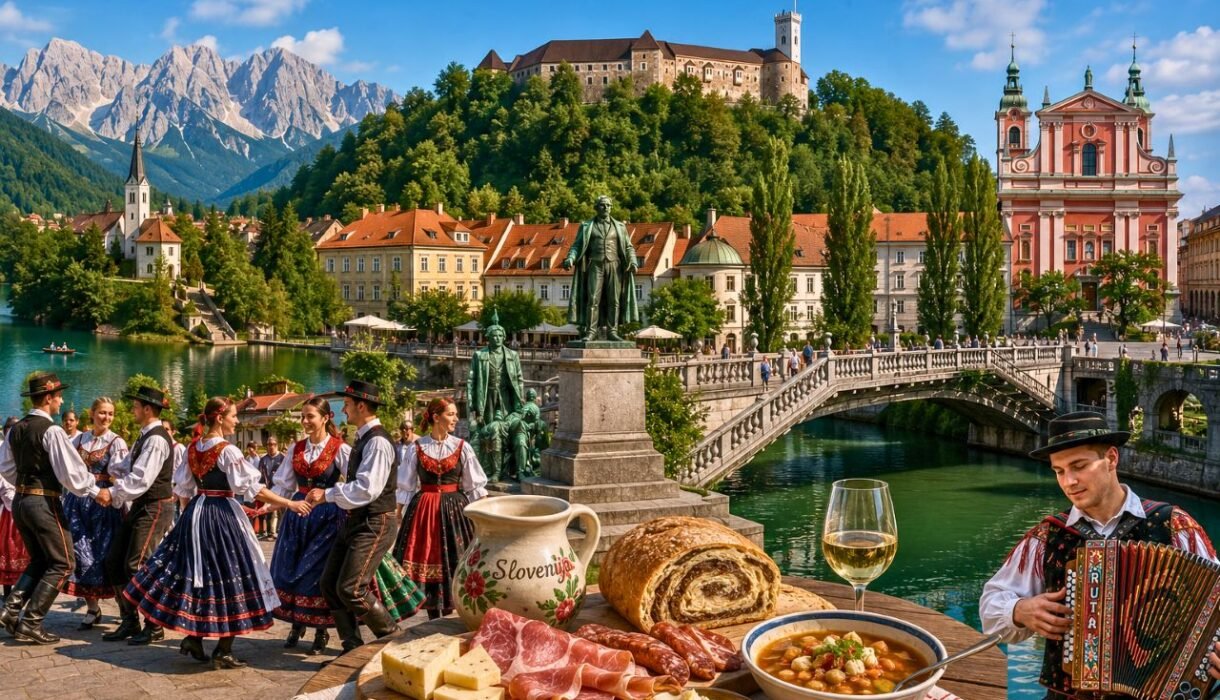

Where the Alps meet the Mediterranean and the Pannonian Plain, Slovenia is a boutique European destination brimming with unspoiled natural beauty and historical depth. The vibrant Culture of Slovenia—known natively as slovenska kultúra—is a fascinating synthesis of Alpine discipline, Mediterranean warmth, and South Slavic communal vitality, shaped by centuries of life at the crossroads of major European empires. The Slovenian people are celebrated globally for their deep environmental consciousness, passion for mountaineering, exceptional linguistic versatility, and a modest yet welcoming spirit. From the romantic cobblestone streets of Ljubljana to the emerald waters of the Soča Valley, Slovenia offers an authentic, well-preserved cultural journey.
History & Origins
Slovenia’s historical identity is a remarkable story of linguistic and cultural preservation without the early establishment of a unified, enduring medieval state.

- Early Slavic Settlement & Carantania: Alpine Slavic ancestors settled the Eastern Alps during the 6th century. In the 7th century, they established the principality of Carantania, one of the earliest Slavic states. Carantania is famous for its ancient ritual of democratically installing dukes—an early form of social contract later admired by Thomas Jefferson during the drafting of the U.S. Declaration of Independence.
- The Habsburg Era & Linguistic Survival: For nearly a millennium, Slovenian lands were incorporated into the Holy Roman Empire and subsequently the Habsburg Monarchy (Austro-Hungarian Empire). Unlike neighbors who consolidated identity around royal dynasties, Slovenians preserved their distinct identity almost entirely through language and literature. In 1550, Protestant reformer Primož Trubar published the first Slovenian printed books (Katekizem and Abecedarij), standardizing the literary language.
- The 19th Century Awakening & Yugoslavia: The 19th-century Romantic movement, led by national poet France Prešeren, galvanized national consciousness. Following the collapse of Austria-Hungary after World War I, Slovenians co-founded the Kingdom of Serbs, Croats, and Slovenes (later Yugoslavia).
- Independence & Modern Integration: In June 1991, Slovenia peacefully declared independence following a brief Ten-Day War. Rapidly transitioning into a prosperous, democratic European model, Slovenia joined NATO and the European Union in 2004, and adopted the Euro in 2007.
Culture, Traditions & Customs
Marriage & Wedding Traditions
Slovenian weddings (poroka) blend modern European celebrations with charming rural folk customs. A beloved traditional game is the Šranga (the village barricade). When a groom comes to collect his bride from her home village, local young men block the road with a wooden log or gate. The groom must playfully negotiate, undergo rustic challenges (like sawing wood), and pay a symbolic “ransom” to the village boys to prove his worthiness and compensate the community for taking one of their maidens.
Kurentovanje & Spring Rites
The most visually spectacular folk tradition is Kurentovanje, centered in the oldest town of Ptuj and inscribed on the UNESCO Intangible Cultural Heritage list. During the carnival season preceding Lent, participants dress as Kurenti—mythical, shaggy sheepskin-clad figures with large horned masks, red tongues, and heavy cowbells tied around their waists. They dance through villages, making deafening noise to scare away winter and summon spring, fertility, and good harvest.
Naming Ceremonies & Life Milestones
Historically rooted in Roman Catholicism, baptism remains a celebrated family milestone. Additionally, celebrating one’s Godovi (Name Day)—the church feast day of the saint after whom one is named—was traditionally more important than individual birthdays in rural Slovenia, involving gatherings with extended family, wine, and sweet pastries.
Languages & Communication
Language Spoken
The official language is Slovenian (slovenščina), a South Slavic language spoken by approximately 2.5 million people worldwide. A unique linguistic marvel of Slovenian is its preservation of the dual grammatical number (dvojina). While most languages distinguish only between singular (one) and plural (more than one), Slovenian has specific grammatical forms used exclusively when speaking about exactly two people or things—adding an inherent sense of intimacy and precision to communication.
Additionally, due to centuries of trade and border sharing, multilingualism is exceptionally high; English, German, and Italian are widely spoken across the country.
Communication Styles & Greetings
Slovenians value polite, modest, and egalitarian communication. Boasting or loud public displays of emotion are generally discouraged in favor of calm sincerity.
- Greetings: A firm handshake with direct eye contact is the standard greeting. Dober dan (Good day) is used in formal settings, while Živijo or Zdravo are friendly, casual greetings among peers.
- Key Phrases: Hvala (Thank you), Prosim (Please / You’re welcome), and Na zdravje! (To health! / Cheers!).
Proverbs & Wisdom
- “Kdor ne skače, ni Slovenec!”
Meaning: “Whoever doesn’t jump isn’t Slovenian!”—a modern, energetic sporting chant reflecting national unity and pride during athletic competitions.
- “Rana ura, zlata ura.”
Meaning: “Early hour, golden hour”—the equivalent of “the early bird catches the worm,” reflecting the strong Alpine work ethic and appreciation for morning diligence.
Geography
Covering just 20,273 square kilometers, Slovenia is one of the most geographically diverse countries on Earth, seamlessly bridging four major European landscapes:
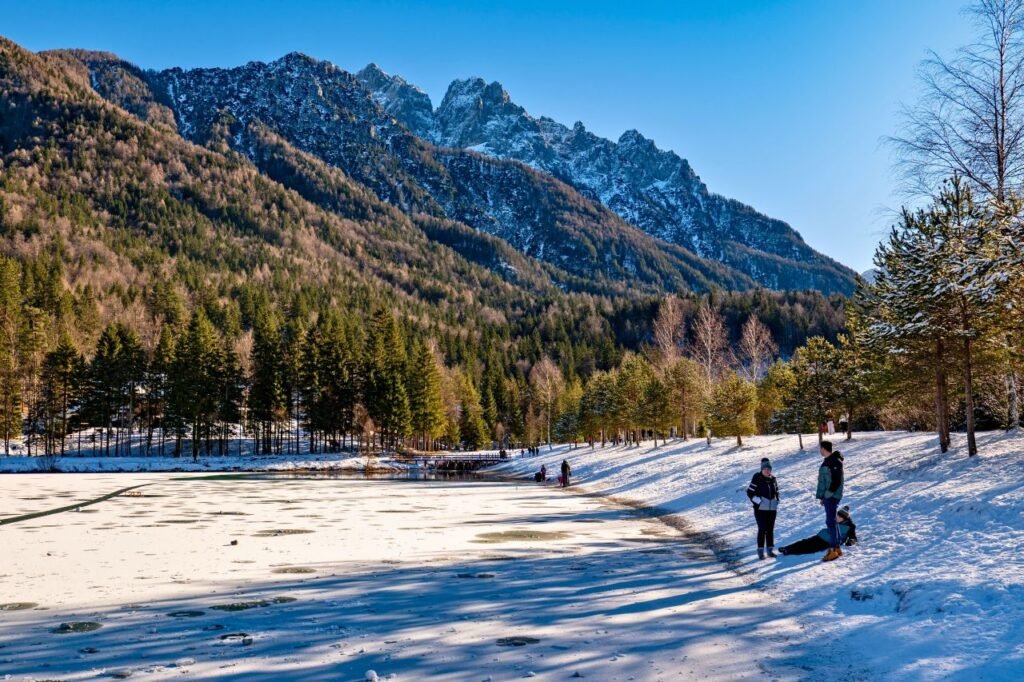
- The Julian Alps: Dominating the northwest, featuring pristine glacial lakes (Lake Bled and Lake Bohinj) and Slovenia’s highest peak, Mount Triglav (2,864 meters)—a peak so central to national identity that it is depicted on the national flag.
- The Karst Plateau: Located in the southwest, this limestone region gave the world the geological term “karst.” It hides thousands of magnificent subterranean caves, including the UNESCO-listed Škocjan Caves and the world-famous Postojna Cave.
- The Adriatic Coast: A short but charming 46-kilometer coastline featuring Venetian-gothic coastal towns like Piran and Koper.
- Pannonian Plains: The eastern region along the Mura and Drava rivers, characterized by rolling hills, vineyards, and therapeutic thermal spas.
Economy
Slovenia boasts a high-income, export-oriented market economy with one of the highest standards of living and GDP per capita among former socialist states.
Often described as the “Green Heart of Europe,” Slovenia is a global leader in sustainable tourism and environmental technology. Key industrial pillars include pharmaceuticals (home to major European generic drug manufacturers), automotive components, electrical engineering, and precision robotics. Agriculture and forestry also play vital roles—over 54% of Slovenia is covered by forests, making it the third most forested country in Europe after Finland and Sweden.
Politics
Slovenia is a stable parliamentary constitutional republic.
- President of the Republic: The Head of State, elected directly by popular vote for a five-year term, serving primarily as a unifying moral figure and representative in international diplomacy.
- Prime Minister: The Head of Government, holding executive administrative authority over domestic policy and the cabinet.
- National Assembly (Državni zbor): A 90-member parliament elected for four-year terms. Crucially, the constitution guarantees two permanent seats specifically reserved for representatives of the indigenous Italian and Hungarian ethnic minorities, underscoring the nation’s commitment to inclusivity.
Ethnic Groups
Slovenia is a relatively homogeneous nation with protected traditional minorities:
| Ethnic Group | Population Share | Regional Focus & Context |
| Slovenians | ~83% | Majority nationwide; South Slavic heritage with strong Alpine/Central European cultural integration. |
| Serbs, Croats, Bosniaks | ~10% | Primarily residing in urban centers; economic and historical ties from the Yugoslav era. |
| Italians & Hungarians | ~0.5% | Indigenous protected minorities in coastal (Italian) and northeastern (Hungarian) border regions. |
| Roma | ~1% | Rich musical heritage and historical settlement in southeastern regions. |
Beliefs & Values
Religious Life
Historically, Roman Catholicism has shaped Slovenia’s moral landscape, traditions, and architecture, with nearly every hilltop featuring a picturesque church. While around 57% of the population identifies as Catholic today, modern Slovenia is a highly secular, tolerant society where freedom of conscience and religious diversity (including Islam and Orthodox Christianity) are legally protected.
Core Cultural Values
- Mountaineering Identity: An old Slovenian adage states that you are not a true Slovenian until you have climbed Mount Triglav. Hiking, skiing, and respecting nature are deeply ingrained in the national soul.
- Čebelarstvo (Beekeeping): Slovenia has an extraordinary passion for apiculture. It is the original home of the gentle Carniolan honey bee (Apis mellifera carnica). In 2017, the United Nations officially declared May 20th as World Bee Day following a successful global initiative spearheaded by Slovenia.
Food & Cuisine
Slovenian cuisine (slovenska kuhinja) is a delicious 24-region culinary patchwork influenced by neighboring Austrian, Italian, and Hungarian traditions, focusing on local farm-to-table freshness.
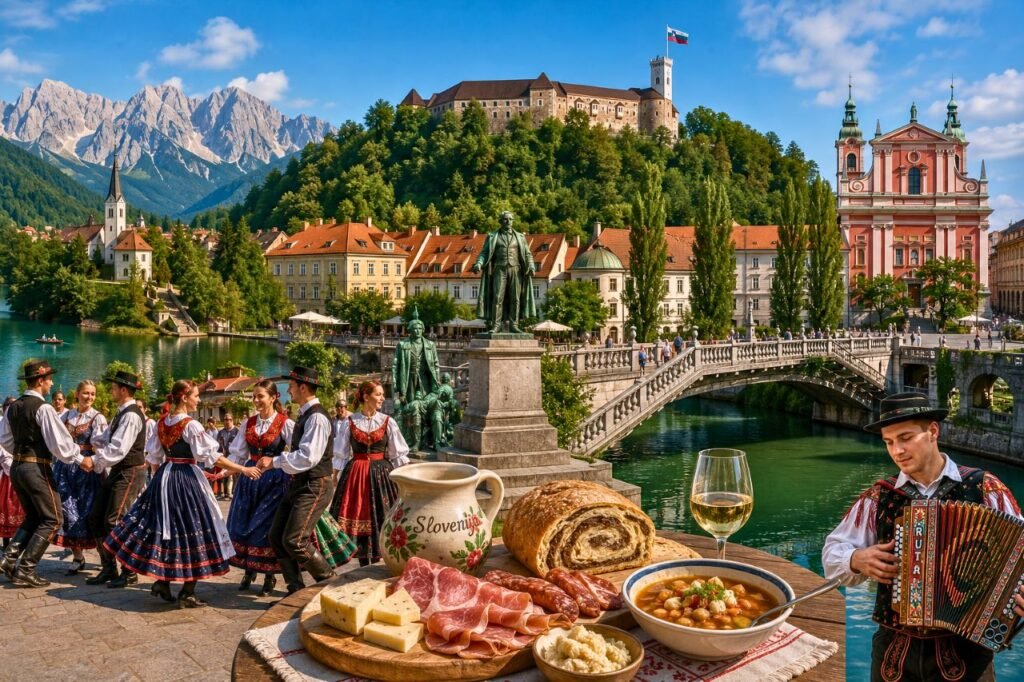
- Potica: The undisputed queen of Slovenian desserts. A festive, labor-intensive rolled dough cake stuffed with rich fillings—most traditionally ground walnuts, tarragon, or poppy seeds—baked in a decorative fluted mold.
- Kranjska Klobasa (Carniolan Sausage): A protected geographical indication sausage made from high-quality pork and bacon, seasoned simply with garlic, salt, and pepper, smoked to perfection.
- Štruklji: Traditional rolled dough dumplings that can be sweet or savory, boiled or baked, filled with cottage cheese, tarragon, apples, or walnuts.
- Kraški Pršut: Dry-cured ham from the Karst region, aged naturally by the cold, dry burja wind blowing off the Alps toward the Adriatic sea.
Clothing & Symbols
Traditional Attire (Narodna Noša)
The traditional Alpine attire of Upper Carniola (Gorenjska) is widely recognized as the national folk costume:
- Men: Wear black breeches, tall leather boots, a linen shirt with a vest, and a felt hat adorned with a badger or wild boar bristle brush.
- Women: Wear a flowing dark skirt, an intricately embroidered white linen blouse, a colorful silk apron, and an elaborate, stiff lace bonnet known as the avba.
Iconic Symbols
- The Linden Tree (Lipa): The traditional sacred tree of the Slovenian people. Historically, village elders gathered beneath the central linden tree to hold councils, resolve disputes, and celebrate dances.
- Panjske Končnice (Painted Beehive Panels): A uniquely Slovenian folk art from the 18th and 19th centuries where beekeepers painted wooden beehive front panels with colorful, humorous, or biblical folk scenes to help bees identify their hives and protect them from evil spirits.
Music, Dance & Art
The Oberkrainer Musical Phenomenon
In addition to ancient polyphonic folk singing, modern Slovenian musical identity was heavily popularized by Slavko Avsenik and his Oberkrainer ensemble in the mid-20th century. Inventing a lively, energetic style of Alpine folk music driven by accordion, trumpet, clarinet, and baritone horn, Avsenik’s tune Na Golici (Trompetenecho) became the most played instrumental song in the world.
Architecture & Plečnik’s Ljubljana
The visual aesthetic of Slovenia’s capital, Ljubljana, was masterfully shaped by 20th-century architect Jože Plečnik. Inscribed on the UNESCO World Heritage list, Plečnik’s human-centered urban design transformed the city with stone bridges (like the iconic Triple Bridge), colonnades, and public squares that harmonize urban life with the flowing Ljubljanica River.
Summary
Slovenia Culture stands as an inspiring model of how a small, determined nation can safeguard its soul across centuries of changing borders. By holding fast to its unique dual-grammar language, treating apiculture and mountaineering as sacred virtues, and preserving rich traditions like Kurentovanje and Potica, Slovenia seamlessly unites the best of Alpine discipline, Mediterranean joy, and Slavic warmth. It invites travelers and scholars alike to explore an accessible, green sanctuary where heritage and modern sustainability thrive in perfect balance.
At Best Culture Insight, we see culture as the heartbeat of every society – the way people live, connect, and express their identity.