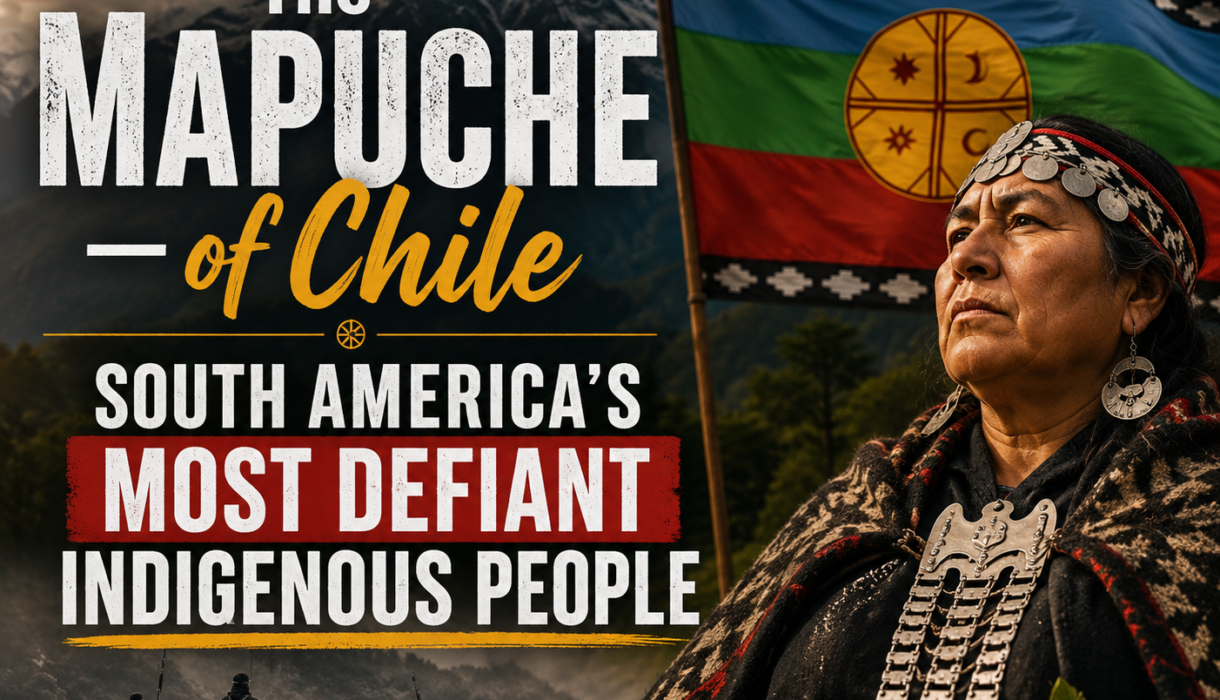
The Mapuche of Chile — South America’s Most Defiant Indigenous People
Posted in :

In the lush, ancient forests and sweeping valleys of south-central Chile live the Mapuche, the largest Indigenous group in the country. Their very name combines two words in their native language, Mapudungun: “Mapu” (meaning earth) and “Che” (meaning people). For centuries, the “People of the Earth” have maintained an unbreakable spiritual bond with their ancestral territory. Yet, beyond their rich cultural identity, the Mapuche hold an extraordinary place in world history as one of the few Indigenous nations in the Americas that successfully resisted both the expanding Inca Empire and the fierce conquests of Spanish colonizers for over three centuries.
Unyielding Resistance to Empire and Conquest
The fierce reputation of the Mapuche was forged on the battlefield during the 16th century. When Spanish conquistadors swept through South America, conquering massive empires like the Incas and Aztecs with ease, they expected a swift victory in Chile. Instead, they encountered a decentralized, tactically brilliant Mapuche force that adapted quickly to European warfare—learning to ride horses, construct fortifications, and utilize guerrilla tactics. Under legendary military leaders like Lautaro and Caupolicán, the Mapuche fought Spanish forces to a standstill, eventually forcing the Spanish Crown to sign the Treaty of Quilín in 1641, which officially recognized the Biobío River as a sovereign border protecting Mapuche land.
Deep Spiritual Connection to Land and Cosmology
To understand the Mapuche’s historic defiance, one must look at their spiritual worldview, where land (Wallmapu) is not a commodity to be bought or sold, but a sacred living entity. Mapuche society relies heavily on the Machi, spiritual leaders and healers—often women—who serve as vital bridges between the physical world and the ancestral spirit realm. Traditional ceremonies like the Nguillatun are held to pray for balance, communal harmony, and healthy harvests, accompanied by the rhythmic sounds of the cultrún (sacred ceremonial drum). Every tree, river, and mountain holds spiritual significance, making the defense of their natural environment a fundamental religious duty rather than a mere political stance.
The Modern Struggle for Autonomy and Rights
Despite surviving centuries of colonial threats, the Mapuche faced severe land loss in the late 19th century during the Chilean military campaign known as the “Pacification of Araucanía.” Forced onto small reservations, generations of Mapuche families were marginalized and stripped of their ancestral territories. Today, the modern Mapuche movement centers on reclaiming these historic lands, preserving the Mapudungun language, and protecting biodiversity against large-scale forestry corporations and hydroelectric projects. While some activists use peaceful political dialogue and legal avenues while others engage in direct land occupations, the underlying goal remains singular: protecting their heritage against modern exploitation.
A Vibrant Legacy Defining Chile’s Identity
Despite historic hardships, the Mapuche spirit remains a powerful, vibrant element of Chilean national identity and South American culture. Today, nearly two million people in Chile identify as Mapuche, contributing significantly to national literature, art, sustainable agriculture, and political discourse. Their traditional textiles, intricate silver jewelry (trapelacucha), and deep ecological wisdom continue to draw worldwide admiration. Ultimately, the story of the Mapuche is far more than a tale of historical resistance; it is a living testament to human resilience, identity, and an unwavering commitment to protecting one’s ancestral roots against all odds.