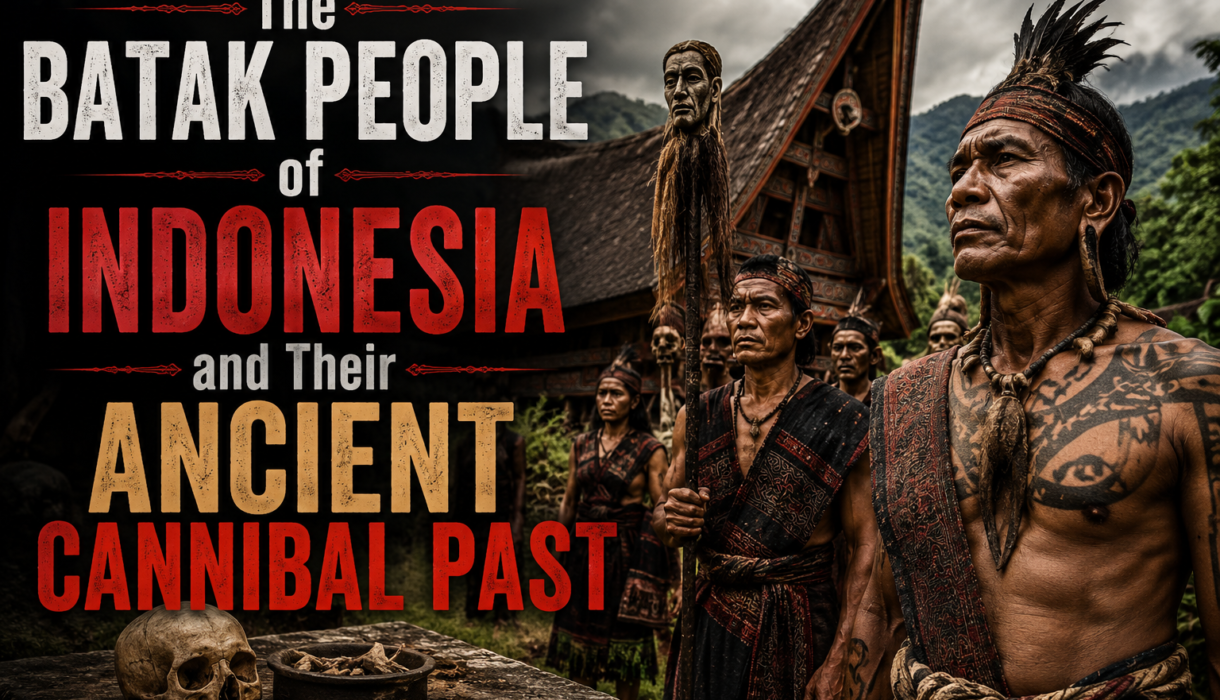

The Batak people, an indigenous ethnic group residing in the lush highlands of North Sumatra, Indonesia—particularly around the majestic Lake Toba—possess one of Southeast Asia’s most captivating cultural histories. Today, the Batak are widely celebrated for their rich musical traditions, intricate wood carvings, unique architecture, and warm hospitality. However, historical accounts from centuries past often highlight a darker, highly misunderstood aspect of their ancestral heritage: the practice of ritual cannibalism.
A System of Justice, Not a Diet
Contrary to popular sensationalism, cannibalism among the ancient Batak was never a daily dietary habit or a indiscriminate act of violence. Instead, historians and anthropologists emphasize that it functioned as a strict judicial mechanism governed by customary law, known as adat. The consumption of human flesh was reserved exclusively as a form of capital punishment for severe societal offenses, including high treason, warfare crimes, espionage, and grave moral transgressions. Executions were conducted publicly by tribal leaders and elders to restore spiritual balance and community order.
Observations of Early European Explorers
The reputation of Batak ritual cannibalism spread globally through the journals of early foreign travelers. European explorers, including Marco Polo in the late 13th century and Sir Stamford Raffles in the 19th century, documented detailed accounts of these practices. Interestingly, modern scholars note that while these rituals were indeed real, the Batak people frequently exaggerated stories of their own ferocity to outside traders. This clever psychological tactic helped protect their highland territory, ancestral pine forests, and valuable spice trades from foreign invasion for centuries.
The Arrival of Christianity and Cultural Transformation
The systematic end of ritual cannibalism occurred during the 19th century, driven by significant geopolitical and religious shifts. German Protestant missionaries, most notably Ludwig Ingwer Nommensen, arrived in the Batak homelands and worked alongside local leaders to introduce Christianity. Coupled with the expansion of Dutch colonial administration across Sumatra, traditional judicial executions were permanently outlawed. Over a few generations, the Batak embraced Christianity and Islam, successfully preserving their core social identity while discarding violent ancient rites.
Preserving History in Modern Indonesia
Today, the ancient past of the Batak people is treated as a historical chapter rather than a defining trait. Sites such as Huta Siallagan on Samosir Island feature ancient stone chair formations where tribal judicial council trials once took place. These preserved landmarks now serve as educational destinations for global travelers seeking to understand the deep complexity of Indonesian history. The modern Batak people stand as a proud, dynamic community whose rich ancestral legacy continues to fascinate scholars and visitors worldwide.