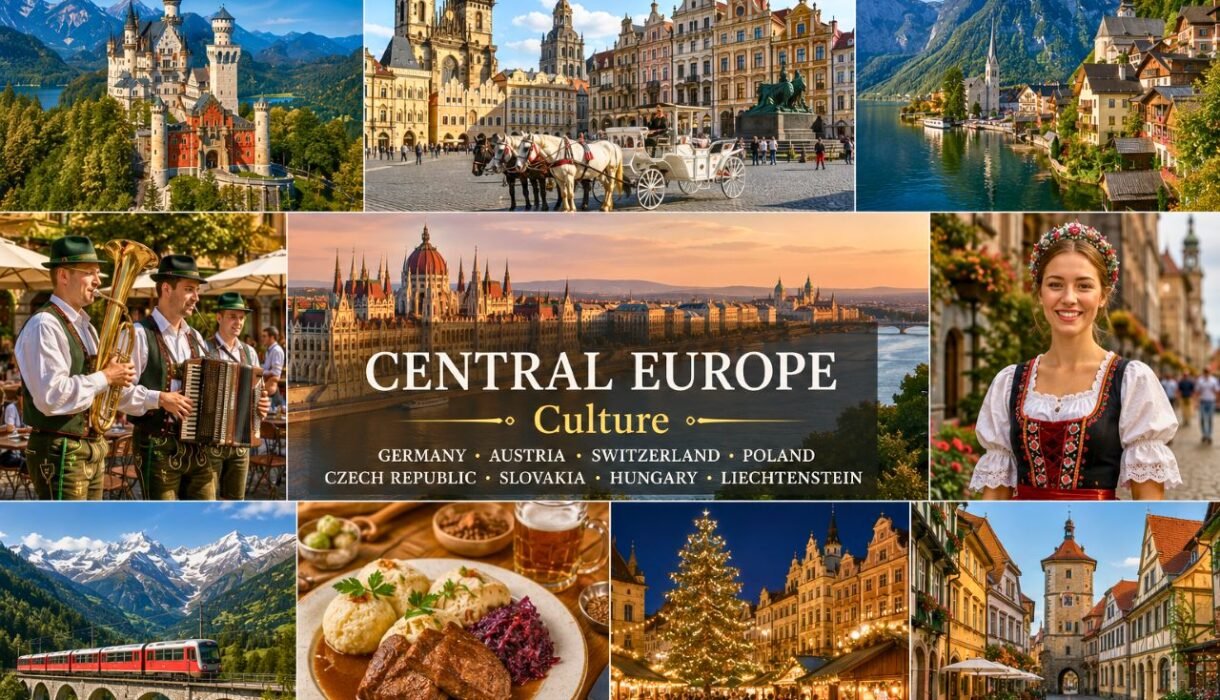

Central Europe Culture: History, Traditions, Arts, and Heritage.
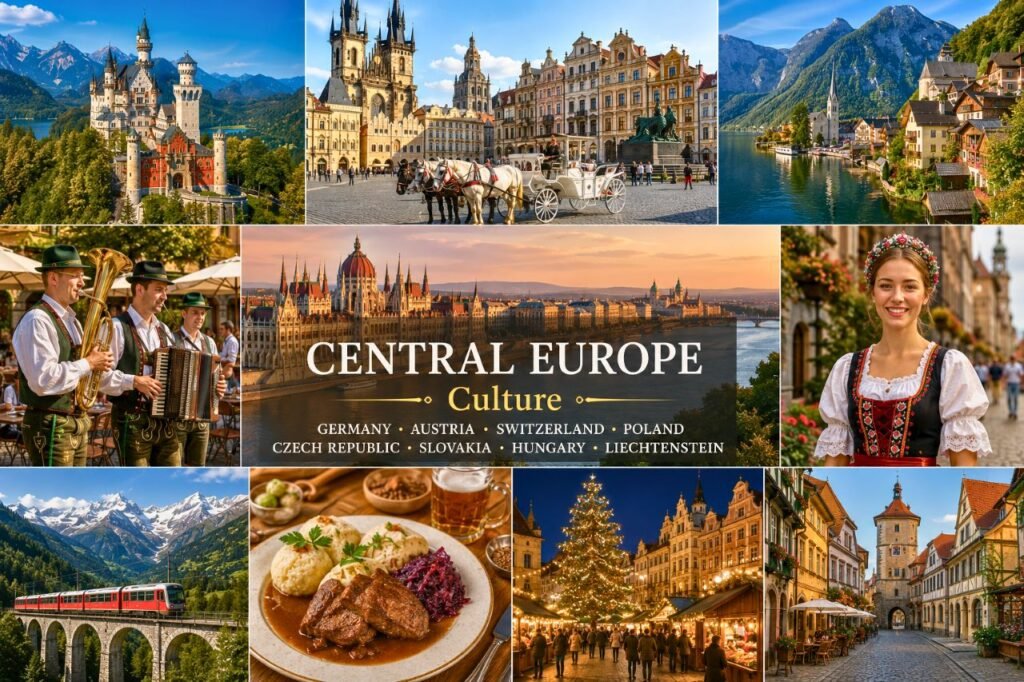
The Culture of Central Europe represents a majestic intellectual and historical crossroads where Western European traditions meet Eastern European influences, forging a distinct regional identity characterized by architectural grandeur, musical sophistication, and vibrant folk customs. Encompassing nations such as Germany, Austria, Switzerland, Poland, the Czech Republic, Slovakia, Hungary, and Liechtenstein, Central Europe has served for centuries as the geographic and cultural heart of the European continent. Defined by historic university towns, imperial Habsburg legacies, seasonal holiday markets, and deeply rooted culinary arts, Central European life reflects a harmonious blend of meticulous craftsmanship, artistic intellectualism, and warm community heritage.
History & Origins
Central Europe’s history is a rich narrative of powerful dynasties, intellectual movements, and resilient cultural preservation across shifting borders.
- Medieval Trade Routes & Holy Roman Empire: During the Middle Ages, the Holy Roman Empire provided a sprawling political framework that connected Germanic, Slavic, and Hungarian lands. Cities like Prague, Krakow, and Vienna developed into major hubs of trade, scholarship, and religious architecture along the Danube and Vistula rivers.
- The Renaissance & University Foundations: Central Europe was an early pioneer in higher learning, establishing prestigious institutions like Charles University in Prague (1348) and the University of Krakow (1364). These academic centers nurtured humanism, scientific inquiry, and astronomical discoveries.
- The Habsburg Legacy & Multi-Ethnic Union: The rise of the Habsburg Monarchy and the subsequent Austro-Hungarian Empire created a unique multi-ethnic space where German, Hungarian, Czech, Polish, Slovak, and South Slavic cultures interacted, exchanging musical, culinary, and architectural traditions.
- 20th-Century Transformation & Reunification: Navigating the devastation of both World Wars and the Cold War division (symbolized by the Iron Curtain), Central Europe demonstrated profound cultural resilience, emerging in the modern era as a unified, prosperous region within Europe.
Culture, Traditions & Customs
Central European customs center on community gatherings, seasonal change, and deeply cherished festive traditions.
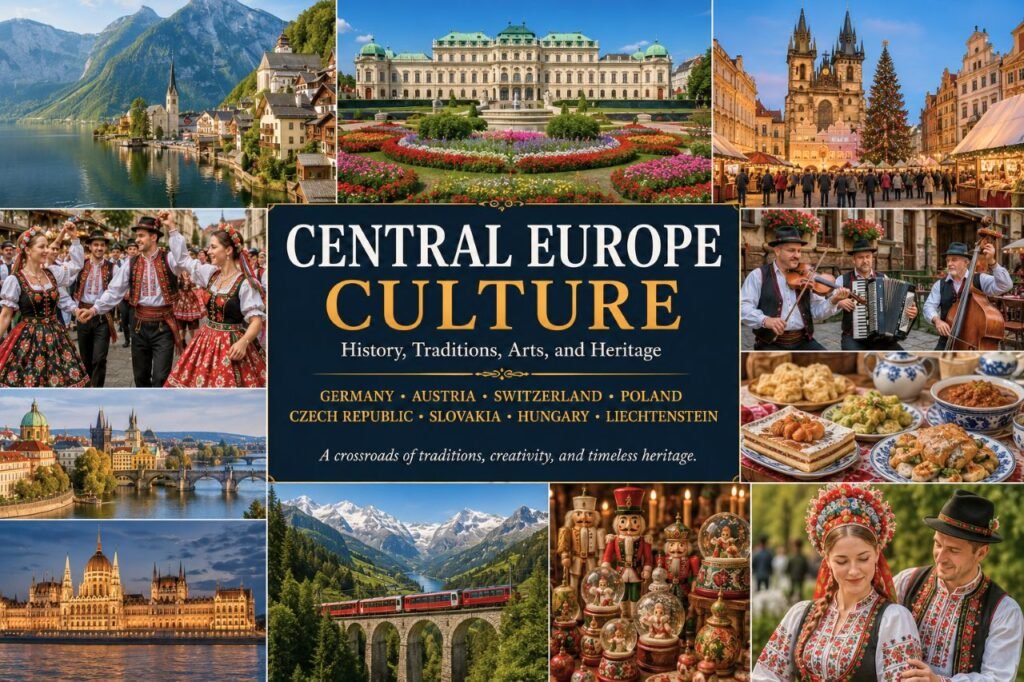
- Christmas Markets (Christkindlmarkt / Kiermasz): Starting in late November, city squares across Germany, Austria, Poland, and the Czech Republic transform into festive open-air markets selling handmade wooden toys, glass ornaments, roasted chestnuts, and spiced mulled wine (Glühwein or Grzaniec).
- Easter & Spring Traditions: Spring welcomes vibrant Easter markets showcasing hand-painted eggs (Kraslice / Pisanki), alongside traditional water-splashing customs like Śmigus-Dyngus in Poland and Pomlázka in the Czech Republic, symbolizing spring renewal and health.
- Spa & Wellness Culture: Central Europe possesses a world-renowned thermal bath and spa culture, particularly in Hungary (Budapest’s historic thermal baths), Germany (Baden-Baden), and the Czech Republic (Karlovy Vary), where mineral waters have been enjoyed for relaxation and health since Roman times.
Languages & Communication
Language Families
Central Europe sits at the literal linguistic intersection of the Germanic, Slavic, and Uralic language families:
- Germanic Languages: German is spoken in Germany, Austria, Switzerland, Liechtenstein, and parts of northern Italy and Luxembourg.
- West Slavic Languages: Polish, Czech, and Slovak share close linguistic roots, written in the Latin alphabet with distinct diacritics.
- Uralic Language (Magyar): Hungarian is a non-Indo-European language with unique Uralic origins, standing out as a distinctive linguistic island in the center of Europe.
Communication Style
Communication across Central Europe values clarity, politeness, and mutual respect. While professional interactions tend to be punctual, organized, and structured, personal relationships reveal deep warmth, intellectual curiosity, and enduring loyalty. Expressing genuine appreciation for local history, literature, and regional dialects is widely admired.
Geography
Central Europe spans a scenic landscape extending from the sandy shores of the Baltic and North Seas to the soaring peaks of the Alps and the Carpathian Mountains.
- River Basins & Valleys: Major river arteries like the Danube, Rhine, Elbe, and Vistula wind through fertile agricultural plains, dramatic river gorges, and vineyard-covered hillsides.
- Alpine & Forested Terrains: Includes the magnificent Alpine arc in Switzerland and Austria, the dense Black Forest (Schwarzwald) in Germany, and the rolling Bohemian Forest along the Czech border.
Economy
Central European economies are recognized worldwide for industrial precision, advanced technology, high manufacturing standards, and sustainable innovation.
- Engineering & Technology: Renowned for world-class automotive design, precision optics, chemical engineering, and environmental technologies.
- Artisanal Craftsmanship: Famous for glassblowing, crystal manufacturing (Bohemian crystal), porcelain production, woodworking, and timekeeping craftsmanship.
- Tourism & Services: Millions of visitors explore Central Europe annually to experience historic UNESCO World Heritage sites, mountain resorts, and cultural capitals.
Politics
Central European nations operate under stable parliamentary democracies, with most maintaining active membership in the European Union, NATO, and the Schengen Area.
- Civic Governance: Political frameworks prioritize democratic representation, social safety nets, environmental conservation, and regional cross-border cooperation through organizations like the Visegrád Group.
- Environmental Leadership: Strong public commitment to green technology, forest conservation, renewable energy transition, and efficient public transit networks.
Ethnic Groups
Central Europe features a rich demographic composition reflecting centuries of shared history:
- Core Regional Populations: Germans, Poles, Austrians, Czechs, Hungarians, Slovaks, Swiss (German, French, Italian, and Romansh communities), and Liechtensteiners.
- Recognized Historical Minorities: Includes the Sorbs in eastern Germany, the Kashubians in northern Poland, the Roma community, and various historical regional sub-groups across the Carpathian arc.
Beliefs & Values
Religious & Secular Heritage
Historically shaped by the Protestant Reformation (initiated in Germany by Martin Luther) and deep-rooted Roman Catholicism (predominant in Poland, Austria, Slovakia, and Hungary), contemporary Central Europe balances revered religious architecture with a modern, tolerant, and largely secular society.
Core Values
- Quality & Precision (Gründlichkeit): A strong appreciation for thoroughness, high craftsmanship, order, and attention to detail in both work and daily life.
- Appreciation for Nature & Outdoor Recreation: Deep reverence for nature, expressed through hiking (Wandern), cycling, mountain sports, and environmental stewardship.
Food & Cuisine
Central European gastronomy offers a comforting, savory blend of farm-fresh ingredients, slow-cooked meats, artisanal breads, and world-famous pastries.
- Bread & Baking Tradition: Bread holds a revered position, with hundreds of varieties of dense sourdough rye breads, pretzel rolls (Brezeln), and seed-crusted loaves baked daily.
- Iconic Regional Dishes:
- Wiener Schnitzel (Austria): Golden, pan-fried breaded veal or pork cutlet served with potato salad and lemon.
- Goulash & Paprikás (Hungary): Hearty meat stews seasoned with rich Hungarian paprika, onions, and slow-simmered vegetables.
- Svíčková & Knedlíky (Czech Republic): Marinated beef sirloin served in a creamy root-vegetable sauce with soft bread dumplings and cranberries.
- Bigos & Pierogi (Poland): Hunter’s stew cooked with sauerkraut, meats, and smoked sausage, alongside savory hand-stuffed dumplings.
- Pastries & Desserts: Famous worldwide for Apple Strudel (Apfelstrudel), Sachertorte, chimney cakes (Kürtőskalács), and plum tarts.
Clothing & Symbols
Traditional Attire
Traditional folk dress (Trachten in German-speaking lands, Stroj in Slavic regions) reflects deep regional pride and intricate textile artistry.
- Trachten & Dirndls: Includes leather breeches (Lederhosen) and fitted bodice dresses (Dirndl), frequently worn during folk festivals, weddings, and regional holidays.
- Folk Embroidery: Vibrant floral motifs and geometric gold-thread stitching adorn aprons, vests, and caps across Polish, Czech, Hungarian, and Slovak regions.
Music, Dance & Art
- Classical Music Supremacy: Central Europe is the undisputed historical home of classical music, nurturing legendary composers such as Johann Sebastian Bach, Wolfgang Amadeus Mozart, Ludwig van Beethoven, Frédéric Chopin, Franz Liszt, Antonín Dvořák, and Béla Bartók.
- Folk Music & Performing Arts:
- Polka & Czardas: Energetic folk dances featuring fast tempo shifts and lively violin accompaniment.
- Thermal Bath & Café Culture Architecture: Striking Secessionist, Art Nouveau, and Modernist art movements flourished across Vienna, Budapest, Prague, and Munich at the turn of the 20th century.
Summary
Central Europe Culture represents an extraordinary fusion of historical intellect, architectural splendor, musical genius, and heartfelt community traditions. By balancing centuries of heritage with forward-looking innovation, the people of Central Europe continue to preserve a vibrant cultural legacy that inspires travelers and scholars worldwide.
At Best Culture Insight, we see culture as the heartbeat of every society – the way people live, connect, and express their identity.