Australian Culture: History, Arts, Traditions, and Legacy of the Sunburnt Country
Posted in :

The Culture of Australia is an extraordinary fusion of the world’s oldest continuous living Indigenous traditions, Anglo-Celtic colonial foundations, and a vibrant multicultural society shaped by post-war global migration. Occupying an entire continent in Oceania, Australia’s unique identity reflects an egalitarian, relaxed lifestyle balanced with an immense reverence for its vast natural landscapes—from coastal beaches to the red sands of the Outback. Known for its ethos of “a fair go,” informal mateship, rich artistic expressions, and passionate sporting heritage, Australian society celebrates an open, diverse lifestyle that bridges ancient spiritual connections to Country with modern cosmopolitan living.
History & Origins
Australia’s cultural evolution spans tens of thousands of years, evolving through distinct epochal shifts:
- Indigenous First Nations Heritage (65,000+ Years): Aboriginal and Torres Strait Islander peoples have inhabited the Australian continent for over 65,000 years, establishing the oldest continuous living cultures on Earth. Deeply tied to the land through spiritual complex networks known as The Dreaming (or Dreamtime), First Nations peoples maintained intricate land management, oral histories, trade routes, and social systems across hundreds of distinct language groups.
- British Settlement & Colonial Era (1788): In 1788, the arrival of the British First Fleet at Port Jackson established a penal colony, introducing British legal systems, English language, and European agricultural practices. The colonial era brought profound hardship and dispossession to First Nations communities while laying the foundation for Anglo-Celtic institutions and pastoral expansion.
- Gold Rushes & Federation (1851–1901): The discovery of gold in the 1850s brought massive influxes of immigrants from Britain, Ireland, China, Europe, and North America. On January 1, 1901, six self-governing British colonies federated to form the Commonwealth of Australia.
- Post-War Multicultural Revolution: Following World War II, Australia launched ambitious migration programs under the slogan “Populate or Perish.” The formal repeal of the White Australia Policy in the 1970s welcomed waves of migrants from Southern and Eastern Europe, Asia, the Middle East, Africa, and the Pacific, transforming Australia into one of the world’s most successful multicultural democracies.
Culture, Traditions & Customs
Australian customs emphasize egalitarianism, relaxed outdoor living, and strong community solidarity.
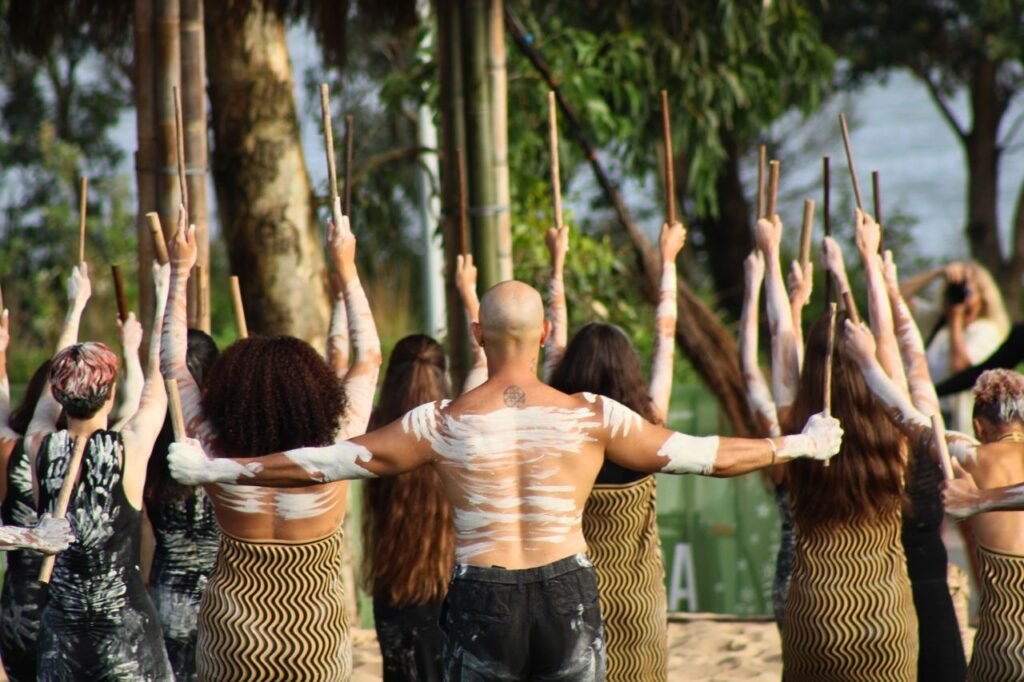
- Aboriginal Rites & Cultural Protocols:
- Welcome to Country & Acknowledgment of Country: Ceremonial practices recognizing First Nations Traditional Custodians of the land. A Welcome to Country is performed by an Elder, while an Acknowledgment of Country is delivered at public gatherings to show respect for Country.
- Initiation & Smoking Ceremonies: Traditional First Nations rites of passage mark transitions into adulthood, while smoking ceremonies use native plant smoke to cleanse spaces and promote spiritual healing.
- Barbecue (BBQ) & Outdoor Gathering Culture: The Australian BBQ is a central weekend social ritual. Families and friends gather in backyards, public parks, and beach reserves equipped with public electric grills to share grilled meats, seafood, and fresh salads.
- National Holidays & Festivals:
- Anzac Day (April 25): A solemn national day of remembrance honoring Australian and New Zealand Army Corps soldiers who served in military conflicts. Begins with dawn services (Dawn Service) and traditional games of Two-Up.
- Australia Day / Survival Day (January 26): Marks the arrival of the First Fleet in 1788, celebrated with citizenship ceremonies and community events, while also acknowledged by many as Invasion Day or Survival Day to honor First Nations resilience.
- Melbourne Cup Day: “The race that stops a nation,” blending horse racing with high fashion and spring festivities.
Languages & Communication
Languages Spoken
- Australian English: The national language, characterized by a distinct accent, unique slang (strine), colorful diminutives (e.g., arvo for afternoon, barbie for barbecue, brekkie for breakfast), and a relaxed cadence.
- First Nations Languages: Prior to European contact, over 250 distinct Indigenous languages and 800 dialects were spoken. Today, active efforts preserve living languages like Pitjantjatjara, Warlpiri, Yolŋu Matha, and Kriol.
- Multicultural Languages: Modern Australia is multilingual, with Mandarin, Arabic, Cantonese, Vietnamese, Italian, and Greek widely spoken across urban households.
Greetings & Slang Expressions
- “G’day, mate!” — The quintessential informal Australian greeting expressing warmth and equality.
- “No worries!” — A foundational cultural philosophy reflecting optimism, helpfulness, and a relaxed outlook.
- “A fair go” — A core moral value demanding equal opportunity, justice, and fairness for every individual regardless of background.
Geography
Australia is the earth’s sixth-largest country by total area and the world’s driest inhabited continent, featuring vastly diverse ecosystems.
- Coastal Urban Belts & Beaches: Over 85% of Australians live within 50 kilometers of the coast, fostering a vibrant surf and coastal lifestyle centered around famous beaches like Bondi and Manly.
- The Outback & Natural Wonders: The vast, arid interior known as the Outback features iconic ancient formations such as Uluru (Ayers Rock), the Kata Tjuta domes, and the Kimberley region.
- Marine & Forest Ecosystems: Home to the world-heritage Great Barrier Reef—the largest coral reef system on Earth—alongside temperate rainforests in Tasmania and ancient tropical rainforests in the Daintree.
Economy
Australia boasts a highly developed, resilient market economy known for abundant natural resources, strong financial institutions, and high standards of living.
- Primary Industries: World-leading exporter of minerals and energy (iron ore, coal, lithium, gold, natural gas) and agricultural goods (beef, wheat, wool, and premium wines).
- Innovation & Services: Major global sector strengths in higher education, international finance, biotechnology, renewable energy transition, and eco-tourism.
Politics
Australia operates as a stable, federal constitutional monarchy with a parliamentary democracy based on the Westminster system.
- Governance Structure: The British Monarch serves as head of state (represented by the Governor-General), while the Prime Minister leads the federal government in Parliament in Canberra.
- Civic Innovations: Australia pioneered key democratic reforms, including the secret ballot (“Australian ballot”) and compulsory voting, ensuring high civic participation rates.
Ethnic Groups
Australia’s population of over 26 million represents a rich cultural mosaic:
- European Ancestry: English, Irish, Scottish, Italian, German, and Greek lineages form historical ancestral foundations.
- First Nations Peoples: Aboriginal and Torres Strait Islander Australians account for approximately 3.8% of the total population, preserving deep cultural connections across rural, remote, and urban communities.
- Asian & Global Communities: Fast-growing Chinese, Indian, Vietnamese, Filipino, and Pasifika communities enrich Australia’s modern suburban and urban life.
Beliefs & Values
Spirituality & Religion
- Indigenous Spirituality (The Dreaming): First Nations spirituality centers on an interconnected worldview where land, ancestors, plants, animals, and human life are bound together through sacred ancestral creation stories.
- Pluralism & Secularism: Contemporary Australia is predominantly secular and highly tolerant. Christianity remains the largest reported religious background, accompanied by growing Buddhist, Islamic, Hindu, and Sikh communities, alongside a large percentage of Australians identifying with no religion.
Core Values
- Egalitarianism & “Tall Poppy Syndrome”: Australians value humility and down-to-earth authenticity. Society tends to criticize arrogance or self-aggrandizement—a trait known as “cutting down tall poppies.”
- Mateship: A prized cultural concept born from frontier harshness and wartime camaraderie, representing loyalty, mutual aid, and unpretentious solidarity.
Food & Cuisine
Australian cuisine has evolved from traditional Indigenous bush tucker and British colonial fare into a world-class fusion celebrating fresh ocean produce and multicultural flavors.
- Bush Tucker (Indigenous Culinary Heritage): Traditional wild foods harvested for millennia, including lemon myrtle, finger lime, macadamia nuts, wattleseed, and native game meats like kangaroo and emu.
- Iconic Australian Staples:
- Vegemite: A savory yeast extract spread thinly over buttered toasted bread, considered a national dietary icon.
- Meat Pies & Sausage Rolls: Flaky pastries filled with minced meat and gravy, typically served with tomato sauce at sporting events.
- Pavlova & Lamingtons: “Pavlova” is a delicate meringue dessert topped with whipped cream and fresh fruits (passionfruit, kiwi), while “Lamingtons” are spongy cake squares dipped in chocolate glaze and rolled in desiccated coconut.
- Café & Coffee Culture: Australia, particularly Melbourne, is internationally acclaimed for pioneering modern third-wave coffee culture, inventing the Flat White espresso drink.
Clothing & Symbols
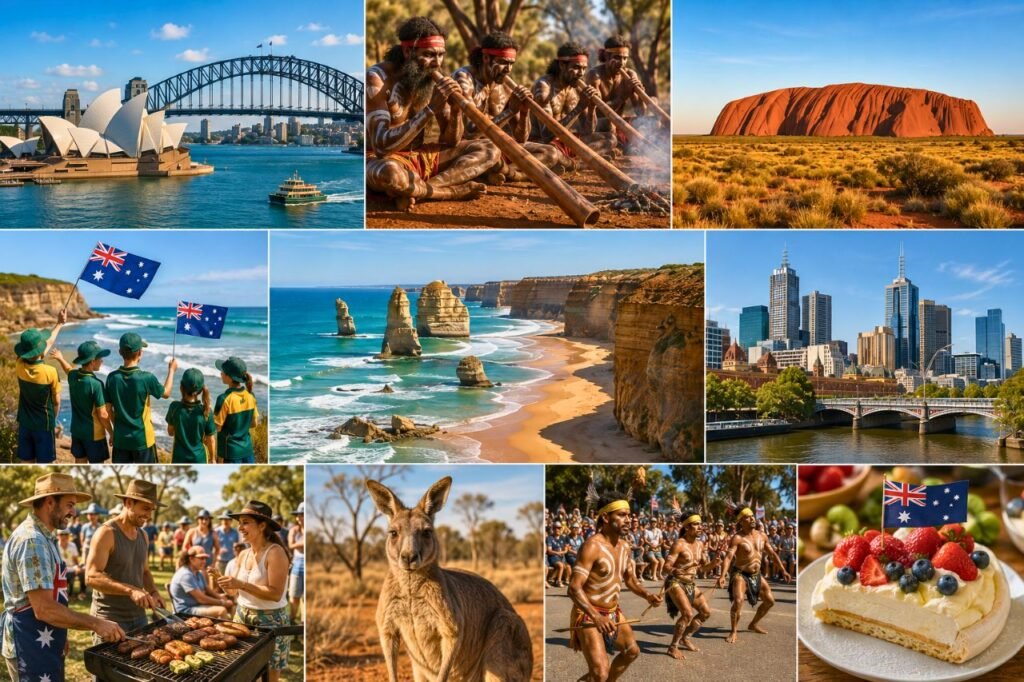
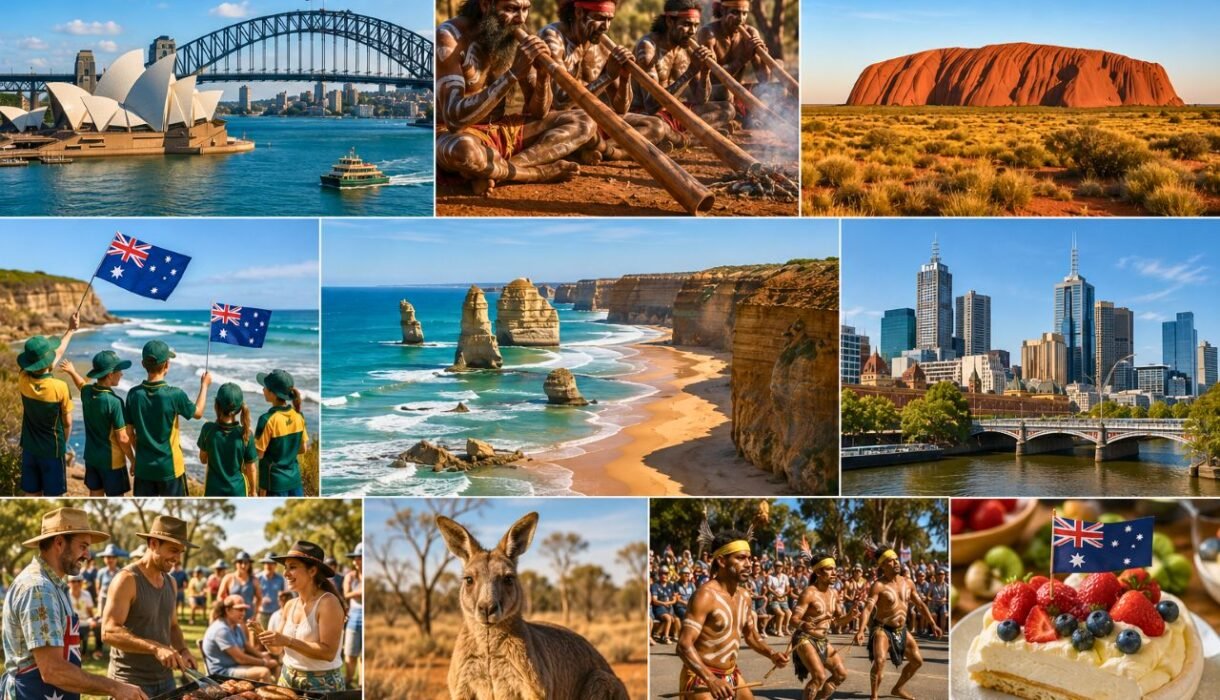
Australia in Vivid Collage
Traditional & Modern Attire
- Bush & Outback Wear: Practical attire designed for harsh sun exposure, including broad-brimmed Akubra felt hats, oilskin Driza-Bone coats, durable denim, and elastic-sided leather R.M. Williams boots.
- Surf & Beachwear: Boardshorts, rash guards, and casual footwear (thongs or flip-flops) form standard everyday summer dress.
National Symbols
- National Colors: Green and Gold, derived from Australia’s national floral emblem, the Golden Wattle (Acacia pycnantha).
- Fauna Symbols: The Kangaroo and Emu, featured on the Commonwealth Coat of Arms because neither animal can easily move backward, symbolizing a nation moving forward.
Music, Dance & Art
- First Nations Artistic Mastery:
- Dot Painting & Bark Painting: Contemporary Indigenous visual arts use intricate dotting techniques and natural earth pigments (ochre) to convey sacred mapping, ancestral waterholes, and Dreaming stories.
- Didgeridoo (Yidaki): An ancient wind instrument crafted from termite-hollowed eucalyptus branches, producing deep, resonant rhythmic drones used during traditional Corroboree dances.
- Performing Arts & Cinema:
- Performing Arts: Home to world-class institutions like Opera Australia, the Australian Ballet, and Bangarra Dance Theatre (a premier Indigenous contemporary dance company).
- Music & Cinema: Global musical legends range from rock icons (AC/DC, INXS) and pop stars (Kylie Minogue) to modern indie pioneers (Tame Impala), alongside an acclaimed film industry (Mad Max, Australia).
Summary
Australia Culture represents a magnificent union of ancient Indigenous heritage, outdoor coastal lifestyle, egalitarian values, and vibrant multicultural innovation. By honoring its First Nations roots, embracing “a fair go” for all citizens, and nurturing world-class arts and culinary traditions, Australia continues to shine as a dynamic cultural beacon in the Oceania region.
At Best Culture Insight, we see culture as the heartbeat of every society – the way people live, connect, and express their identity.