The Reed Dance of Eswatini — 80,000 Bare-Breasted Women Dancing Before a King Is Not What You Think
Posted in :

Every year, in the late southern winter, tens of thousands of young women gather in the Kingdom of Eswatini for one of Africa’s most breathtaking and misunderstood cultural spectacles: the Umhlanga, or Reed Dance. International media headlines often reduce this week-long festival to sensationalist tropes about a monarch choosing a bride from thousands of bare-breasted dancers. However, to view the ceremony purely through a modern Western lens misrepresents its true purpose. In reality, the Reed Dance is a deeply revered ritual centered on female solidarity, cultural pride, nation-building, and the preservation of historic traditions.
The True Purpose Behind the Reeds
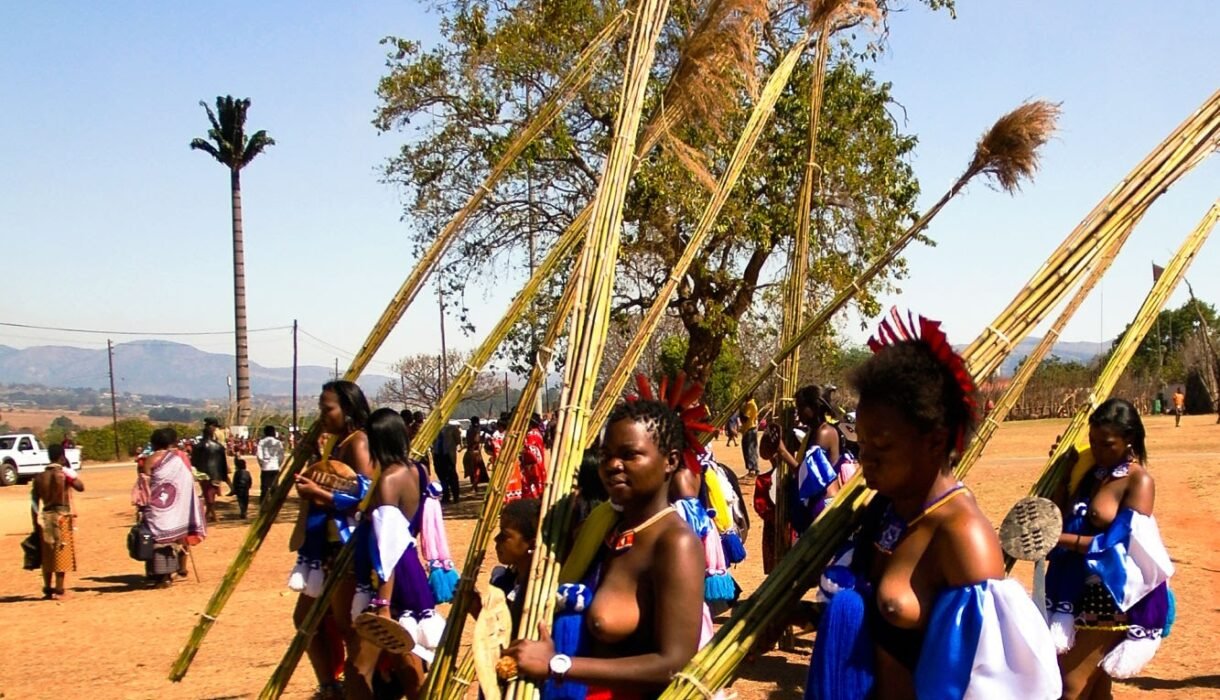
At its core, the Umhlanga is a labor of dedication and community service. The week-long ceremony begins with young, unmarried, and childless women travelling from chiefdoms across the nation to the royal residence at Ludzidzini. Armed with knives, they journey long distances into riverbanks to cut tall reed stalks. These reeds are gathered into heavy bundles and carried back to the royal palace, where they are used to repair the windbreak fences protecting the Queen Mother’s compound (Indlovukazi). The act symbolizes the youth physically surrounding, insulating, and upholding the nation’s spiritual center.
A Celebration of Sisterhood and Chastity
Contrary to external assumptions, the atmosphere among the participants is not one of competition or servitude, but of joyous camaraderie. For young women, the festival provides a unique space to bond with peers from distant regions, share experiences, and learn vital life lessons from female elders. Traditionally, participation is an explicit celebration of chastity and bodily autonomy. In a society where women face modern social pressures, the festival acts as a protective culturally anchored space that encourages self-respect, moral strength, and independence before marriage.
Understanding the Ceremonial Attire
Sensational coverage frequently fixates on the traditional dress worn during the dance. In Eswatini culture, clothing reflects age, status, and life stage. Unmarried maidens wear indlamu—brightly colored beaded skirts, ankle rattles, and traditional waist bands—while leaving the upper body uncovered according to historic custom. Within traditional African cosmology, the human body is viewed naturally rather than through a hyper-sexualized lens. Wearing traditional attire is an act of deep cultural pride, connecting the younger generation directly to the ancestral history of their land.
Protecting National Identity in a Changing World
Beyond its social dimensions, the Reed Dance serves a crucial political and civic purpose. Eswatini is one of the world’s last remaining absolute monarchies, and the festival acts as a unifying ritual that reinforces national identity across different chiefdoms. By gathering tens of thousands of youth together under a shared traditional heritage, the kingdom actively preserves its language, music, dance forms, and governance structure in an era where global homogenization threatens to erase indigenous cultures.
A Powerful Statement of Female Empowerment
While the climax of the festival involves dancing before the King (Mswati III) and the Queen Mother, selecting a bride is neither the primary objective nor a mandatory yearly outcome of the event. Instead, the final days are a celebratory display of strength, rhythm, and song. The maidens sing chants that celebrate womanhood, lament social issues, and express solidarity. For the young women involved, stepping onto the parade grounds is an empowering statement that they are the guardians of Eswatini’s future.
Preserving Heritage for Future Generations
The Umhlanga offers a vivid lesson in the importance of cultural context. What appears exotic or controversial from afar is, in truth, an enduring tradition built on unity, respect, and service. As Eswatini navigates the demands of the 21st century, the Reed Dance remains a vital bridge between past and present—proving that ancient rituals can continue to offer dignity, identity, and strength to the next generation.