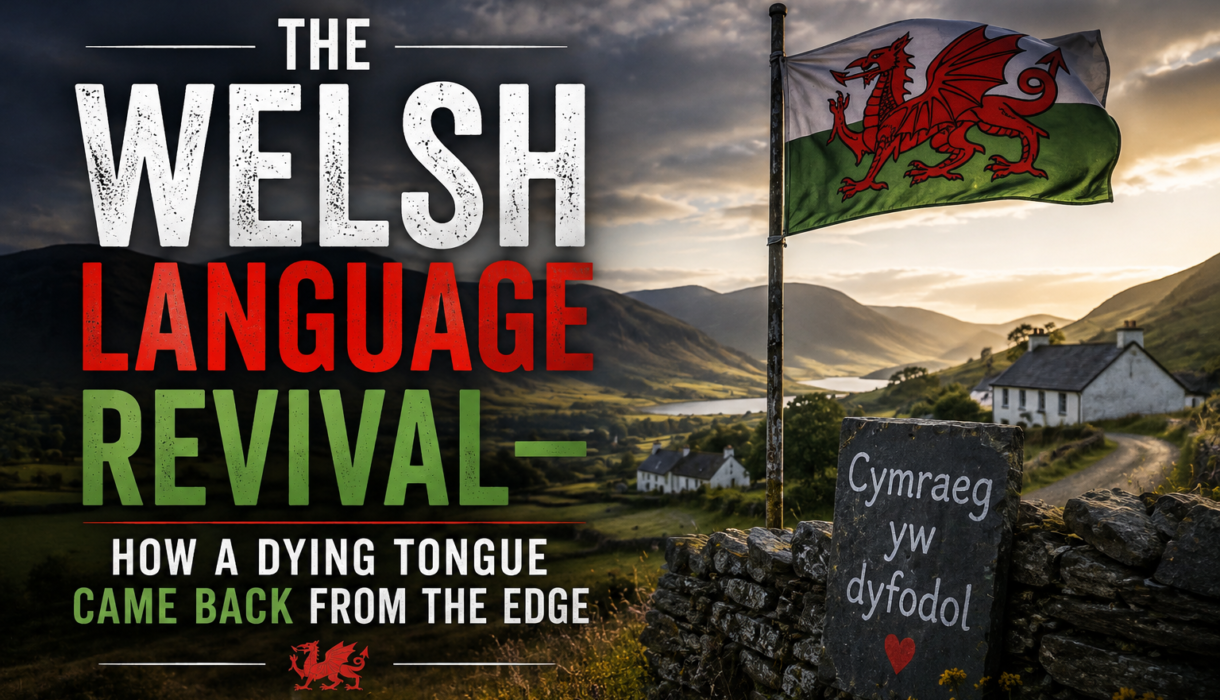

The story of the Welsh language (Cymraeg) is one of the most remarkable cultural comebacks in modern history. As one of Europe’s oldest living languages, Welsh once faced what appeared to be an inevitable decline due to centuries of political marginalization, industrial shifts, and aggressive assimilation policies. By the late 20th century, the proportion of Welsh speakers had dropped dramatically, leading sociolinguists to warn that the ancient Celtic tongue was on the brink of extinction. Today, however, Wales stands as a global beacon for language revitalization, having systematically engineered a vibrant rebirth that offers a masterclass in cultural preservation.
From Suppression to Grassroots Activism
The roots of the language’s decline run deep into history, notably accelerated by 19th-century British policies designed to prioritize English in administration and schooling. Infamous practices like the “Welsh Not”—a wooden tally stick used in classrooms to punish children caught speaking their native tongue—instilled a generational stigma around the language. By the 1981 census, less than 19% of the Welsh population spoke the language, down from over 50% at the turn of the century. This crisis sparked a powerful civil rights movement led by activist groups like Cymdeithas yr Iaith (The Welsh Language Society), whose non-violent protests demanded bilingual road signs, equal legal status, and dedicated broadcasting rights.
Education as the Engine of Rebirth
Central to the survival of Welsh was a revolutionary shift in the country’s educational framework. Recognizing that language transmission could no longer rely solely on the home, the government introduced Welsh-medium schools (Ysgolion Cymraeg), where subjects are taught primarily in Welsh. This immersive approach turned the education system into an engine for language creation, enabling thousands of parents who spoke only English to raise fluent, bilingual children. Today, Welsh-medium education is widely praised for boosting cognitive skills and academic performance, making it a highly desirable choice for families across Wales regardless of their linguistic background.
Policy, Media, and Official Status
Grassroots enthusiasm was backed by crucial political and legal reforms that institutionalized the language in public life. The creation of S4C in 1982—a dedicated Welsh-language television channel—gave the language a vibrant modern presence in entertainment and news. Subsequent legislation, including the Welsh Language Acts of 1993 and 2011, granted Welsh official equal status to English in Wales, mandating that public bodies offer fully bilingual services. Today, the Welsh Government’s ambitious Cymraeg 2050 strategy aims to reach one million active Welsh speakers by mid-century, supported by workplace training programs and free digital learning platforms like Duolingo.
A Global Blueprint for Language Reclamation
The Welsh language revival proves that language death is not inevitable when political will aligns with community passion. By combining legal protection, immersive schooling, and modern media, Wales transformed Cymraeg from a vulnerable legacy into an indispensable asset of modern national identity. For minority language communities across the world—from the Gaelic speakers of Scotland to indigenous populations in the Americas—the Welsh experience offers a tested, optimistic blueprint showing how ancient words can successfully navigate and flourish within the modern digital era.