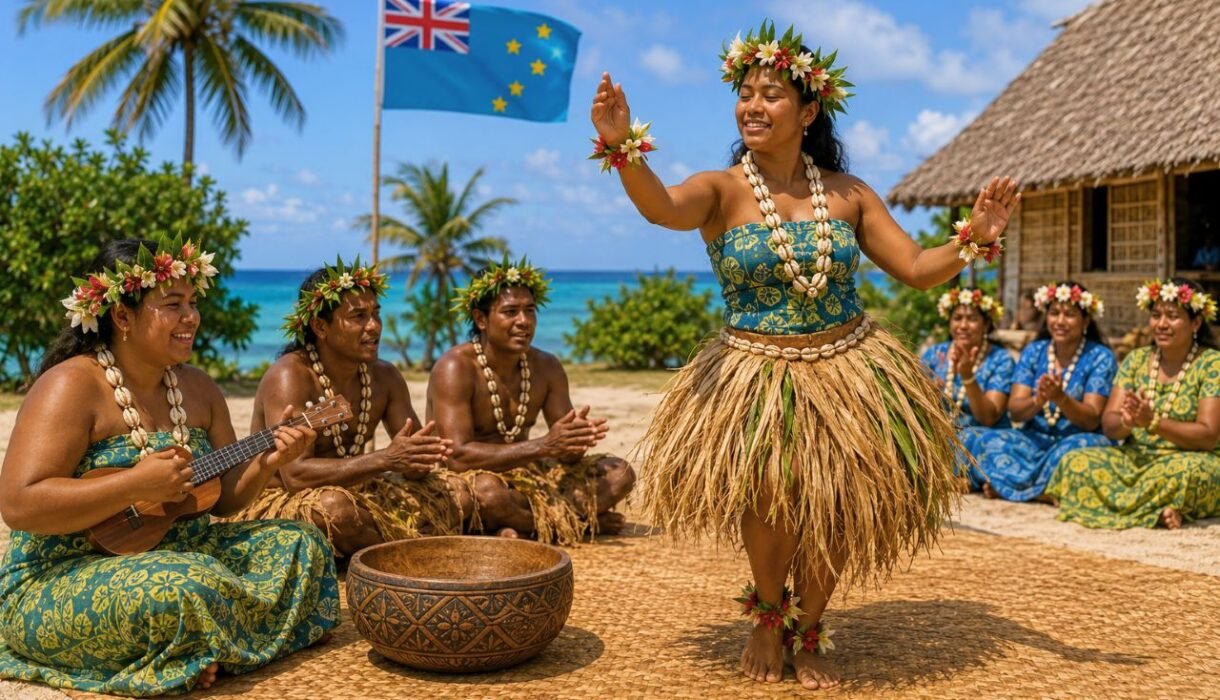

The Culture of Tuvalu is a remarkably preserved Polynesian heritage that thrives in one of the most remote and intimate archipelagos in Oceania. Formerly known as the Ellice Islands, Tuvalu consists of nine low-lying coral atolls scattered across the central Pacific Ocean. Governed by the principles of Falekaupule (traditional island councils of elders) and Olaga Fakafenua (communal village life), Tuvaluan identity is rooted in mutual support, oral storytelling, mastery of seafaring, and a deep, harmonious bond with the ocean. Despite facing modern environmental challenges, the people of Tuvalu maintain an extraordinarily vibrant cultural fabric centered around family solidarity, vibrant communal music, and shared island pride.
History & Origins
The origins of Tuvalu are tied to ancient Polynesian navigators and millennia of Pacific seafaring:
- Polynesian Settlement (circa 1000–1400 CE): The early ancestors of Tuvaluans sailed west from neighboring Polynesian hubs, primarily Samoa, Tonga, and the Tokelau Islands, in double-hulled voyaging canoes (Lualua). Eight of the nine atolls were permanently settled, giving rise to the native name Tuvalu, which translates to “Eight Standing Together” (the ninth island, Niulakita, was settled later).
- European Contact & The Ellice Islands Name:
- Spanish Explorers: Spanish navigator Álvaro de Mendaña sighted Nui in 1568 and Niulakita in 1595.
- Naming (1819): Captain Arent de Peyster named Funafuti “Ellice’s Island” after British merchant Edward Ellice. Eventually, the entire group became known as the Ellice Islands.
- Colonial Period & The Gilbert and Ellice Islands (1892–1975):
- Protectorate: Great Britain declared a protectorate over the Ellice Islands and neighboring Micronesian Gilbert Islands (now Kiribati) in 1892, formally establishing the Gilbert and Ellice Islands Crown Colony in 1916.
- World War II: Funafuti served as a strategic military base for Allied forces fighting Japanese troops in the Pacific, with airfields constructed across the main islet.
- Separation & Independence (1978): In 1974, Ellice Islanders voted overwhelmingly in a referendum to separate from the Gilbert Islands due to ethnic and cultural differences (Polynesian versus Micronesian). On October 1, 1978, Tuvalu officially gained full independence as a sovereign nation within the Commonwealth.
Culture, Traditions & Customs
At the core of Tuvaluan society is communal living, where individual interests are aligned with the collective well-being of the village:
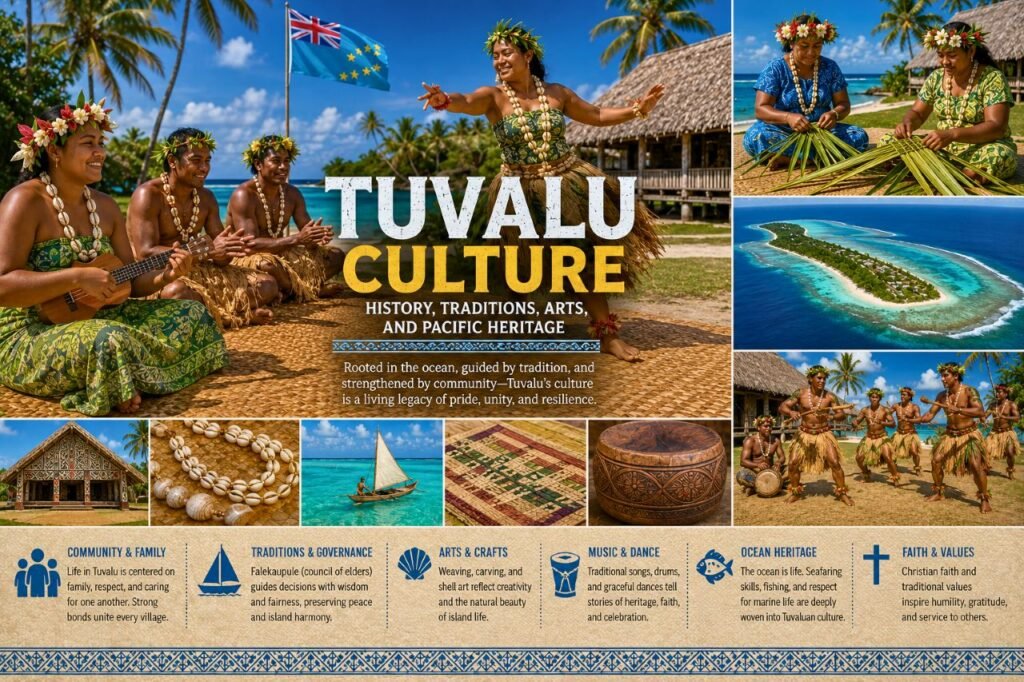
- The Falekaupule System: Each island features a central meeting house called the Falekaupule (or Maneapa), governed by the Ahiga (the council of elders or Ulu-Aliki). All major decisions regarding land disputes, community work, local laws, and island festivals are debated and resolved in this sacred hall.
- Kaitasi (Shared Ownership): Traditional land and property rights are held collectively by extended family clans (Aliki or Aiga). Land is divided through family lineages to ensure every family member maintains access to planting pits and fishing grounds.
- Rites of Passage & Life Celebrations:
- Fakanau & Naming Ceremonies: The birth of a child is celebrated with family feasts where elders bestow meaningful ancestral names reflecting family history, ocean events, or island lineage.
- Weddings (Fakafetaui): Tuvaluan weddings involve extensive gift exchanges of handmade pandanus mats (Mota), coconut oil, taro crops, and woven garlands (Fou).
- Funerals: Funerals involve multi-day vigils, hymn singing, and ritual mat wrapping, honoring the deceased person’s contribution to island life.
Languages & Communication
Languages Spoken
- Tuvaluan (Te ‘Gagana Tuvalu): An official language belonging to the Ellicean branch of Polynesian languages. While mutually intelligible across most islands, distinct local dialects exist between the northern islands (such as Nanumea) and southern islands (such as Funafuti).
- English: Official language widely used in government administration, civil service, higher education, and international diplomacy.
- Gilbertese: Spoken on the island of Nui due to historical migrations from neighboring Kiribati.
Greetings, Expressions & Expressions
- “Talofa” — The universal Tuvaluan greeting meaning “Hello” or “Warm welcome.”
- “Fakafetai” — “Thank you.”
- “Tofaga” — “Goodbye” or “Farewell.”
- “Malo te ola” — “Good health” or “Long life to you.”
- “Sili te alofa i meagafua” — A Tuvaluan proverb meaning “Love is greater than material possessions”—highlighting the supreme value placed on human relationships over physical wealth.
Geography
Tuvalu is one of the smallest and most geographically isolated nations on Earth, consisting of nine coral atolls and reef islands:
- Low-Lying Island Chain: The total land area across all nine atolls (Funafuti, Nanumea, Nanumaga, Niutao, Nui, Nukufetau, Nukulaelae, Vaitupu, and Niulakita) is just 26 square kilometers (10 square miles).
- Funafuti Atoll: The capital and largest urban center, containing a wide central lagoon (Te Namo) surrounded by narrow strips of palm-covered land.
- Elevation & Marine Ecosystems: The highest natural elevation in the entire nation is barely 4.6 meters (15 feet) above sea level, making Tuvalu exceptionally rich in marine biodiversity, vibrant coral reefs, and sandy islets.
Economy
Tuvalu’s economy is small, specialized, and heavily connected to international licensing and marine resources:
- Subsistence Fishing & Agriculture: Rural villagers rely on reef fishing, coconut harvesting, and cultivation of giant swamp taro (Pulaka).
- Licensing & Remittances: Key national revenues stem from selling fishing licenses to foreign fleets operating in Tuvalu’s vast Exclusive Economic Zone (EEZ), international aid, remittances sent home by Tuvaluan merchant mariners, and royalties from its country-code domain extension .tv.
- Currency: The national currency is the Tuvaluan Dollar (TVD), which is pegged at parity to the Australian Dollar (AUD) (both circulate freely).
Politics
Tuvalu is a stable constitutional monarchy with a parliamentary democracy:
- Governance System: Parliament consists of 16 members elected from the island constituencies for four-year terms. The Prime Minister serves as Head of Government, while King Charles III is Head of State, represented locally by a native Governor-General.
- Non-Partisan Parliament: Candidates run as independents rather than through political parties, voting on legislation based on island consensus and community priorities.
Ethnic Groups
- Tuvaluan Majority (~96%): Indigenous Polynesians form the overwhelming majority of the nation’s population.
- Mixed & Minority Groups (~4%): Includes individuals of mixed Tuvaluan and I-Kiribati heritage, alongside small communities of other Pacific islanders and expatriates.
Beliefs & Values
Religion & Spirituality
- Christianity (97%+): Introduced by Samoan missionaries from the London Missionary Society in the 1860s, Christianity transformed Tuvaluan society. Today, the Ekalesia Kelisiano Tupuolo o Tuvalu (the Congregational Christian Church of Tuvalu) is the national state church.
- Ancestral Respect: Pre-Christian spiritual concepts regarding spirit guidance and ocean tapus (Sa) blend seamlessly with modern Christian faith.
Core Values
- Alofa (Love & Compassion): Expressed through unselfish sharing of food, shelter, and resources.
- Fakaaloalo (Respect): Deep respect accorded to village elders (Matai or Ulu-Aliki), parents, and church leaders.
- Inati (Sharing System): The traditional practice where community catches of fish or garden harvests are brought to the Falekaupule and distributed equally among all village households.
Food & Cuisine
Traditional Tuvaluan cuisine relies on local seafood, coconuts, and subterranean root crops cultivated in coral sand pits.
- Key Dishes & Delicacies:
- Pulaka: Giant swamp taro cultivated in large pits dug deep into the freshwater lens beneath the coral sand. It is boiled, mashed, or baked for special village feasts.
- Palusami: Young taro leaves filled with seasoned coconut cream and baked over hot stones.
- Fresh Seafood: Tuna, flying fish, red snapper, and coconut crab cooked in fresh coconut milk, lime, or wrapped in banana leaves.
- Kaleve (Toddy): Sweet sap collected daily from cut coconut palm blossoms, enjoyed fresh in the morning or fermented.
Clothing & Symbols
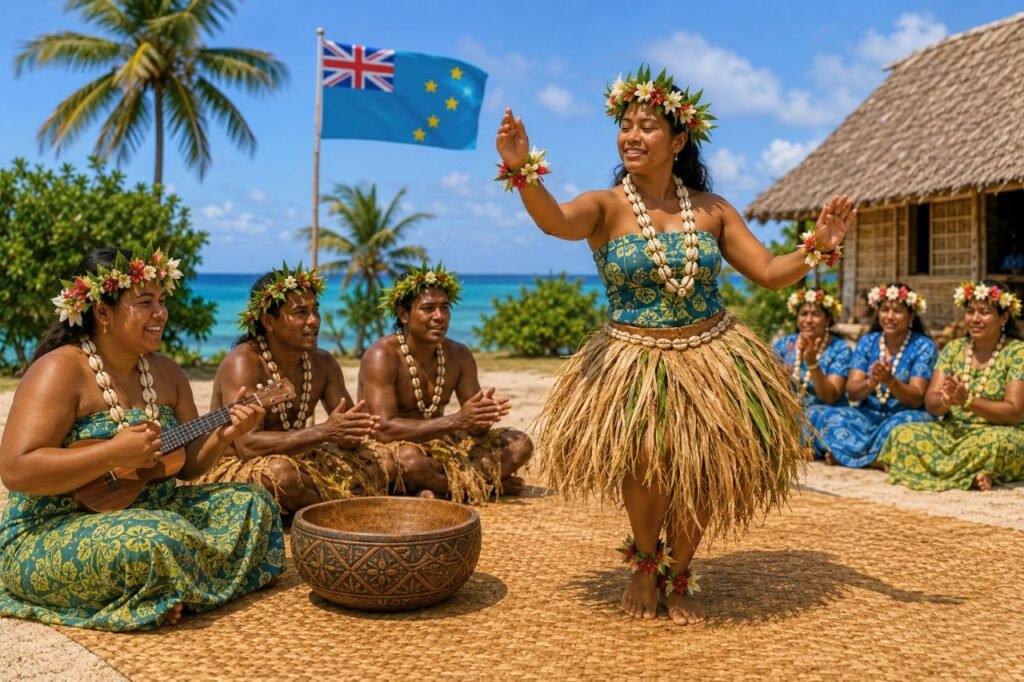
Traditional Attire
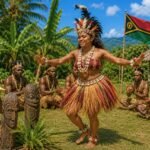
- Titi: Traditional skirts crafted from dried pandanus leaves, coconut fibers, or hibiscus bark, dyed in vibrant colors and worn for customary dances.
- Fou: Intricate floral headbands and neck garlands crafted from fragrant frangipani, tiare flowers, and green leaves, given to honored guests as a sign of welcome and respect.
Cultural Symbols
- Outrigger Canoe (Paopao): Hand-carved from native breadfruit trees, symbolizing Tuvaluan navigation, survival, and ocean mastery.
- Tuvalu Coat of Arms: Features a traditional Falekaupule meeting hall, eight sea shells symbolizing the original settled islands, and the national motto: “Tuvalu mo te Atua” (“Tuvalu for the Almighty”).
Music, Dance & Art
- Fatele: The magnificent, heart-pumping traditional dance of Tuvalu. Men and women sit in lines singing melodic chants and beating wooden boxes (Pate) or tin cans, while dancers rise to perform expressive, synchronized arm movements that accelerate to a thrilling climax.
- Siva: Gentle, storytelling solo or duet dances performed during informal family gatherings.
- Handicrafts & Weaving: Tuvaluan women (Fafine) are master weavers, crafting fine floor mats (Mota), sleeping mats, fans (Ili), and woven baskets using dried pandanus and coconut leaves.
Summary
Tuvalu Culture stands as an extraordinary testament to Polynesian resilience, community unity, and ocean stewardship in Oceania. Guided by the wisdom of the Falekaupule, the energy of the Fatele, and an unshakeable spirit of communal support (Inati), Tuvalu continues to preserve its timeless heritage for generations to come.
At Best Culture Insight, we see culture as the heartbeat of every society – the way people live, connect, and express their identity.

I was wondering if you ever considered changing the structure of your site?
Its very well written; I love what youve got to say. But maybe you could a little more in the way of content so people could connect with it better.
Youve got an awful lot of text for only having 1 or two images.
Maybe you could space it out better?