Palau Culture: History, Traditions, Arts, and Pacific Heritage
Posted in :

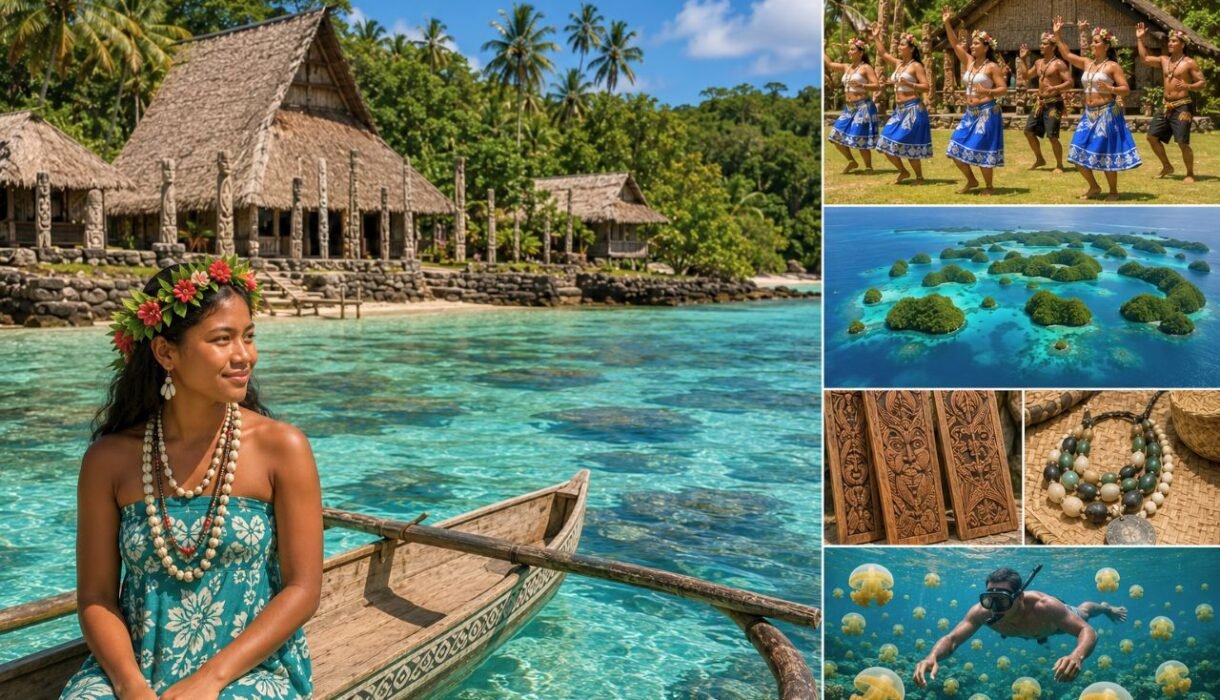
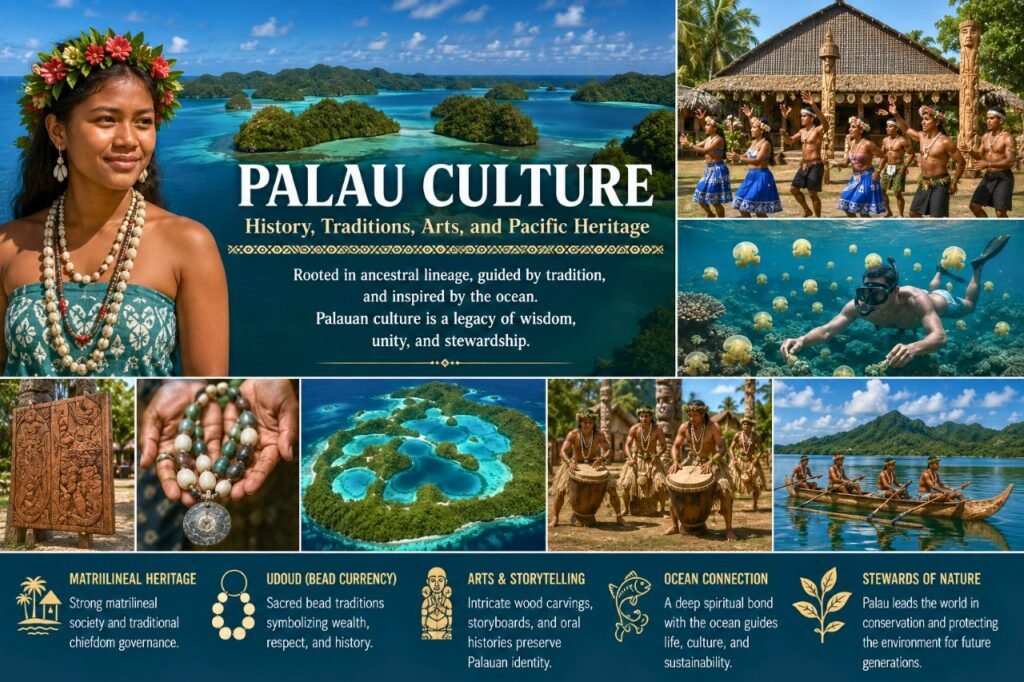
The Culture of Palau (Belau in the Palauan language) stands as one of the most resilient and sophisticated island heritages in Micronesia and the broader Oceania region. Comprising over 300 emerald-like islands scattered across the western Pacific Ocean, Palau is world-renowned for its matrilineal social governance, traditional village chiefdoms, exquisite carved storyboards, and pioneering environmental stewardship. Grounded in ancestral lineage, customary bead currency (Udoud), and a profound spiritual connection to the marine environment, Palauan society successfully balances centuries-old customs with a forward-looking, modern democratic state.
History & Origins
Palau’s history spans over three millennia of seafaring discovery, tribal alliance, and complex colonial encounters:
- Austronesian Settlement (circa 1000 BCE): The original settlers arrived by outrigger canoes from Maritime Southeast Asia (likely Indonesia and the Philippines). Over centuries, these islanders developed a highly organized society centered on village council houses (Bai) and terraced hillsides across the main island of Babeldaob.
- The Rock Islands & Monolithic Civilizations: Ancient Palauans inhabited the limestone Rock Islands (Chelbacheb), leaving behind megalithic stone faces (such as the Badrulchau stone monoliths) and burial caves before migrating to larger volcanic islands due to water scarcity.
- Colonial Eras (18th–20th Centuries):
- Spanish Rule (1885–1899): Spain formally claimed the islands, introducing Christianity and European commerce.
- German Era (1899–1914): Germany purchased Palau from Spain, initiating commercial phosphate mining and coconut plantations.
- Japanese Mandate (1914–1944): Japan developed Koror into a bustling administrative center, introducing public education, infrastructure, and agricultural projects prior to World War II. During WWII, Palau was the site of the fierce Battle of Peleliu in 1944.
- US Trust Territory & Republic Status (1947–Present): Administered by the United States as part of the Trust Territory of the Pacific Islands after World War II, Palau adopted its own constitution in 1981 and became a sovereign, independent republic in 1994 under a Compact of Free Association with the USA.
Culture, Traditions & Customs
Palauan life operates under a dual system of modern civil law and enduring traditional custom (Osiik):
- Matrilineal Clan Governance: Palauan society is strictly matrilineal. Clan lineage, land ownership rights, and traditional titles pass through women (Klobak). While male chiefs (Ibedul and Reklai) represent the village publicly and govern councils, elder clan women (Mechesil Belau) hold the ultimate power to select, appoint, or remove these chiefs.
- Palauan Bead Money (Udoud): One of the few active traditional currency systems in the world. Made of antique glass and enamel beads brought by ancient trade, Udoud pieces have distinct names, histories, and values. They are exchanged during major life events such as birth ceremonies, marriages, house completions, and funerals.
- Rites of Passage:
- Ngasech (First-Birth Ceremony): A prominent cultural ceremony honoring a young mother after giving birth to her first child. The mother undergoes weeks of ritual hot baths prepared with medicinal herbs and coconut oil. On the day of the Ngasech, she is adorned with turmeric, woven skirts, and Palauan money, emerging publicly onto woven mats as her clan celebrates her strength and motherhood.
- Kemeldiil (Funerals): Funerals are critical social gatherings where clan obligations are settled, traditional money is exchanged, and land rights are reviewed by village elders.
Languages & Communication
Languages Spoken
- Palauan (Tekoi er a Belau): An official language belonging to the Malayo-Polynesian branch of Austronesian languages. Unlike most Micronesian tongues, Palauan is closely related to Sunda-Sulawesi languages of Indonesia and the Philippines.
- English: Official and universally spoken in education, government administration, commerce, and media.
- Regional Languages: Japanese is still spoken by older generations, while Sonsorolese and Tobian are spoken on Palau’s outer southern atolls.
Greetings, Expressions & Philosophy
- “Alii” (pronounced Ah-lee) — The universal Palauan greeting meaning “Hello” or “Welcome.”
- “Sulang” — Expresses “Thank you.”
- “Ke Mo Er Ker?” — “Where are you going?” (A friendly, common informal greeting).
- Respect & Modesty: Palauan etiquette emphasizes quiet dignity, deference to matriarchs and chiefs, and communal harmony.
Geography
Palau is situated in the western Pacific Ocean, northeast of Indonesia and east of the Philippines:
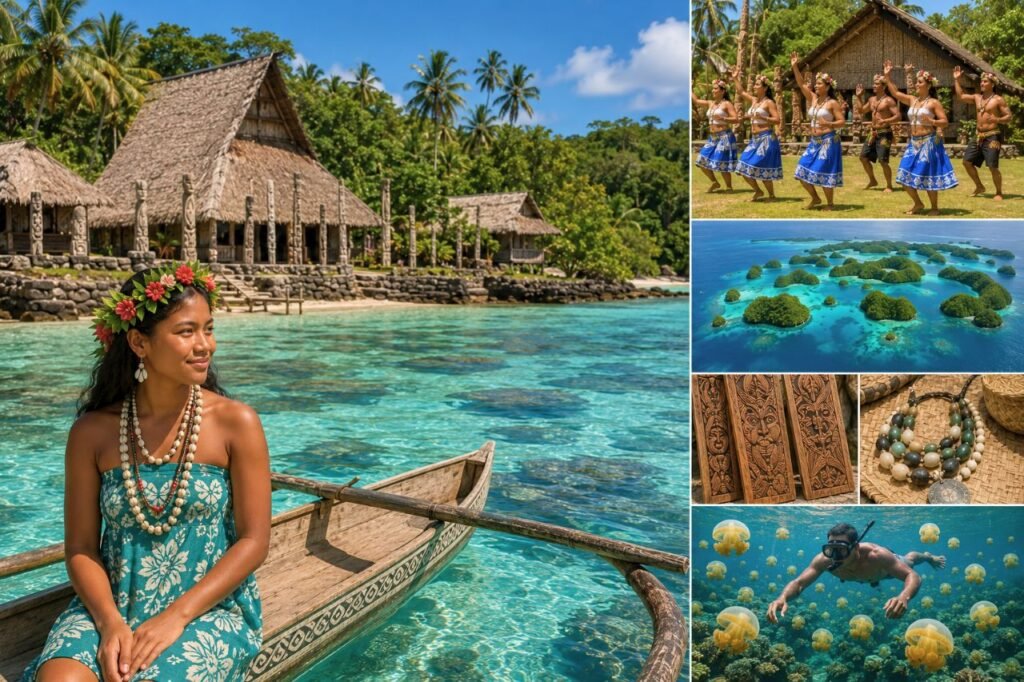
- The Rock Islands (Chelbacheb): A UNESCO World Heritage site consisting of over 400 mushroom-shaped limestone islets covered in tropical rainforest, fringed by crystal-clear turquoise lagoons and coral reefs.
- Babeldaob Island: The largest island in Palau, featuring volcanic mountains, dense rainforests, waterfalls, and the national capital, Ngerulmud in Melekeok State.
- Jellyfish Lake: A unique marine lake on Eil Malk island home to millions of stingless golden jellyfish.
Economy
Palau’s economy relies heavily on sustainable eco-tourism, marine protection, and foreign partnerships:
- Eco-Tourism & The Palau Pledge: World-renowned for scuba diving and marine conservation. In 2017, Palau became the first nation to require visitors to sign the Palau Pledge stamped into their passports—a eco-promise to the children of Palau to preserve the natural environment.
- Compact of Free Association: Financial support from the United States under the Compact agreement supports government infrastructure, healthcare, and education services.
Politics
Palau is a democratic presidential republic operating in free association with the United States:
- Executive & Legislative Governance: The President and Vice President are directly elected, alongside a bicameral National Congress (Olbiil Era Kelulau).
- Council of Chiefs: Traditional authority is constitutionally protected. The Council of Chiefs advises the President on traditional laws, land rights, and customary affairs.
Ethnic Groups
- Palauan Majority (~73%): Ethnically Micronesian with historical maritime links to Southeast Asia and Polynesia.
- Minority Communities: Significant expatriate communities include Filipinos, Chinese, Micronesians, Japanese, and Americans working in tourism, healthcare, and construction.
Beliefs & Values
Religion & Spirituality
- Christianity: Introduced in the 19th century, over 80% of Palauans practice Christianity (predominantly Roman Catholicism and Protestantism).
- Modekngei: A native syncretic religion founded in the early 20th century that blends traditional Palauan spiritual beliefs with Christian teachings, emphasizing island harmony and ancestral respect.
Core Values
- Klobak (Communal Solidarity): Cooperation among clan members to support extended family needs.
- Bul (Conservation Mandate): An ancient customary law where chiefs declare an immediate moratorium on fishing or harvesting in specific areas to allow natural ecosystems to recover.
Food & Cuisine
Traditional Palauan cuisine revolves around root crops, fresh ocean seafood, and rich coconut preparations:
- Key Dishes & Staples:
- Kukau (Taro): The primary cultural staple cultivated in wetland taro patches (Mesei) tended exclusively by women.
- Fresh Seafood: Reef fish, red snapper, tuna, land crab, and sea cucumber prepared grilled, boiled, or cooked in rich coconut milk.
- Demok: A flavorful traditional soup made from taro leaves, coconut milk, and land crab meat.
- Fruit Bat Soup (Kebekel): A traditional delicacy served during special gatherings, cooked with ginger and scallions.
Clothing & Symbols
Traditional & Modern Attire
- Traditional Grass Skirts: Women historically wore woven grass skirts made from hibiscus bark or palm fibers, decorated with natural dyes.
- Modern Attire: Casual, light clothing is standard today. Formal events feature men in collared island shirts and women in tropical dresses accompanied by fresh flower leis (Marmar).
National Symbols
- The Bai (Meeting House): Symbolizes community governance, art, and unity.
- Keai (Yellow-feathered Bird / Nautilus): Depicted on traditional art and storyboards representing voyaging and marine heritage.
Music, Dance & Art
- Carved Storyboards: Palau’s most famous visual art form. Wooden boards intricately carved and painted with scenes depicting ancient legends, village battles, and natural spirits.
- Traditional Dance (Ruk & Matamatak): Men perform energetic posture dances (Ruk), while women perform graceful line dances (Matamatak) accompanied by chanting and wooden percussion instruments.
Summary
Palau Culture offers an extraordinary model of matrilineal strength, environmental leadership, and enduring Pacific tradition. By honoring ancestral chiefs, protecting pristine marine waters through customary law, and celebrating vibrant life-cycle rituals, Palau stands as a shining beacon of Oceania’s living cultural heritage.
At Best Culture Insight, we see culture as the heartbeat of every society – the way people live, connect, and express their identity.