Marshall Islands Culture: History, Traditions, Arts, and Pacific Heritage
Posted in :

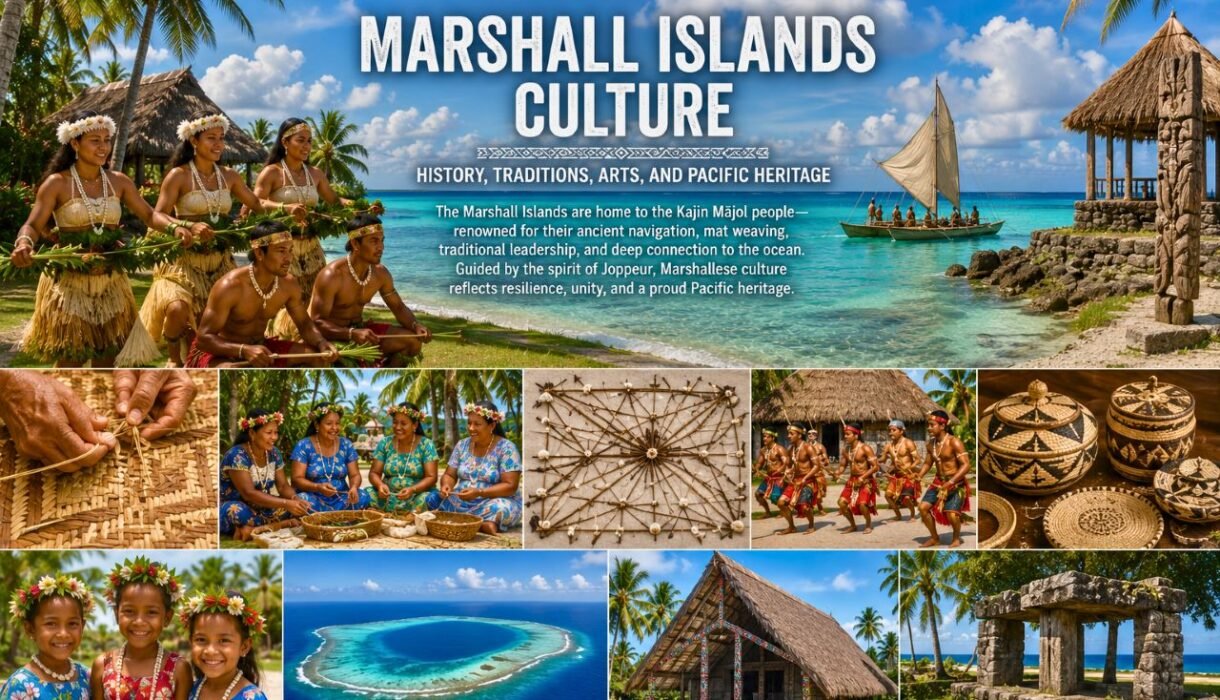
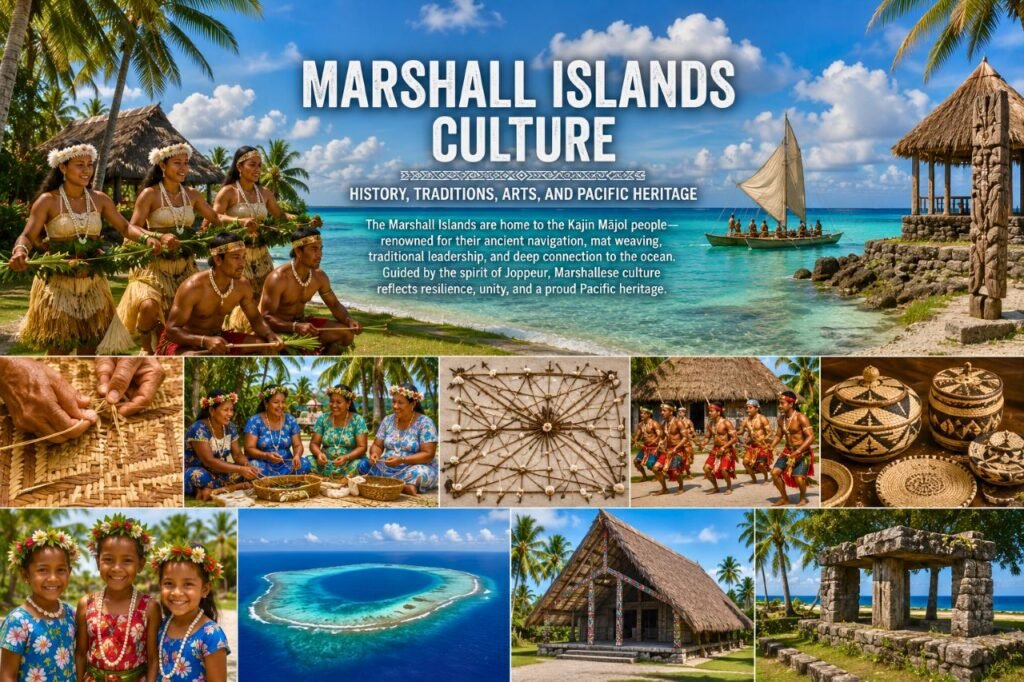
The Culture of the Marshall Islands (Mājol) is an extraordinary, matrilineal seafaring heritage anchored in the heart of Micronesia in Oceania. Comprising 29 low-lying coral atolls and five solitary islands scattered across nearly 2 million square kilometers of the central Pacific Ocean, the Marshall Islands are home to the Kajin Mājol (Marshallese) people—renowned worldwide for their ancient stick-chart ocean navigation, intricate mat weaving, and deep communal solidarity. Built upon the sacred principle of Joppeur (communal sharing and mutual support) and guided by matrilineal land tenure, Marshallese society balances traditional paramount chiefdoms (Iroij) with modern democratic governance, standing as a resilient beacon of Pacific island identity.
History & Origins
The cultural history of the Marshall Islands spans thousands of years of oceanic exploration, tribal chiefdoms, and complex geopolitical transformations:
- Austronesian Voyagers & Settlement (circa 1000 BCE): The original ancestors of the Marshallese were skilled Austronesian seafarers who migrated across the Pacific. Over centuries, these voyagers developed unparalleled open-ocean navigation techniques, mastering wave swell patterns and stellar paths to colonize isolated coral atolls.
- The Stick-Chart Navigation Era: Marshallese navigators (Rii-meto) created world-famous Stick Charts (Mattang, Meddo, and Rebbilib)—intricate wooden frameworks made from coconut midribs and cowrie shells that mapped ocean swell reflections and island locations, passed down confidentially through elite family lines.
- European Contact & The Name “Marshall”: Spanish explorers passed through the region in the 16th century, but it was British Captain John Marshall who visited in 1788, giving his name to the archipelago.
- Colonial Eras (Germany, Japan, & USA):
- German Protectorate (1885–1914): Centered on commercial copra (dried coconut meat) trade.
- Japanese Mandate (1914–1945): Introduced Asian agricultural and educational influences before World War II.
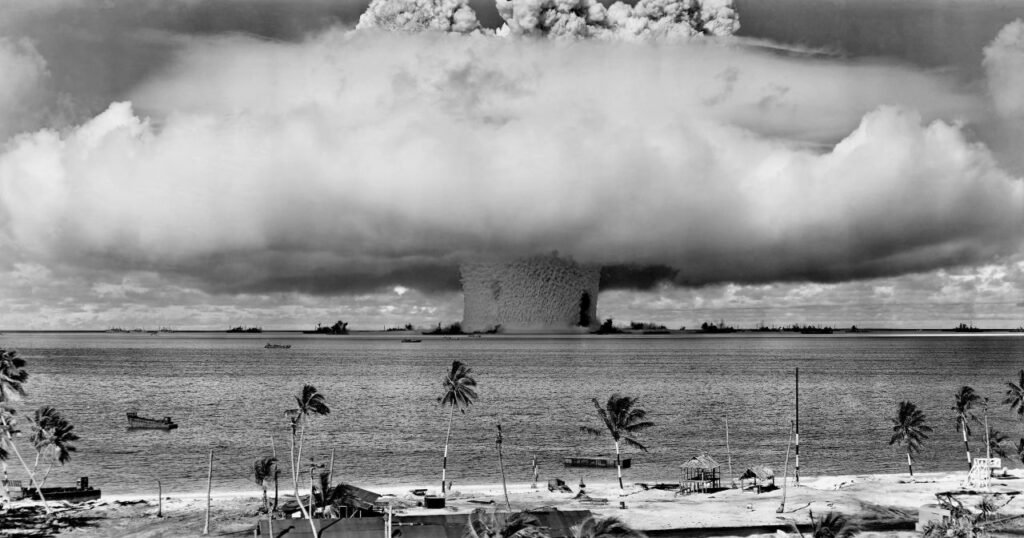
- US Trust Territory & Nuclear Testing (1947–1986): Following WWII, the United States administered the islands. Between 1946 and 1958, 67 nuclear tests were conducted at Bikini and Enewetak atolls, profoundly impacting Marshallese health, land displacement, and national memory.
- Independence & Compact of Free Association (1986–Present): The Republic of the Marshall Islands (RMI) achieved full sovereignty in 1986 under a Compact of Free Association with the United States, maintaining a distinct cultural heritage alongside modern ties.
Culture, Traditions & Customs
Marshallese social structure is strictly matrilineal, meaning family lineage, clan membership (Jowi), and land ownership rights are passed down through women.
- Land Ownership & Clan Structure: Land (Jenej) is the physical and spiritual lifeblood of every Marshallese person. It is governed by three primary social tiers:
- Iroijlaplap (Paramount Chief): Oversees clan territory, resolves disputes, and protects cultural customs.
- Alap (Clan Head/Landowner): Usually the eldest male or female of the lineage, responsible for managing land use and family welfare.
- Rijerbal (Workers/Tillers): Clan members who cultivate the land, fish, and contribute to communal resources.
- Rites of Passage:
- Kemem (First Birthday Celebration): The most significant family milestone in the Marshall Islands. Historically, due to high infant mortality rates on isolated atolls, reaching one year of age was a major blessing. Today, a child’s Kemem involves huge feasts, traditional songs, and community-wide gift distribution.
- Marriage (Moko): Traditionally arranged to strengthen clan alliances and land holdings. Modern weddings incorporate Christian church services with elaborate woven mat exchanges (Jaki).
- Funerals (Ilep): Community gatherings lasting several days where extended clans present woven mats, food, and monetary gifts to honor the deceased and support the grieving family.
- Festivals & National Celebrations:
- Custom Day (September 29): A national holiday dedicated to preserving Marshallese tradition through canoe races, weaving competitions, and cultural storytelling.
- Constitution Day (May 1): Celebrates the founding of the republic with parades, traditional dance performances, and sports tournaments.
Languages & Communication
Languages Spoken
- Kajin Mājol (Marshallese): A Malayo-Polynesian language within the Austronesian family, spoken by virtually the entire population. It features two main regional dialects: Rālik (western island chain) and Ratak (eastern island chain).
- English: Widely spoken in government, education, business, and international diplomacy.
Greetings, Expressions & Philosophy
- “Iakwe” (pronounced EE-ah-kway): The universal Marshallese greeting, translating literally to “You are a rainbow” or “Love to you.” It embodies warm affection, hospitality, and peace.
- “Bar lo eok” — Means “See you later.”
- “Kommol tātā” — Expresses “Thank you very much.”
- Proverb: “Jokebot jān ije, bōtaāb emōj an dānnin mejāl” (“Though we are far apart, our shared waters bind us together”), reflecting oceanic unity and clan loyalty.
Geography
The Marshall Islands consist of two parallel chains of low-lying coral atolls situated in Micronesia, halfway between Hawaii and Australia.
- Rālik Chain (Sunset Chain): Includes 18 atolls, featuring Kwajalein Atoll (the world’s largest coral lagoon) and Enewetak Atoll.
- Ratak Chain (Sunrise Chain): Includes 15 atolls, featuring Majuro Atoll (the national capital and economic hub) and Arno Atoll.
- Atoll Geography: The islands have an average elevation of less than two meters above sea level, making the country exceptionally sensitive to rising sea levels and ocean climate shifts.
Economy
The Marshall Islands operates a dual economy combining urban monetary commerce with traditional rural subsistence:
- Government & Compact Funding: A significant portion of national revenue derives from financial assistance provided under the US Compact of Free Association.
- Marine Resources & Licensing: Revenue is generated by granting commercial tuna fishing rights to international fleets in its vast Exclusive Economic Zone (EEZ).
- Copra & Artisanal Handicrafts: In outer atolls (Outer Islands), copra processing and hand-woven handicrafts generate essential household income.
Politics
The Republic of the Marshall Islands is a sovereign parliamentary republic in free association with the United States.
- Executive & Legislative Governance: The Parliament (Nitijeļā) consists of 33 senators elected by popular vote. The President is chosen by parliament members to serve as both head of state and head of government.
- Council of Iroij (Traditional Chiefs): A 12-member constitutional advisory body composed of paramount chiefs who advise parliament on customary laws, traditional land rights, and cultural heritage.
Ethnic Groups
- Marshallese Majority: Over 92% of the population identifies as ethnically Marshallese (Micronesian).
- Mixed & Immigrant Communities: Smaller resident populations include mixed Marshallese-American, Chinese, Filipino, I-Kiribati, and other Pacific Islander communities residing mainly in Majuro and Kwajalein.
Beliefs & Values
Religion & Spirituality
- Christianity: Introduced by American Congregationalist missionaries in the 1850s, Christianity is deeply woven into daily life. Over 90% of the population belongs to Protestant denominations (such as the United Church of Christ) or the Roman Catholic Church. Sunday services feature vibrant choral singing.
- Ancestral Spirits & Nature Lore: Indigenous cosmology persists alongside Christian faith. Beliefs in ancestral guardians (Lōkōm) and sacred reef spirits continue to shape traditional fishing protocols and respect for natural landmarks.
Moral Values
- Joppeur (Communal Generosity): The moral mandate that no person should go hungry or unsheltered while neighbors have food or land.
- Respect for Matriarchs & Chiefs: Deep reverence for mothers, grandmothers, and paramount chiefs as keepers of land rights and social harmony.
Food & Cuisine
Marshallese cuisine centers on fresh marine life, tropical root crops, and coconut products adapted to coral atoll soils.
- Core Staples:
- Mā (Breadfruit): A versatile starch roasted over open coals, boiled, or preserved as fermented breadfruit paste (Bwiro).
- Mōkwān (Pandanus Fruit): Highly prized for its sweet, aromatic juice and chewable fiber, rich in vitamins.
- Kōrkōr / Ek (Fresh Seafood): Reef fish, tuna, mahi-mahi, land crabs, and lobster prepared raw, boiled in coconut milk, or smoked over dried coconut husks.
- Iaraj (Taro): Swamp taro cultivated in hand-dug compost pits across wetter outer atolls.
Clothing & Symbols
Traditional & Modern Attire
- Jaki (Woven Pandanus Mats): Historically, men and women wore fine hand-woven pandanus waist mats decorated with geometric border patterns. Today, these mats are preserved for ceremonial attire.
- Marmar (Floral Leis): Hand-strung floral crowns made from plumeria, hibiscus, and pandanus blossoms, given as gestures of love and welcome.
- Modern Dress: Light cotton dresses (Jōmbo) for women and casual shirts with trousers for men are standard everyday wear.
Cultural Symbols
- Outrigger Canoe (Walap): Represents oceanic freedom, teamwork, and ancestral engineering.
- Mattang (Stick Chart): The ultimate symbol of indigenous intellect and navigational mastery.
Music, Dance & Art
- Biit (Traditional & String Band Music): A fusion of traditional chanting with Spanish, German, and American musical influences. Acoustic guitars, ukuleles, and rhythm boxes accompany rich vocal harmonies.
- Jobwa (Traditional Chiefly Dance): A rare, sacred stick dance traditionally performed exclusively before paramount chiefs (Iroij) to demonstrate discipline and agility.
- Craftsmanship & Weaving: Marshallese craftspeople are renowned throughout the Pacific for weaving ultra-fine pandanus handbags, fans, wall hangings, and miniature outrigger canoe models.
Summary
Marshall Islands Culture is a testament to matrilineal strength, ocean navigation, and community endurance. By preserving the wisdom of stick-chart navigators, honoring the sacred Maneaba and Joppeur principles, and celebrating family through the Kemem, the Marshallese people preserve a vibrant island legacy that continues to shine brightly across Oceania.
At Best Culture Insight, we see culture as the heartbeat of every society – the way people live, connect, and express their identity.