Voodoo in Haiti: What the West Gets Completely Wrong
Posted in :

For decades, Western popular culture has reduced Haitian Vodou (often misspelled “Voodoo”) to sensationalized tropes of pin-stuck dolls, malevolent curses, and cinematic zombies. These Hollywood sensationalisms have created a profound caricature of a rich, deeply organized religion practiced by millions. In reality, Vodou is a sophisticated spiritual system rooted in community support, moral philosophy, and ancestral honor. Understanding the true essence of Vodou requires looking beyond sensationalized entertainment to explore a sacred, living faith that served as the very catalyst for human freedom.
The Hollywood Myth of “Voodoo Dolls” and Dark Magic
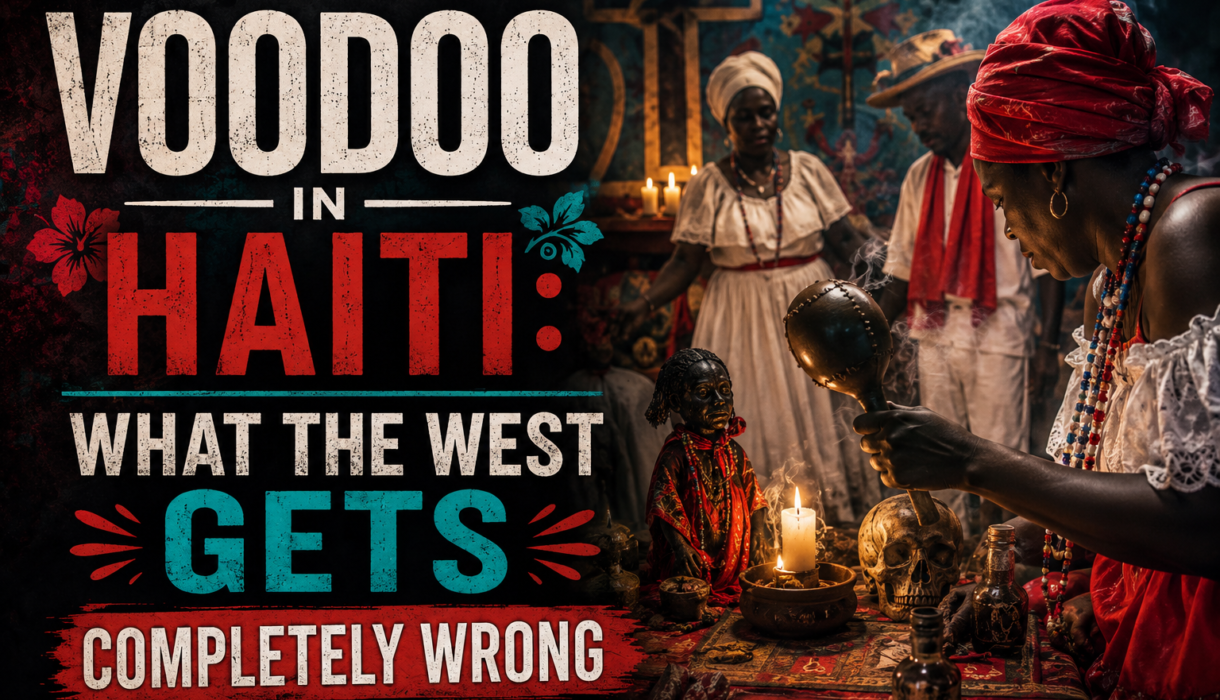
The most pervasive misconception in the West is the iconic “Voodoo doll,” depicted as a tool used to inflict harm on enemies. In authentic Haitian Vodou, this concept does not exist. The notion of sticking pins into small effigies was largely fabricated by 19th-century sensationalist writers and early 20th-century American film studios during the U.S. military occupation of Haiti. While practitioners do make alter dolls or fabric figures, these are created as physical representations of beloved ancestors or as instruments of healing, prayer, and positive spiritual connection—never for malevolent torture.
A Monotheistic Faith Focused on Healing and Ancestors
Contrary to the popular belief that Vodou is a form of chaotic polytheism or demon worship, it is actually a monotheistic religion. Practitioners believe in a supreme creator God known as Bondye (from the French Bon Dieu, meaning “Good God”). Because Bondye is considered distant and beyond direct human reach, practitioners communicate through spiritual intermediaries called Lwa (or Loa). These spirits represent distinct aspects of nature, justice, wisdom, and health. The primary purpose of Vodou ceremonies is not to summon malevolent forces, but to seek moral guidance, physical healing, and harmony within the broader community.
The Sacred Catalyst for Liberty and Historical Resilience
To truly grasp Vodou’s significance, one must acknowledge its pivotal role in human rights history. Born from the tragic synthesis of diverse West African traditions forced together during the transatlantic slave trade, Vodou provided enslaved Africans in Saint-Domingue with a shared identity and moral strength. In August 1791, a sacred Vodou ceremony at Bois Caïman served as the spiritual catalyst for the Haitian Revolution, leading to the creation of the world’s first independent Black republic. Far from being a force of destruction, Vodou was an ideological foundation for freedom and human dignity.
Syncretism and Modern Cultural Identity
A key reason Vodou is frequently misunderstood is its complex relationship with Catholicism. During centuries of French colonial rule, enslaved Africans were forced to hide their native spiritual practices under Catholic iconography to avoid brutal punishment. Over generations, this survival tactic evolved into a profound form of religious syncretism, where spirits (Lwa) became intertwined with Catholic saints. Today, many Haitians proudly practice both Catholicism and Vodou simultaneously. It is not a contradictory duality, but a cohesive worldview that emphasizes reverence for ancestors, respect for nature, and an enduring sense of community resilience.