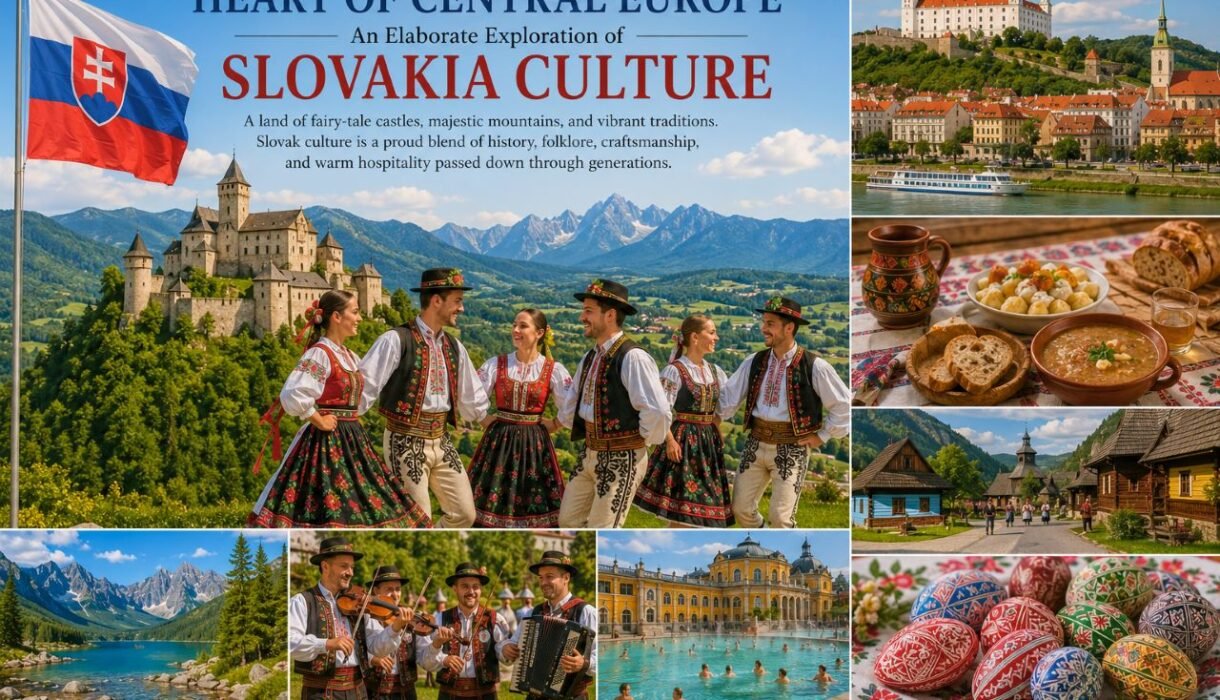

Nestled in the geographical heart of Central Europe, framed by the jagged peaks of the High Tatras and the sweeping Danube River, Slovakia is a land of fairy-tale castles, thermal springs, and vibrant folk traditions. The captivating Culture of Slovakia—known natively as slovenská kultúra—is an enduring fusion of West Slavic roots, mountain pastoralism, and centuries of shared Central European history within the Habsburg and Austro-Hungarian Empires. The Slovak people are globally recognized for their modest warmth, deep connection to nature, exceptional craftsmanship, and a hospitable spirit rooted in rural mountain communities. From the bustling streets of Bratislava to the timber-built villages hidden in alpine valleys, Slovakia offers a rich, remarkably preserved cultural tapestry.
History & Origins
The historical development of Slovakia reflects a long journey of cultural preservation amidst powerful neighboring empires.
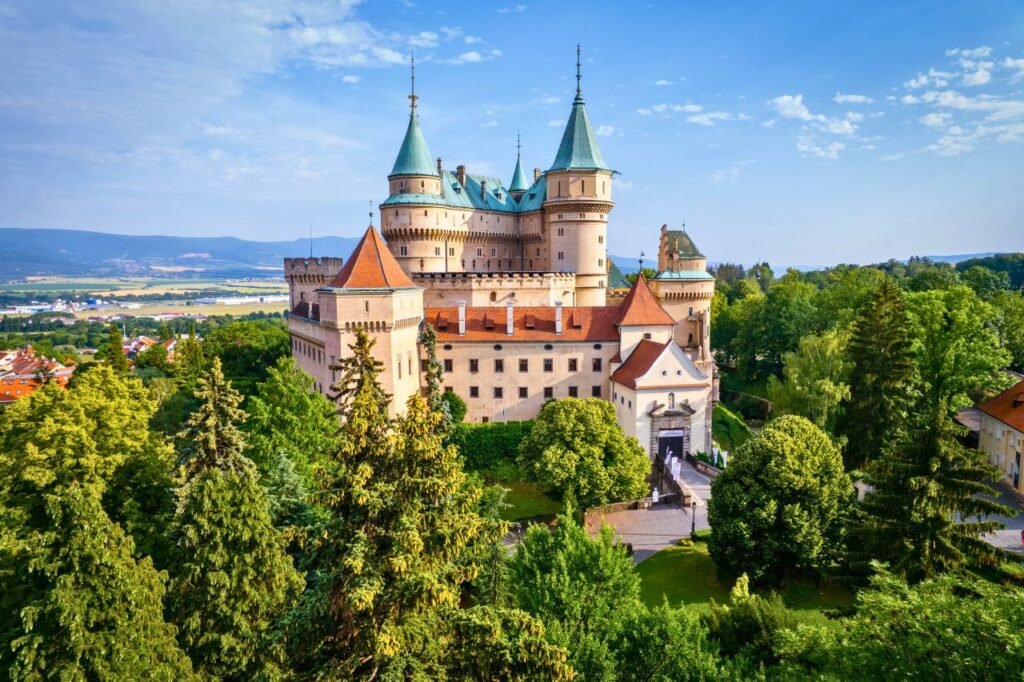
- Slavic Roots & Great Moravia: West Slavic tribes settled the Carpathian Basin during the 5th and 6th centuries. In the 9th century, the region became the heartland of Great Moravia, a medieval Slavic empire. In 863 CE, the Byzantine brothers Saints Cyril and Methodius arrived, creating the Glagolitic script and translating religious texts, establishing a literary and spiritual foundation for the Slavic world.
- A Thousand Years in the Kingdom of Hungary: Following the collapse of Great Moravia, the territory of modern Slovakia was integrated into the Kingdom of Hungary (and later the Habsburg Empire) for a millennium, often referred to as Upper Hungary (Horná Zem). Bratislava (then Pressburg or Pozsony) served as the capital and coronation city of the Hungarian Kingdom for over 200 years while Buda was under Ottoman occupation.
- National Awakening & Czechoslovakia: The 19th century sparked a vibrant Slovak National Awakening led by intellectuals like Ľudovít Štúr, who codified the modern Slovak literary language based on central dialects. In 1918, following World War I, Slovaks joined Czechs to form Czechoslovakia.
- The Velvet Divorce & Modern Era: After surviving Nazi occupation during World War II and decades under communist rule, the peaceful Velvet Divorce on January 1, 1993, led to the dissolution of Czechoslovakia. Modern Slovakia emerged as an independent, democratic republic, joining NATO and the European Union in 2004.
Culture, Traditions & Customs
Marriage & Wedding Rituals
Slovak weddings (svadba) blend Christian solemnity with lively, ancient folk games. A dramatic central custom is the Čepčenie (Unveiling of the Bride), held at midnight. The bride’s wedding veil is removed by married women and replaced with a čepiec (a traditional embroidered bonnet), symbolizing her official transition from maidenhood to womanhood. The groom and guests then take turns dancing the Redový tanec with the newly bonneted bride, contributing symbolic financial gifts to the couple’s new household.
Naming Ceremonies & Name Days
In addition to birthdays, Slovaks celebrate Meniny (Name Days). Every calendar day is associated with specific traditional names. On their name day, individuals receive flowers, chocolates, and good wishes from colleagues, friends, and family, making it an extended annual celebration of personal identity.
Easter & Spring Customs
One of Slovakia’s most famous and unusual seasonal traditions occurs on Easter Monday (Veľkonočný pondelok). Young men visit local women to playfully sprinkle them with fresh water or submerge them in streams (oblievačka) and gently whip their legs with braided willow switches decorated with ribbons (šibačka). Rooted in pre-Christian fertility rites, this practice is believed to bestow youth, health, and vitality for the coming year, after which the men are rewarded with hand-painted Easter eggs (kraslice), treats, and traditional spirits.
Languages & Communication
Language Spoken
The official state language is Slovak, a West Slavic language spoken by over 5 million people. Often referred to by linguists as the “Esperanto of Slavic languages,” Slovak occupies a central phonological position, making it mutually intelligible with Czech and broadly understandable to speakers of Polish, Serbian, and Croatian.
Communication Style & Etiquette
Slovaks tend to be polite, practical, and modest. While reserved upon first meeting, they become warm, generous hosts once a personal connection is built.
- Greetings: A firm handshake accompanied by direct eye contact is standard. Dobrý deň (Good day) is used formally, while Ahoj or Čau are popular casual greetings among friends.
- Household Etiquette: It is customary to take off your shoes upon entering a Slovak home, replacing them with house slippers provided by the host. Bringing a gift of flowers, wine, or chocolates is expected when invited for a meal.
- Key Phrases: Ďakujem (Thank you), Prosím (Please / You’re welcome), and Na zdravie! (To health! / Cheers!).
Proverbs & Wisdom
- “Bez práce nie sú koláče.”
Meaning: “Without work, there are no cakes”—the Slovak equivalent of “no pain, no gain,” highlighting the deep cultural respect for honest labor.
- “Hosť do domu, Boh do domu.”
Meaning: “A guest in the house is God in the house”—underscoring the absolute sanctity of hospitality.
Geography
Slovakia is a landlocked nation covering roughly 49,000 square kilometers, characterized by dramatic topographical elevation shifts from south to north:
- The Carpathian Mountains: The dominant geographical feature, stretching across central and northern Slovakia. The High Tatras (Vysoké Tatry) represent the highest range in the Carpathians, boasting alpine peaks like Gerlachovský štít (2,655 meters), pristine glacial lakes (plesá), and deep valleys.
- Lowlands & Rivers: The southern region features fertile agricultural plains along the Danube River (Podunajská nížina).
- Underground Wonders: Slovakia is home to thousands of subterranean caves, including unique UNESCO-listed sites like the Ochtinská Aragonite Cave and Ice Caves in Slovak Paradise National Park.
Economy
Slovakia features an advanced, high-income market economy integrated into the European Union and Eurozone.
Often dubbed the “Detroit of Europe,” Slovakia is the world’s largest producer of automobiles per capita, boasting major manufacturing plants for global brands like Volkswagen, Kia, Peugeot, and Jaguar Land Rover. Additionally, the nation maintains strong sectors in information technology, metallurgy, forestry, and green energy generation powered by nuclear and hydroelectric plants.
Politics
Slovakia is a parliamentary democratic republic.
- President: The Head of State, elected directly by popular vote every five years, serving as a moral authority and commander-in-chief while exercising formal diplomatic duties.
- Prime Minister: The Head of Government, holding executive administrative authority over the cabinet and public policy.
- National Council (Národná rada): A unicameral parliament consisting of 150 members elected proportionally for four-year terms.
Ethnic Groups
Slovakia maintains a relatively homogeneous demographic profile, alongside historical minority populations with distinct regional heritages:
| Ethnic Group | Population Share | Regional Focus & Context |
| Slovaks | ~83% | Majority nationwide; West Slavic base with deep Christian traditions. |
| Hungarians | ~7.5% | Concentrated along the southern border region; rich architectural and agricultural impact. |
| Roma | ~2% (official) | Present in Eastern Slovakia; vibrant musical and artisanal traditions. |
| Rusyns & Ukrainians | ~1% | Concentrated in the northeastern Carpathian mountain regions; Eastern Orthodox/Greek Catholic. |
Beliefs & Values
Religious Heritage
Over 60% of the population identifies as Roman Catholic, alongside significant Evangelical Lutheran and Greek Catholic communities. Religion has historically served as a stabilizing pillar of national identity and community life, especially in rural mountain regions.
Core Values
Slovak worldview revolves around rodina (family), hard work, and a profound respect for the natural environment. Weekends are frequently spent hiking in national parks, foraging for wild mushrooms (húby), or tending family gardens and vineyards.
Food & Cuisine
Slovak cuisine is rustic, comforting, and designed historically to sustain mountain farmers and sheep herders through harsh winters. Staples include potatoes, cabbage, pork, milk products, and sheep cheese.
- Bryndzové Halušky: The national dish of Slovakia. Small, tender potato dumplings (halušky) tossed with creamy Bryndza (a salty, unpasteurized sheep milk cheese unique to the region) and topped with fried, crispy pork bacon bits. It is traditionally paired with a glass of sour whey (žinčica).
- Kapustnica: A rich, savory sauerkraut soup cooked with smoked pork sausage, dried forest mushrooms, and plums, traditionally served as a Christmas Eve centerpiece.
- Trdelník: A sweet, hollow pastry made from rolled dough wrapped around a wooden spit, grilled over open coals, and coated in sugar, walnuts, and cinnamon.
- Tatratea & Borovička: Distinct local spirits—Borovička is a traditional juniper-flavored spirit, while Tatratea is a world-famous herbal tea-based liqueur originating from mountain chalets.
Clothing & Symbols
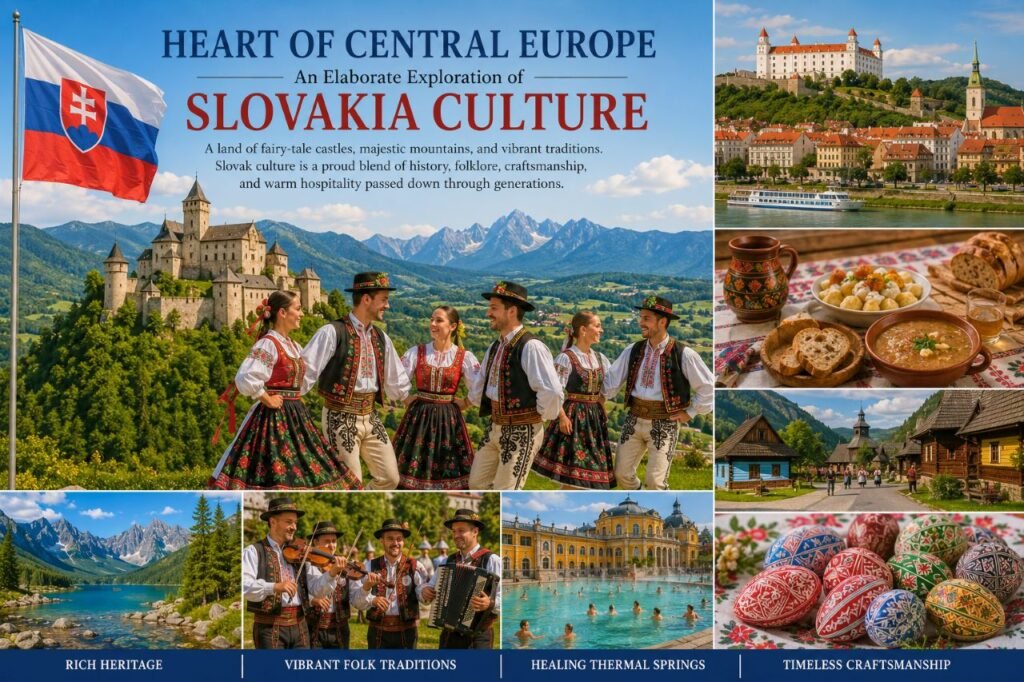
Slovakia: A cultural journey through landscapes
Traditional Folk Costume (Kroj)
The Kroj is one of the most diverse folk costumes in Europe, with over 60 distinct regional variations across Slovakia’s valleys.
- Craftsmanship: Characterized by elaborate geometric floral embroidery, lace trimming, puffed sleeves, and vibrant ribbons.
- Significance: Historically, the style, color, and intricate patterns of a kroj communicated an individual’s exact village, marital status, religion, and social standing. Today, kroj is proudly worn during folk festivals and major church holidays.
Iconic National Symbols
- The Double Cross on Three Hills: Featured prominently on the national flag and coat of arms, the double-barred Christian cross stands atop three blue mountain peaks representing the historic Tatra, Fatra, and Mátra ranges.
- Vlkolínec: A UNESCO World Heritage village in central Slovakia consisting of untouched, colorful wooden timber houses representing traditional Northern Carpathian folk architecture.
Music, Dance & Art
The Fujara Flute
Slovakia’s most famous musical contribution is the Fujara—a massive, two-meter-long wooden overtone bass flute traditionally carved and decorated by shepherds in central Slovakia. Inscribed on the UNESCO Intangible Cultural Heritage list, its deep, haunting sound is completely unique in world music.
Folk Performance & Dance
Slovak folk music features fast-paced fiddle ensembles, accordions, and cimbaloms (hammered dulcimers). The traditional dances, such as the energetic Odzemok (a heroic shepherd’s axe dance featuring high leaps and squats), highlight mountain vitality and strength.
Woodcarving & Fine Art
Slovakia boasts a world-class legacy of Gothic woodcarving, exemplified by Master Paul of Levoča, who created the world’s tallest wooden Gothic altar in Saint James Church during the 16th century. Modern Slovak art was shaped by figures like Martin Benka and Andy Warhol, whose parents emigrated from the Rusyn village of Miková (leading to the establishment of the Andy Warhol Museum of Modern Art in Medzilaborce).
Summary
Slovakia Culture stands as an extraordinary, well-preserved treasure at the heart of Europe. By holding fast to its West Slavic linguistic heritage, safeguarding shepherd folklore like the Fujara, preserving traditional timber architecture, and welcoming visitors with warmth and Bryndzové Halušky, Slovakia seamlessly bridges ancient mountain traditions with modern European life. It is a nation that invites the world to slow down, explore its misty mountain peaks, and discover a sanctuary of genuine hospitality and timeless beauty.
At Best Culture Insight, we see culture as the heartbeat of every society – the way people live, connect, and express their identity.