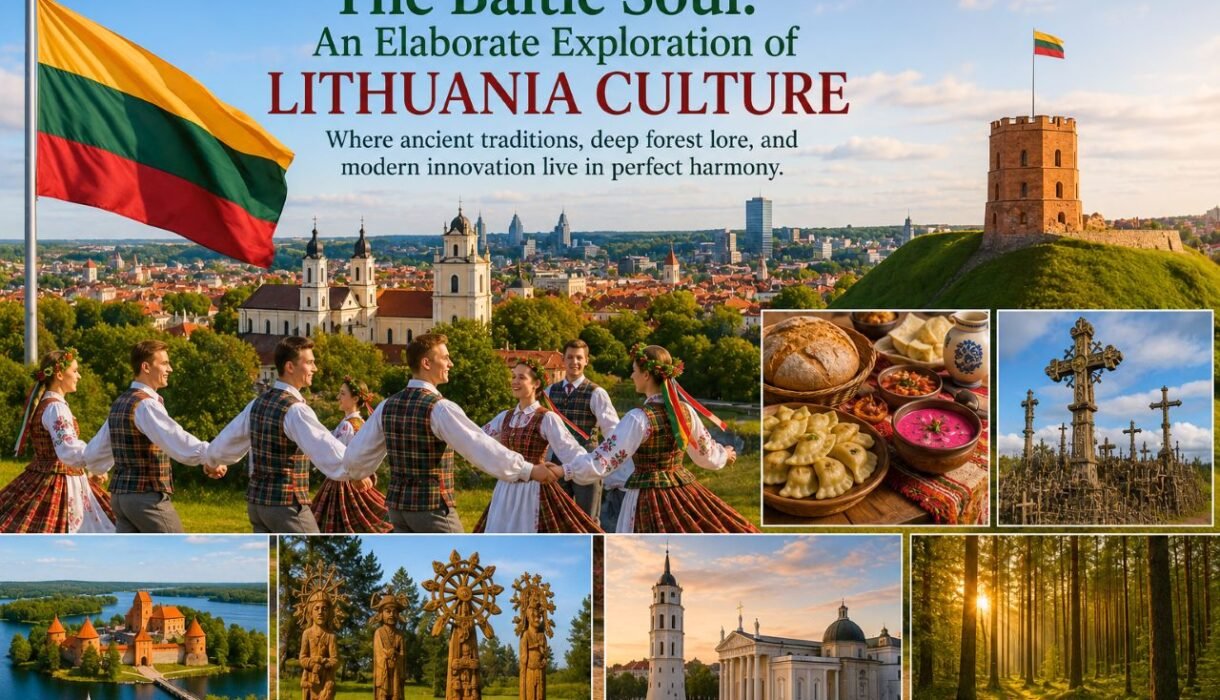

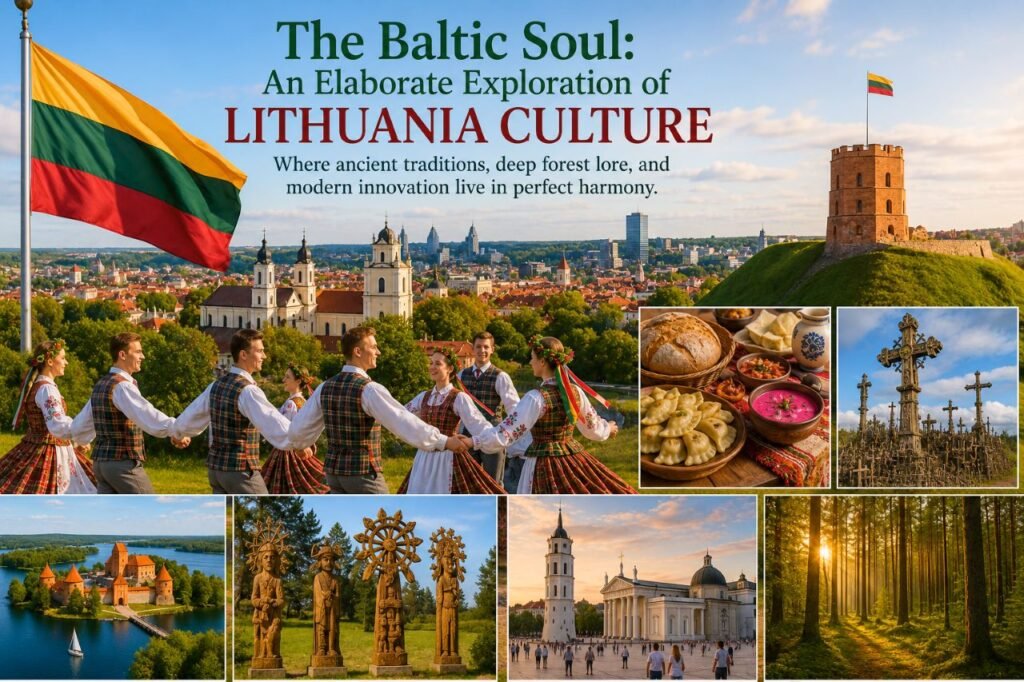
Situated along the southeastern shores of the Baltic Sea, Lithuania is a country where ancient traditions, deep forest lore, and high-tech modernism live side by side. As the largest of the three Baltic states, Lithuania holds a unique cultural position in Europe.
The people of Lithuania, known as Lithuanians (Lietuviai), possess a resilient identity shaped by centuries of historic triumphs, heartbreaking occupations, and an enduring connection to nature. This comprehensive article delves into the rich traditions, values, language, and customs of this sovereign nation, celebrating its distinct heritage and vibrant cultural legacy.
History & Origins
Lithuania’s history is an epic narrative of vast empires, cultural endurance, and a passionate fight for independence.

- Baltic Beginnings: The ancestors of modern Lithuanians were Baltic tribes who settled the region thousands of years ago. Living within dense, protective primeval forests, they developed an intense, nature-focused spiritual worldview and remained isolated from early Roman and Slavic expansions.
- The Grand Duchy of Lithuania: Unified under King Mindaugas in 1253, Lithuania grew rapidly. By the 15th century, under Grand Duke Vytautas the Great, the Grand Duchy of Lithuania was the largest country in Europe, stretching from the Baltic Sea all the way to the Black Sea.
- The Polish-Lithuanian Commonwealth: In 1569, Lithuania joined Poland in a powerful political alliance known as the Union of Lublin. This commonwealth lasted over two centuries, creating an era of shared nobility, architecture, and high culture, until it was partitioned by neighboring empires in the late 18th century.
- The Struggle for Sovereignty: Lithuania fell under the rule of the Russian Empire, facing strict cultural bans on its written language. After briefly regaining independence in 1918, the nation was forcibly annexed by the Soviet Union following World War II. Lithuania’s resilience culminated on March 11, 1990, when it became the first Soviet republic to declare the restoration of its independence, paving the way for its modern integration into the European Union.
Culture, Traditions & Customs
Joninės (Midsummer Festival)
Celebrated on the night of June 23–24, Joninės (also known as Rasos) is a magical celebration deeply rooted in ancient pagan solstitial rites. Lithuanians head into nature to celebrate the longest day of the year.
Young women weave beautiful crowns of wild flowers and float them down rivers with candles to predict marriage. Massive bonfires are lit on hillsides, and folk songs are sung late into the night. According to folklore, couples who venture deep into the woods at midnight just might find the mythical, blooming fern flower, which brings eternal wisdom and wealth.
Užgavėnės (The Chasing of Winter)
Held seven weeks before Easter, Užgavėnės is a boisterous carnival that bids farewell to the dark winter months and welcomes the spring.
People wear handmade, intentionally frightening wooden masks depicting witches, devils, and mythical creatures. The festival features a theatrical street battle between Lašininis (representing winter, fat, and meat) and Kanapinis (representing spring, hemp, and lean fasting food). The celebration ends by burning a giant straw effigy named Morė, symbolizing the destruction of winter evils and the rebirth of nature.
Marriage and Life Rites
Traditional Lithuanian weddings are famous for their lively, multi-day customs. A key character is the Piršlys (Matchmaker), who jokingly guides the festivities. Historically, guests stage a mock trial of the Matchmaker for telling tall tales, and the bride rescues him by gifting him a hand-woven traditional sash.
When newborns are named or baptized, grandparents and godparents assume massive symbolic roles, often presenting the infant with linen shirts and silver spoons to wish them a pure, prosperous life.
Languages & Communication
An Ancient Indo-European Treasure
The official language, Lithuanian (Lietuvių kalba), is an absolute linguistic marvel. It is one of the oldest living languages in the world and has retained archaic structural features from Proto-Indo-European that have been lost in almost every other modern tongue. Because of its incredible preservation of ancient grammar forms, it shares surprising structural and vocabulary similarities with ancient Sanskrit.
Greetings & Expressions
Lithuanian communication is generally polite, sincere, and thoughtful. Trust is built through actions rather than loud declarations.
- “Laba diena!” / “Labas!”
Meaning: “Good day!” (the formal greeting) / “Hello!” (the warm, universal greeting used among friends).
- “Kuo giliau į mišką, tuo daugiau medžių.”
Proverb: “The deeper into the forest you go, the more trees you find.” This phrase means that as you dig deeper into any complex issue, you will discover more hidden layers and details.
- “Iš mažos gilės didelis ąžuolas išauga.”
Proverb: “From a tiny acorn, a mighty oak tree grows.” This expression honors patience, steady hard work, and the incredible potential found in humble beginnings.
Geography
Lithuania’s landscape is defined by gentle, rolling plains, thick pine forests, and thousands of lakes. The nation shares land borders with Latvia, Belarus, Poland, and Russia (Kaliningrad Exclave).
Its crown jewel is the Curonian Spit, a narrow, 61-mile-long peninsula of massive, shifting sand dunes and coastal pine woods that separates the Curonian Lagoon from the Baltic Sea. The inland geography features dense woodland zones, lush river valleys carved out by the Nemunas River, and protected marshlands that support a diverse array of Baltic wildlife.
Economy
Lithuania has built a highly dynamic, modern, and open economy that is fully integrated into western markets.
- High-Tech Laser Industry: Lithuania is a prominent global leader in scientific laser technologies. Lithuanian-manufactured lasers are utilized in top research centers, universities, and industrial manufacturing systems across the globe.
- Fintech Hub: The capital city of Vilnius has developed into one of Europe’s largest and fastest-growing hubs for financial technology and digital banking licenses, thanks to a highly forward-thinking regulatory framework.
- Information Technology and Cyber Security: Backed by excellent public fiber-optic infrastructure, Lithuania excels in software engineering, digital services, and robust data center operations.
Politics
Lithuania is a semi-presidential representative democratic republic.
The political system features a President as the head of state, who is elected directly by the public for a five-year term and handles foreign policy, national defense, and constitutional matters. The legislative branch is a unicameral parliament known as the Seimas, consisting of 141 members elected to four-year terms through a mixed voting system. The executive government is led by the Prime Minister, who manages domestic administration alongside the cabinet of ministers.
Ethnic Groups
Lithuania features a highly stable social makeup, with native citizens making up the vast majority of the population alongside long-standing historic minority groups.
| Ethnic Group | Estimated Population Share | Historical & Social Context |
| Lithuanians | ~84.6% | Indigenous Baltic population holding deep cultural ties to the land |
| Poles | ~6.5% | Concentrated mostly in the southeast, with centuries of shared history |
| Russians | ~5.0% | Settled mostly in urban industrial areas and coastal trade hubs |
| Belarussians | ~1.0% | Historic borderland residents and newer professional arrivals |
| Others | ~2.9% | Includes Ukrainians, Jewish communities, and the unique Lipka Tatars |
Beliefs & Values
Deep Pagan Roots and Catholic Faith
Lithuania holds the historical distinction of being the last nation in Europe to officially convert to Christianity, adopting it in 1387. Because of this late transition, ancient pagan beliefs regarding sacred groves, oak trees, and nature spirits (Baltų tikėjimas) survived for centuries, subtly blending into the local practice of Roman Catholicism. Today, the Catholic faith serves as a strong cultural pillar, symbolizing historical resistance against foreign oppression.
The Hill of Crosses (Kryžių Kalnas)
Located near Siauliai, the Hill of Crosses is a deeply moving monument to Lithuanian faith, cultural endurance, and national defiance.
For generations, citizens left wooden and metal crosses on this hill to honor loved ones and pray for freedom. During the Soviet occupation, the regime bulldozed the hill multiple times, yet every single night, locals risked their safety to plant new crosses. Today, hundreds of thousands of crosses cover the hill, creating a stunning testament to the unbreakable spirit of the culture.
Food & Cuisine
Traditional Lithuanian food is hearty, satisfying, and deeply connected to the seasonal yields of local fields and forests, featuring potatoes, rye, wild mushrooms, pork, and dairy.
- Cepelinai (Zeppelins): The iconic national dish. These are large, football-shaped dumplings made from a mixture of raw grated potatoes and riced cooked potatoes. They are stuffed with seasoned minced pork meat or curd cheese, boiled, and served with a generous topping of sour cream, melted butter, and crispy bacon bits (Spirgučiai).
- Šaltibarščiai (Cold Beet Soup): A vibrant, shocking-pink cold soup that is an absolute favorite during hot summer days. It is made from pickled beets, crisp cucumbers, fresh dill, kefir, and hard-boiled eggs. It is always served with a side of hot, golden roasted potatoes garnished with fresh dill.
- Juoda Duona (Dark Rye Bread): This dense, fragrant, fermented sourdough dark rye bread is a sacred staple of the Lithuanian table. It is present at every major life event and milestone, symbolizing hospitality, fertility, and long-term family stability.
Clothing & Symbols
Traditional Costumes (Tautinis Drabužis)
Lithuanian traditional clothing is famous for its intricate geometric weaving patterns. Women wear long, pleated skirts with geometric aprons, white linen shirts embroidered with red thread, and structured vests.
The crown jewel of the attire is the woven sash (Juosta), which features ancient Baltic geometric symbols meant to guard and protect the wearer. Men wear linen shirts, wool trousers, and long coats tied with similar woven sashes.
Powerful Cultural Symbols
- The Vytis (The White Knight): One of Europe’s oldest coats of arms, featuring a charging knight on horseback holding a raised sword. It represents courage, sovereignty, and the relentless defense of the homeland.
- The Columns of Gediminas: An ancient geometric glyph representing the defensive castle gates built by the early Grand Dukes. It stands as a powerful symbol of national statehood.
- Amber (Gintaras): Often called “Baltic Gold,” this fossilized pine resin washes ashore along the Baltic beaches. It is deeply woven into local mythology and is used to create jewelry and protective amulets.
Music, Dance & Art
Dainos (Traditional Folk Songs)
Music is the true voice of the Lithuanian soul. Traditional folk songs, known as Dainos, feature poetic, melancholic themes centering on nature, agricultural cycles, and family life.
Lithuania is also famous for Sutartinės, a rare form of multi-part polyphonic singing performed by women. These songs use complex rhythmic layering and vocal dissonances that have been recognized by UNESCO on the Representative List of the Intangible Cultural Heritage of Humanity.
The Song and Dance Celebration (Dainų Šventė)
Held once every four years, the Lithuanian Song and Dance Celebration is a massive, awe-inspiring festival that gathers tens of thousands of singers and dancers from across the globe into a single open-air amphitheater. The massed choir sings traditional Dainos in powerful harmony, creating a sea of traditional costumes that demonstrates the unifying strength of Baltic culture.
M.K. Čiurlionis and Wooden Cross-Crafting
In fine arts, the nation’s most celebrated figure is Mikalojus Konstantinas Čiurlionis, a visionary symbolist painter and musical composer who blended abstract cosmic art with Baltic folk motifs.
Lithuania is also famous for its traditional folk art of Cross-Crafting (Kryždirbystė). These are tall, intricately hand-carved oak crosses featuring a unique blend of Catholic imagery and ancient sun symbols, crafted by master artisans to guard local crossroads and village squares.
Summary
The culture of Lithuania is a brilliant testament to the power of memory, natural connection, and historical endurance. By preserving one of the world’s most ancient languages, celebrating joyous seasonal festivals like Joninės, and keeping traditional arts like Sutartinės alive, Lithuanians have protected an invaluable heritage. The nation gracefully balances this ancient Baltic soul with an innovative modern economy, standing as a proud, creative, and welcoming community in the heart of modern Europe.
At Best Culture Insight, we see culture as the heartbeat of every society – the way people live, connect, and express their identity.