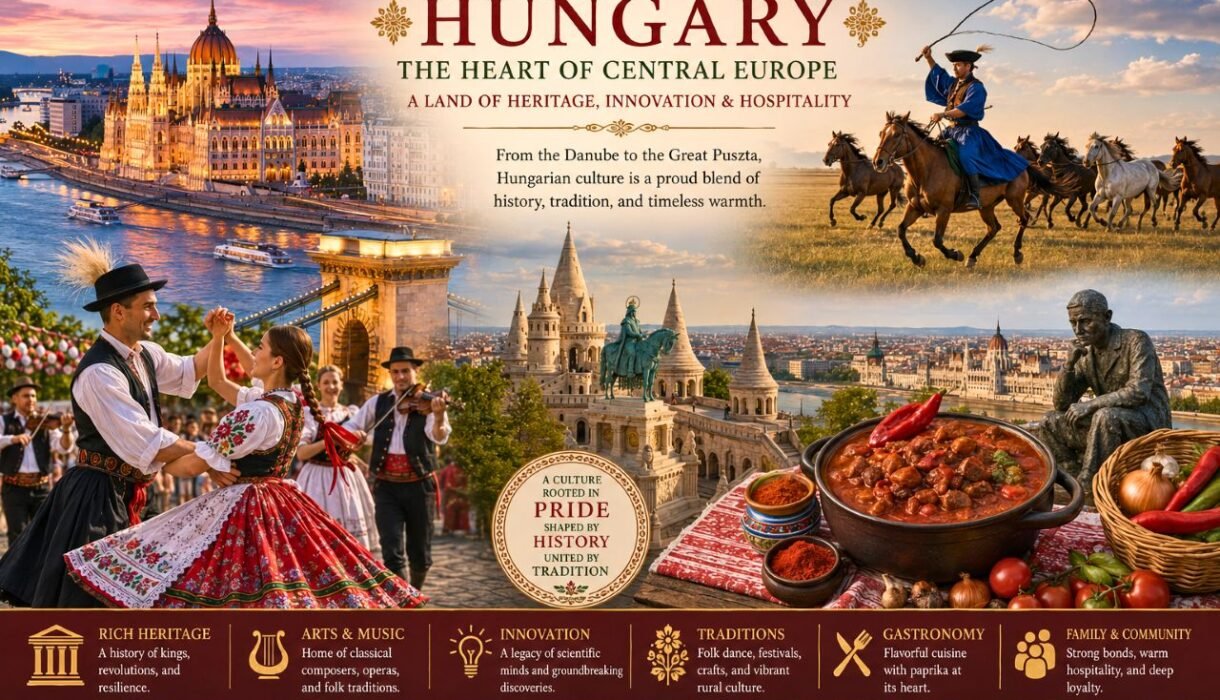

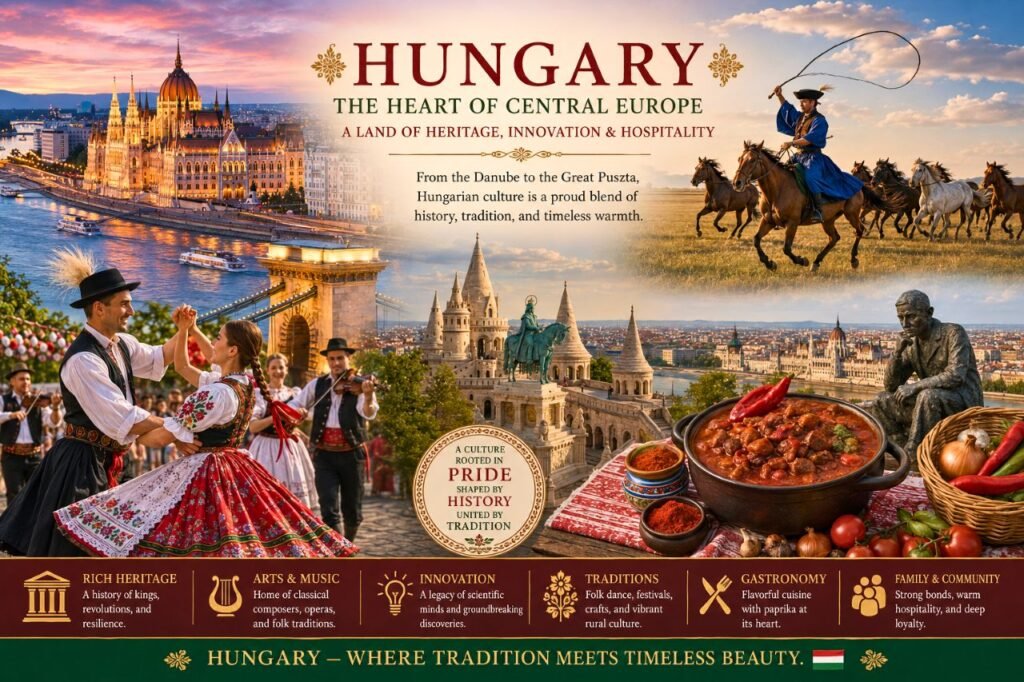
Nestled in the fertile basin of Central Europe, Hungary (Magyarország) stands as a profound cultural island surrounded by a sea of Slavic, Germanic, and Romance nations. Unlike its neighbors, Hungary traces its identity to the nomadic riders of Western Siberia, giving rise to a culture that is beautifully unique, fiercely resilient, and intellectually brilliant.
The Hungarian people, who call themselves Magyars, possess an identity defined by a complex history of triumph and heartbreak, a world-class tradition of scientific innovation, and an artistic heritage that flourishes in both grand urban opera houses and rural village festivals. From the architectural majesty of Budapest’s illuminated Parliament building along the Danube to the boundless horizons of the Great Puszta plains, Hungarian culture celebrates deep-rooted traditions, intense family loyalty, and a legendary culinary art centered around the warmth of homegrown spices.
History & Origins
The historical trajectory of the Magyars is a sweeping epic of nomadic migration, medieval chivalry, centuries of foreign occupation, and ultimate cultural preservation.
[Uralic/Siberian Roots] ➔ [Migration & Conquest of 896 AD] ➔ [Christianization under St. Stephen] ➔ [Ottoman & Habsburg Rule] ➔ [Austro-Hungarian Empire] ➔ [Trianon & the Soviet Era]
- The Magyars’ Arrival: The ancestors of the Hungarian people migrated over centuries from the Ural Mountains and the Volga River region. Led by the legendary chieftain Árpád, seven nomadic Magyar tribes crossed the Carpathian Mountains in 896 AD to settle the fertile Pannonian Basin, an event celebrated historically as the Honfoglalás (Conquest of the Homeland).
- The Christian Kingdom: In the year 1000 AD, Grand Prince Stephen was crowned the first King of Hungary with a crown sent by Pope Sylvester II. Canonized as Saint Stephen, his reign converted the nation to Western Christianity, anchoring Hungary firmly within the European geopolitical fold.
- Occupations and Empires: Due to its strategic central location, Hungary became a frequent battleground. The nation suffered devastating invasions by the Mongols in 1241, followed by a 150-year occupation of its central territories by the Ottoman Empire after the Battle of Mohács in 1526. Afterward, Hungary was absorbed into the Catholic Habsburg Empire. In 1867, a compromise established the Austro-Hungarian Dual Monarchy, transforming Budapest into a glittering global metropolis rivaling Vienna.
- The Modern Era: The 20th century brought immense challenges. The Treaty of Trianon (1920) following World War I stripped Hungary of over two-thirds of its historic territory and millions of ethnic Magyars. This was followed by a brutal Nazi occupation during World War II, and decades of oppressive Soviet-communist rule. The heroic but crushed Hungarian Revolution of 1956 signaled the country’s unyielding desire for liberty, culminating in the peaceful transition to a democratic republic in 1989.
Culture, Traditions & Customs
Traditional Weddings (Magyar Menyegző)
A traditional Hungarian wedding is a multi-day community celebration filled with folk music, endless food, and symbolic rituals. The festivities are orchestrated by a Vőfély (wedding master of ceremonies), who wears folk attire adorned with ribbons and recites humorous poems and advice to the couple.
A critical highlight of the reception is the Midnight Bridal Dance (Menyasszonytánc). At the stroke of midnight, the bride changes out of her white dress into a traditional red folk dress (menyecskerúha). Guests must pay a symbolic fee—clinking coins into a metal pot—to dance briefly with the bride, helping launch the new family’s finances.
Birth and Naming Ceremonies
Historically, naming conventions carried deep ancestral weight. Hungarians celebrate both individual birthdays and Name Days (Névnap). Name Days are based on Catholic saint feast days and historical calendars. They are highly celebrated across Hungarian society, with colleagues and friends presenting flowers, chocolates, or local spirits to the individual whose name appears on that day’s calendar page.
Festivals and Rites of Passage
- Busójárás (The Carnival of Mohács): Held in late winter in the southern town of Mohács, this UNESCO-recognized festival features local men donning terrifying, hand-carved wooden masks, thick sheepskin cloaks, and large cowbells. They march through the town squares to frighten away the winter cold and commemorate the historic scaring off of Ottoman forces.
- Easter Monday Locsolkodás (Watering of the Girls): A vibrant springtime custom. Young men visit their female friends and relatives to recite playful folk verses and splash them with water or cologne. This ritual stems from ancient pagan fertility rites. In return for keeping the girls from “wilting,” the men are rewarded with beautifully hand-painted eggs, homemade pastries, and shots of fruit brandy.
Languages & Communication
The official language is Hungarian (Magyar nyelv), a member of the Finno-Ugric language family. It stands completely distinct from the surrounding Indo-European tongues like Slavic or Germanic.
Linguistic Structure and Unique Identification
Hungarian is an agglutinate language, meaning suffixes are added onto base words to express complex grammatical relationships, prepositions, and tenses. It is famously unique for using the Eastern Name Order, where the family name (surname) is stated before the given name (e.g., Saint Stephen is called Szent István, and the famous composer Liszt Franz is Liszt Ferenc).
Essential Conversational Expressions
- “Jó napot” (Good day) and “Egészségedre” (To your health/Cheers) are standard everyday greetings across the country.
- “Sírva vigad a magyar”
Translation: “The Hungarian rejoices while weeping.” This culturally profound proverb describes a distinct national trait: a bittersweet romantic worldview where great joy is always tempered by an awareness of historical struggles.
Geography
Hungary is a landlocked nation located precisely in the heart of Central Europe. Its landscape is dominated by the Carpathian Basin, split directly down the middle by the majestic Danube River (Duna), while the Tisza River snakes through the eastern territories.
The country is divided into three distinct geographic zones:
- The Great Alföld (Puszta): A vast, flat pastoral grassland stretching across the east and south, famous for its historic cowboy culture, traditional wells, and unique indigenous livestock like gray cattle and Racka sheep.
- The Transdanubian Region: A rolling landscape of hills and low mountains in the west, home to Lake Balaton, the largest freshwater lake in Central Europe, affectionately nicknamed the “Hungarian Sea.”
- The North Hungarian Mountains: A forested volcanic mountain chain hosting the country’s highest peak, Kékes (1,014 meters), famous for its deep caves, dense beech forests, and historic wine valleys.
Economy
Hungary operates a highly developed, export-driven market economy with a powerful focus on industrial manufacturing, technological innovation, and foreign investment. Key sectors include:
- Automotive Industry: Major German and international automotive giants run massive high-tech manufacturing plants inside Hungary, driving a large percentage of national GDP.
- Pharmaceuticals and Engineering: Backed by a historic legacy of scientific achievement, Hungary is a major hub for biotechnology, software engineering, and medical research.
- High-Value Agriculture: Benefiting from rich volcanic soil and a warm continental climate, Hungary produces elite grain crops and high-end fruits, and maintains a world-class wine industry featuring the legendary sweet Tokaji Aszú dessert wine.
Politics
Hungary is a unitary parliamentary republic operating under its fundamental constitution, known as the Basic Law.
The legislative branch is the unicameral National Assembly (Országgyűlés), consisting of 199 members who meet in the Neo-Gothic Parliament building along the Danube. The Prime Minister holds executive government authority, while the President serves as the ceremonial head of state. Hungary joined NATO in 1999 and became a full member state of the European Union in 2004, and continues to play an influential, often distinct role in regional European politics.
Ethnic Groups
The vast majority of the resident population identifies as ethnically Hungarian/Magyar (approximately 85-90%).
The largest minority group is the Roma (Gypsy) community, who possess a highly influential musical and cultural heritage that has deeply enriched Hungarian folk art. Under the national constitution, 13 distinct historical ethnic minorities are officially recognized, including Germans, Slovaks, Romanians, Croatians, Serbs, and Ukrainians. This framework grants these groups specific localized rights to preserve their original native languages and distinct communal identities.
Beliefs & Values
Religious Landscape
Hungary’s spiritual landscape was forged by the Protestant Reformation and the Catholic Counter-Reformation. Historically, the nation is primarily Roman Catholic (with deep roots in Transdanubia), alongside a significant and historically influential Calvinist Protestant population centered around the eastern city of Debrecen, famously nicknamed the “Calvinist Rome.” A historic Jewish community has also deeply shaped urban intellectual life, especially in Budapest.
Core Cultural Values
- Család (Family First): Hungarian society is traditionally family-centric. Multigenerational support networks remain common, with grandparents playing an active role in raising children.
- Intellectual Pride: Hungarians hold an immense, justified pride in their contributions to global human intellect. Despite a relatively small population, Hungarians or individuals of Hungarian descent have won numerous Nobel Prizes.
- The Inventions: The country is the proud birthplace of world-changing innovations, including the ballpoint pen (László Bíró), the Rubik’s Cube (Ernő Rubik), the basics of the computer architecture (John von Neumann), and the safety match (János Irinyi).
Food & Cuisine
Hungarian cuisine (Magyar konyha) is a hearty, complex culinary art characterized by slow-simmered meats, rich stews, dairy innovations, and the bold, aromatic use of ground red paprika.
- The Paprika Obsession: True Hungarian paprika is not just a color agent; it provides a sweet, smoky, and earthy base for almost all traditional dishes. It is essential to Gulyás (Goulash), which is a rich, slow-cooked soup made of tender beef chunks, potatoes, carrots, and onions, traditionally simmered outdoors over an open fire in a copper cauldron (bogrács).
- Pörkölt and Paprikás: Pörkölt is a thick, concentrated meat stew heavy on onions and paprika, while Csirkepaprikás (Chicken Paprikash) incorporates a velvety addition of sour cream (tejföl), traditionally served over soft egg noodles called nokedli.
- Lángos: The ultimate Hungarian comfort street food. It is a large disc of yeast dough, deep-fried until golden crisp on the outside and soft inside, then rubbed with fresh garlic cloves and piled high with sour cream and shredded cheese.
- Halászlé (Fisherman’s Soup): A fiery, bright-red river fish soup prepared with carp, catfish, and massive amounts of sweet and hot paprika, traditionally consumed during Christmas Eve celebrations.
Clothing & Symbols
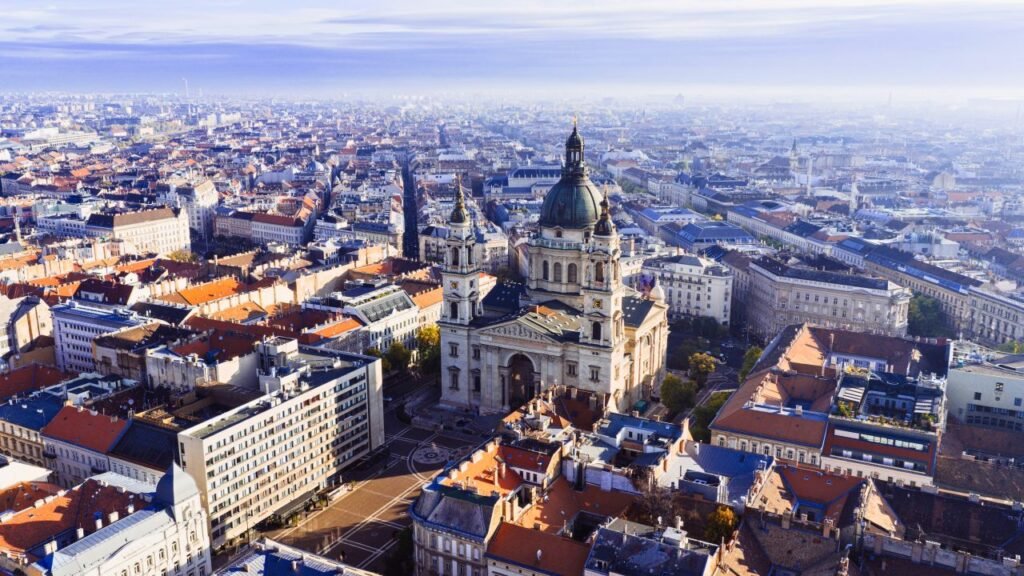
Discover Hungary Culture, Heritage, and Beauty
Folk Costumes (Népviselet)
Hungarian folk dress varies wildly by region, reflecting local wealth and social status. The most famous costume styles come from the Matyó region and the Kalocsa region.
Women’s attire typically features white linen shirts with dramatic billowed sleeves, dark pleated skirts worn over multiple starched petticoats, and elaborately embroidered aprons. Men wear wide-legged white linen trousers that resemble skirts (gatya), vests with decorative metal buttons, and round felt hats adorned with feathers or flowers.
Embroidery and National Symbols
- Kalocsa and Matyó Embroidery: These world-famous needlework styles feature vibrant, stylized floral patterns—mostly deep red roses, tulips, and paprika pods—stitched onto clothing and tablecloths, symbolizing the natural bounty of the Hungarian soil.
- The Coat of Arms: Features a shield split into two sides. The left side displays the historic Árpád Stripes (four silver and four red horizontal bands representing the country’s historic rivers). The right side features a silver double cross rising out of three green hills, topped by the iconic Holy Crown of Saint Stephen, instantly recognizable by its distinct bent cross.
Music, Dance & Art
Musical Traditions and Folk Dance
Music is a fundamental element of the Hungarian soul. The nation developed a unique genre known as Cigányzene (Hungarian Romani Music), featuring virtuosic violin solos, double bass, and the haunting, percussive tones of the Cimbalom (a large stringed instrument struck with padded mallets).
The Táncház (Dance House) movement is a highly successful cultural preservation method. Young urbanites gather in community halls to learn authentic village folk dances to the accompaniment of live acoustic string bands. These energetic dances feature complex syncopated rhythms, rhythmic boot-slapping by the men (legényes), and synchronized spinning by couples.
High Art and Classical Legends
Hungary has contributed immense genius to the classical world:
- Franz Liszt: The 19th-century piano virtuoso who captured the wild romanticism of his homeland in his Hungarian Rhapsodies.
- Béla Bartók and Zoltán Kodály: 20th-century ethnomusicologists who traveled to remote villages to record authentic folk songs, weaving these ancient scales into modern classical compositions. Kodály developed the globally acclaimed Kodály Method of music education.
Summary
The culture of Hungary is a brilliant testament to survival, intellectual drive, and artistic passion. By preserving their distinct Uralic language and nomadic heritage while evolving into a sophisticated Central European powerhouse, the Magyars have created an enduring national identity. From the smoky warmth of a cauldron of simmering goulash to the intricate beauty of Kalocsa embroidery and the lively rhythms of a village dance house, Hungary offers a culturally rich, welcoming experience that continues to educate, inspire, and captivate the global community.
At Best Culture Insight, we see culture as the heartbeat of every society – the way people live, connect, and express their identity.