
Situated at the geographic and cultural crossroads of Central Europe, Austria possesses a culture renowned for its sophistication, artistic genius, and breathtaking alpine heritage. The Austrian people, or Österreicher, have cultivated a society where imperial grandeur coexists harmoniously with a deep, rustic appreciation for nature.
Austrian culture is characterized by the concept of Gemütlichkeit—a unique word describing a state of warmth, coziness, and unhurried friendliness. It is a nation that has given the world monumental classical music, unparalleled architectural marvels, and a lifestyle that treats leisure, conversation, and alpine exploration as sacred arts.
History & Origins
The historical evolution of Austria has profoundly shaped the broader identity of the European continent.
[Celtic & Roman Settlements]➔[The Babenberg Dynasty]➔[The Habsburg Empire]➔[Austro-Hungarian Dual Monarchy]➔[Modern Democratic Republic]
- The Early Eras and Babenbergs: Originally inhabited by Celtic tribes and later integrated into the Roman Empire, Austria’s distinct political identity began taking shape under the Babenberg dynasty in 976 AD. The name Ostarrîchi (meaning “eastern realm”) was first recorded in 996 AD, eventually evolving into the modern German name Österreich.
- The Imperial Habsburg Dynasty: In 1273, the Habsburgs rose to power, initiating an imperial dynasty that lasted for nearly 650 years. Through strategic marriages and political alliances rather than outright conquest, the Habsburgs expanded their territory to rule over a massive, multi-ethnic empire.
- From Empire to Modern Republic: The empire evolved into the Austro-Hungarian Dual Monarchy in 1867, turning Vienna into the brilliant cultural capital of Europe. Following defeat in World War I, the empire collapsed. Austria endured a tumultuous 20th century—including annexation into Nazi Germany and post-WWII Allied occupation—before establishing itself as a staunchly neutral, highly prosperous democratic republic in 1955.
Culture, Traditions & Customs
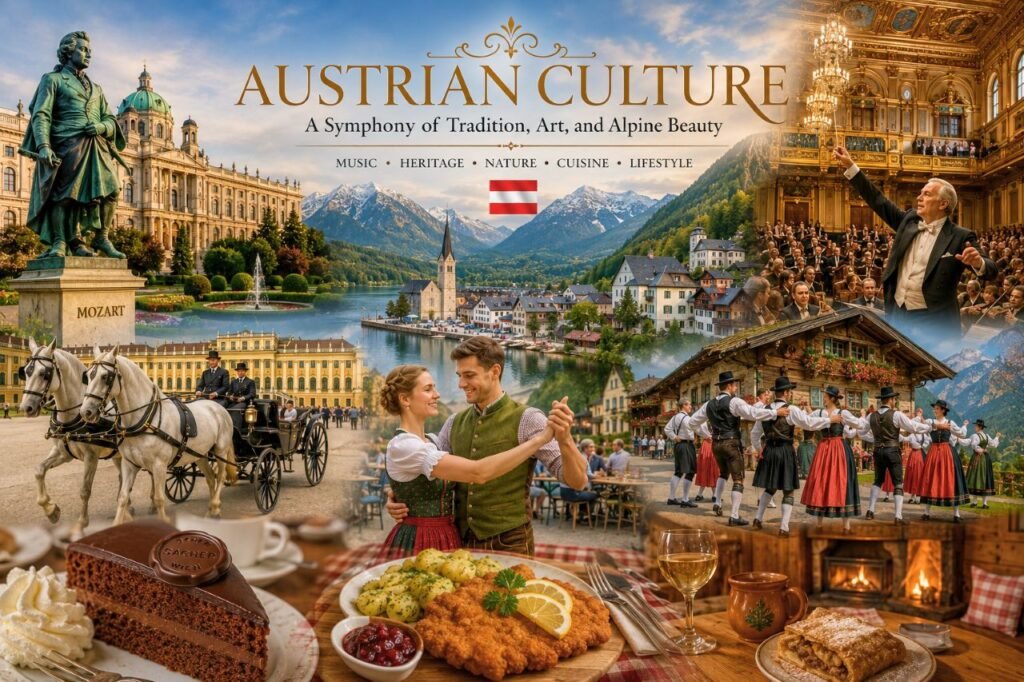
A celebration of Austrian culture
Marriage & Rites of Passage
Austrian weddings blend modern celebrations with regional alpine folklore. In rural regions, traditions like Brautstehlen (the kidnapping of the bride by friends of the groom to a local pub) remain popular, forcing the groom to pay the bar tab to win her back. Major life milestones, such as baptisms and the Matura (the rigorous final high school graduation examinations), are celebrated with formal family gatherings and hearty banquets.
Festivals & Seasonal Customs
- The Viennese Ball Season: A glittering highlight of Austrian high culture. Every winter, over 450 formal balls take place across Vienna. Governed by strict dress codes, classical waltzes, and historic etiquette, these events preserve the grace of the imperial court.
- Almabtrieb: Celebrated in early autumn, this vibrant alpine festival marks the return of cattle from high mountain pastures to the valleys for winter. The cows are spectacularly decorated with elaborate floral crowns, mirrors, and large bells to ward off evil spirits.
- Krampusnacht: Occurring on December 5th, this ancient winter tradition features menacing, furry creatures called Krampus parading through alpine villages. Accompanying Saint Nicholas, these folkloric figures playfully scare onlookers, punishing children who misbehaved during the year.
Languages & Communication
The official language of the country is Austrian German (Österreichisches Deutsch). While it shares a written standard with Germany, it possesses unique vocabulary, expressions, and a distinct, softer pronunciation.
Regional Dialects
Outside of formal settings, regional dialects are spoken proudly across the country. The dominant dialects belong to the Bavarian-Austrian linguistic group, with the exception of the westernmost state of Vorarlberg, which speaks an Alemannic dialect closely related to Swiss German.
Greetings & Etiquette
Austrians value formal politeness and clear eye contact. The standard greeting is Guten Tag, but the universally beloved Austrian greeting is Servus (casual) or Grüß Gott (meaning “Greet God,” used respectfully across all generations, especially in the south and rural areas). When parting ways, the distinct phrase Wiederschauen (“Until we look again”) is preferred.
Geography
Austria is a landlocked nation defined by its spectacular topography. Roughly 60% of the country’s territory is covered by the Alps, featuring towering peaks like the Großglockner, which reaches an elevation of 3,798 meters.
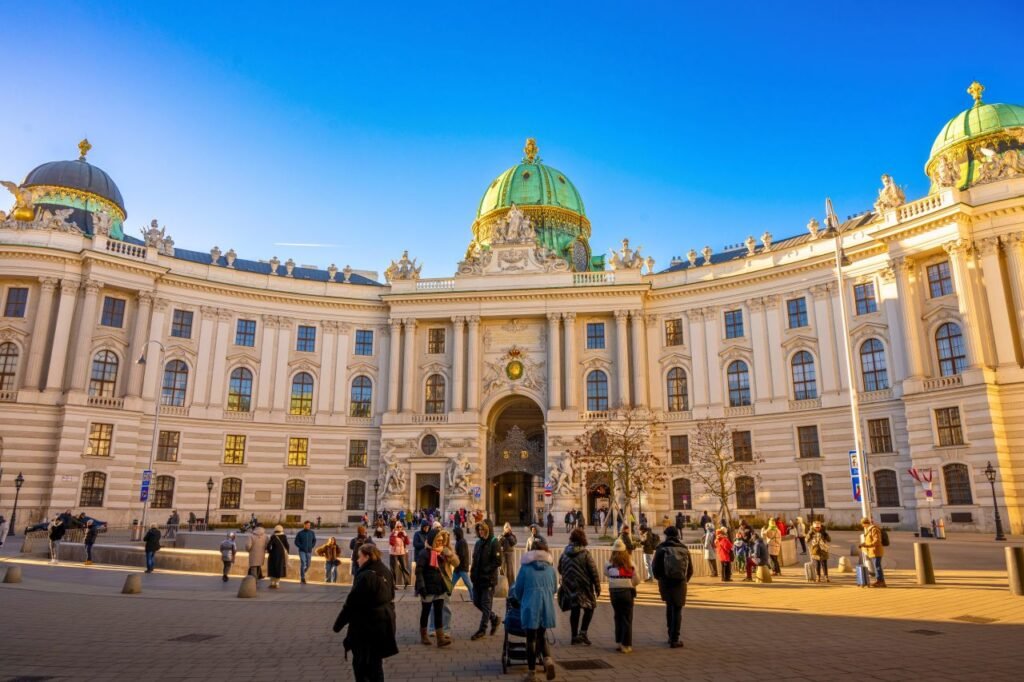
The majestic Danube River winds through the northern lowlands, connecting the historic cities of Linz and Vienna. The country is divided into nine federal states (Bundesländer), ranging from the flat vineyard plains of Burgenland in the east to the dramatic, snow-capped glacial valleys of Tyrol and Salzburg in the west.
Economy
Austria boasts one of the highest standards of living and strongest economies in the European Union. Its economic framework is built on a highly developed social market system. Key drivers include:
- High-Tech Engineering and Manufacturing: Specializing in automotive components, machinery, and green energy technology.
- Organic Agriculture: Austria leads Europe in organic farming practices, prioritizing sustainable, small-scale family agriculture.
- International Tourism: Drawing millions annually to its world-class winter ski resorts, alpine hiking trails, and historic cultural monuments.
Politics
Austria is a federal parliamentary representative democratic republic. The head of government is the Federal Chancellor (Bundeskanzler), while the head of state is the Federal President (Bundespräsident).
The national parliament consists of two chambers: the Nationalrat (National Council) and the Bundesrat (Federal Council). A defining pillar of Austrian global identity is its permanent neutrality, enshrined in its constitution since 1955. This status has made Vienna a major global diplomatic hub, hosting headquarters for the United Nations, OPEC, and the IAEA.
Ethnic Groups
The vast majority of the population identifies as ethnically Austrian. However, due to its historic position as the heart of a multi-ethnic empire and modern immigration patterns, Austria is home to diverse communities.
The state officially recognizes six historic indigenous ethnic minorities: Slovenes (in Carinthia), Croats and Hungarians (in Burgenland), and Roma, Czechs, and Slovaks. In recent decades, immigration has introduced large, vibrant communities originating from Germany, the Western Balkans, and Turkey.
Beliefs & Values
Religion & Secularization
Historically, the Roman Catholic Church served as a cornerstone of Austrian life and politics. While society has become increasingly secularized, Catholic traditions, holidays, and stunning Baroque architecture continue to anchor the national calendar. Protestantism, Islam, and Orthodox Christianity also represent significant religious communities.
The Art of Coffee House Culture
One cannot understand the Austrian worldview without experiencing the Viennese Coffee House Culture, officially designated by UNESCO as an Intangible Cultural Heritage.
A traditional coffee house is treated as an extended living room. Patrons are welcome to sit for hours with a single cup of coffee (Melange) and a newspaper, reflecting the Austrian philosophy that life should be savored slowly, prioritizing community conversation and intellectual debate over hurried productivity.
Food & Cuisine
Austrian cuisine (Österreichische Küche) is a comforting, rich culinary tradition heavily influenced by the diverse regions of the former Habsburg Empire, drawing inspiration from Hungary, Bohemia, and Italy.
- Wiener Schnitzel: The undisputed national dish. A tender, thinly pounded cutlet of veal (or pork), coated in flour, beaten eggs, and breadcrumbs, then pan-fried in clarified butter until beautifully golden and crisp.
- Tafelspitz: A favorite dish of Emperor Franz Joseph. It features tender, slow-simmered beef served with minced apples and horseradish (Apfelkren) and chive sauce.
- Apfelstrudel & Sachertorte: Austrian desserts are world-famous. The Apfelstrudel features paper-thin layers of pastry wrapped around spiced apples, raisins, and toasted breadcrumbs. The legendary Sachertorte, invented in Vienna, is a dense, rich chocolate cake coated in apricot jam and dark chocolate glaze, traditionally served with a dollop of unsweetened whipped cream (Schlagobers).
Clothing & Symbols
Tracht: Dirndl and Lederhosen
Unlike many European nations where traditional garments are confined to history museums, Austria’s historic attire, known as Tracht, remains a vibrant part of modern daily life.
- The Dirndl: A traditional dress worn by women, consisting of a close-fitting bodice, a low-necked blouse, a full skirt, and a colorful apron.
Cultural Subtext: The placement of the apron bow acts as a subtle relationship status indicator: tied on the left means single; tied on the right means married or engaged; tied in the middle means a virgin; and tied at the back indicates a widow or a waitress.
- Lederhosen: Durable, embroidered leather shorts featuring distinctive H-shaped suspenders, traditionally worn by men in alpine regions for physical labor, festivals, and weddings.
National Symbols
The national flag consists of three equal horizontal bands of red, white, and red. According to legend, the flag was inspired by Duke Leopold V during the Siege of Acre in 1191; after a fierce battle, his white tunic was soaked in blood, but when he removed his wide belt, a pristine white stripe remained underneath. The national emblem features a black single-headed eagle holding a hammer and sickle, symbolizing the unity of the working classes, with broken chains on its talons representing the liberation from totalitarianism.
Music, Dance & Art
The Capital of Classical Music
Austria’s contribution to Western classical music is unmatched. During the 18th and 19th centuries, Vienna became the global epicenter of musical innovation, nurturing the geniuses of Wolfgang Amadeus Mozart, Joseph Haydn, Ludwig van Beethoven, Franz Schubert, and the waltz king, Johann Strauss II. Today, this heritage is kept alive by world-renowned institutions like the Vienna Philharmonic Orchestra and the annual Salzburg Festival.
Visual Arts & Architecture
In the visual arts, Austria was the birthplace of the revolutionary Vienna Secession movement at the turn of the 20th century. Master artists like Gustav Klimt (famous for The Kiss) and Egon Schiele challenged traditional artistic boundaries. Architecturally, the country is a spectacular living museum, shifting seamlessly from medieval Gothic structures to the ornate Baroque palaces of Schönbrunn and the Belvedere, and onward to the colorful, eco-friendly modern designs of Friedensreich Hundertwasser.
Summary
Austrian culture is an intricate, beautifully preserved tapestry woven from imperial ambition, artistic excellence, and alpine resilience. By fiercely protecting its historic customs—whether through the preservation of Tracht, the elegant traditions of the Viennese ball, or the unhurried sanctuary of the coffee house—Austria has successfully maintained its unique soul in a rapidly changing world. It remains a nation that sings, dances, and lives with a profound sense of grace, inviting all who visit to slow down and join its beautiful, timeless waltz.
At Best Culture Insight, we see culture as the heartbeat of every society – the way people live, connect, and express their identity.