The Cultural Mosaic of the North: A Deep Journey Into Canada Culture
Posted in :

Spanning across six time zones and stretching from the Atlantic to the Pacific and up into the Arctic Ocean, Canada is the second-largest country by landmass in the world. Yet, the true vastness of this North American giant lies within its social identity. Far from a singular melting pot, Canada is globally celebrated as a cultural mosaic—a vibrant canvas where distinct ethnic heritages are legally, socially, and passionately encouraged to retain their unique textures. – Canada Culture
To meet the people of Canada is to experience a society deeply rooted in the values of peace, tolerance, and community solidarity. From the ancestral wisdom of First Nations, Inuit, and Métis peoples to the foundational legacies of French and British settlers, and the ongoing contributions of global immigrants, Canadian culture is a beautifully evolving experiment in multi-ethnic harmony.
History & Origins
The historical framework of Canada spans millennia, beginning long before European sails touched its coastlines.
The First Peoples
The land was originally populated by diverse, sophisticated Indigenous civilizations. The First Nations developed intricate governance systems across the woodlands and plains; the Inuit mastered life in the frozen Arctic; and the Métis emerged later as a distinct culture born from the unions of Indigenous women and European fur traders. These communities lived by deep spiritual connections to the land, passing down oral histories and complex ecological knowledge.
European Convergence
The European chapter opened in the late 15th and 16th centuries with expeditions by explorers like John Cabot and Jacques Cartier. The lucrative fur trade ignited deep colonial interest, leading to the establishment of New France along the St. Lawrence River and British settlements around Hudson Bay.
- The Treaty of Paris (1763): Following the Seven Years’ War, France ceded its North American territories to Great Britain. Crucially, the British allowed French Canadians to retain their civil law, Catholic faith, and linguistic rights, laying the bedrock for Canada’s dual identity.
- Confederation (1867): On July 1, 1867, the British North America Act united Nova Scotia, New Brunswick, and the Province of Canada (Ontario and Quebec) into a single dominion.
Through the 20th century, successive waves of global migration—and an ongoing national journey toward truth and reconciliation with Indigenous peoples—transformed Canada into a modern, fully independent sovereign state.
Culture, Traditions & Customs
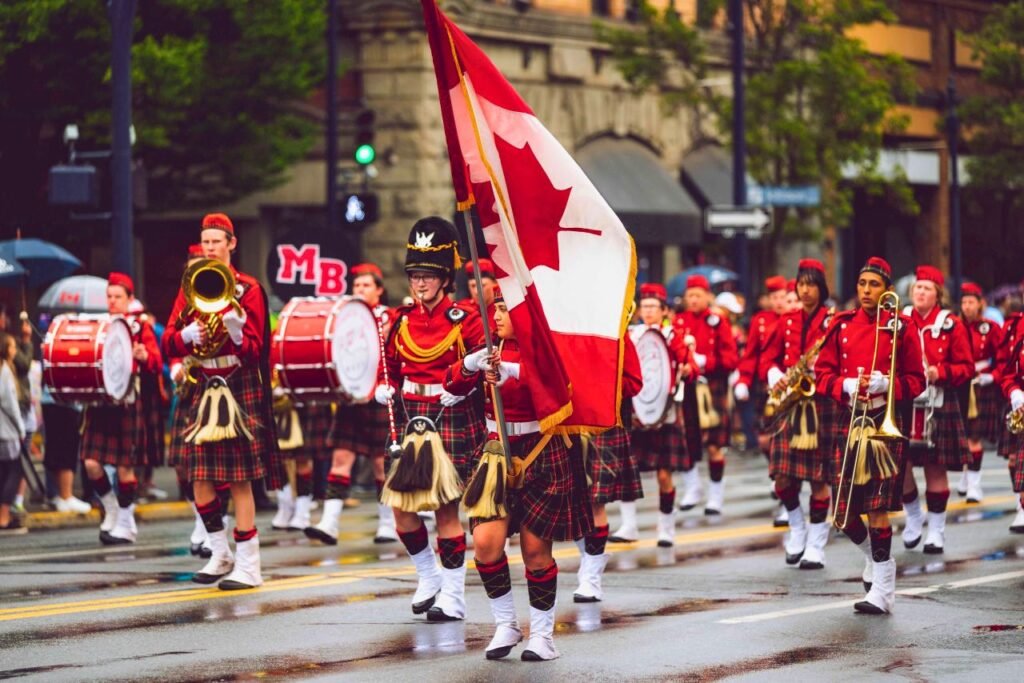
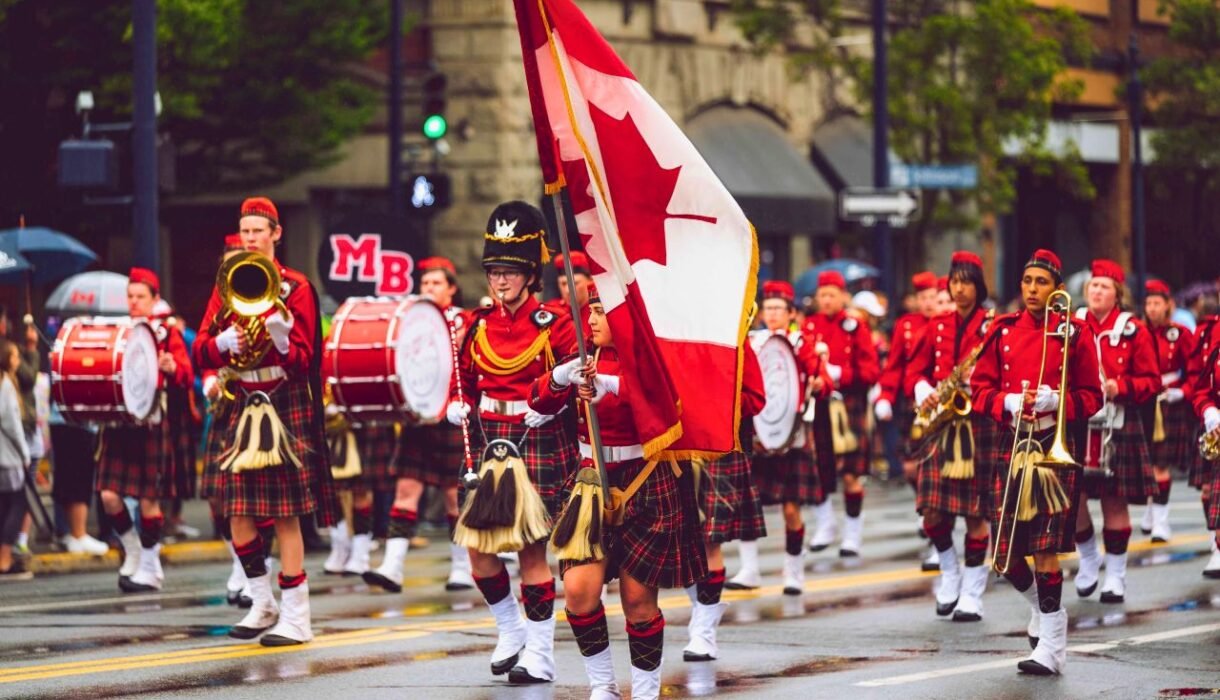
Festive marching band in Victoria, BC, celebrating with Canadian flags and colorful costumes – Victoria, BC, Canada
Social Frameworks and Lifespan Customs
Canadian life is underpinned by a profound respect for privacy balanced with a strong safety net of civic responsibility. Family structures are highly diverse, ranging from traditional nuclear setups to expansive, cross-cultural extended families.
Life milestones—such as graduations, weddings, and retirements—are widely celebrated with casual backyard barbecues, community hall parties, or multi-faith ceremonies that blend ancestral rites with contemporary Canadian lifestyles.
Distinctly Canadian Festivals
Canada’s calendar is highly defined by the changing of the seasons, giving rise to iconic community traditions:
- The Winter Carnivals: To celebrate rather than endure the cold, cities host massive winter events. The Carnaval de Québec features monumental snow sculptures and night parades led by its famous mascot, Bonhomme, while Ottawa’s Winterlude turns the Rideau Canal into the world’s largest skating rink.
- The Calgary Stampede: Billed as “The Greatest Outdoor Show on Earth,” this annual July festival in Alberta celebrates western heritage with world-class rodeos, chuckwagon races, and massive pancake breakfasts, drawing millions of visitors.
- Indigenous Powwows: Held across the country throughout the spring and summer, Powwows are sacred, vibrant gatherings of song, dance, and socialization that preserve and showcase Indigenous cultural resilience and ancestral pride.
Languages & Communication
Canada is officially a bilingual nation, a defining status enshrined in its Charter of Rights and Freedoms. English and French possess equal status in all federal government institutions, courts, and official national media.
While English is spoken by the vast majority of Canadians, French is the proud, vibrant mother tongue of Quebec and is spoken in vibrant Acadian and Franco-Ontarian communities across the country. Additionally, over seventy distinct Indigenous languages are actively spoken, with major revitalization efforts supporting tongues like Inuktitut, Cree, and Ojibwe.
Popular Canadian Expressions and Proverbs:
- “Eh?” – The classic, universal Canadian tag used at the end of a sentence to invite agreement, check for understanding, or turn a statement into a question.
- “Loonie” and “Toonie” – The affectionate, official slang terms for Canada’s one-dollar coin (which features a loon bird) and two-dollar coin.
- “Double-Double” – A ubiquitous coffee order meaning a regular coffee with two creams and two sugars, made famous by the iconic national chain Tim Hortons.
- “As busy as a beaver” – A classic local expression used to describe someone working with relentless, industrious energy.
Geography
Canada’s geography is staggering in its diversity and scale. The country is divided into ten provinces and three northern territories, split into highly distinct environmental regions:
[ The Spatial Architecture of Canada ] ┌─────────────────────────┬─────────────────────────┬─────────────────────────┐ │ The Atlantic Coast │ The Central Heartland │ The Western Plains │ │ Maritime fishing ports, │ The urban, industrial │ Vast agricultural wheat │ │ rugged wave-swept cliffs│ corridor along Ontario │ fields, big skies, and │ │ and historic lighthouses.│ and French-speaking QC. │ ranching landscapes. │ └─────────────────────────┴─────────────────────────┴─────────────────────────┘ [ The Pacific Coast & The Arctic North ] Thick temperate coastal rainforests of British Columbia meeting the massive, permafrost-bound tundra and glacial islands of Nunavut and the Northwest.The landscape is defined by its pristine natural freshwater networks, holding roughly 7% of the world’s renewable clean water supply. The majestic Rocky Mountains dominate the west, while the massive, rocky expanse of the Canadian Shield wraps around Hudson Bay, rich in timber, minerals, and ancient glacial lakes.
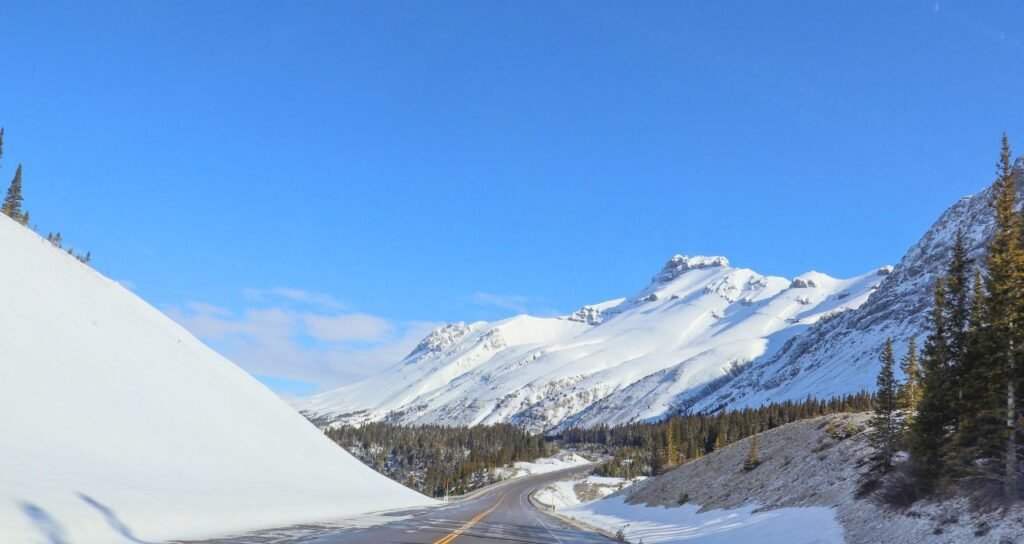
Stunning view of a snowy mountain road under a clear blue sky.
Economy
Canada boasts an incredibly prosperous, highly advanced mixed economy, ranking among the top ten nations globally in terms of GDP. The economic engine is driven by an abundance of natural resources, including vast reserves of crude oil, natural gas, timber, uranium, and minerals.
Simultaneously, the nation has modernized into a powerhouse of knowledge-based industries, including cutting-edge artificial intelligence research, aerospace engineering, and interactive digital media. The automotive sector, clean energy development, and a booming service industry further anchor its domestic stability, supported by deep trade relationships with the United States and international partners.
Politics
Canada operates as a parliamentary democracy and a constitutional monarchy. King Charles III is the ceremonial head of state, represented nationally by a Governor General and provincially by Lieutenant Governors. Legislative power is held by the bicameral Parliament, consisting of an appointed Senate and an elected House of Commons.
Executive authority is held by the Prime Minister, who leads the Cabinet as the head of the majority political party in parliament. The political landscape is defined by its federal system, which divides governance cleanly between national responsibilities (like defense and foreign policy) and provincial mandates (such as healthcare and public education), maintaining an exceptionally stable democracy.
Ethnic Groups
Centuries of continuous, organized global migration have crafted a deeply diverse, multi-ethnic population layout:
| Broad Ethnic Origins | Demographic Footprint | Cultural Contribution & Legacy |
| European Roots | ~52.5% | Primarily British, Irish, Scottish, and French ancestries, followed by substantial German, Italian, and Ukrainian heritages. |
| Visible Minorities | ~43.2% | Rapidly growing communities including South Asian, Chinese, Black/African-Caribbean, Filipino, Arab, and Latin American Canadians. |
| Indigenous Peoples | ~4.3% | Made up of First Nations, Métis, and Inuit communities, who provide the foundational heritage and deep history of the land. |
Beliefs & Values
The value system of Canada is explicitly grounded in the principles of Multiculturalism, which became official state policy in 1971. Rather than forcing conformity, Canadian worldview promotes cultural preservation as a fundamental human right.
Spiritually, the country is highly pluralistic. While the majority of Canadians historically identify as Christian (divided between Roman Catholicism and various Protestant denominations), the active immigration of the last few decades has seen vibrant growth in Islam, Hinduism, Sikhism, Buddhism, and Judaism.
Furthermore, Canadian social values place an immense emphasis on progressive human rights, gender equality, environmental stewardship, and a universal, single-payer public healthcare system that functions as a core source of national pride.
Food & Cuisine
Canadian cuisine is a diverse, comforting fusion of seasonal, land-derived ingredients and global culinary traditions brought by waves of settlers.
The Ultimate Comfort Food: Poutine
Originating in rural Quebec during the late 1950s, Poutine has risen to become Canada’s most recognizable and beloved culinary staple.
- The Fries: Thick-cut potatoes fried until they are perfectly golden brown and crispy on the outside, yet soft inside.
- The Curds: Fresh, “squeaky” cheese curds placed directly onto the hot fries.
- The Gravy: A rich, piping-hot brown gravy poured generously over the top, melting the cheese slightly while maintaining the crunch of the fries.
Other Local Staples
- Maple Syrup: Canada produces roughly 75% of the world’s pure maple syrup. Harvested in early spring from maple orchards across Quebec and Ontario, this liquid gold is used in everything from pancakes to traditional maple taffy cooled on fresh winter snow.
- The Butter Tart: A quintessential Canadian dessert consisting of a flaky pastry shell filled with a rich, gooey mixture of butter, sugar, and egg, often baked with raisins or pecans.
- Bannock: A traditional, dense quick bread adopted and adapted by Indigenous communities across Canada, commonly fried or baked until golden and served warm with stews or wild berry preserves.
Clothing & Symbols
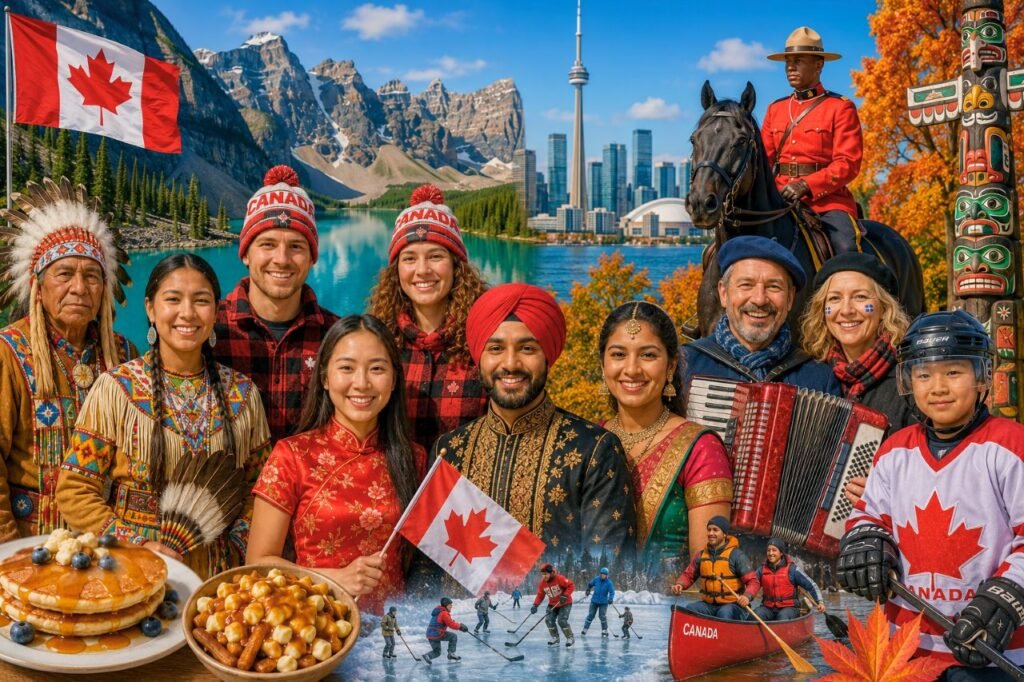
Canada’s cultural diversity and landscapes
The Uniform of the North
In daily life, Canadians wear standard modern clothing tailored to withstand the vast swings of the climate, with heavy down-filled parkas, tuques (winter hats), and waterproof boots becoming universal armor during the snowy winters.
Historically, the nation’s textile legacy is represented by the Hudson’s Bay Point Blanket, a distinctive cream-colored wool blanket accented with green, red, yellow, and indigo stripes, which was traded for furs during the 18th century and remains a major visual symbol of Canadian commercial history.
[ The Architecture of the Maple Leaf ] ┌─────────────────────────┬─────────────────────────┬─────────────────────────┐ │ Left Red Bar │ The Center White disk │ Right Red Bar │ │ Taken from the historic │ Represents the vastness │ Taken from the historic │ │ British military banner │ of Canada's snow-bound │ British military banner │ │ and royal standard. │ landscape and northern │ and royal standard. │ │ │ geography. │ │ └─────────────────────────┴─────────────────────────┴─────────────────────────┘ [ Centerpiece: The Lous-Lous Maple Leaf ] An 11-pointed stylized red maple leaf, representing the rich natural forests of Canada, national unity, and the shared identity of all citizens.The absolute primary symbol of the nation is the Maple Leaf, which sits proudly at the center of the national flag. Adopted in 1965, the flag features a central white square flanked by two solid red bars, containing a stylized 11-pointed red maple leaf. The colors red and white were declared Canada’s official colors by King George V in 1921. Other major national symbols include the Beaver, representing industriousness and the historic fur trade, and the Totem Pole, carved by West Coast Indigenous peoples to display lineage and history.
Music, Dance & Art
Visual Arts and The Group of Seven
The visual arts landscape of Canada shifted permanently in the 1920s with the rise of The Group of Seven. These legendary landscape painters pioneered a distinct, rugged artistic style using bold colors and sweeping brushstrokes to capture the raw, untamed beauty of the Canadian wilderness, breaking away from traditional European realism.
Concurrently, Indigenous artists like Kenojuak Ashevak revolutionized modern Canadian art with bold, graphic Inuit printmaking and stone sculptures that showcase northern wildlife and spiritual worldviews.
Soundscapes and Performance
Canada’s musical output is globally powerful. The traditional folk roots are kept alive through French-Canadian kitchen fiddling, Acadian step-dancing, and Maritime sea shanties. Simultaneously, Canada has birthed some of the world’s most influential popular musicians across genres, including Joni Mitchell, Leonard Cohen, Celine Dion, Rush, and Drake.
[ The Cultural Icons of Canada ] ┌─────────────────────────┬─────────────────────────┬─────────────────────────┐ │ Kitchen Parties │ Throat Singing │ Ice Hockey │ │ Maritime folk gathering │ Traditional Inuit vocal │ More than a sport—an │ │ featuring lively fiddle │ art mimicking the sound │ obsessive winter ritual │ │ music and step-dancing. │ of wind and wildlife. │ that unifies communities│ └─────────────────────────┴─────────────────────────┘└─────────────────────────┘The winter months see the entire country unite around its unofficial national religion: Ice Hockey. Played on frozen backyard ponds and in massive urban arenas alike, hockey is an essential percussive and cultural ritual that transcends ethnic lines, unifying generations of Canadians.
Summary
The culture of Canada stands as an extraordinary global testament to the beauty that emerges when a modern country chooses to celebrate, rather than suppress, its ethnic and linguistic diversity. By weaving together ancient Indigenous worldviews, historic French and British institutional heritages, and a modern, official framework of multiculturalism, this northern nation has carved out an incredibly resilient and progressive identity. From the warmth of a Maritime kitchen party to the shared joy of a bowl of hot poutine, Canada continues to shine—proudly preserving its cultural mosaic and sharing its welcoming spirit with the world.
At Best Culture Insight, we see culture as the heartbeat of every society – the way people live, connect, and express their identity.