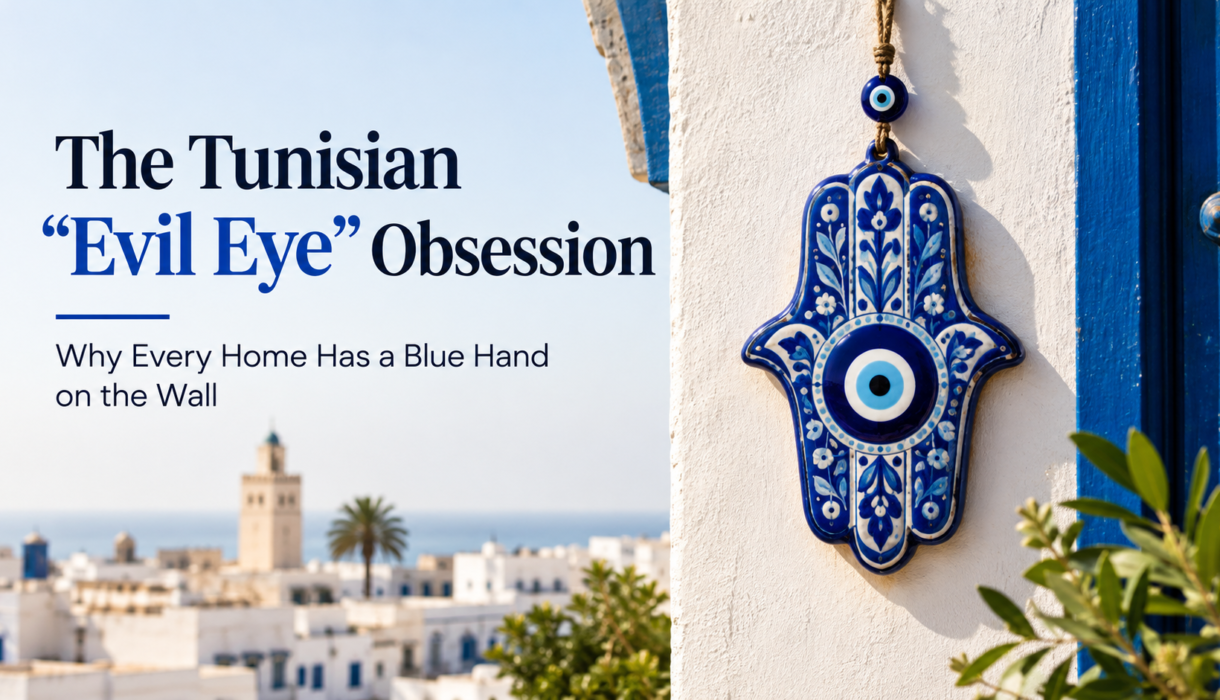

Walk through the sun-drenched streets of Tunis, the whitewashed coastal village of Sidi Bou Said, or a quiet rural village in inland Tunisia, and you will quickly notice a recurring motif. Adorning wooden front doors, hanging above living room doorways, dangling from rearview mirrors, and painted onto vibrant ceramic tiles is a distinctive blue hand symbol. Known locally as the Khamsa (or the Hand of Fatima), this iconic emblem is far more than a decorative souvenir or a nod to traditional craft. It is a powerful, centuries-old protective talisman designed to ward off the Ayn, commonly known across the Mediterranean and Arab world as the “Evil Eye.”
To understand why this symbol is ubiquitous in modern Tunisia, one must first grasp the psychological weight of the Evil Eye concept itself. In Tunisian culture, as well as in many neighboring societies, the Evil Eye represents a force of involuntary harm caused by envy, jealousy, or even excessive, unreserved admiration. The belief holds that a gaze filled with silent envy—whether directed at someone’s healthy child, a newly built home, a successful business, or personal happiness—can inadvertently project negative energy and bring bad luck, illness, or financial ruin. To safeguard against this invisible threat, Tunisians rely on a time-tested spiritual defense system embedded directly into their everyday architecture and decor.
The Deep Historical and Spiritual Origins of the Khamsa
The roots of the blue hand reach back thousands of years, predating modern borders and organized religions in North Africa. Archaeologists and historians trace the symbol back to ancient Carthage—a formidable Phoenician civilization centered in present-day Tunisia. The Carthaginians revered Tanit, a supreme lunar goddess of fertility, motherhood, and protection, whose symbol was often depicted as a raised hand or a stylized triangle topped with a horizontal bar. Over centuries, as the region transitioned through Roman, Byzantine, Berber, and Islamic influences, the protective hand adapted to changing belief systems while retaining its core function as a shield against harm.
In contemporary Tunisian culture, the word Khamsa literally translates to “five” in Arabic, referring to the five fingers of the hand. The number five holds deep symbolic resonance across multiple traditions in the region. In Islamic culture, it is frequently associated with the five pillars of Islam and the protective hand of Fatima Zahra, the daughter of the Prophet Muhammad. In Jewish communities that historically flourished across North Africa, the symbol is known as the Hand of Miriam. Despite these varying cultural lineages, the underlying purpose across every community remains identical: to block negative energies and project divine protection over a household.
The Power of the Color Blue in Mediterranean Defense
While the hand shape provides the primary defense, its vibrant blue color plays an equally crucial secondary role in North African folklore. Historically, blue has been regarded across the Mediterranean basin as a color capable of absorbing or deflecting bad luck. The specific shade—often a bright cobalt or turquoise blue—is believed to mimic the sky and ocean, symbolizing purity, tranquility, and cosmic energy. According to traditional beliefs, when an envious person casts a glare toward a home, their gaze is immediately drawn to the striking blue pigment of the hand, neutralizing the negative intent before it can cross the threshold.
This visual strategy is deliberately deployed at the most vulnerable entry points of a home. Front doors, windows, and main archways serve as the primary physical boundaries between the private family sanctuary and the outside world. By fixing a blue Khamsa directly above or beside the main entrance, homeowners create a symbolic shield that scrutinizes every guest and passerby, ensuring that only good intentions enter the living space.
Modern Life, Subtle Rituals, and Social Harmony
In modern Tunisia, the reliance on the Khamsa is not restricted to rural areas or older generations; it flourishes equally among urban professionals, young families, and the highly educated. Beyond displaying the physical hand, daily Tunisian dialect is filled with subtle linguistic phrases designed to neutralize envy in real-time. When admiring a child’s beauty or a friend’s accomplishment, it is customary to say “Macha’Allah” (as God has willed) or “Tbarkallah” (blessed be God), explicitly attributing the good fortune to divine providence rather than personal pride, thus stripping the compliment of any potential “eye.”
Ultimately, Tunisia’s enduring fascination with the blue hand reflects a deeply rooted desire for peace, security, and social harmony within the home. Rather than representing paranoia, the Khamsa functions as a comforting cultural touchstone—a shared, unspoken understanding that human happiness is delicate and worth protecting. By blending ancient Carthaginian history, vibrant aesthetics, and a universal human instinct for safety, the blue hand remains a timeless sentinel standing guard over every Tunisian home.