The Tiny Nation With Over a Dozen Ethnic Groups — Each Living as if in a Separate Country
Posted in :

On the northern coast of South America lies Suriname, the smallest independent nation on the continent. Tucked between dense Amazonian rainforests and the Atlantic Ocean, this tiny country is home to roughly 600,000 people. Yet, despite its small geographic footprint and modest population, Suriname boasts one of the most complex demographic landscapes in the world. Within its borders live over a dozen distinct ethnic groups, each preserving its own language, customs, religious practices, and social structures so thoroughly that stepping into different neighborhoods can feel like crossing international borders.
Unlike many multicultural nations where cultures blend into a central national identity, Suriname operates as a fascinating tapestry of distinct cultural enclaves. Here, East Indians, Maroons, Creoles, Javanese, Indigenous peoples, Chinese, Dutch, and European descendants coexist. Each community maintains its heritage with remarkable fidelity, allowing visitors and locals alike to experience the sights, sounds, and traditions of completely different continents within a single day’s travel.
A Global Map Condensed Into One Country
The origin of Suriname’s extraordinary diversity stems from centuries of complex colonial history. Following the abolition of slavery, the colonial government brought indentured laborers from around the globe to work on agricultural plantations. Contract workers arrived from India (then known as British India), Java in Indonesia, and China, joining the indigenous populations, European settlers, and West African descendants already living there.
Rather than assimilating into a single culture over time, these groups established their own towns, villages, and city districts. Today, you can visit a village deep in the rainforest where life closely mimics West African traditions, and then travel a short distance to a coastal settlement where Javanese gamelan music plays in the background and traditional Indonesian dishes are served at every corner.
Living Parallel Lives in Harmony
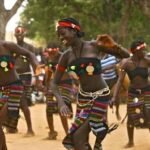
What makes Suriname truly remarkable is not just the presence of these diverse ethnic groups, but how distinctly each community maintains its daily way of life. The Indo-Surinamese population, descended from 19th-century Indian laborers, maintains traditional Hindu and Muslim customs, celebrating festivals like Phagwa (Holi) and Diwali with immense grandeur. Meanwhile, the Maroon communities—descendants of escaped African slaves who formed independent settlements in the interior rainforests—preserve African language dialects, woodcarving arts, and tribal governance systems that have survived virtually untouched for generations.
Similarly, the Javanese community continues to speak Javanese alongside Dutch, building traditional warungs (eateries) and celebrating traditional Javanese holidays. In the capital city of Paramaribo, it is common to see a grand synagogue standing directly next to an ornate mosque, sharing a parking lot and peaceful relations for decades—a rare sight in the modern political landscape.
Languages That Divide and Connect
Language in Suriname reflects this unique living setup. While Dutch serves as the official administrative language for government and education, it is far from the only tongue spoken on the streets. Every ethnic group relies heavily on its ancestral language for daily life within its community, whether it is Sarnami Hindustani, Javanese, Hakka, or indigenous tongues like Carib and Arawak.
To bridge these linguistic divides, the population relies on Sranan Tongo, an English-based creole language that developed as a shared medium of communication. This language allows members of different ethnic groups to trade, conduct business, and interact easily while still returning home to speak their native heritage languages.
The Secrets to Peaceful Coexistence
In many parts of the world, deep ethnic diversity within small geographical boundaries leads to political friction or civil unrest. Suriname, however, has largely managed to avoid major inter-ethnic conflicts. Political power and social representation are historically distributed among various ethnic parties, encouraging coalition-building and political negotiation rather than domination by a single group.
Furthermore, mutual respect for cultural boundaries plays a vital role. Each community respects the customs, dietary rules, and religious holidays of its neighbors. National holidays in Suriname reflect this balance, as the government officially recognizes major Christian, Hindu, Muslim, and indigenous celebrations as national days of rest for the entire population.
A Powerful Lesson for a Globalized World
Suriname demonstrates that national unity does not require cultural uniformity. By allowing each ethnic group to preserve its distinct identity, language, and tradition, this tiny South American nation functions as a living laboratory of global harmony. It proves that people from entirely different corners of the Earth can live side by side, maintaining their individual heritage while building a peaceful, shared future.