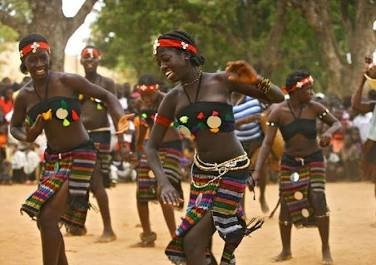
The Bijagós Archipelago — Where Women Propose to Men and Nobody Finds It Strange
Posted in :

Off the Atlantic coast of Guinea-Bissau lies the Bijagós Archipelago, a cluster of roughly 88 tropical islands where long-held traditions shape daily life. While modern dating customs in most parts of the world expect men to take the initiative in romantic relationships, the islanders of Bijagós follow a completely different set of rules. Here, courtship and marriage are guided entirely by women, creating a social system where female leadership is accepted as a normal part of existence.
In this unique society, a young woman decides when she is ready to marry and chooses her prospective husband. Rather than using expensive rings or formal speeches, the traditional marriage proposal involves a simple yet symbolic act: the woman prepares a special dish—often fish marinated in red palm oil—and presents it at the man’s home. If the man accepts and eats the meal, the engagement is official. Rejection is exceedingly rare, as the gesture reflects months of careful mutual understanding rather than a sudden surprise.
Female Ownership and Economic Independence
The freedom women enjoy in choosing a spouse is directly linked to their central position in economic and domestic affairs. In the Bijagós culture, land, property, and family homes belong primarily to women. When a couple marries, the husband moves into his wife’s home rather than the other way around. Women construct and maintain these residences, hold authority over household finances, and manage agricultural production.
Because women control the primary assets, they maintain complete social and economic independence throughout their lives. This economic autonomy gives women full authority over family decisions, child-rearing, and the organization of village labor. Men typically contribute through fishing, clearing land, and tapping palm trees, but the overarching management of community welfare remains in female hands.
Spiritual Authority and Matrilineal Lineage
Beyond domestic and economic roles, the social standing of Bijagós women is rooted in their spiritual leadership. The community follows a matrilineal system, meaning family identity, clan inheritance, and social status are passed down through the mother’s bloodline. Children belong to their mother’s clan, ensuring that lineage and ancestral rights remain strictly tied to women.
Spiritual life on the islands is guided by female priestesses known as Okinka. These spiritual leaders act as intermediaries between the physical world and ancestral spirits. Because the Okinka oversee sacred rituals, law enforcement, and major community decisions, religious life reinforces respect for female authority.
Relationship Dynamics and Divorce Rights
The freedom of choice granted to women extends beyond marriage to include the resolution of relationships. If a marriage is no longer harmonious, the wife has the sole right to initiate a divorce. To dissolve the union, she simply asks her husband to leave the house, placing his personal belongings outside the front door.
Because the home and land remain her property, the separation process is straightforward and free of complex legal disputes. The man returns to his mother’s or sister’s household without public stigma, and both individuals are free to remarry. This system encourages mutual respect within marriages, as relationships rely on ongoing goodwill rather than legal obligation.
Preserving Culture in a Changing World
While modern influences, education, and globalization are gradually introducing Western marital customs to the larger towns, the core islands of the archipelago continue to preserve these traditional gender roles. The community views their system not as a progressive statement, but as a practical tradition handed down through generations.
Ultimately, the Bijagós Archipelago offers a fascinating look at how human societies can organize family life, romance, and leadership. By placing women at the center of marital choices, economic ownership, and spiritual governance, the islanders have created a stable social structure that has quietly endured for centuries.