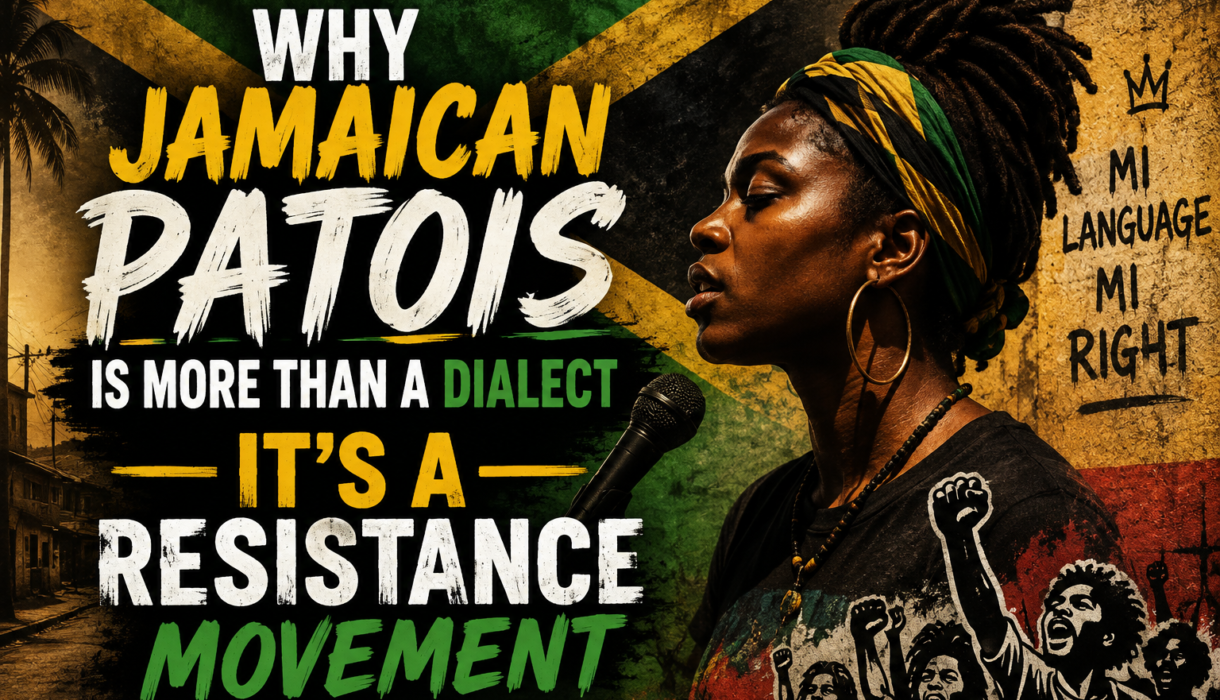
Why Jamaican Patois Is More Than a Dialect — It’s a Resistance Movement
Posted in :

To the uninitiated ear, Jamaican Patois (or Patwa) might sound like a colorful, simplified variation of English. However, defining Patois as merely a regional accent or slang completely ignores its profound history and political power. Developed out of necessity on 17th-century plantations, Jamaican Patois is a fully structured language forged through survival, anti-colonial struggle, and cultural identity. It represents an enduring linguistic fortress—a powerful medium through which an enslaved population reclaimed their humanity, outsmarted their oppressors, and preserved their African heritage.
Born Out of Struggle and Survival
The origins of Jamaican Patois lie in the brutal crucible of the transatlantic slave trade. When British colonizers brought enslaved West Africans to Jamaica, they systematically separated people who spoke the same native languages to prevent communication and rebellion. In response, enslaved Africans combined elements of English vocabulary with the deep grammatical structures, phrasal rhythm, and vocabulary of West African languages like Akan, Ashanti, and Igbo. This newly created creole language allowed them to communicate secretly right in front of plantation overseers, effectively serving as an undercover tool for planning escapes, organizing resistance, and preserving oral history.
Linguistic Sovereignty vs. Colonial Suppression
For centuries, colonial authorities and elite institutions systematically attempted to suppress Patois, branding it as “bad English” or an inferior dialect spoken only by the uneducated. This linguistic elitism was designed to marginalize native speakers and force assimilation into British norms. Yet, Jamaicans stubbornly refused to abandon their language. By choosing to speak Patois in the face of institutional discrimination, generations of Jamaicans engaged in a daily act of civil disobedience. They maintained linguistic sovereignty, asserting that their mother tongue possessed equal validity, emotional depth, and intellectual capacity as any European language.
Reggae, Rastafari, and Global Liberation
In the 20th century, Patois transformed from a local counter-culture into a worldwide voice of liberation, largely driven by the Rastafari movement and reggae music. Legendary icons like Bob Marley, Peter Tosh, and Miss Lou (Louise Bennett-Coverley) elevated Patois onto the international stage, using its distinct vocabulary to challenge oppression and imperialist systems (which Rastafarians famously called “Babylon”). Concepts like “I and I”—a Patois phrase emphasizing the spiritual unity between all people and God—redefined how language could express equality. Through reggae, Patois became the universal soundtrack for global civil rights and anti-apartheid struggles.
A Modern Symbol of Identity and Global Impact
Today, Jamaican Patois continues to shape global popular culture, heavily influencing modern English slang, hip-hop, UK drill, and afrobeat lyrics worldwide. Within Jamaica, a growing movement of linguists and educators advocates for Patois to be granted full official status alongside English, ensuring it is recognized in schools and formal spaces. Patois is far more than a dialect; it is a living monument to human resilience. Every time a Jamaican speaks Patois today, they are honoring an unbroken chain of ancestors who used the power of words to shatter the chains of oppression.