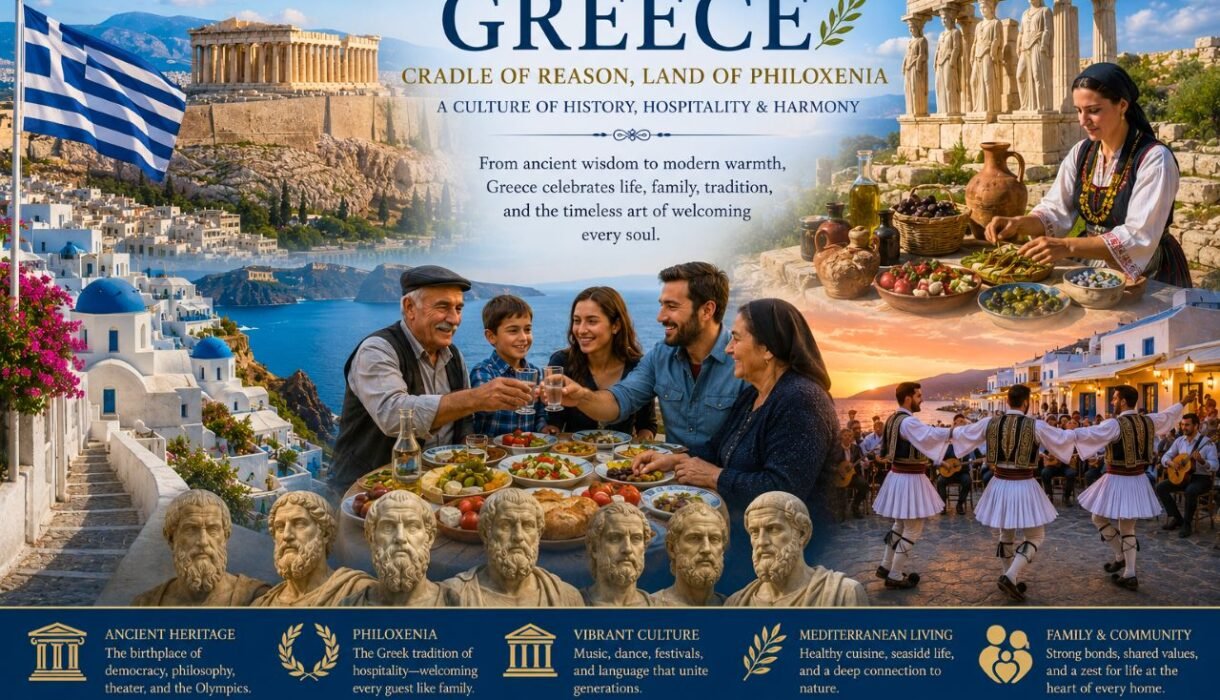

Anchored at the crossroads of Europe, Asia, and Africa, Greece (Ellada) represents one of the most foundational cultural landscapes in human history. Famously recognized as the birthplace of Western democracy, philosophy, theater, and the Olympic Games, Greece has continuously shaped the intellectual and artistic contours of the Western world for millennia. – Culture
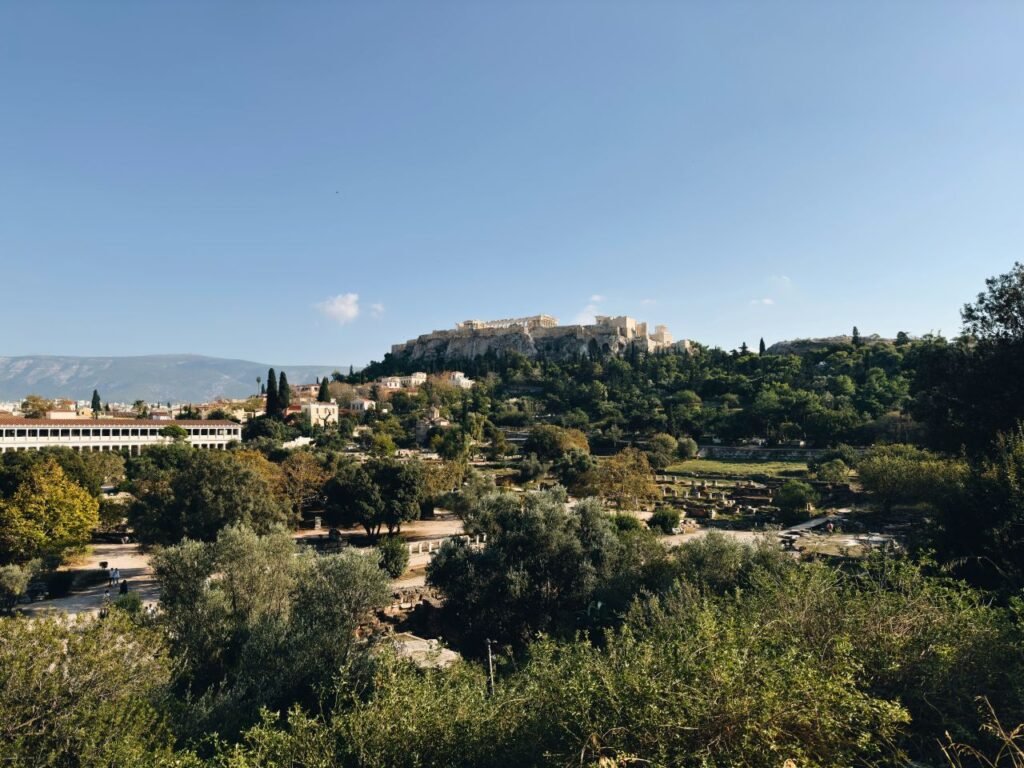
The Greek people (Hellenes) possess a cultural identity characterized by an unyielding zest for life, an intense devotion to family, and a deeply ingrained code of hospitality known as philoxenia (literally “love of the stranger”). Far from being a relic of museum exhibitions, Greek culture is a living, breathing experience. From the ancient, sun-bleached columns of the Athenian Acropolis to the whitewashed villages of the Aegean islands and the rugged mountain communities of Epirus, Greece offers a timeless celebration of human connection, regional pride, and culinary art.
History & Origins
The historical evolution of Greece is a sweeping, multi-millennial epic of intellectual enlightenment, maritime mastery, foreign subjugation, and cultural endurance.
[Minoan & Mycenaean Dawns]➔[Classical Golden Age & Democracy]➔[Hellenistic Empire of Alexander]➔[The Byzantine Empire]➔[Ottoman Rule]➔[1821 War of Independence & Modern State]
- The Antiquity Foundations: Greek civilization emerged out of the highly advanced Bronze Age Minoan and Mycenaean cultures. By the 5th century BC—the Classical Golden Age—city-states like Athens and Sparta flourished. This period birthed the foundational philosophies of Socrates, Plato, and Aristotle, the epic poems of Homer, and the architectural masterworks of the Parthenon. Following this, Alexander the Great expanded the Hellenistic world, spreading Greek language, science, and thought across the Middle East and Egypt.
- The Byzantine Era: With the partition of the Roman Empire, Greece became the cultural and geographic heart of the Byzantine Empire (the Eastern Roman Empire). Lasting for over a thousand years from Constantinople, Byzantium fused Roman political administration with Greek language and Orthodox Christianity, creating a profound artistic and religious heritage that defines Greece to this day.
- Subjugation to Sovereignty: Following the fall of Constantinople in 1453, Greece fell under the rule of the Ottoman Empire for nearly four centuries. Throughout this dark period, the Greek identity was fiercely preserved by the Orthodox Church, local folk poetry, and clandestine schools. On March 25, 1821, the Greeks launched a legendary War of Independence, successfully establishing the modern sovereign Greek state.
Culture, Traditions & Customs
Philoxenia and Social Etiquette
Social interaction in Greece revolves around warmth and community. Greeks are expressive communicators who use animated gestures, direct eye contact, and passionate tones. Philoxenia dictates that a guest in a Greek home must be treated with absolute generosity—offered a continuous stream of coffee, cold water, and homemade sweets (glyka tou koutaliou). Turning down food or drink from a host can be interpreted as a slight against their hospitality.
Life Milestones and Traditions
- Name Days (Onomastiki Giorti): In Greece, celebrating an individual’s Name Day—the feast day of the saint after whom they are named—is historically more important than celebrating their actual birthday. Friends, neighbors, and extended family drop by the individual’s home uninvited to offer congratulations (Hronia Polla—”May you live many years”), while the host provides pastries and traditional drinks.
- Traditional Weddings: Greek Orthodox weddings are elaborate, beautiful ceremonies filled with ancient symbolism. The couple is crowned with matching tiaras or wreaths (stefana) joined by a single ribbon, symbolizing their eternal spiritual union. During the reception party, guests throw plates onto the dance floor—a traditional custom (spasimo piaton) designed to ward off bad luck and express pure joy (kefi).
- The Evil Eye (To Mati): One of Greece’s most enduring folk beliefs is the Mati, a superstitious belief that a person can catch bad luck or physical sickness from the envious or overly complimentary gaze of another. To protect against this, Greeks wear small, blue glass eye amulets (matiatika) or make a soft blowing sound (ftou, ftou, ftou) after giving a compliment to shield the person from harm.
Languages & Communication
The official language is Greek (Ellinika), which boasts an independent branch within the Indo-European language family and represents the longest documented living history of any European tongue.
Linguistic Heritage
The Greek language gave the world its modern alphabet and a vast lexicon of scientific, medical, and philosophical vocabulary. Spoken modern Greek (Dimotiki) is phonetic, fluid, and highly expressive.
Conversational Expressions
- “Kalimera” (Good morning) and “Yamas” (To our health/Cheers) are essential everyday greetings heard across every tavern and town square.
- “Siga-siga”
Translation: “Slowly, slowly.” This ubiquitous phrase represents the relaxed Mediterranean worldview, emphasizing that life should be savored rather than rushed through stress and corporate anxiety.
Geography
Greece is located on the southern tip of the Balkan Peninsula, characterized by a highly mountainous landscape and a vast maritime footprint. Mountains cover approximately 80% of the country, with the legendary Mount Olympus rising as the highest peak (2,918 meters), historically revered as the home of the ancient Olympian gods.
The country boasts an extraordinary coastline spanning over 13,676 kilometers, flanked by the Ionian Sea to the west and the Aegean Sea to the east. This maritime territory contains over 6,000 islands and islets, though only around 227 are permanently inhabited. These island clusters—including the Cyclades, the Dodecanese, and the massive southern island of Crete—possess distinct eco-climates, coastal geologies, and independent architectural styles.
Economy
Historically built on maritime commerce, Greece operates a modern service-oriented market economy that has demonstrated incredible resilience and adaptation. Key drivers include:
- Tourism: A massive pillar of national wealth, welcoming tens of millions of international visitors annually to explore global heritage sites and pristine island resorts.
- Merchant Shipping: Greece controls the largest merchant shipping fleet on Earth, dominating international maritime cargo transport and logistics across every ocean.
- Agriculture and Food Export: Exporting massive quantities of high-value Mediterranean staples, including world-renowned extra virgin olive oil, Kalamata olives, feta cheese, honey, and premium wines.
Politics
Greece is a unitary parliamentary republic. Legislative power is vested in the unicameral Parliament, known as the Vouli ton Ellinon (300 seats), located in the heart of Athens.
The Prime Minister serves as the head of government, wielding executive political authority, while the President serves as the ceremonial head of state. The political arena operates on a system of robust democratic participation. Greece officially joined NATO in 1952 and became a full member of the European Union in 1981, serving as a critical democratic anchor in the eastern Mediterranean region.
Ethnic Groups
The vast majority of the country’s population identifies as ethnically Greek (around 93%).
The nation’s demographic layout has grown increasingly diverse over the past few decades due to its position as an entry point into the European Union. The largest recognized immigrant group is the Albanian community, which has integrated into Greek economic and social life over the past thirty years. Smaller resident communities include immigrants from Bulgaria, Romania, Georgia, Pakistan, and various nations across the Middle East and Africa.
Beliefs & Values
The Orthodox Church as a National Anchor
The overwhelming majority of Greeks (approximately 90%) belong to the Greek Orthodox Church. Eastern Orthodoxy is tightly woven into the nation’s cultural and constitutional identity, acting as a historical guardian of Greek language and nationalism during centuries of foreign occupation. Religious holidays are simultaneously major civic events.
Core Values: Philotimo
The absolute moral center of the Greek worldview is summarized by another untranslatable word: Philotimo.
[Honor & Self-Respect] + [Duty to Family] + [Pride in Community] + [Generosity to Others] = PhilotimoPhilotimo represents a deep sense of personal honor, rectitude, and responsibility toward one’s fellow human beings. To act without philotimo is considered the ultimate social failure. This moral value drives the profound collective solidarity found within Greek village life, where neighbors support one another through all economic and personal hardships.
Food & Cuisine
Greek cuisine (Elliniki kouzina) is the ultimate expression of the Mediterranean Diet, celebrated globally for its health benefits, clean flavors, and reliance on fresh, unadulterated local ingredients. Cooking methods prioritize roasting, baking, and drizzling generous amounts of extra virgin olive oil.
- The Sacred Olive Tree: Olive oil is the lifeblood of Greek food culture, used in practically every hot and cold dish. Meals are accompanied by fresh Horiatiki (traditional Greek salad), a combination of crisp cucumbers, ripe tomatoes, red onions, kalamata olives, green peppers, and a large slab of sheep’s milk Feta cheese seasoned with wild oregano.
- Moussaka: The undisputed king of Greek comfort food. It is an oven-baked casserole made of layered sliced eggplants, tender potatoes, and spiced minced beef or lamb, topped with a thick layer of creamy, golden-baked béchamel sauce.
- Souvlaki and Gyros: The definitive Greek street food. Souvlaki consists of grilled skewers of tender pork or chicken, while Gyros features seasoned meat roasted on a vertical spit, wrapped in warm pita bread with tomatoes, onions, fries, and plenty of garlic-infused Tzatziki (yogurt, cucumber, and dill dip).
- Fasolada: Historically revered as the national dish of Greece. It is a simple, hearty white bean soup cooked with carrots, celery, onions, and plenty of olive oil, originating back to antiquity as a staple food for the peasantry.
Clothing & Symbols
Traditional Costumes and Regional Identity
Traditional Greek folk clothing (Paradosiakes Foresies) displays amazing variety across different islands and mainland provinces. On the islands, men historically wore baggy, pleated black trousers known as vraka, paired with embroidered vests.
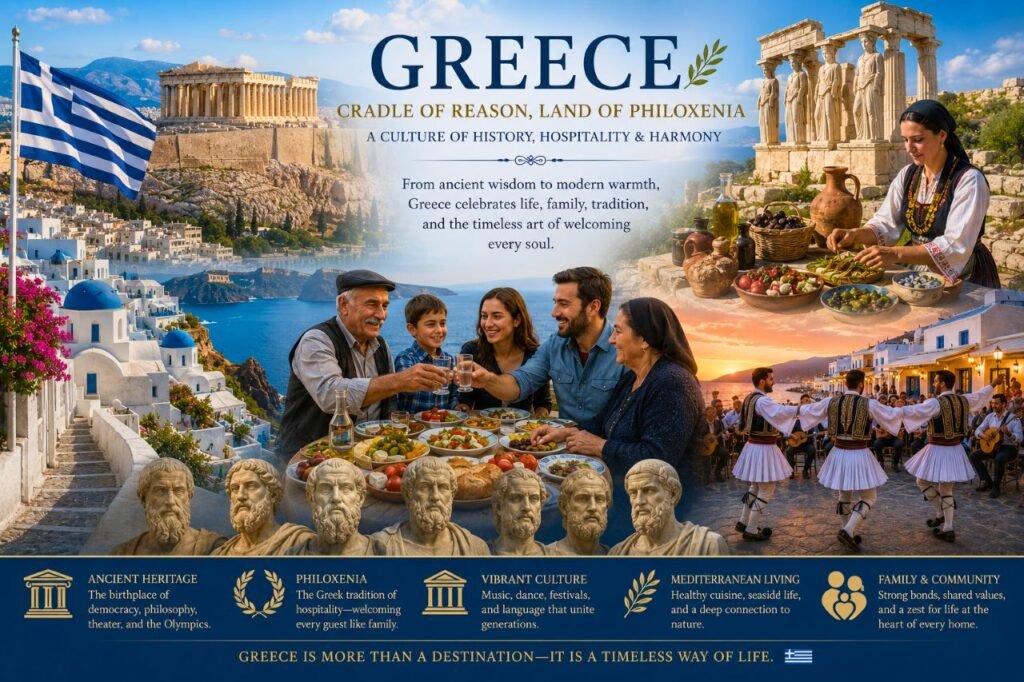
The most famous traditional uniform belongs to the Evzones (the presidential guard). They wear the Foustanella, a stiff, white kilt featuring exactly 400 pleats—each pleat symbolizing a single year of Ottoman occupation over Greece. This is paired with wool stockings and tsarouchia (wooden-soled red leather shoes topped with large, black wool pompoms).
National Symbols
The national flag features nine horizontal stripes of blue and white, with a white Orthodox cross set in the upper hoist corner. The nine stripes represent the nine syllables of the legendary revolutionary war cry: “Eleftheria i Thanatos” (Freedom or Death). The blue represents the bright Aegean sky and sea, while the white symbolizes the pure intent of the revolutionaries fighting for independence.
Music, Dance & Art
The Rebetiko and Folk Performances
Music and dance are vital communal acts in Greece, used to express sorrow, romantic longing, and pure celebratory ecstasy (kefi).
- Rebetiko: Often called the “Greek Blues,” Rebetiko emerged in the early 20th century among urban working-class refugees. Played on the iconic stringed Bouzouki, these soulful songs tell stories of marginalization, love, and exile.
- Traditional Folk Dances: Greece possesses hundreds of regional folk dances. The Syrtos and Kalamatianos are danced in an open circle holding hands, led by a dancer who performs acrobatic leaps. The world-famous Sirtaki dance (popularized by the film Zorba the Greek) features a slow, rhythmic progression that builds into an exhilarating, fast-paced finale.
Visual Arts from Antiquity to Modernity
Greek artistic genius spans from the perfect anatomical symmetries of classical marble sculptures to the ethereal gold-leaf iconography of the Byzantine era. In the modern era, Greece has birthed legendary literary giants, including poets George Seferis and Odysseus Elytis (both Nobel Prize laureates), who beautifully captured the luminous light, sea, and historic weight of the Hellenic landscape.
Summary
The culture of Greece stands as an enduring, radiant monument to the human spirit, intellectual balance, and communal joy. By masterfully anchoring their modern national identity to their profound classical philosophy, deep Orthodox spirituality, and the welcoming warmth of philoxenia, the Greek people have cultivated a lifestyle that continues to capture the imagination of the entire world. From the communal tables sharing olive-drenched salads to the powerful strings of the bouzouki and the historic beauty of its landscapes, Greece shines bright as a timeless beacon of resilience, warmth, and cultural depth.
At Best Culture Insight, we see culture as the heartbeat of every society – the way people live, connect, and express their identity.